wayground logo

Free Printable Worksheets

Font size

S
M
L
XL
Worksheets

Midterm Review

Total questions: 90

Worksheet time: 59mins

Name
Class
Date
1.

What information can we learn from ice cores?

a)

We can learn how the climate has changed.

b)

We can learn how the dinosaurs died

c)

We can learn about droughts

2.

What was the name given to all the continents when they were joined as one super continent?

a)

Supreme Continent

b)

Eurasia

c)

Plate tectonics

d)

Pangaea

3.

The movement of the tectonic plates is caused by

a)

the rotation of the Earth.

b)

convection currents in the Asthenosphere

c)

the gravity of the iron-nickel core.

d)

the Moho discontinuity.

4.
What are the three types of Evidence that supports Alfred Wegener's Theory? 
a)
Fossils, Fish, and Land
b)
Sedimentary, Magma, and Climate
c)
Fossils, Land forms, and Climate
d)
Climate, Land forms, and Metamorphic rock 
5.

Two plates come together or collide at what boundary?

a)

Convergent

b)

Divergent

c)

Transform

6.

Two plates spread or move apart at what boundary?

a)

Convergent

b)

Divergent

c)

Transform

7.

Two plates slide past each other at what boundary?

a)

Covergent

b)

Divergent

c)

Transform

8.

New oceanic crust (sea floor) is created at this boundary.

a)

Divergent Oceanic

b)

Divergent Continental

c)

Convergent Oceanic

d)

Transform

9.

Oceanic crust (sea floor) is destroyed at this boundary.

a)

Convergent Oceanic-Continental

b)

Divergent Oceanic-Oceanic

c)

Convergent Continental-Continental

d)

Divergent Continental-Continental

10.

The process where oceanic crust slides under another plate and is melted is called ___________.

a)

seafloor spreading

b)

subduction

c)

continental drift

d)

recycling

11.

What two crustal features occur near every subduction zone?

a)

Volcanoes and Trenches

b)

Rift Valleys and Mid Ocean Ridges

c)

Volcanoes and Rift Valleys

d)

Mid Ocean Ridges and Trenches

12.

The process that occurs at a divergent oceanic boundary that creates new crust (sea floor) is called?

a)

Subduction

b)

Seafloor Spreading

c)

Continental Drift

d)

Volcanism

13.

What is the 'magic' that is happening in the upper mantle that helps move the 'lithospheric plates'?

a)

Convection

b)

Subduction

c)

Seafloor Spreading

14.

What is the only event associated with ALL plate boundaries?

a)

Volcanoes

b)

Earthquakes

c)

Subduction

d)

Deep Trenches

15.

These are NOT plate boundary features. They are areas where hot mantle plumes push up through the lithospheric plates to create volcanic islands such as Hawaii.

a)

Hotspots

b)

Convergent Boundary

c)

Divergent Boundary

d)

Transform Boundary

16.
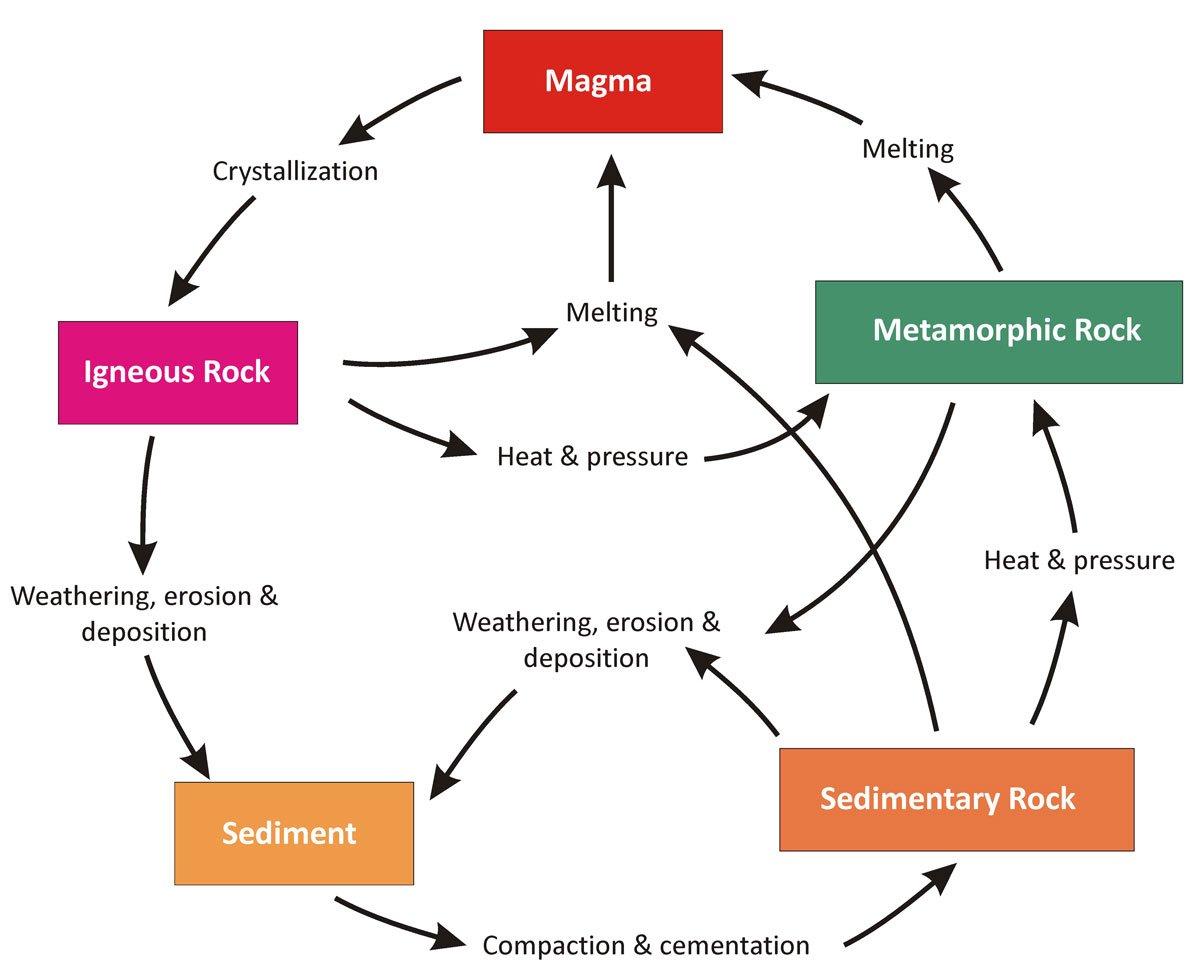
Formed by heat and pressure
a)
Sedimentary
b)
Metamorphic
c)
Extrusive Igneous
d)
Intrusive Igneous
17.
Formed by cooling & solidification of magma
a)
Sedimentary
b)
Metamorphic
c)
Extrusive Igneous
d)
Intrusive Igneous
18.
Formed by cooling & solidification of lava
a)
Sedimentary
b)
Metamorphic
c)
Extrusive Igneous
d)
Intrusive Igneous
19.
Formed by weathering & erosion
a)
magma
b)
sediments
c)
sedimentary rock
d)
intrusive igneous
20.
Formed by melting
a)
magma
b)
sediments
c)
sedimentary rock
d)
intrusive igneous
21.
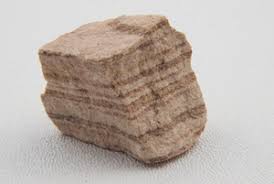
Has wavy bands.
a)
sedimentary rock
b)
metamorphic rock
c)
extrusive igneous rock
d)
intrusive igneous rock
22.
Contains fossils. 
a)
sedimentary rocks
b)
metamorphic rocks
c)
extrusive igneous rocks
d)
intrusive igneous rocks
23.
The three groups of rocks are classified by
a)
How they form
b)
Color
c)
Grain size
d)
Chemical Composition
24.

Erosion is

a)

dissolving of minerals

b)

breaking down of rocks

c)

movement of sediment to a new location

d)

evaporation of minerals

25.
When you are describing the sizes of the mineral grains in a rock, you are detailing the rock's _____
a)
Texture
b)
Composition
c)
Sedimentation
d)
Igneous-ness
26.
The individual particles that make up a rock are known as _____
a)
Grains
b)
Textures
c)
Metamorphs
d)
Lava
27.

True or False: The terms weathering and erosion mean the same thing and can be used interchangeably.

a)
b)
28.

The process of transporting weathered material is known as...

a)

Weathering

b)

Erosion

c)

Deposition

29.

The deposit of sediment to a new location is known as...

a)

Weathering

b)

Deposition

c)

Erosion

30.

Which of the following are agents of erosion? (Select all that apply.)

a)

Wind

b)

Water

c)

Ice

d)

Gravity

31.

Frost Wedging occurs when rock breaks due to water continually freezing and thawing within cracks in the rock. Is frost wedging an example of mechanical or chemical weathering?

a)

Chemical weathering

b)

mechanical weathering

32.
Which of the following is NOT a type of chemical weathering?
a)
water
b)
carbon dioxide
c)
ice wedging
d)
living organisms secreting acid to break down rocks
33.
What is weathering?
a)
The process by which
water, ice, wind or gravity
moves fragments of rock
and soil.
b)
The process by which
water, ice, wind or gravity
deposit rock sediments
and soil in a new place.
c)
The breaking down of
Earth’s crust into smaller
and smaller pieces.
34.
Which type of climate will have faster chemical weathering?
a)
Hot and Wet
b)
Cold and Dry
c)
Hot and Cold
d)
Cold and Wet
35.
A measure of the amount of dissolved salts in a given amount of liquid
a)
salinity
b)
bio-indicators
c)
wave
d)
tide
36.
Which of the following are indicators of healthy water systems?
a)
high nitrates, high pH, and low temperatures
b)
low temperatures, high dissolved oxygen, and neutral pH
37.
Under which condition are large numbers of fish in a lake likely to die?
a)
when the water's dissolved oxygen is low and temperature is high
b)
right after a storm with heavy rainfall
38.

Potable water is water that is ______________.

a)

polluted

b)

safe to drink

c)

biological

39.

The pH of healthy water is _______________.

a)

0-5

b)

6.5-8.5

c)

9-14

40.

The health of a water system is determined by the balance between what variables (choose all that apply)?

a)

physical

b)

physiological

c)

biological

d)

chemical

41.

Temperature, turbidity, and water movement are the _____________ factors used to determine water quality.

a)

physical

b)

chemical

c)

biological

42.

Dissolved oxygen, pH, nitrates, and salinity are _____________ factors used to determine water quality.

a)

physical

b)

chemical

c)

biological

43.

Which will occur if humans continue to overload water systems with excess nutrients?

a)

A. chemosynthesis

b)

B. eutrophication

c)

C. nitrification

d)

D. photosynthesis

44.

Which process would most likely increase the dissolved oxygen level in a freshwater lake?

a)

A. algae bloom

b)

B. lake turnover

c)

C. photosynthesis

d)

D. respiration

45.

Which is the best example of a point source pollution?

a)

A. runoff from fields

b)

B. pesticides sprayed into the air

c)

C. oil spill from a boat in the Atlantic Ocean

d)

D. smoke from multiple industries in a large city

46.

Cholera is a bacterial disease that is spread throughout a community by contaminated water. How can the spread of cholera (bacteria) be prevented?

a)

by giving healthy people antibiotics before they get sick

b)

by hand washing with contaminated water before food preparation

c)

by using Chlorine to treat water before it enters the water supply

d)

by using waste to fertilize fields instead of releasing it into the water supply

47.

Which human activity has the most negative impact on water quality?

a)

washing clothes

b)

recreational boating

c)

flushing toilets

d)

agriculture

48.

Which best describes the relationship between temperature and dissolved oxygen in a lake?

a)

As temperature increases, dissolved oxygen increases

b)

As temperature increases, dissolved oxygen decreases

c)

As temperature decreases, dissolved oxygen decreases

d)

A change in temperature has no effect on dissolved oxygen

49.

Process used in water treatment process where water is pushed through screens, sand, gravel and coal to remove organisms and trash

a)

filtration

b)

chlorination

c)

coagulation

d)

bioreactors

50.

Process used in water treatment process where chemicals like alum is added to water causing flocs- globs of trash that pathogens stick to.

a)

filtration

b)

chlorination

c)

coagulation

d)

bioreactors

51.

Pollutants discharged from a single identifiable location (e.g., pipes, ditches, channels, sewers, tunnels,)

a)

dechlorination

b)

point source pollution

c)

oils

d)

asbestos

52.

pollution that comes from many sources rather than from a single, specific site

a)

nonpoint source pollution

b)

point source pollution

c)

sewage

d)

aeration chamber

53.

Secondary treatment in an aeration basin allows ___________ processes to use microorganisms to grow and continue treating the pollutants in the wastewater.

a)

biological

b)

physical

c)

chemical

d)

noisy

54.
The circulation of the earth's water, in which water evaporates from the sea into the atmosphere, where it condenses and falls as rain or snow, returning to the sea by rivers or returning to the atmosphere by evapo-transpiration is called the...
a)
carbon cycle
b)
nitrogen cycle
c)
water cycle
d)
rock cycle
55.
An area of land in which all of the water falling or flowing over it drains to the same location is a/an…
a)
watershed
b)
watertable
c)
river
d)
aquifer
56.
Water that is located in the ground in the pores within rock is called…
a)
watershed
b)
surface water
c)
groundwater
d)
water cycle
57.
What is the source of groundwater?
a)
rain, snow, melted glaciers
b)
ocean water
c)
icebergs
d)
water from fossilized animals
58.
An underground layer of permeable rock that holds groundwater which can be extracted by drilling a well.
a)
water table
b)
aquifer
c)
watershed
d)
river
59.
The area of an aquifer in which rock pores are completely filled with water.
a)
water table
b)
watershed
c)
zone of saturation
d)
surface water
60.
The top boundary of the zone of saturation in an aquifer which can fluctuate based on precipitation and the amount of draw from wells
a)
aquifer
b)
water table
c)
watershed
d)
drainage system
61.
Groundwater is found in permeable rock.  Permeable means…
a)
porous
b)
nothing can pass throughc
c)
caves and caverns
d)
answer not shown
62.
How can surface pollutants contaminate groundwater?
a)
runoff with water and penetrate soil
b)
seep into ground and rock
c)
spread in aquifer to contaminate large areas
d)
all answers are correct
63.

A river and all the streams and smaller rivers that flow into it together makeup a

a)

tributary

b)

water shed

c)

river system

64.

Algae can overgrow a lake when the lake contains too many

a)

nutrients

b)

eutrophication

c)

tributaries

65.
This is a picture of a
a)
slump
b)
creep
c)
mudflow
d)
landslide
66.
These are called _______________________.
a)
slumps
b)
mudflows
c)
creeps
d)
landslides
67.
This is a picture of a
a)
slump
b)
creep
c)
mudflow
d)
landslide
68.
This is a picture of 
a)
slumps
b)
creeps
c)
mudflows
d)
landslides
69.

What landform is this?

a)

trench

b)

mid ocean ridge

c)

formation foundry

70.

Type of boundary that can create mountains?

a)

convergent

b)

divergent

c)

transformation

71.
What are the two basic types of plates on earth?
a)
oceanic and atmospheric
b)
continental and oceanic
c)
continental and magnetic
d)
oceanic and divergent
72.

The earthquakes experienced in California are related to tectonic plates because these catastrophic events are the result of -

a)

two tectonic plates sliding past each other.

b)

tectonic plates melting as they slide into the mantle.

c)

tectonic plates being weathered over time.

d)

two tectonic plates pulling away from each other.

73.
In the diagram, letter "A" is labeling the _____
a)
Hanging Wall
b)
Foot Wall
c)
Gallery Wall
d)
Accent Wall
74.
A type of fault where rocks on either side move past each other sideways is called:
a)
normal fault
b)
reverse fault
c)
strike-slip fault
75.

The three types of stress that leads to faults include:

a)

tension, compression, and normal stress

b)

tension, compression, and shearing stress

c)

deformation, tension, and shearing stress

76.
Where is the point at which the first movement occurs during an earthquake?
a)
Epicenter
b)
Focus
c)
Fault
d)
Plate
77.
Where is the point on the Earth’s surface directly above the focus of an earthquake?
a)
Epicenter
b)
Fault
c)
Hypocenter
d)
Tremor
78.
Which type of wave is the first to arrive after an earthquake occurs?
a)
P Wave
b)
Rayleigh Wave
c)
S Wave
d)
Shear Wave
79.
What is an instrument that detects and records waves produced by earthquakes? (This piece of equipment can measure the magnitude of an earthquake.)
a)
Epicenter
b)
Fault
c)
Seismogram
d)
Seismograph
80.
Which scale measures the intensity of the ground movement?
a)
Mercalli Scale
b)
Richter Scale
c)
Seismogram Scale
d)
Bernoulli Scale
81.

. Which type of seismic wave causes the most destruction to property?

a)

surface wave

b)

S wave

c)

P wave

82.
What are solid rock fragments that are ejected during a volcanic eruption?
a)

Lahar

b)
Magma
c)
Pyroclastic Material
d)
Silica
83.
What type of volcano is made of lava fragments that have been ejected from a volcanic vent?
a)
Caldera
b)
Cinder Cone
c)
Composite Volcano
d)
Shield Volcano
84.
If contour lines are close together, then the slope is
a)
gentle
b)
steep
c)
flat
d)
going up and down
85.
What are the curved lines on a topographic map called?
a)
contour lines
b)
contour intervals
c)
slope
d)
elevation
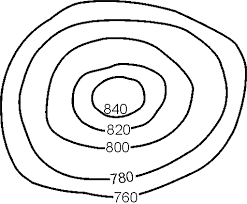
86.
Determine the contour interval:
a)
5 m
b)
10 m
c)
15 m
d)
20 m
87.

The distance between contour lines is called...

a)

Contour interval

b)

Contour line

c)

Colors

d)

Mountains

88.
An experiment in which one and ONLY ONE, variable is changed.
a)
variable
b)
coordinate
c)
controlled experiment
d)
standard
89.
The variable that is being tested or changed
a)
independent variable
b)
dependent variable
c)
control variable
90.
What step does every scientific experiment begin with?
a)
hypothesis
b)
question/problem
c)
procedures
d)
conclusion