
Font size
 Worksheets
Topic 1 Exam Review - 11.2023
Total questions: 153
Worksheet time: 2hrs 38mins


they never move.
they aren't needed by humans.
they are not made of cells.
they don't break down.
All organisms are composed of one or more cells.
True
False

Stem cells have which of the following properties?
They ONLY have the capacity to divide and self renew.
They are differentiated.
The can ONLY divide to produce differentiated cells.
The have the capacity to divide to self renew AND produce differentiated cells.

What part of the adult body houses stem cells that can differentiate into blood cells?
Umbilical cord
Bone marrow
Skin
Small intestine
This source produces stem cells capable of differentiating into only a limited number of cell types.
Pluripotent
Embryonic stem cells
Adult stem cells
Somatic cells
Stargardt’s Disease is a condition of which part of the body?
Ears
Eyes
Blood
Brain
The cell theory states that_________
cells come from cells
all organisms are made of cells
cells are the basic unit of structure and function for life
all of the above

A multicellular organism is made of
one cell
multiple cells
unicellular cells
there is no such thing as a "multicellular" organism

What is a cell?
the basic unit of life
a group of tissues working together to perform a function
the largest level of biological organization

The skin is an example of what level of biological organization?
cell
organ
tissue
organism
What level of biological organization is the largest (includes all other levels)?
organ
organ systems
organism
cells
About how wide is a staple?
1m
1dm
1cm
1mm
About how wide is the tip of a sharp pencil?
1m
1dm
1cm
1mm
What is leukemia?
The flu
A cancer of blood tissue
A bone
A degenerative eye disease

Which characteristic of living things is represented in the picture?
Respond to stimuli
Grow and develop
Evolution
Made of cells
This is the countless chemical reactions that sustain life.
Metabolism
Sex
Nuclear Fission
Homeostasis
An emergent property is
often sold before it goes back underwater.
when groups of cells bond together to become a tissue.
when the interaction of individual component produce new functions.
when an organism can exist without metabolizing.
Every cell is surrounded by a membrane.
True
False

Only animal cells house material which has all the instructions needed for the cell’s activities.
True
False
Cells have their own energy system that powers all of that cell’s activities.
True
False
A virus is the smallest unit of life.
True
False

Giant algae is an ideal organism for scientists to study because
it is made of a single, giant cell.
it has many nuclei in each of its cells.
it is not made of cells.
it reproduces rapidly so there is always more to study.


Select all features which distinguish electron microscopes from light microscopes.
Greater zoom
Greater resolution
More colors visible
Wider FOV


Select all features of E. Coli
Plasma membrane


Prokaryotes, by definition, do not have a nucleoid region.
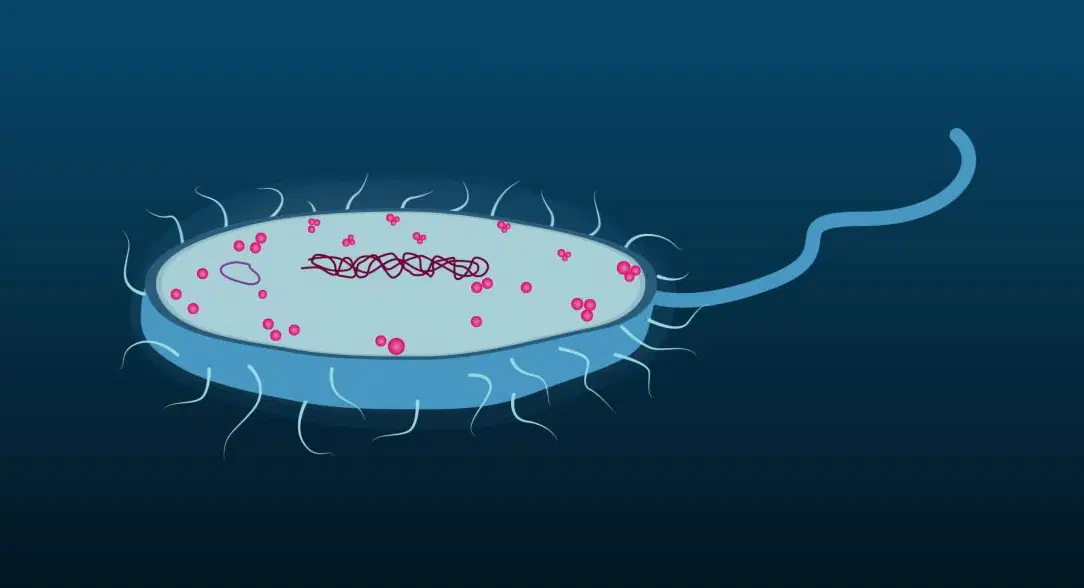

Replicates plasmids
Replicates DNA


This whip-like tail is utilized by prokaryotes for locomotion.


The rough endoplasmic reticulum is called "rough" because:
it grew up on the wrong side of the cell.
it has chloroplasts attached.


Found only in plants (except for a couple super rare instances)
Produces ATP
Produces sugar

How many membranes do Ribosomes have?
The nucleus is so important that it has a double membrane so tight that nothing can pass in or out of it.
False

This organelle's slogan is "powerhouse of the cell" because it produces ATP.

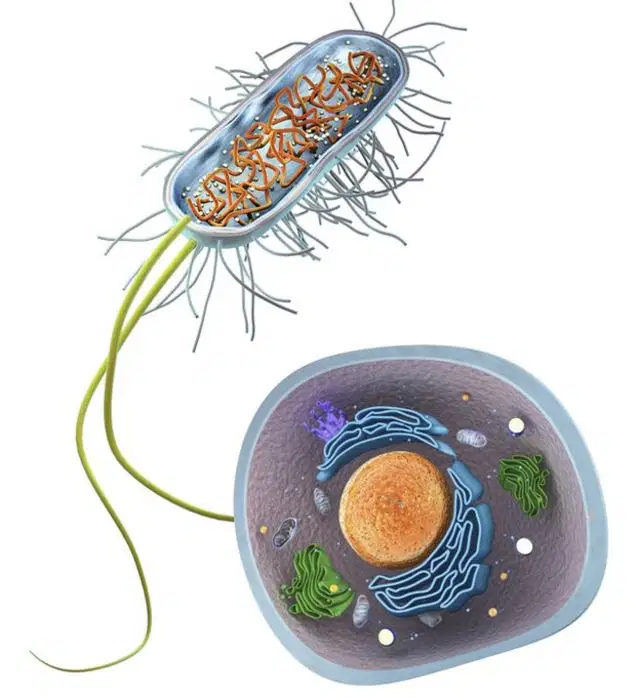
Compartmentalization
Differentiation

This organelle processes proteins to be secreted for use outside the cell.
Smooth ER

Plants and animal cells are examples of this type of cell:
Prokaryotic
Eukaryotic
Eukaryotic and prokaryotic
Neither eukaryotic nor prokaryotic
This part of the experiment serves as a basis of comparison:
Experimental group
Control group
Data
Responding variables

Dependent variable
Independent variable
Data
Control group

How many variables do we want to test/change during a controlled experiment?
1
2
3
4

A custodian notices some dirty tables and wants to know which cleaner is the best to use. He tests three different cleaners and looks at how well they clean compared to tap water. What is the independent variable?
Type of cleaner
Tap water
The dirt
How clean the tables get

An experiment is being done to determine how light affects the growth of small zinnia plants. One plant is placed in full sunlight, the second in a shaded area, the third in an unlit closet. What is the independent variable in the experiment?
Amount of light
Plant in the closet
Growth of the plants
Plant in the shaded area
What is the control group for?
The thing you change
The thing you measure
Comparison
Things that stay the same
A custodian notices some dirty tables and wants to know which cleaner is the best to use. He tests three different cleaners and looks at how well they clean compared to tap water. What is the control group?
Type of cleaner
Tap water
The dirt
How clean the tables get
An experiment is being done to determine how light affects the growth of small zinnia plants. One plant is placed in full sunlight, the second in a shaded area, the third in an unlit closet. What is the control group in this experiment?
Amount of light
Plant in the closet
Growth of the plants
Plant in the shaded area
The things that are kept the same to ensure the results are due to the experiment is called..
Constants
Dependent Variables
Independent Variables
Control groups
The variable which is changed on purpose is:
Constant
Control
Independent Variable
Dependent Variable

Brand of paper towel
Amount of water absorbed
Type of liquid
How many sheets used

In a study to determine whether how long a student sleeps affects test scores, the independent variable is:
Test scores
Amount of sleep
Work ethic
Quality of the teacher

You think rising sea temperatures might affect the amount of algae in the water.
What is the independent variable?
Water temperature
Amount of algae
Species of algae
Water depth

Study the attached graph and select the one true statement.
The independent variable is distance
The independent variable is d=25t
The dependent variable is time
The dependent variable is distance
On a graph, the independent variable should be placed on the:
X Axis
Y Axis
Z Axis
The independent variable cannot be graphed.

A scientist hypothesizes the the temperature at which an alligator's egg is incubated will determine whether the alligator will be male or female. The independent variable is
the male alligators
the gender of the alligator
the temperature
the incubator

A scientist hypothesizes the the temperature at which an alligator's egg is incubated will determine whether the alligator will be male or female. The dependent variable is
the temperature
the size of the baby alligators
the incubator
the gender of the baby alligators
Vertical
Diagonal
Criss-cross
Horizontal
Vertical
Horizontal
Criss-cross
Diagonal
What is a variable?
Something used to compare the parts of a whole
Something that is useful for displaying data or information that changes over time
Any display of information with tabs, rows and/or columns
Anything in an experiment that can change and can affect the outcome of the experiment

Which of the following would be a reasonable claim for this graph?
As the elevation increases, the temperature decreases.
As the elevation increases, the temperature increases.
As the elevation increases, the temperature is unaffected.
The air is thinner at higher elevations due to the decreased force of gravity so it cannot absorb as much heat and the temp is lower.

Examine the cartoon. Which is an inference?
The animals are going to leave earth.
The gate is broken.
There is a rocket in the distance.
There are two giraffes.
Examine the cartoon. Which is an observation?
The animals are going to leave earth.
The gate is broken.
The giraffes are going to get on the rocket.
The boss is in the tower on the left.

After a period of dormancy, something begins to grow and put out shoots.
Germinate
Outlier
Geranium
Ruminate

The proportion of your forearm to your forearm plus hand.
1 : 1
1 : 2
1 : 3.14
1 : 1.6
Another term for maintaining an internal balance is...
Equality
Equential
Homeostasis
Balance
Plasma Membrane
Phospholipid
How many phospholipids thick is the plasma membrane?

Which letter indicates the Hydrophobic region of the plasma membrane?

Which letter indicates the Hydrophilic region of the plasma membrane?
B

What is the name for when a single molecule has both a polar region and a non-polar region?
Bihydrophicity
Amphipathic
Hydrophilic
Dipolarity
Which of the following descriptions of the plasma membrane indicate that it is dynamic?
Davson-Danielli Model
The plasma membrane allows certain things to pass freely while others are not. What is this feature called?
Singer Nicholson Model

What type of macro-molecule is labeled here as a "receptor"?
Carbohydrate
Protein
Lipid
Nucleic Acid
A state where all the parts of a system are in balance
Brownian Motion
Enclosure
Something which cannot be dissolved into another liquid or aqueous solution
Micelle
Lysosome
Which letter indicates a molecule of cholesterol?
B
C
D
E
This part of a phospholipid is made of "fatty acids".
Phosphate Head
Lipid Tails
Bilayer
Amphipathic
A phospholipid has this many greasy, non-polar tails.
0
1
2
3
This type of membrane protein is large enough to stick out on both sides of the plasma membrane.
Integral protein
Peripheral protein
Integumentary protein
Carboprotein
This type of membrane protein resides in the plasma membrane but only on one side, it does not go all the way across the membrane.
Integral protein
Peripheral protein
Integumentary protein
Carboprotein
These enable cell-to-cell communication.
Membrane proteins
Cholesterol
Phospholipids
Free ribosomes
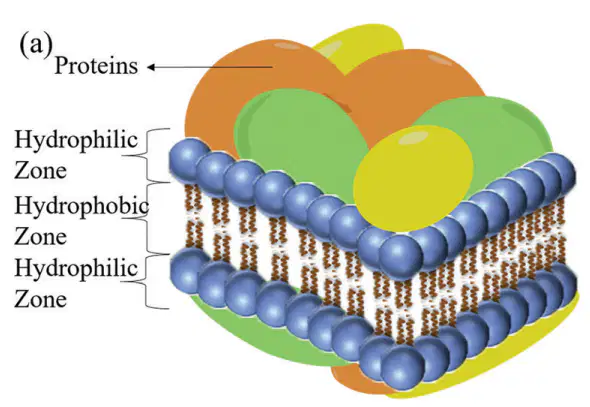
This "sandwich" model of the plasma membrane was found to be inaccurate after tests with freeze-fracturing.
Fluid mosaic
Davson–Danielli
Singer–Nicholson
Singer-Danielli
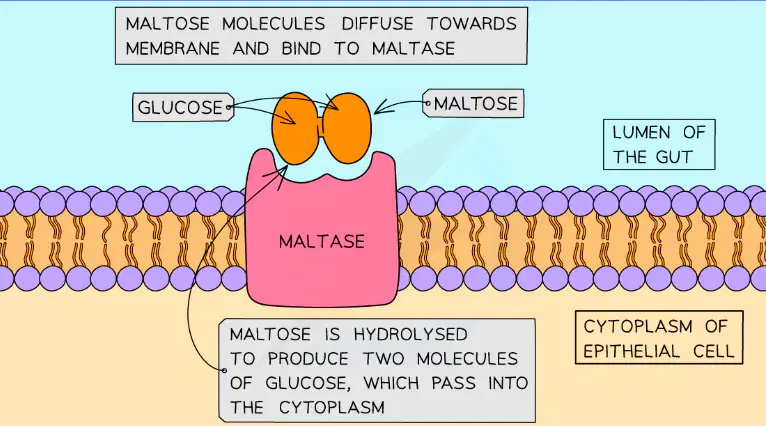
Immobilized enzymes with their active site on the outside are particularly found in which part of the body?
Heart
Brain
Small intestine
Lungs
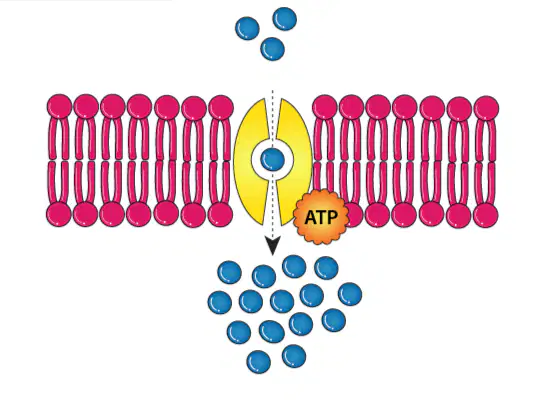
Which membrane protein function involves the use of ATP to move particles across the membrane?
Hormone binding sites
Immobilized enzymes
Pumps for active transport
Channels for passive transport
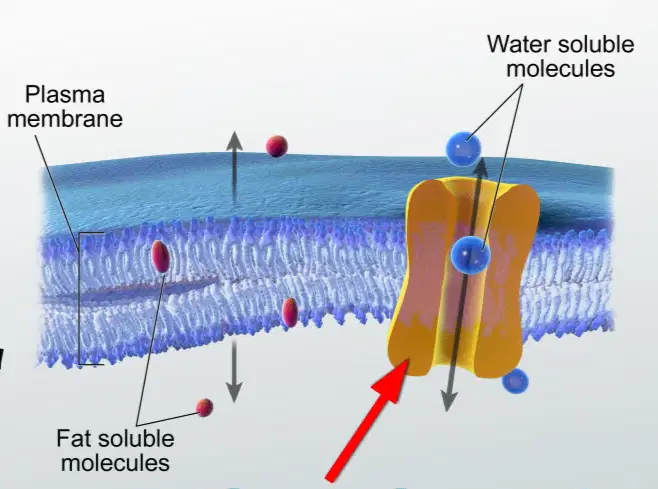
How do certain membrane proteins assist in the movement of hydrophilic particles across the cell membrane?
By binding and releasing hormones
By forming tight junctions between cells
By immobilizing enzymes
By allowing facilitated diffusion through channels
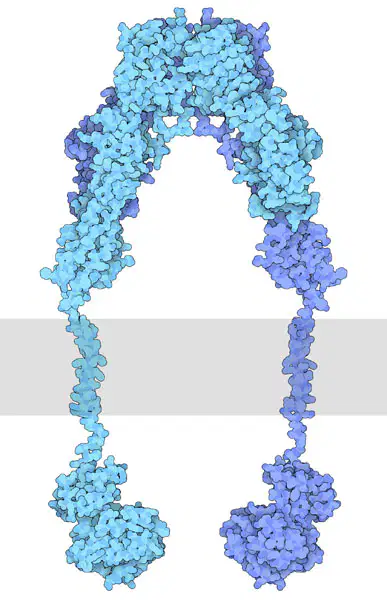
The primary role of hormone binding sites or hormone receptors in membrane proteins is to:
Produce hormones
Receive hormones such as insulin
Facilitate the diffusion of hormones
Pump hormones using ATP
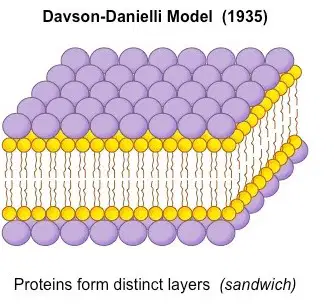
Select all issues with the Davson-Danielli model that were solved by Singer and Nicholson's Fluid mosaic.
Variable membrane thickness
Hydrophobic region of proteins in contact with water
Membrane components can move freely
Hydrophilic region phospholipids separated from the water

Type of passive transport that moves molecules from areas of high concentration to areas of low concentration.
Channel proteins
Osmosis
Simple diffusion
Endocytosis

Type of passive transport that moves water from areas of high water potential to areas of low water potential.
Channel proteins
Osmosis
Simple diffusion
Endocytosis
This process is an example of active transport. This processes occurs when large substances (or bulk amounts of smaller substances) exit the cell without crossing the membrane.
Channel proteins
Carrier proteins
Exocytosis
Endocytosis
Select the two key qualities of the cell membrane:
Semi-permeable
Selective
Reproduction
Division

Small non-polar molecules like O2 and CO2 enter a cell through
simple diffusion
osmosis
facilitated diffusion
phagocytosis
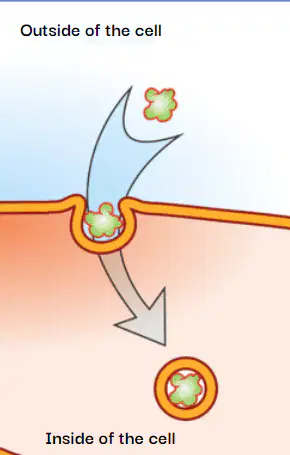
Which form of active transport is being shown?
Facilitated Diffusion
Exocytosis
Endocytosis
Proton pump
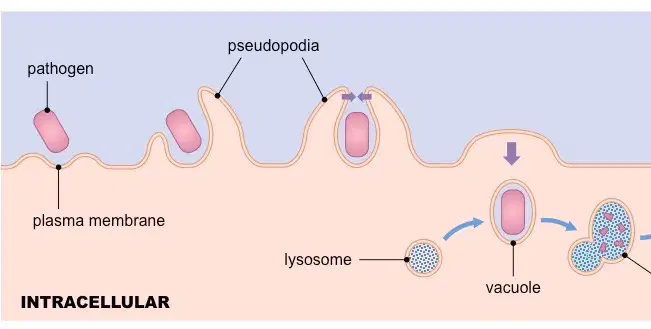
White blood cells engulfing an invading pathogen is an example of:
Phagocytosis
Exocytosis
Pinocytosis
Facilitated Diffusion
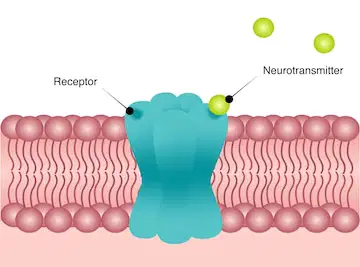


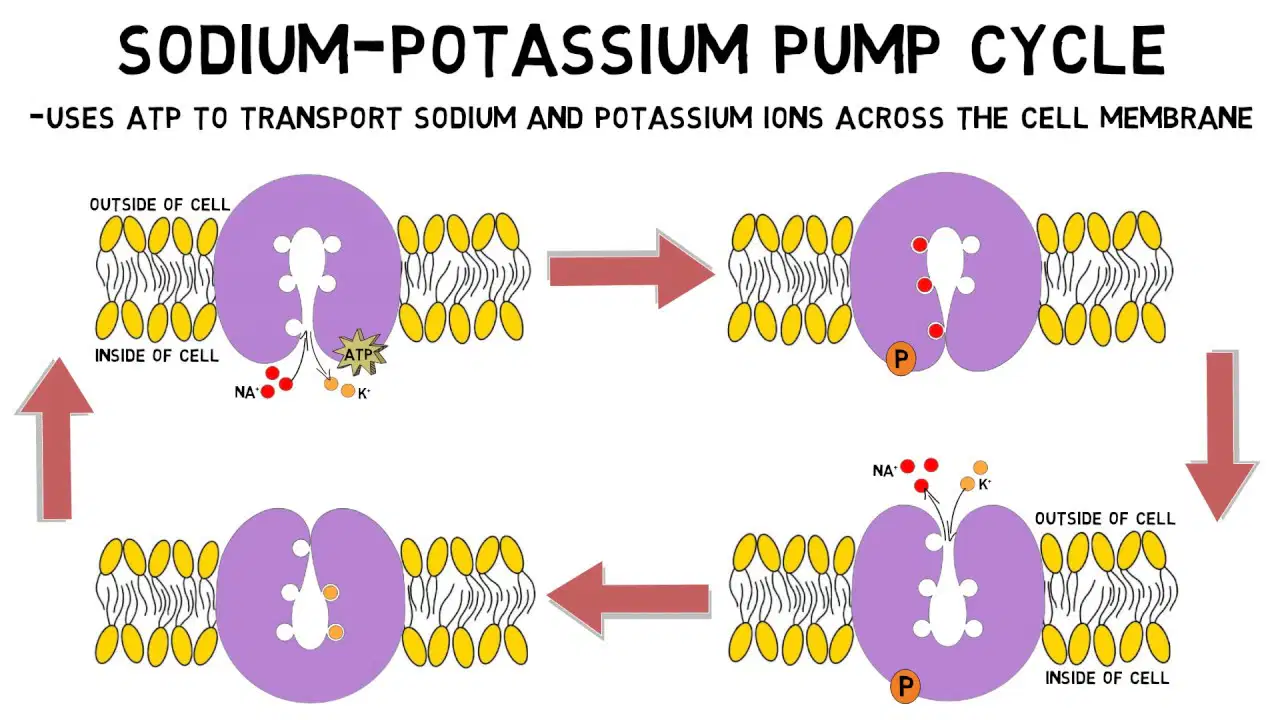
The sodium potassium pump is an example of
Passive Transport
Active Transport
Facilitated Diffusion
Endocytosis
If the body can no longer make ATP, which type of transport would be impacted?
Facilitated Diffusion
Osmosis
Active Transport
Simple Diffusion
If you could no longer make ATP, which type of transport could still occur. Choose all that apply.
Diffusion
Pinocytosis
Exocytosis
Osmosis
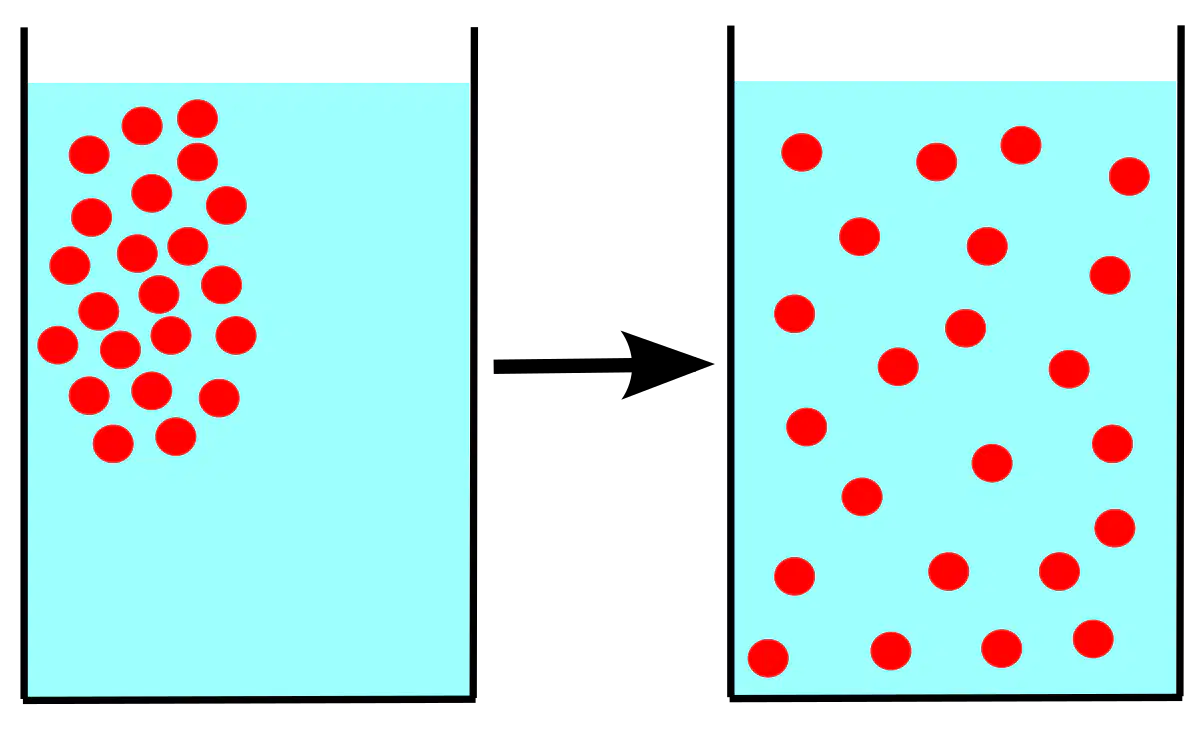
Diffusion occurs when molecules
move through a permanent barrier
move against the concentration gradient
move from high to low concentration
move from low to high concentration

Look at the picture. What is most likely to occur over a period of time?
Oxygen will leave the cell.
Oxygen will enter the cell.
Carbon dioxide will leave the cell.
Carbon dioxide will enter the cell.
A plant's root cell already has a higher concentration of nutrients inside the cell than outside of the cell. How can the cell still take in nutrients?
Diffusion
Passive Transport
Active Transport
Facilitated Diffusion
What type of molecules can easily diffuse through the cell membrane? (Select all.)
Small Molecules
Large Molecules
Charged Molecules
Nonpolar Molecules
You bought some fresh flowers from the store but they started to look wilted. Once you placed them in a vase full of water, the leaves and stems began to swell again. What process is responsible for this swelling?
Photosynthesis
Osmosis
Diffusion
Active Transport

The solution surrounding the cell in Diagram B, would be defined as:
hypertonic
hypotonic
isotonic

The solution surrounding the cell in Diagram C, would be defined as
hypertonic
isotonic
hypotonic


All cells come from pre-existing cells.
The cell is the most basic unit of life.
All living organisms are composed of one or more cells.
All cells have a nuclear envelope.

Which term means "evolution of life from inanimate substances?"
Abiogenesis
Pasteurization
Endosymbiosis
Panspermia

Margulis
Miller - Urey
Singer - Nicolson
Pasteur

Margulis
Miller - Urey
Singer - Nicolson
Pasteur

Sterilization
Abiogenesis
Panspermia
Inoculation

Residual
Supplementary
Vestigial
Redundant

Redundant
Supplementary
Vestigial
Residual

Proportion
Redundant
Vestigial
Residual

Obsolete
Precede
Residual
Proportion

Methane
Hydrogen
Water
Ammonia
Oxygen
Which statement provides evidence for endosymbiosis?
Early prokaryotes contributed to a large increase in oxygen in the atmosphere.
Eukaryotic mitochondria and chloroplasts have their own circular DNA.
Certain groups of ancient prokaryotes developed mechanisms to carry out aerobic respiration.
Experiments by Miller and Urey produced simple organic molecules in abiotic conditions.

In a copy of Louis Pasteur’s famous experiment, broth was put into flasks as shown in the diagrams.
What results would be expected with no spontaneous generation of life?
Decomposition of broth by microbes occurred only in Flask W.
Decomposition of broth by microbes occurred only in Flasks W and X.
Decomposition of broth by microbes occurred only in Flasks W, X and Y.
Decomposition of broth by microbes occurred only in Flasks W, X and Z.
What is evidence for the endosymbiotic theory?
RNA can catalyze metabolic reactions.
Meteorites contain organic molecules.
Amino acids can be synthesized from inorganic compounds.
Mitochondria possess their own DNA.

The statement relates to Pasteur’s experiments.
What did this statement suggest?
Mold evolved by endosymbiosis.
Oxygen is required for anaerobic respiration.
Cells can only be formed by division of pre-existing cells.
Nutrients are a requirement for mold growth.

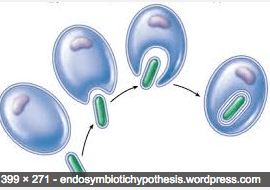
The diagram shows the proposed theory of endosymbiosis.
Which of the following explains why cells that contained mitochondria-like organelles had an evolutionary advantage?
They were able to photosynthesize
They had more DNA
They were able to make more use of available energy
They were immune to bacterial invasion.

What did electrical sparks in Miller and Urey's experiment mimic?
The Sun's energy
Lightning
Volcanic eruptions
Cosmic radiation

Cells without a nucleus.
Eukaryotic
Prokaryotic
Prebiotic
Nucleary

Which question were Miller and Urey trying to answer with their experiment?
Where do cells come from?
How did prokaryotes form cell membranes?
How are biomolecules formed?
What gave rise to the Eukaryotic cell?

