
 Worksheets
Unit 8 - Evolution
Total questions: 82
Worksheet time: 4hrs 6mins

Evolution occurring gradually and slowly over long periods of time
Homeostasis
Stasis
Punctuated Equilibrium
Gradualism

Oldest rocks and ancestors would be deeper in the ground
Speciation
Homologies
Recessive Traits
Fossil Record

Evolution occurring quickly due to catastrophic events
Homeostasis
Gradualism
Stasis
Punctuated Equilibrim

The hypothesis that physical structures with no known purpose are leftovers from an ancestor.
Homologous Structure
Vestigial Structure
Anatomical Analogy
Developmental Homology

Populations of organisms change over time from inherited genetic changes
Darwin
Evolution
Common Ancestor
Incomplete Dominance

Popularized natural selection with his book On
the Origin of Species by Means of Natural Selection in 1859
after his observations sailing on the HMS Beagle.
Curie
Hooke
Linnaeus
Darwin

Favorable genetic traits are passed on causing a survival advantage in a particular environment.
speciation
natural selection
cladogram
inherent danger

The theory that all living things are descendants of one
original living cell and evolved via natural selection.
Darwinism
cladogram
metaphase
common ancestor

The purposeful breeding of two individuals to produce desired traits in offspring.
Also known as selective breeding.
Natural Selection
Artificial Selection
Unnatural Selection
Phylogenetics

A diagram that shows the theory of Evolution from a Common Ancestor.
Phylogenetic Tree
Natural Selection
Artificial Selection
Branching Tree

A branching diagram that shows evolutionary relationships between species
Root System
Mitochondria
Cladogram
Adaptive Radiation

What type of anatomical structure is shown in the picture?
Analogous Structure
Homologous Structure
Vestigial Structures
None

What type of anatomical structure is shown in the picture?
Analogous Structure
Homologous Structure
Vestigial Structures
None
Elk with large antlers are very favorable to hunt by humans.
Directional Selection
Disruptive Selection
Stabilizing Selection
Natural Selection
A male spider has a leg snapped off by a human trying to smash it. It cannot do the "dance" to perfection. The first female spider who sees him dance decides to eat him. What types of isolation is this?
Behavioral Isolation
Geographical Isolation
Temporal Isolation
Speciation
Babies born before their due date (premature) often have many complications, and babies born after their due date (post mature) can be stillborn or die shortly after birth. What types of selection is this?
Directional Selection
Disruptive Selection
Stabilizing Selection
Natural Selection
In a species of bird, males with really colorful feathers attract females, and really dull coloration helps camouflage from predators. Males with medium coloration aren't selected for by females. What type of selection is this?
Directional Selection
Disruptive Selection
Stabilizing Selection
Natural Selection
Juliet, a grass frog in Mississippi hears Romero, a grass frog in Louisiana sing a beautiful mating call. She falls in love but is separated by mile wide river. They never meet in person. What type of isolation is this?
Behavioral Isolation
Geographical Isolation
Temporal Isolation
Speciation
A female Chinook salmon swims up river and lays her unfertilized eggs in March. A male Chinook swims up the same river in June seeking some eggs to fertilize. What type of isolation is this?
Behavior Isolation
Geographical Isolation
Temporal Isolation
Speciation

What type evidence of evolution is being shown in the picture?
Fossil Record
Anatomical Homology
Biogeography
Embryology

Cetaceans are whales and their relatives. The diagram shows some fossils of cetaceans. Which statement provides the best evidence that Ambulocetus natans is an ancestor of Basilosaurus isis?
Homologous structures occur in each fossil.
Similar nitrogenous bases are found in the DNA of each fossil.
The fossils were found in different locations.
The youngest fossil is larger than the older fossils.
Bactrian camels, dromedaries, llamas, and alpacas are all members of the same taxonomic family, Camelidae. Members of this family all have two toes, no hooves, true canine teeth, and a split upper lip. The family Camelidae originated in North America. The physical features of animals in this family and the family’s geographical origin provide evidence that all these animals -
Live in the same type of ecosystem
Have slowly evolved to become herbivores
Have a common ancestor
Exchanged DNA at some point in the past.
Which of the following statements are true?
A. Analogous structures are structures found in different species that have similar functions resulting from a common ancestor.
B. Analogous structures are structures found in different species that have similar functions resulting from natural selection.
C. Homologous structures are structures found in different species that have similar anatomical forms, resulting from a common ancestor.
D. Homologous structures are structures found in different species that have similar anatomical forms, resulting from natural selection.
B & D
A & D
A & C
B & C

The limbs of several organisms are shown in the illustrations. Scientists sometimes compare the limbs of these organisms to look for evidence of common ancestry. These limbs provide evidence of common ancestry because they -
Have the same basic structure.
Perform the same function.
Are the same size.
Are parts of mammals.

Scientists can determine relatedness among organisms by comparing partial amino acid sequences. The table shows four partial amino acid sequences from four organisms. Which organism is the LEAST related to the other three organisms?
Organism 1
Organism 2
Organism 3
Organism 4

This cladogram shows the evolutionary relationships among some mammals based on homologous structures. Which statement is supported by this cladogram?
Hippopotamuses are more closely related to cows than to javelinas.
Toothed whales are more closely related to mouse deer than to hippopotamuses.
Javelinas and pigs are more closely related than baleen whales and toothed whales.
Cows and mouse deer are more closely related than javelinas and pigs.

The image shows part of the humerus bone in different genera of primates. Which statement is best supported by the observable structures of the different humerus bones.
The primates lived in similar environments.
The primates shared a common ancestor.
The primates interbreed with similar organisms in a population.
The primates had diets that consisted of similar types of foods.


Organisms with traits that are favorable to their survival and reproduction are ________ likely to pass on their genes to the next generation, and thus become ________ common in the population
Who would have stated "acquired traits" such as a giraffe needing a long neck so they stretch it over time
Darwin
Lamarck
Mutations are important because they bring about
death of the organism in which they develop
genetic variation needed for a population to evolve
benefits for the individual, not for the population
changes in genotype, but not phenotype
Why is competition important for natural selection?
It shows which variations are more successful, allowing the organisms with those variations to survive.
It causes organisms, regardless of which traits they have, to die out, reducing the population size.
It causes organisms to get stronger due to having to outcompete other species.
Competition is not important for natural selection.


According to Oparin & Haldane, all of the following were thought to compose early earth's atmosphere, except.....
ammonia
hydrogen gas
hydrocarbons
oxygen
water vapor

The illustrations below show the embryos of a fish, a reptile, and a bird at the same stage of development. Which of the following can be concluded from the illustrations?
All the embryos grow at the same rate.
All the embryos will develop identical structures.
All the organisms share a recent common ancestor.
All the organisms will be the same relative size as adults.
Based on fossil evidence, scientists concluded that whales evolved from hoofed mammalian ancestors that lived on land. New evidence confirms this and suggests that among the hoofed mammals, the hippopotamus is the closest living relative of whales. Which of the following was the most likely source of this new evidence?
Comparisons of lifespans
Comparisons of gene sequences
Mapping of geographic distributions
Calculation of population birth rates
Snakes such as boa constrictors and pythons have tiny leg bones buried in their muscles. These leg bones are vestigial structures that have little or no known function in snakes. Which best explains the presence of these vestigial structures in snakes?
Snakes evolved from organisms with legs.
Snakes are developing legs for walking on land.
Snakes born with an extra set of DNA develop legs as they mature.
Snakes have only one copy of the allele for legs in their chromosomes.
Which of the following observations most strongly supports evolutionary links between fossil organisms and modern organisms?
The fossil organisms and modern organisms have identical body sizes.
The fossil organisms and modern organisms have homologous body structures.
The fossil organisms are hundreds of thousands of years old, and modern organisms have been around for hundreds of years.
The fossil organisms are found in many different rock layers, and modern organisms live in many different habitats.
For many years, biologists disagreed about whether giant pandas are more closely related to raccoons or bears. Which of the following types of evidence was most useful in determining the evolutionary relationship of giant pandas to other animals?
Diet
Behavior
Genetic sequences
Anatomical features
A trait or change in lifestyle that helps a plant or animal survive in its environment
adaptation
evolution
homologous
vestigial
Species not closely related evolve similar traits due to their similar environment
Convergent evolution
divergent evolution
parallel evolution
Species from the same ancestor accumulate differences over time
convergent evolution
divergent evolution
parallel evolution

Select the word that goes best with the image
camouflage
survive
theory
One of the accepted scientific theories describing the origin of life on Earth is known as chemical evolution. According to this theory, which of the following events would need to occur first for life to evolve?
onset of photosynthesis
origin of genetic material
Synthesis of organic molecules
formation of the plasma membrane
Which types of organisms developed first due to the early environmental conditions on Earth?
prokaryotic and aerobic
prokaryotic and anaerobic
eukaryotic and aerobic
eukaryotic and anaerobic
The Miller-Urey experiment of 1953 was designed to test the hypothesis that lightning supplied the energy needed to turn atmospheric gases into organic molecules such as amino acids. Which of the following describes why the Miller-Urey theory is widely accepted today?
Amino acids spontaneously form from molecules in the atmosphere today.
Organic molecules are present today in extremely high concentrations.
The process of synthesizing organic molecules from a mixture of gases has been successfully modeled in the laboratory.
No other alternative hypotheses have been introduced.

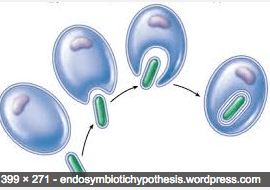
The diagram below shows a proposed theory of the origin of eukaryotic cells, called endosymbiosis.
Which of the following explains why cells that contained mitochondria-like organelles had an evolutionary advantage?
They were able to photosynthesize
They had more DNA
They were able to make more use of available energy
They were immune to bacterial invasion.

The theory of evolution suggests that earth’s first oxygen came from
plants
aerobic prokaryotes
chemical decomposition
photosynthetic prokaryotes
Endosymbiotic theory states that chloroplasts and mitochondria were once what?
Bacteria engulfed by larger cells
Amino acids
Large eukaryotes
Algae
The theory of endosymbiosis proposes that chloroplasts were once which organism?
Autotrophic prokaryotes
Heterotrophic eukaryotes
Mutated macromolecules
Parasites who fed on larger cells
The endosymbiotic theory states that certain organelles within eukaryotic cells may have originated as independent organisms.
Therefore, it is possible that mitochondria were once ____________________.
aerobic prokaryotes
photosynthetic bacteria
small eukaryotic cells
anaerobic prokarytoes
Which of the following refers to the evolution of life from nonliving materials?
physical evolution
organic evolution
chemical evolution
microevolution
Which of the following refers to gradual changes in living organisms resulting in more complex organisms?
chemical evolution
organic evolution
microevolution
macroevolution
What is the idea that living organisms come from nonliving matter?
spontaneous generation
law of biogenesis
chemical evolution
biological evolution
What is a scientific law that states that living organisms come only from other living organisms?
spontaneous generation
chemical evolution
organic evolution
law of biogenesis

