
 Worksheets
OChem2
Total questions: 59
Worksheet time: 30mins
Which of the statements below accurately describe(s) alkanes
They are least reactive class of organic compounds.
All carbons in alkanes are ap' hybridized.
Alkanes have no functional group.
Alkanes contain only carbon-carbon single bonds
All of the above
A series of compounds, that differ only by the number of __________ groups is called a homologous series.
-CH3
-OH
-NH2
-CH2-
>C=O
Predict the molecular formula of a branched alkane that contains 55 carbon atoms
C55 H110
C55 H114
C55 H112
C55 H116
C55 H115

What is the correct IUPAC name for the following structure
4-(2-bromo-1-methylethyl)-3-methylheptane
3-(1-methylpropyl)-1-bromo-2-methylhexane
1-bromo-2,4-dimethyl-3-propylhexane
2,4-dimethyl-1-bromo-3-propylhexane
How many secondary carbons are found in 5-ethyl-3,3,4-trimethylheptane
2
3
5
4
1
A branch alkane has _________ boiling point relative to the isomeric linear alkane Therefore there are ________ London force interactions in the branched alkane
a higher, stronger
a higher, weaker
a lower, stronger
a lower, weaker
the same; similar
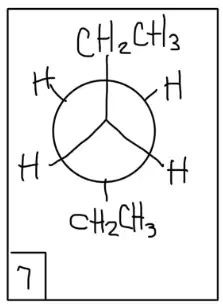
What is the name of the compound below
n-octane
n-pentane
n-propane
n-hexane
n-heptane
Which of the statements below correctly describes the chair conformations of trans-1- ethyl-4-methylcyclohexane
The higher energy chair conformation has both ethyl and methyl group in axial positions
The higher energy chair conformation has both ethyl and methyl group in equatorial positions
The lower energy chair conformation has the ethyl group in axial position and the methyl group in the equatorial position
The lower energy chair conformation has the ethyl group in equatorial position and the methyl group in the axial position
All of the above conformations have the same energy
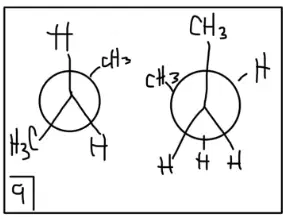
What is the relationship between the two structures below
Constitutional isomers
Conformational isomers
Not isomers
Degenerate isomers
Cis-trans isomers
Which of the following statements concerning the conformers of butane is true?
The eclipsed and totally eclipsed conformation have the same amount of torsional strain.
The lowest energy conformation of butane is the gauche conformation
There is more torsional strain in the anti conformation than in the totally eclipsed conformation
Butane spends most of the time in totally eclipsed conformation.
The gauche and anti conformations differ primarily in the amount of torsional strain present
Which of the following is true about the twist bond confirmation of cyclohexane
Higher angle strain in the twist boat
Lower angle strain in the twist boat
Lower torsional strain in the twist boat
Higher torsional strain in the twist boat
None of the above is true
____ is the study of energy chnages that accompany chemical and physical transformation
Kinetics
Entropy
Mechanism
Thermodynamics
Enthalpy
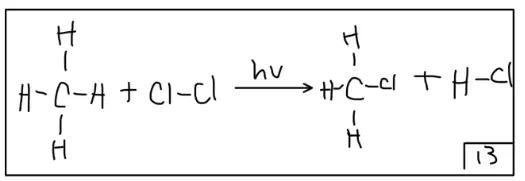
Which of the following occurs in the first propagation step of the free radical chlorination of methane?
A Cl₂ molecule splits into two chlorine free radicals.
A chlorine free radical abstracts a hydrogen atom from methane.
A methyl radical reacts with a Cl₂ molecule.
A methyl radical reacts with a chlorine free radical.
Two chlorine free radicals combine to form a Cl₂ molecule
Which of the following statements regarding cyclobutane is correct?
The lowest energy conformation is one in which the bond angles are
slightly less than 90° even though this increases angle strain
The lowest energy conformation of cyclobutane is a planar one in which all of the bond angles is 90°.
The lowest energy conformation is one in which the bond angles are greater than 90° so that angle strain is significantly reduced
The lowest energy conformation of cyclobutane is known as the chair conformation
None of the above statements is correct
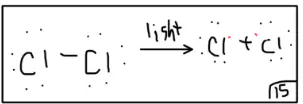
Which of the following is true for the initiation step of a free radical chlorination reaction?
∆H°> 0 and ∆S° <0
∆H°> 0 and ∆S° >0
∆H°< 0 and ∆S° >0
∆H°< 0 and ∆S° <0
∆H°= 0 and ∆S° =0
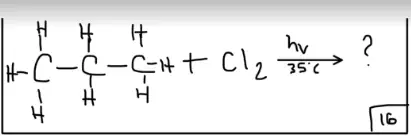
How many monochlorinated products are possible in the free radical chlorination of propane?
one
two
three
four
five
Which of the following happens in exothermic reaction
Stronger bonds are broken and weaker bonds are formed and energy is consumed.
Weaker bonds are broken and stronger bonds are formed and energy is released
Stronger bonds are broken and weaker bonds are formed and energy is released.
Weaker bonds are broken and stronger bonds are formed and energy is consumed
Bonds broken and bonds formed are of equal strength.
Why does the rate of a reaction increase as the temperature is increased
Because the molecules make more collisions with the wall of the reaction vessel
Because the frequency factor (4) increases
Because the activation energy decreases
Because the fraction of molecules with kinetic energy greater than Ea increases
Because the activation energy increases
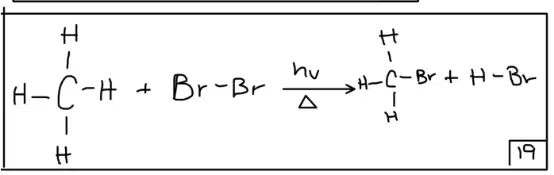
What is the heat of reaction (∆H°) for the following free-radical bromination?
Bond Dissociation Enthalpy:
CH3-H= +435
Ch3-Br= +293
Br-Br= +192
H-Br= +368
-25 kJ/mol
+34 kJ/mol
+57 kJ/mol
-34 kJ/mol
-43 kJ/mol
If ∆G° for a given reaction at 25° C is less than zero, which of the following correctly describes this reaction at this temperature
The reaction must be exothermic
The reaction must be endothermic
Keq is greater than zero
There is no change in temperature
None of the above.

The following is an example of an sn1 reaction. doubling the concentration of tert-butyl bromide [(CH3)C-Br] Causes the rate two double. doubling the concentration of hydroxide ion [-OH] has no effect on the rate of the reaction. what is the overall order of this reaction?
First Order
Second Order
Third Order
Fourth Order
Fifth Order
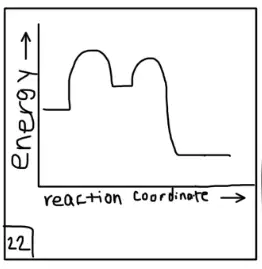
The following is an energy diagram for a two-step reaction. Which of following statements is not true regarding this diagram?
First step is endothermic
Second step is exothermic
The reverse reaction is endothermic
The reaction has an intermediate
The reaction is endothermic overall
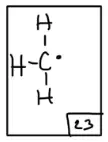
What is the hybridization state of the carbon atom in the methyl free radical
sp3
sp1
sp4
sp2
sp6
Which of the following statements is true regarding the ring strain of cycloalkanes per CH2 groups:
Cyclpentane has less ring strain per CH2 group than any other cycloalkane.
Cyclobutane has more ring strain per CH2 group than any other cycloalkane
Cyclopropane has more ring strain per CH2 group than any other cycloalkane
Cyclohexane has less ring strain per CH2 group than any other eyeloalkane
More than one of the above
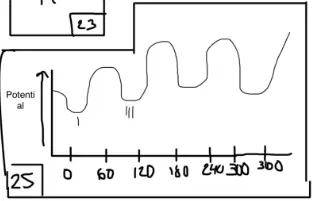
The graph below shows the relative torsional energies of the butane conformations Name the conformations that belong to the locations I, II, III, and IV respectively
anti, eclipsed, gauche, totally eclisped
totally eclipsed, anti, eclipsed, gauche
gauche, totally eclipsed, anti, eclipsed
eclipsed, gauche, totally eclipsed, anti
totally eclipsed, gauche, eclipsed, anti
A series of compounds, which differ only by the number of-CH2- groups, is called a(n) _____ series.
alkane
hydrocarbon
saturated
homologous
alkene
Triacontane is an unbranched alkane that contains 30 carbon atoms in each molecule. How many hydrogen atoms are present in each molecule of triacontane?
30
32
58
60
62
A linear alkane has ____ boiling point relative to the isomeric branched alkane. There are ____ London dispersion force interactions in the branched alkanes
a higher, stronger
a higher, weaker
a lower, stronger
a lower; weaker
the same; similar
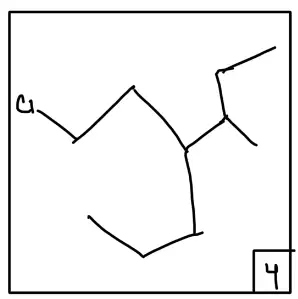
What is the correct IUPAC name for the following structure
4-(2-chloro-1-methylethyl)-3-methylhexane
3-sec-butyl-1-chloro-2-methylhexane
1-chloro-2,4-dimethyl-3-propylhexane
2,4-dimethyl-1-chloro-3-propylhexane
4-(2-chloro-1-methylethyl)-3-methylheptane
Which of the statements below correctly describes the chair conformations of cis-1,4- dimethylcyclohexane?
The higher energy chair conformation contains two axial methyl groups
The higher energy chair conformation contains one axial methyl group and one equatorial methyl group
The lower energy chair conformation contains one axial methyl group and one equatorial methyl group
The two chair conformations are of equal energy
The lower energy chair conformation contains two axial methyl groups
Which of the following best describes the molecules of a sample of ethane gas at room temperature
Almost all of the molecules are frozen or locked in the eclipsed conformation
Almost all of the molecules are frozen or locked in the staggered conformation
The molecules are rapidly interconverting between the eclipsed and staggered conformations, but at any one time slightly more of them are present in the eclipsed conformation
The molecules are rapidly interconverting between the eclipsed and staggered conformations, but at any one time slightly more of them are present in the staggered conformation
There will be a 50:50 mixture of eclipsed and staggered conformations.
Which of the following correctly lists the conformations of cyclohexane in order of increasing energy?
chair< boats< twist< half-chair
half-chair<boat<twist<chair
chair<twist<half-chair<boat
chair<twist<boat<half-chair
half-chair<twist<boat<chair
Which of the following happens in endothermic reactions
Stronger bonds are broken and weaker bonds are formed and energy is consumed
Weaker bonds are broken and stronger bonds are formed and energy is released
Stronger bonds are broken and weaker bonds are formed and energy is released
Weaker bonds are broken and stronger bonds are formed and energy is consumed
Bonds broken and bonds formed are of equal strength
If the concentration of (CH3) 3 CBr is tripled, the rate of the reaction triples. If the concentration of CH3CH2OH is doubled, the rate of the reaction is unchanged. Which of the following correctly describes the kinetics of this reaction
The reaction is third order in (CH3) 3 CBr
The reaction is first order in CH3CH2OH
The reaction is second order overall
The reaction is first order overall
None of the above
How many monochlorinated products are possible in the chlorination of cyclopentane
one
two
three
four
five
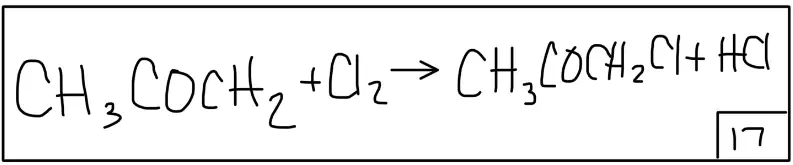
Given the chlorination of acetone shown below, choose the correct rate equation
rate k [CH3COCH3]
rate k [Cl2]
rate k [CH3COCH3] [Cl2]
rate k [CH3COCH3] [Cl2]^1/2
none of the above
The following reaction has a value of ∆G°=-2.1kj/mol What is the K eq value at room temperature (25 °C) for this reaction? (R = 8.314J / K * mol)
CH3Br + HS -> CH3SH + HBr
2.3
5.6
1.9
3.2
7.5
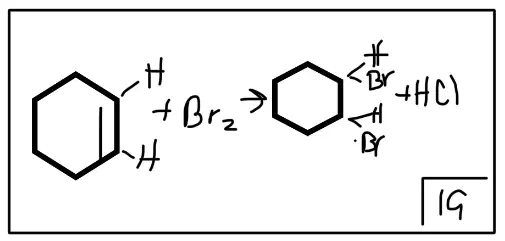
Shown below is the bromination of cyclohexene. When the concentration of cyclohexene is doubled, the reaction rate doubles. When the concentration of bromine is doubled, the reaction rate quadruples (increases fourfold). What is the overall rate of the reaction?
1st Order
2nd Order
3rd Order
4th Order
0th Order
Which of the statements below is not true regarding alkanes
They are least reactive class of organic compounds.
They are called unsaturated hydrocarbons
Alkanes have no functional group.
They contain only hydrogen and sp2 hybridized carbon
More than one of the above
How many tertiary carbons are there in 3-ethyl-2,4,5-trimethylheptane
2
3
5
4
1

answer to the best of your abilities
A
B
C
D
E

answer
A
B
C
D
E

answer
A
B
C
D
E
Which of the following occurs in the secondary propagation step of the free radical chlorination of methane?
A Cl₂ molecule splits into two chlorine free radicals.
A chlorine free radical abstracts a hydrogen atom from methane.
A methyl radical reacts with a Cl₂ molecule.
A methyl radical reacts with a chlorine free radical.
Two chlorine free radicals combine to form a Cl₂ molecule

?
A
B
C
D
E
Which of the following happens in endothermic reaction
Stronger bonds are broken and weaker bonds are formed and energy is consumed.
Weaker bonds are broken and stronger bonds are formed and energy is released
Stronger bonds are broken and weaker bonds are formed and energy is released.
Weaker bonds are broken and stronger bonds are formed and energy is consumed
Bonds broken and bonds formed are of equal strength.

?
A
B
C
D
E

?
A
B
C
D
E
The graph below shows the relative torsional energies of the butane conformations Name the conformations that belong to the locations I, II, III, and IV respectively
anti, eclipsed, gauche, totally eclisped
totally eclipsed, anti, eclipsed, gauche
gauche, totally eclipsed, anti, eclipsed
eclipsed, gauche, totally eclipsed, anti
totally eclipsed, gauche, eclipsed, anti

?
A
B
C
D
E

?
A
B
C
D
E

?
A
B
C
D
E

?
A
B
C
D
E

?
A
B
C
D
E

?
A
B
C
D
E

?
A
B
C
D
E

?
A
B
C
D
E

answer to the best of your abilities
A
B
C
D
E

?
A
B
C
D
E

