
Font size
 Worksheets
Protein Synthesis
Total questions: 94
Worksheet time: 3580secs
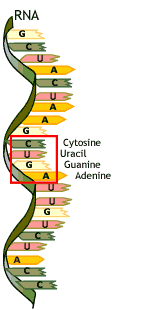

The mRNA leaves the ________ to find the ribosome to make proteins.
cell
nucleotide
nucleus
mitochondrion
DNA holds the code for making
lipids
carbohydrates
proteins
sugars
Choose the sequence of the mRNA strand that would be match up with to the following strand:
GTAGTCA
UATUAGA
ACGACTG
CAUCAGU
CATCAGT
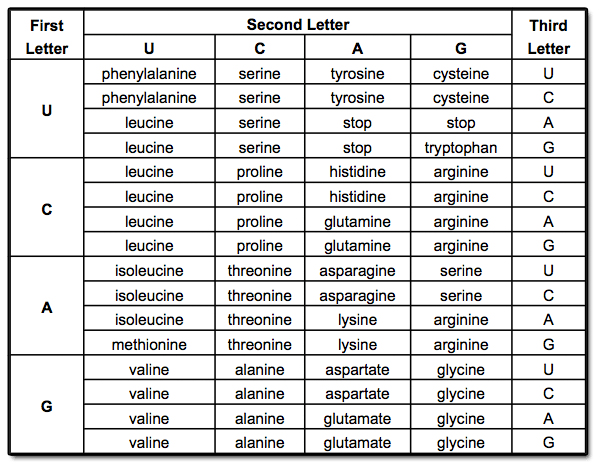
The mRNA leaves the ________ to find the ribosome to make proteins.
cell
nucleotide
nucleus
mitochondrion
DNA holds the code for making
lipids
carbohydrates
proteins
sugars
Choose the sequence of the mRNA strand that would be match up with to the following strand:
GTAGTCA
UATUAGA
ACGACTG
CAUCAGU
CATCAGT


What is the location in the cell for translation?
nucleus
mitochondria in cytoplasm
ribosome in cytoplasm
chloroplast in cytoplasm
Where are proteins assembled (put together) in a cell?
Nucleus
Ribosome
Cell Membrane
Muscles
In what process is mRNA synthesized?
Transcription
Translation
DNA Replication
Mitosis
Where does TRANSCRIPTION occur?
Nucleus
Ribosome
Cytoplasm
Mitochondria
Why must transcription occur where DNA can be found?
because DNA can't leave
because ribosomes are in the nucleus
because DNA polymerase is found there
because helicase unzips the DNA
Which of the following is a codon?

ATG
AUG
AUT
How many codons equals 1 amino acid?
1
2
3
4
How many nucleotides equal 1 amino acid?
1
2
3
4
On which molecule can an anticodon be found?
mRNA
DNA
tRNA
rRNA

Where is the anticodon located?
at the top of the molecule it's found on
at the bottom of the molecule it's found on
on the right of the molecule it's found on
on the left of the molecule it's found on
What is the purpose for anti-codons?
to ensure the correct amino acid is dropped off
to match the strand of DNA
to decode a sequence of 4 nucleotides into an amino acid
to make me hate biology

A polypeptide is a sequence of ____________________ held together by a ______________ bond.
amino acids; peptide
fatty acids; ionic
proteins; hydrogen
fatty acids; covalent
Which two thing are found on a molecule of tRNA?
amino acids; anticodons
amino acids; codons
ribose sugar; proteins
deoxyribose sugar; codons
How do you know when to begin translating a strand of mRNA?
look for AUG
start at the beginning
look for ATG
when Ms. H tells me to
How do you know when to STOP translating a strand of mRNA?
look for STOP on the decoder
stop at the end of the strand
you don't
when Ms. H tells me to
TRANSCRIBE this DNA sequence: TACGTTACT
AUGCAAUGA
ATGCAATGA
AUGGATUGA
TACGTTACT
TRANSLATE this RNA sequence: AUGCAAUGA
Met-Glu-Stop
Met-His-Stop
Thr-Glu-Stop
Thr-Pro-Stop
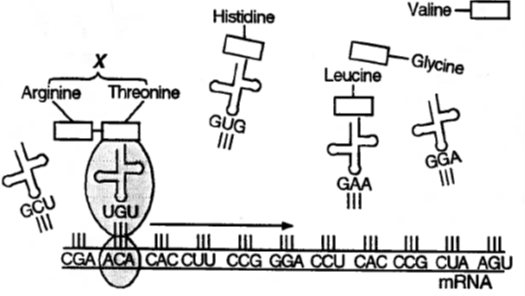
A DNA nucleotide may be made up of a phosphate group, along with
deoxyribose sugar and uracil
ribose sugar and cytosine
deoxyribose sugar and thymine
ribose sugar and adenine
Which of the following units are repeatedly joined together to form a strand of DNA? (This is the MONOMER of DNA.)
amino acids
nucleotides
fatty acids
polysaccharides
The important enzyme related with transcription is;
gyrase
DNA polymerase
RNA polymerase
ligase


What's does the question mark in the picture represent?
mRNA
amino acids
tRNA
Codon
ribosome

What's does the question mark in the picture represent?
mRNA
amino acids
tRNA
Codon
ribosome

What process is happening in the diagram?
transcription
translation
dna replication
mitosis

rRNA makes up what organelle of the cell?
Nucleus
Cytoplasm
Ribosome
Mitochondria

What is the structure shown in the middle of the pink box?
tRNA
Amino Acid
Anticodon
Codon

What is the structure shown in the middle of the pink box?
tRNA
Amino Acid
Anticodon
Codon

What is the structure shown in the middle of the pink box?
tRNA
Amino Acid
Anticodon
Codon

What is the structure shown in the image?
tRNA
mRNA
rRNA
xRNA

Which codon below is the code for Leucine?
UUA
UUC
AUU
CUA
Which of the following statements is correct about the differences between DNA and RNA?
RNA contains the same bases as DNA, except uracil is present instead of guanine
DNA is not present in prokaryotes, while RNA is
DNA is present as a single-stranded molecule while RNA is double-stranded
The sugar molecule in RNA has one more hydroxyl group than the sugar molecule in DNA


During Transcription, DNA is converted into ____
mRNA
tRNA
rRNA
a Protein
During Translation, mRNA is converted into a _______
DNA
Protein
tRNA
rRNA

the tRNA carries an
Amino Acid
Polysaccaride
Lipid
DNA
Many amino acids and put together and folded up to form a ______
Protein
DNA strand
mRNA strand
Carbohydrate

During transcription, DNA is converted in mRNA inside the _______.
Cell Membrane
Ribosome
Nucleus
Cytoplasm

During Translation, mRNA finds a ________ to make a protein.
Nucleus
Ribosome
Amino Acid
Mitochondria
Which nitrogen base is in the DNA, but is NOT in the mRNA?
Thymine
(T)
Cytosine
(C)
Guanine
(G)
Adenine
(A)
Match the DNA codon ATC to the correct mRNA codon.
UAG
AUC
TAG
UUG
Match the DNA codon GCA to the correct mRNA codon
CCU
GCT
CGU
CGA
Match the mRNA codon UUA to the correct tRNA anti-codon
AAT
AAU
AUA
ATA

Use your codon chart to match the mRNA CUU to the correct amino acid
VAL
TYR
LEU
PHE

Use your codon chart to match the mRNA ACU to the correct amino acid.
Thr
Ala
Val
Gly
Amino Acids are built up to make_______
DNA
mRNA
Lipids
Proteins
Amino acids form a polypeptide chain that is then folded up to form a protein, what type of bond holds together a polypeptide chain?
Hydrogen Bonds
Polypeptide Bonds
Nitrogen Bonds
Carbon Bonds

Use your codon chart to find the amino acid that codes for AGU
Tyr
Gly
Arg
Ser

Use your codon chart to find the amino acid that codes for the mRNA codon GCA
Thr
Ala
Pro
Ser

Use your codon chart and find the amino acid that codes for the mRNA codon UAA
Phe
Tyr
START
STOP
Ribosomes make ________
DNA
Proteins
Amino Acids
Lipids
Use your codon chart to figure out what amino acid codes for the mRNA codon AUG
START
(Met)
Ile
Val
Leu
Amino Acids form a __________ ____ that is then folded into a protein
Polypeptide Chain
Protein Chain
Carbohydrate
Deoxyribose Nucleic Acid

