

Wayground logo

Free Printable Worksheets

Font size

S
M
L
XL
Worksheets

Types of Chemical Reactions

Total questions: 92

Worksheet time: 4hrs 45mins

Name
Class
Date
1.
4Si + S8 --> 2Si2S4
a)
Synthesis
b)
Decomposition
c)
Single displacement
d)
Double displacement
2.
3Ca + 2AlCl3 --> 3CaCl2 + 2Al
a)
Synthesis
b)
Decomposition
c)
Single diplacement
d)
Double displacement
3.
3KOH + H3PO4 --> K3PO4 + 3H2O
a)
Synthesis 
b)
Decomposition
c)
Single displacement
d)
Double displacement
4.
2Pb(NO3)2 --> 2PbO + 4NO2 + O2
a)
Synthesis 
b)
Decomposition
c)
Single displacement
d)
Combustion
5.
3Mg + N2 --> Mg3N2
a)
Synthesis 
b)
Decomposition
c)
Single displacement
d)
Combustion
6.
2NO2 --> N2 + 2O2
a)
Synthesis
b)
Decomposition
c)
Single displacement
d)
Combustion
7.
P4 + 3O2 --> 2P2O3
a)
Synthesis 
b)
Decomposition
c)
Single displacement
d)
Combustion
8.
Fe + H2SO4 --> Fe2(SO4)3 + H2
a)
Synthesis (combination)
b)
Decomposition
c)
Single replacement
d)
Combustion
9.
NH3 + HCl ---> NH4Cl 
a)
Synthesis
b)
Decomposition
c)
Single Replacement
d)
Double Replacement
10.
H2SO4 + Fe -->H2 + FeSO4
a)
Synthesis
b)
Decomposition
c)
Single Replacement
d)
Double Replacement
11.
C4H12 + O2 --> CO2 + H2O
a)
Synthesis
b)
Combustion
c)
Single Replacement
d)
Double Replacement
12.
PbCl2 + AgNO3 ---> Pb(NO3)2 + AgCl 
a)
Synthesis
b)
Decomposition
c)
Single Replacement
d)
Double Replacement
13.
Which of the following is the general formula for a decomposition reaction?
a)
A + B  → AB
b)
AB → A + B
c)
AB + C → AC + B
d)
AB + CD → AC + BD
14.
Which reaction type is the following: C5H10O4 + O2 --> CO2 + H2O
a)
Decomposition
b)
Single Replacement
c)
Combustion
d)
Double Replacement
15.
When balancing equations a ____ can be placed to the left of a formula of a substance to make the equations balanced
a)
charge
b)
subscript
c)
random number
d)
coefficient
16.
What coefficient should be used to make the following equation balanced?
N2+O2--> _NO 
a)
1
b)
2
c)
3
d)
4
17.
Is the equation balanced?: 2H2O + O2 --> 4MgO + 3Fe
a)
Yes
b)
No
18.
Balance this equation:
 __Li + __Cl2 -> __LiCl
a)
2Li + Cl2 -> 4LiCl2
b)
2Li + Cl2 -> LiCl2
c)
2Li +  Cl2 -> 2LiCl
19.
What is a reactant?
a)
a volatile chemical
b)
a dangerous substance
c)
the substances you start with in a chemical reaction
d)
the substances that are formed by a chemical reaction 
20.
What is a product?
a)
a fancy word for make-up
b)
a volatile chemical
c)
the substances you start with in a chemical reaction
d)
the substances that are formed by a chemical reaction
21.

Balancing the following:

____ Al + ____ HCl → ____ AlCl3 + ____ H2
a)
1,3,1,2
b)
2,3,2,3
c)
2,6,2,3
d)
3,2,6,2
22.
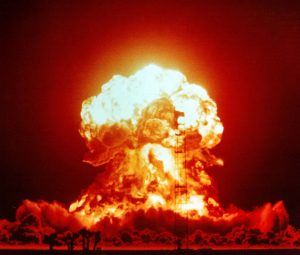
What type of reaction is shown in the photo?
a)
Exothermic
b)
Isothermic
c)
Endothermic
d)
None of the  above
23.
How does an exothermic reaction feel?
a)
cold
b)
warm
c)
You can't feel it
d)
None of the above
24.
How do you know that energy is being absorbed during a chemical reaction?
a)
Temperature increases
b)
Temperature decreases
25.
The ___________ the surface area of the reactants, the faster the reaction rate.
a)
larger 
b)
smaller
26.
Increasing the temperature will increase the kinetic energy of particles, therefore increasing the collisions between particles.
a)
false
b)
true
27.
Usually lowering the temperature will slow down a reaction.
a)
false
b)
true
28.
Increasing the concentration of the reactants will slow down the reaction.
a)
false 
b)
true
29.
Exothermic reactions release heat to the surroundings.
a)
true
b)
false
30.
A catalyst increases the efficiency of collisions between reactants.
a)
true
b)
false
31.
You observe bubbles after adding metal to a solution. Do you assume a chemical reaction took place?
a)
Yes
b)
No
32.

In the equation, 2Mg + O2 ---> 2MgO, which are the reactants?

a)

Mg and O2

b)

MgO

c)

Mg and MgO

d)

O and MgO

33.
Balance this equation,            Al2O3 ---> Al + O2 
a)
Cannot be balanced
b)
2Al2O3 ---> 2Al + 3O2 
c)
2Al2O3 ---> 4Al + 3O2 
d)
3Al2O3 ---> 2Al + O2 
34.
Balance this equation:  H2 + N2 → NH3
a)
 H2 + 4N2 → NH3
b)
 H2 + 3N2 → 2NH3
c)
 3H2 + N2 → 2NH3
d)
 2H2 + 2N2 → 2NH3
35.
Balance this reaction: ____ HCN + ____ CuSO4 ---->____ H2SO4 + ____ Cu(CN)2
a)
2,1,1,2
b)
2,1,1,1
c)
1,2,2,1
d)
1,2,1,1
36.
Balance this reaction: ____ RbNO3 + ____ BeF2 ----> ____ Be(NO3)2 + ____ RbF
a)
1,1,1,1
b)
1,2,1,1
c)
2,1,1,2
d)
2,1,2,1
37.
___C3H8 +___O2 --> ___CO2 + ___H2O
a)
1,5,3,4
b)
2,10,6,8
c)
already balanced
d)
1,5,5,4
38.
__Al + __Fe3N2 -->__AlN + __Fe
a)
already balanced
b)
4,2,4,6
c)
2,1,2,3
d)
1,2,1,3
39.
__H2O2 --> __H2O + __O2
a)
already balanced
b)
2,1,1
c)
2,2,1
d)
2,1,2
40.

Which of the following is a acid-base reaction (hint: it is double replacement?

a)

2Na + Cl2 → 2NaCl

b)

CH4 + 2O2 → CO2 + 2H2O

c)

HCl + KOH → KCl + H2O

d)

CaCO3 → CO2 + CaO

41.

Classify this reaction

2Ca(s) + O2(g) --> 2CaO(s) (hint: the charge of 2 elements change)

a)

Precipiation

b)

Acid-Base

c)

Redox

d)

Single Replacement

42.

Classify this reaction: (hint: the charge of 2 elements change)

4Fe + 3O2 --> 2Fe2O3

a)

Redox

b)

Precipitation

c)

Acid-Base

d)

Single Replacement

43.

Classify this reaction (hint the charge of 2 elements change): Zn + H2O --> ZnO2 + H2

a)

Redox

b)

Acid-Base

c)

Precipiation

d)

Double Replacement

44.

Classify this reaction: (hint the charge of 2 elements change)

4Fe + 3O2 --> 2Fe2O3

a)

Redox

b)

Acid-Base

c)

Precipitation

d)

Double Replacement

45.

Classify this reaction

ZnCl2 (aq) + LiOH (aq) → Zn(OH)2 (s)+ LiCl (aq) (hint: look at the phases). This should be double replacement!

a)

precipitation

b)

acid-base

c)

redox

d)

synthesis

46.

BaSO4

a)

soluble

b)

insoluble

47.
AgCl
a)
soluble
b)
insoluble
48.
NH4NO3
a)
soluble
b)
insoluble
49.
Zinc Carbonate
a)
Soluble 
b)
Insoluble 
50.
Which substance is insoluble in water?
a)
MgS
b)
BF3
c)
Sr(OH)2
d)
MgO
51.

Which type of reaction is:

C7H16 + 10 O2 → 7 CO2 + 8 H2O

a)
Synthesis
b)
Decomposition
c)
Single Displacement
d)
Combustion
52.

Which type of reaction is:

3 Pb + 2 H3PO4 → 3 H2 + Pb3(PO4)2

a)
Synthesis
b)
Single Displacement
c)
Double Displacement
d)
Combustion
53.

In the equation, 2Mg + O2 ---> 2MgO, which are the reactants?

a)

Mg and O2

b)

MgO

c)

Mg and MgO

d)

O and MgO

54.

The red numbers in the image represent

a)

subscripts

b)

coeffiecients

c)

roman numerals

d)

none of the answer options are correct

55.

When balancing a chemical equation, you can only change _________, you can never change _______!

a)

coefficients, subscripts

b)

subscripts, coefficients

c)

formulas, subscripts

d)

coefficients, formula units

56.
The following reaction is an example of what reaction type? 
CoCO3 → CoO + CO2
a)
Synthesis
b)
Decomposition
c)
Single Replacement
d)
Double Replacement
57.
Si + S8 --> Si2S4
a)
Synthesis (combination)
b)
Decomposition
c)
Single replacement
d)
Double replacement
58.
How many atoms of carbon (C) are in C6H12O6?
a)
3
b)
6
c)
12
d)
24
59.
Is the following equation balanced?...
Al + O2 --> 2Al2O3
a)
Yes!
b)
No!
60.
The number of atoms you begin with in a chemical reaction ...
a)
must be the same as the number of  atoms you end with
b)
must be an even number
c)
can be different to the number you finish with
d)
changes depending on how much energy is formed
61.

What is the Law of Conservation of Mass?

a)

It states that matter cannot be created or destroyed.

b)

It states that energy cannot be created or destroyed.

c)

It states that matter can be created or destroyed.

d)

It states that sound can be created or destroyed.

62.

Is the equation balanced?: 2H2O + O2 --> 4MgO + 3Fe

a)

yes

b)

no

63.
What is the right part of a chemical equation called...
2H2 + O2 --> 2H2O
a)
Reactants
b)
Products 
c)
Yields 
d)
Chemical Equation 
64.
Why is the following chemical equation not balanced?
H2 + O2 --> H2O
a)
each side of the equation has a different number of oxygen atoms
b)
each side of the equation has a different number of hydrogen atoms
c)
each side has the same mass
65.
What mathematical function do coefficients perform in a balanced equation?
a)
addition
b)
subtraction
c)
multiplication
d)
division
66.
Balance this equation
_Al +_HCl --> _H2 +_AlCl3
a)
2, 6, 3, 2
b)
it is already balanced
c)
4, 12, 3, 4
d)
2, 1, 4, 5
67.
Balance this equation-
__P4 + __O2 --> __P2O3
a)
it is already balanced
b)
2, 1, 3
c)
1, 2, 3
d)
1, 3, 2
68.
What are the spectator ions in the reaction of sodium chloride with silver nitrate?
a)
silver and nitrate
b)
sodium and chloride
c)
sodium and nitrate
d)
silver and chloride
69.
In this equation,
CuCl2 + NaOH  → Cu(OH)2 + NaCl
Which product is insoluble?
a)
copper(II) hydroxide
b)
sodium chloride
c)
sodium hydroxide
d)
copper(II) chloride
70.
In this equation,
CuCl2 + NaOH  → Cu(OH)2 + NaCl
Which product is insoluble?
a)
copper(II) hydroxide
b)
sodium chloride
c)
sodium hydroxide
d)
copper(II) chloride
71.
Which of these results in formation of a precipitate?
a)
BaNO3(aq)  +  NaCl(aq)→
b)
KNO3(aq)  +  LiOH(aq)→
c)
Zn(NO3)2(aq)  +  NaOH(aq)→
d)
NaNO3(aq)  +  Ba(OH)2(aq)→
72.
What is the result of the reaction between potassium bromide and ammonium sulfide?
a)
potassium sulfide precipitates
b)
ammonium bromide precipitates
c)
potassium ammonium precipitates
d)
no precipitate is formed
73.

Identify the reaction that results in the formation of a precipitate.

a)

AgNO3(aq) + NaOH(aq)→

b)

BaNO3(aq) + CaCl2(aq)→

c)

NaNO3(aq) + KOH(aq)→

d)

More than one of these form precipitates

74.
Which of the following does NOT form a precipitate?
a)
Pb(NO3)2(aq) + 2KI(aq) →
b)
Sr(NO3)2 (aq) + K2SO4(aq) →
c)
AgNO3(aq) + Na2S(aq) →
d)
 Pb(NO3)2(aq) + AgNO3(aq) →
75.
Which of the following does NOT form a precipitate?
a)
Pb(NO3)2(aq) + 2KI(aq) →
b)
Sr(NO3)2 (aq) + K2SO4(aq) →
c)
AgNO3(aq) + Na2S(aq) →
d)
 Pb(NO3)2(aq) + AgNO3(aq) →
76.

In this equation,

CuCl2+ NaOH → Cu(OH)2 + NaCl

Identify the insoluble product?

a)

copper(II) hydroxide

b)

sodium chloride

c)

sodium hydroxide

d)

copper(II) chloride

77.
Which of these lists contains only soluble substances?
a)
sodium nitrate, potassium chloride, calcium carbonate
b)
lead nitrate, lead chloride, lead sulfate
c)
calcium nitrate, copper chloride, ammonium phosphate
d)
silver nitrate, barium sulfate, copper carbonate
78.

Which of the following is a neutralization reaction?

a)

2Na + Cl2 → 2NaCl

b)

CH4 + 2O2 → CO2 + 2H2O

c)

HCl + KOH → KCl + H2O

d)

CaCO3 → CO2 + CaO

79.

Which element is common to all acids?

a)

Hydrogen

b)

Oxygen

c)

Carbon dioxide

d)

Helium

80.

When carbonates react with acids, which gas is produced?

a)

Hydrogen

b)

Carbon dioxide

c)

Oxygen

d)

Nitrogen

81.
A neutralisation reaction is a reaction between 
a)
Acid and a Base 
b)
Acid and water 
c)
Base and water 
d)
None of the above 
82.
What type of reaction is the following: 
HCl  + Zn --> ZnCl2 + H2
a)
Neutralisation
b)
Acid and a metal 
c)
Acid and a carbonate 
d)
Ionic 
83.

.............................. + sodium hydroxide --> sodium chloride + water

a)

Nitric acid

b)

Sulphuric acid

c)

Hydrochloric acid

d)

Ethanoic acid

84.

Which of the following is a neutralization reaction?

a)

2Na + Cl2 → 2NaCl

b)

CH4 + 2O2 → CO2 + 2H2O

c)

HCl + KOH → KCl + H2O

d)

CaCO3 → CO2 + CaO

85.

Identify the type of chemical reaction (a)  

Choose from the below words
Synthesis
Decomposition
Single replacement
Double replacement
Combustion
86.

Identify the type of chemical reaction

a)

Synthesis

b)

Decomposition

c)

Single replacement

d)

Double replacement

e)

Combustion

87.

Identify the type of chemical reaction

a)

Synthesis

b)

Decomposition

c)

Single replacement

d)

Double replacement

e)

Combustion

88.

Identify the following chemical reaction.

3 HBr + 1 Al(OH)3 ----> 3 H­2O + 1 AlBr3

a)

Synthesis (or combination)

b)

Decomposition

c)

Single displacement

d)

Double displacement

89.

Identify the following chemical reaction.

Pb + FeSO4 ----> PbSO4 + Fe

a)

Synthesis (or combination)

b)

Decomposition

c)

Single displacement

d)

Double displacement

90.

Identify the type of chemical reaction

a)

Synthesis

b)

Decomposition

c)

Single replacement

d)

Double replacement

e)

Combustion

91.

Identify the type of chemical reaction

a)

Synthesis

b)

Decomposition

c)

Single replacement

d)

Double replacement

e)

Combustion

92.

Identify the type of chemical reaction

a)

Synthesis

b)

Decomposition

c)

Single replacement

d)

Double replacement

e)

Combustion
