
 Worksheets
Unit 3 Constant velocity
Total questions: 97
Worksheet time: 3hrs 45mins
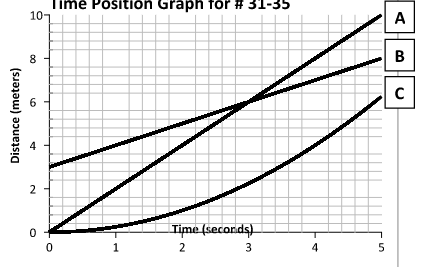


What does the slope of a position vs time graph tell you?
Displacement
Distance traveled
Velocity
Acceleration
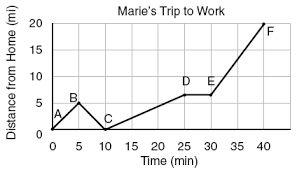
When was Marie driving the fastest?
C to D
D to E
E to F
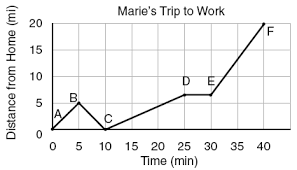
During what period of time was Marie stopped?
0-5 minutes
5-10 minutes
10-25 minutes
25-30 minutes
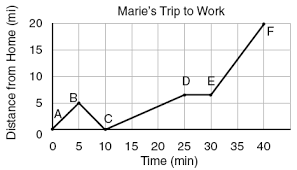
What could account for Marie’s motion at 27 minutes?
She was late so she broke the speed limit
She forgot something at home and ran back to get it
She was stopped at a red light
She was driving across the top of a hill
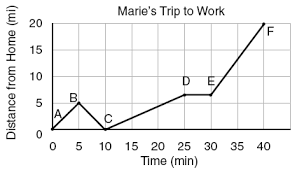
How far away is Marie's work from her house? (Hint: Think straight line distance not actual path traveled.)
40 mi
25 mi
20 mi
5 mi
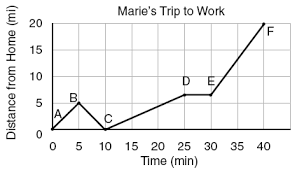
How does her speed at 3 minutes compare with her speed at 7 minutes?
She is driving faster at 3 minutes.
She is driving faster at 7 minutes.
She is driving the same speed just opposite directions.
She is going uphill at 3 minutes and downhill at 7.
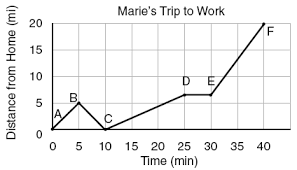
How far did Marie go before she turned around?
20 mi
5 mi
10 mi
25 mi
Which of these position vs. time graphs shows an object changing direction?


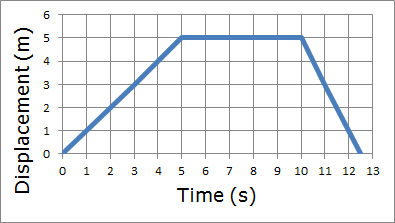
According to the graph, what was the velocity for the first 5 seconds?
1 m/s
0.5 m/s
5 m/s
2 m/s
According to the graph, what was the average speed from 0-10 seconds?
1 m/s
0.5 m/s
5 m/s
0 m/s

What is the change in position from 0-4 seconds?
3-1 = 2 meters
1-3 = -2 meters
0-1 = -1 meters
1-0 = 1 meter

What is the total distance traveled over the whole trip (0-9 seconds)?
5 meters
2 meters
1 meter
3 meters

What is the displacement for the whole trip?
1 meter
-1 meter
0 meters
3 meters
What is the average velocity for the whole trip?
-0.11 m/s
0.33 m/s
0 m/s
-0.20 m/s
What is the average speed for the whole trip?
0.56 m/s
0.33 m/s
0 m/s
0.67 m/s
The location of an object related to a zero point.
position
speed
distance
displacement
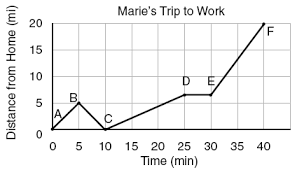
It usually takes Marie 30 minutes to get to work. Did her trip take...
The average amount of time.
Longer then average amount of time.
Shorter then average amount of time.
How far away is Marie's work from her house?
40 mi
25 mi
20 mi
5 mi
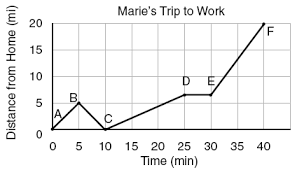
What could be a possible explanation for why Marie turned around at point B.
She arrived at work.
She forgot her lunch
She was waiting at a stop light.
She was sick and went home to sleep.

In Segment DE Marie was stopped at a red light. How long was she stopped for?
1 min.
10 min.
30 min.
5 min.
from 3rd second to 5th second, the object is
moving at a constant speed
speeding up
not moving
slowing down
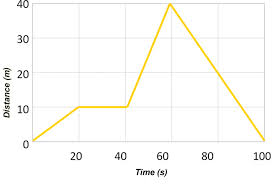

This position vs. time graph shows an object...
not moving
moving with constant velocity
moving with changing velocity

This position vs. time graph shows an object...
not moving
moving with constant velocity
moving with changing velocity

This position vs. time graph shows an object...
not moving
moving with constant velocity
moving with changing velocity
According to the graph, what was the Speed for the first 5 seconds?
1 m/s
0.5 m/s
5 m/s
2 m/s


Describe the motion:
constant velocity to the right
not moving
constant velocity to the left

Describe the motion:
constant velocity to the right
not moving
constant velocity to the left

Describe the motion:
constant velocity to the right
not moving
constant velocity to the left

Which line shows an object moving to the right?
A
B
C
D
Which line shows an object moving to the left?
A
B
C
D
Which line shows an object that is stopped?
A
B
C
D
What is the difference between the motion of object B and object D?
B is moving faster than D
D is moving faster than B
B is moving to the right, D is moving to the left
D is moving to the right, B is moving to the left
Which object is moving the fastest?
A
B
C
D
The (a) the slope, the faster the object is moving.
The (a) the slope, the slower the object is moving.

What is the object's starting position?
20 m to the right
20 m to the left
60 m to the right
60 m to the left
What is the object's ending position?
20 m to the right
20 m to the left
60 m to the right
60 m to the left
What is the object's motion between 0-1 seconds?
not moving
medium speed to the right
medium speed to the left
What is the object's motion between 1-3 seconds?
not moving
medium speed to the right
medium speed to the left
What is the object's motion between 3-5 seconds?
not moving
medium speed to the right
medium speed to the left
What is the object's motion between 5-6 seconds?
not moving
medium speed to the right
medium speed to the left
faster speed to the right
faster speed to the left

When is the object moving to the right?
0-10 seconds
10-15 seconds
15-40 seconds
40-60 seconds
When is the object moving to the left?
0-10 seconds
10-15 seconds
15-40 seconds
40-60 seconds
When is the object stopped?
0-10 seconds
10-15 seconds
15-40 seconds
40-60 seconds
What is the object's initial position?
0 m
60 meters to the right
40 meters to the left
In which of the following graphs below are both runners moving at the same speed?


Which position time graph matches the velocity time graph displayed above?


Which of the following shows an object at rest? (PAY ATTENTION TO WHAT TYPE OF GRAPH YOU'RE LOOKING AT)


Which VT graph matches this PT graph?


Which VT graph matches this PT graph?

A battery powered car is guided through an obstacle course. The graph shows how the car traveled over a period of time.
Between which two points was the speed of the car the fastest?
P and Q
Q and R
R and S
S and T

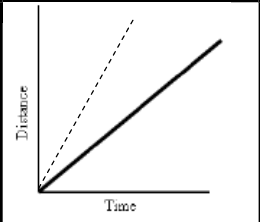
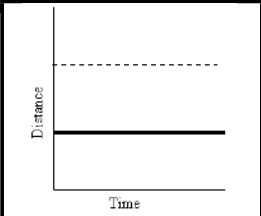
Maria walked slowly to college along the road, she stopped to look at her watch, she realized she was going to be late for science lab, and she began running.


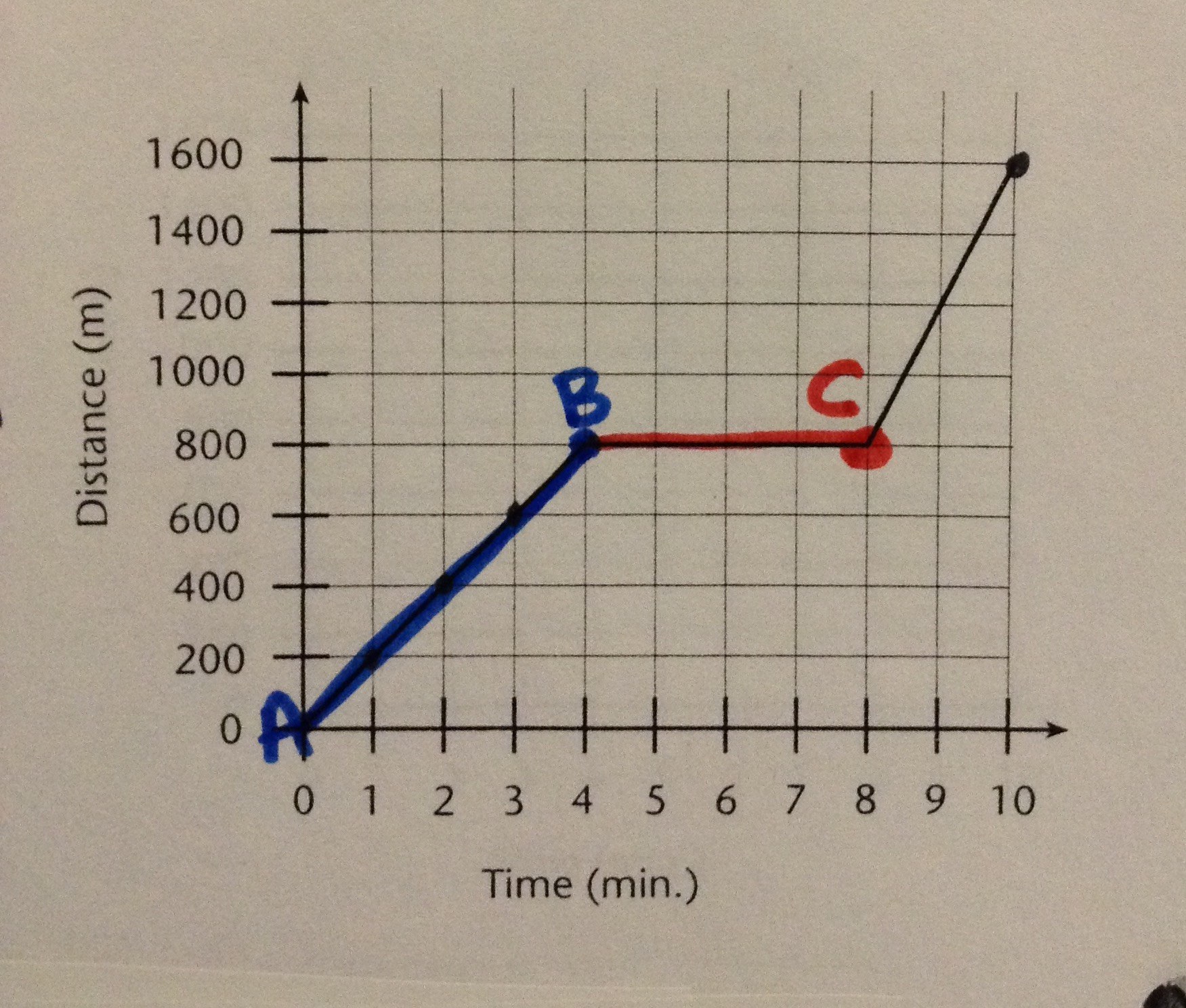
The graph shows Ashley riding her bike to Maria's house.
What was occurring from point B to point C?
She was increasing her speed.
She stopped for 4 minutes
She was decreasing in speed
She was moving forward at a steady 800 m/s

Which line represents a runner moving at a fast pace?
Green
Red
Blue
None of them
Which line represents a runner moving at a slow pace?
Green
Red
Blue
None of them
Which line represents a runner who is stopped?
Green
Red
Blue
None of them

What is happening to the runner's velocity?
Speeding up
Slowing down
Staying constant (stopped)
Staying constant (moving)

What is happening to the runner's velocity?
Speeding up
Slowing down
Staying constant (stopped)
Staying constant (moving)

What does this motion map indicate?
Forward at a constant velocity
Backward at a constant velocity
Forward getting faster
Backward getting faster
Forward slowing down then backwards getting faster.

What does this motion map indicate?
Forward at a constant velocity
Backward at a constant velocity
Forward getting faster
Backward getting faster
Forward slowing down then backwards getting faster.

What does this motion map indicate?
Forward at a constant velocity
Backward at a constant velocity
Forward slowing down
Forward getting faster
Backwards slowing down

What does this motion map indicate?
Forward at a constant velocity
Backward at a constant velocity
Forward slowing down
Forward getting faster
Backwards slowing down

What does this motion map indicate?
Forward at a constant velocity
Backward at a constant velocity
Forward slowing down
Forward getting faster
Backwards slowing down

Which is TRUE?
A is slower than C
B is the fastest
C is slowing down
all are going forward

Which is TRUE if the dots are 2 seconds apart and the scale is in meters?
A has a speed of 2 m/s.
B has a speed of 2 m/s.
A is going in the negative direction
A is moving slower than B

At the beginning of the motion map the object is?
moving at a velocity of 3 km/s
moving at a velocity of 4 km/s
at rest for 1 second
at rest for 3 seconds

Which describe the motion correctly?
the object never changed speed
the object returned to the start
the object stopped for awhile
the object always went forward


