
 Worksheets
Unit 5 Review Quizizz
Total questions: 100
Worksheet time: 54mins

Which star is likely to be the hottest? Use the H-R diagram
Type B Star
White Dwarf
Red Giant
Type G Star (Sun)

Which mass of star will have the shortest life span?
Low Mass Star
Medium Mass Star
High Mass Star
Very High Mass Star

Which stage of life is the sun currently in?
White Dwarf
Planetary Nebula
Main Sequence
Red Giant

What is the name of the cosmic cloud of dust and gas that is the first stage in the birth of a star?
Protostar
Spiral Galaxy
Quasar
Stellar Nebula

Which elements are found in a main sequence star?
Hydrogen (H)
Helium (He)
Carbon (C)
Oxygen (O)

The layer of the sun’s atmosphere that gives off visible
light
Photosphere
Corona
Solar Flare

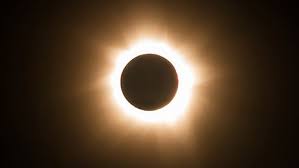
the layer of the sun’s atmosphere that looks like a
halo during an eclipse
Photosphere
Solar Flare
Corona

the joining of hydrogen atoms to form helium
Nuclear Fusion
Nuclear Fission

the layer of the sun’s interior where energy is
transferred mainly by electromagnetic radiation
Convection Zone
Radiation Zone
Corona

the layer of the sun’s atmosphere that has a reddish
glow
Corona
Photosphere
Chromosphere

areas of gas on the sun’s surface that are cooler than
the gases around them
Freckles
Corona
Sun spot
Large loops of super-hot gas that extend out from the Sun’s surface.
Solar prominences
Sunspots
Solar flares
Photosphere
The two elements the sun is made of.
Argon & Nitrogen
Hydrogen & Oxygen
Nitrogen & Oxygen
Hydrogen & Helium
How many Earth's could fit inside the sun?
One
Ten
One Thousand
One Million
True or False: Tides are caused by the gravitational pull of the Moon and Sun on the surface waters of Earth.
True
False
True or False: Tides are the regular rising and falling of ocean levels.
True
False
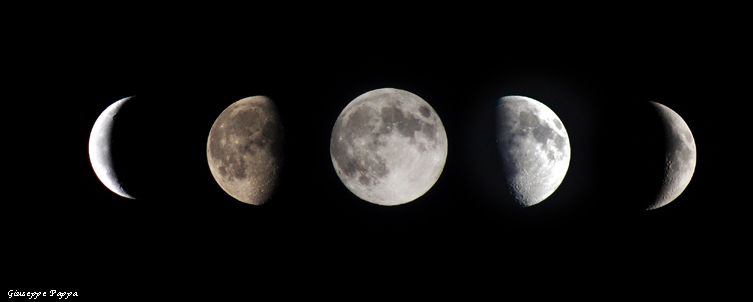
Which moon phase is completely dark?
New moon
Full moon
Quarter moon
Gibbous moon
Which moon is greater than half lit?
New moon
Crescent moon
Gibbous moon
Quarter moon
Which moon is half lit?
New moon
Gibbous moon
Crescent moon
Quarter moon
Which moon is less than half lit?
Gibbous moon
New moon
Quarter moon
Crescent moon
The the bright side of the moon is growing on the right, (light on the right) it is a _______ moon.
Waxing
Waning
The bright side of the moon is getting smaller on the left, (light on the left), this is a _________ moon.
Waxing
Waning
Approximately how long does it take the moon to make one revolution around Earth?
365.25 days
24 hours
29 days
84 years

What phase is this?
Full Moon
New Moon
First Quarter
Last Quarter
What does "waning" mean?
Staying the same
Having one side illuminated
Getting bigger and brighter
Getting smaller and darker
What does "waxing" mean?
Can't be seen at all
Getting smaller and darker
Getting bigger and brighter
Total illumination
Tides are....
Temperature changes in the ocean caused by the Sun
Caused by daily eclipses
The regular rise and fall of ocean levels
Created by the change of seasons
Tides occur...
Daily
Hourly
Monthly
Weekly


Using the diagram, what is the name of Part (A) of this eclipse?
penumbra
umbra
annular eclipse
partial eclipse
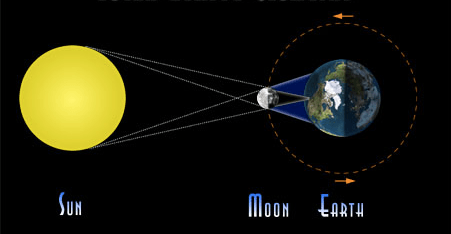
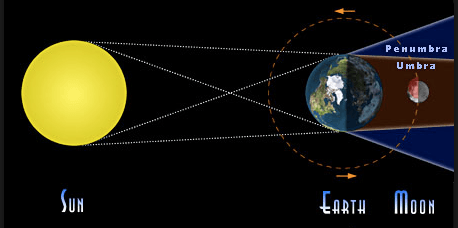
What is the LIGHTER part of the shadow cast by Earth or Moon during an eclipse?
umbra
penumbra
corona
What is the DARKER part of the shadow cast by Earth or Moon during an eclipse?
umbra
penumbra
corona

What does amoeba use for locomotion?
cilia
flagellum
pseudopods
feet
Which basic function of life is demonstrated by a single-celled organism using cilia, flagella, or pseudopodia?
growth
movement
homeostasis
respond to stimuli
Which statement describes all protists?
They have nuclei.
They are multicellular.
They are unable to move on their own.
They can be seen with the unaided eye.


Protists classified by how they obtain energy are:
Cilia, Flagella, and Pseudopod
Fungi-like, Plant-like, and Animal-like
Photosynthesis, Mitochondria, Cytoplasm
An organism’s ability to maintain stable internal conditions is called
taxonomy.
evolution.
development.
homeostasis.
A structure that is found in plant cells but not in animal cells is a
cell wall.
nucleus.
cell membrane.
nuclear envelope.
Which of the following is NOT one of the four kingdoms of eukaryotes?
fungi.
archaea.
protists.
plants.
If the amount of food resources increases, the population of an animal would
increase
decrease
stay the same
go extinct
The largest amount that an environment can support
limiting factor
carrying capacity
ecosystem
population
environmental factors that cause a population to stop growing or decrease in size
carrying capacity
limiting factor
ecosystem
community


Groups of cells with similar functions.
Organs
Molecules
Tissues
Organelles

Group of tissues with similar functions.
Organelles
Cells
Tissues
Organs

Group of organs with similar functions.
Organism
Cell
Organ
System
Any single living individual, and can refer to a single human, animal, plant,
Protista, bacteria, or fungi.
Community
Cell
Population
Organism


Which color would an extremely hot star be?
orange
yellow
red
blue
A giant body of hot gases that is held together by gravity and produces its own light is
a planet.
a nebula.
a star.
a comet.
The color of a star depends on its
size.
temperature.
shape.
magnitude.
Felix examined several photos of stars. To compare their temperatures, he looked at the colors of the stars. He organized the photos in order from coolest to hottest. Which of these answers shows the correct order?
red, yellow, white, blue
white, blue, yellow, red
yellow, white, blue, red
blue, yellow, white, red
Where is the asteroid belt found?
Between Earth and Mars
Between Uranus and Neptune
Between Mercury and Venus
Between Mars and Jupiter
What planet has a very hot surface and is most like Earth in size?
Venus
Mercury
Mars
Uranus
What is the correct order of the planets in the Solar System, starting closest to the Sun?
Mars, Mercury, Earth, Venus, Jupiter, Saturn, Uranus, Neptune,
Mercury, Venus, Earth, Mars, Jupiter, Saturn, Uranus, Neptune
Mercury, Mars, Venus, Earth, Jupiter, Saturn, Uranus, Neptune,
Mercury, Venus, Earth, Mars, Jupiter, Neptune, Uranus, Saturn
What do Mercury, Venus, Earth, and Mars all have in common?
They are all very cold planets.
They are considered terrestrial planets, that is rocky or have metals with hard surface.
They are about the same size.
They are considered gas giants
The inner planets are also called a
Gas giants
Terrestrial planets
Large planets
Asteroid
Name for region containing all 8 planets, the sun, asteroids, and other celestial objects?
The Solar System
The Degoba System
Asteroid Belt
Kuiper Belt system
The sun is a...
planet
star
comet
asteroid
What is the object that all planets in our solar system orbit?
The moon
The sun
The Milky Way
Mercury
The inner and outer planets are separated by the __________.
asteroid belt
moon
comets
dwarf planets

What planets are these?
Inner(Rocky) Planets
Outer(Gas Giants) Planets

These planets are the?
Inner(Rocky) planets
Outer(Gas Giants) planets
What planet has thousands of beautiful, tiny rings made of chunks of ice and rock?
Jupiter
Saturn
Uranus
Neptune
What planet is closest to the sun?
Neptune
Mercury
Mars
Venus

A piece of rock that did NOT burn up in the atmosphere and LANDED on Earth _____ .
Meteorite
Shooting Star
Meteor
Asteroid
the closest planet to the Sun, very cold on one side and very hot on the other, smallest planet, and no moons. This is the smallest planet in our solar system
Moon
Meteor
Uranus
Mercury

