
Font size
 Worksheets
Ducksters Physics Final - Motion, Work and Energy Units
Total questions: 130
Worksheet time: 1hrs 5mins
direction
MASS
Scalar
Vector
A number value

What is the resultant of the two vectors shown above?
+5
-5
+15
-15

What is the net force?
balanced
unbalanced
kinetic energy
friction
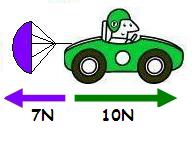
Using vector addition, what is the net force?
3 N
3 N, right
17 N, right
3 N, left
Mass is the measure of how much ______ is in an object.
Density
Weight
Matter
Gravity
Force
Weight is the measure of the force of ______ on an object.
Density
Mass
Matter
Gravity
Velocity
What unit of measurement is used for mass in physics?
Liters
Kilograms
Meters
Kelvins
Newtons
What unit of measurement is used for weight in physics?
Liters
Kilograms
Meters
Kelvins
Newtons
Finish the formula: Force = Mass * _________
Velocity
Weight
Acceleration
Temperature
Momentum
What is the weight of a 1kg mass object on planet Earth?
1 pound
1 Newton
5 Newtons
9.8 Newtons
9.8 pounds
The sum of all forces acting on an object and direction is called the
Balanced Force
Net Force
Unbalanced Force
Contact Force
A push/pull exerted on an object is called
Force
Momentum
Speed
Net force

Are the forces balanced or unbalanced?
Balanced
Unbalanced
A Newton is a unit of ______.
Acceleration
Inertia
Force
Velocity

Name the missing force.
Gravitational Force
Normal Force
Tension Force
Friction Force
The force that keeps objects on top of surfaces instead of letting them sink into the surface is known as:
Normal Force
Gravitational Force
Friction Force
Air resistance
A rightward force is applied to a dresser to accelerate it to the right across the bedroom floor.


What is the magnitude and direction of the force in the free body diagram shown?
70 N right
70 N left
50 N right
50 N left
What is the unit of measurement used in physics for speed?
Seconds
Seconds per meter
Meters
Meters per second
Hours per mile
Complete the formula: Speed = ______/Time. What is the ______?
Mass
Distance
Direction
Temperature
Weight
If a person runs 100 meters in 10 seconds, what is their average speed?
1 m/s
2 m/s
5 m/s
10 m/s
100 m/s
If a car travels 18,000 meters in 30 minutes, what is its average speed?
1 m/s
6 m/s
10 m/s
60 m/s
600 m/s
Acceleration is the rate of change of an object's _______.
Speed
Force
Velocity
Momentum
Mass
What is the standard unit of measurement for acceleration?
Meters
Meters per second
Seconds per meter
Meters per second squared
Meters per second cubed
According to Newton's Second Law, mass times acceleration equals _______.
Weight
Force
Distance
Time
Velocity
Which of the following formulas is used to find acceleration?
a = F/m
a = m/F
a = Fm
a = mv
a = F/v
An object with constant acceleration will have an increasing _______.
Mass
Weight
Direction
Velocity
Atomic weight
True or False: Assuming no air friction, an object in freefall would have constant acceleration.
TRUE
FALSE
If the velocity of an object changed from 30 m/s to 60 m/s over a period of 10 seconds, what would the average acceleration be?
1 meters per second squared
3 meters per second squared
6 meters per second squared
30 meters per second squared
33 meters per second squared
What is another term used for negative acceleration?
Velocity
Speed
Direction
Force
Deceleration
How much gravity an object has depends on its _______.
Weight
Speed
Momentum
Mass
Acceleration
Which of the following has the strongest gravitational pull?
A bowling ball
A car
The Earth
The planet Mars
The Sun
When will gravity be the strongest?
The further away you are from an object
The closer you are to an object
The faster your relative speed is to an object
All of the above
None of the Above
True or False: Gravity helps the Earth to stay in orbit around the Sun.
TRUE
FALSE
What do we call the force of gravity on an object?
Weight
Mass
Speed
Acceleration
Velocity
True or False: The more mass an object has, the faster it will fall.
TRUE
FALSE
What natural phenomena occurs on Earth due to the gravity of the Moon?
Earthquakes
Hurricanes
Volcanic eruptions
Thunder storms
Ocean tides
Where would you weigh the most?
Mars
Pluto
Earth
The Sun
The Moon
3 min is how many seconds, if 1 min = 60secs?
60 s
.05 s
180 s
There is no answer
Friction is a force that acts in the ______ direction of the intended motion of an object.
Same
Parallel
Opposite
Northern
None of the Above
Friction changes the energy of an object from kinetic energy to _____ energy.
Electric
Stored
Solar
Heat
Wind
In what way can friction be reduced?
Using grease
Using a wheel
Using oil
Using a ball
All of the above
The measurement of the amount of friction a surface will generate is called the '______ of friction'.
Calibration
Coefficient
Smoothness
Description
Fact
A block sitting still on the side of a ramp is an example of what type of friction?
Dry friction
Rolling friction
Fluid friction
Static Friction
None of the Above
In what way does friction help us in our everyday life?
Brakes on a car
Standing up
Climbing a hill
Skiing down a slope
All of the above
A ______ is anything that can change the state of motion of an object.
Mass
Force
Weight
Velocity
Temperature
Which of the following is the First Law of Motion?
The greater the mass of an object, the more force it will take to accelerate the object
Any object in motion will continue to move in the same direction and speed unless forces act on it
For every action, there is an equal and opposite reaction
Which of the following is the Second Law of Motion?
The greater the mass of an object, the more force it will take to accelerate the object
Any object in motion will continue to move in the same direction and speed unless forces act on it
For every action, there is an equal and opposite reaction.
Which of the following is the Third Law of Motion?
The greater the mass of an object, the more force it will take to accelerate the object
Any object in motion will continue to move in the same direction and speed unless forces act on it
For every action, there is an equal and opposite reaction
Which law of motion says that the harder you kick a ball, the farther it will go?
First Law of Motion
Second Law of Motion
Third Law of Motion
Which law of motion says that when you kick a ball, there is an equal force on your foot as there is on the ball?
First Law of Motion
Second Law of Motion
Third Law of Motion
Which law of motion says that a kicked ball would fly forever if it wasn't for forces like air friction and gravity?
First Law of Motion
Second Law of Motion
Third Law of Motion
How many basic types of simple machines are there?
2
3
5
6
10
A slide and a ramp are examples of what type of simple machine?
Lever
Wheel and Axle
Pulley
Inclined plane
Screw
What type of simple machine uses a wheel with a groove in it for a rope?
Lever
Wheel and Axle
Pulley
Inclined plane
Screw
What type of simple machine is an inclined plane wrapped around a pole?
Lever
Wheel and Axle
Pulley
Wedge
Screw
An axe and a chisel are examples of what type of simple machine?
Lever
Wheel and Axle
Wedge
Inclined plane
Screw
What simple machine multiplies force when a rigid object pivots on a fulcrum?
Lever
Wheel and Axle
Wedge
Inclined plane
Screw
What type of energy is stored energy?
Kinetic energy
Electrical energy
Potential energy
Nuclear energy
Radiant energy
What type of energy is generated by the movement of electrons?
Kinetic energy
Electrical energy
Potential energy
Nuclear energy
Radiant energy
What type of energy do we get from the rays of the sun?
Kinetic energy
Electrical energy
Potential energy
Nuclear energy
Radiant energy
What type of energy can be generated by splitting atoms?
Kinetic energy
Electrical energy
Potential energy
Nuclear energy
Radiant energy
What type of energy comes from movement or motion?
Kinetic energy
Electrical energy
Potential energy
Nuclear energy
Radiant energy
What is the standard unit of measurement for energy in physics?
Ampere
Volt
Newton
Joule
Watt
The 'Law of ________ of Energy' says that energy is never created or destroyed, it just changes states.
Induction
Reduction
Conservation
Production
Generation
What type of energy source will eventually run out?
Renewable
Nonrenewable
All of the above
None of the above
Which of the following is a renewable energy source?
Solar power
Wind power
Hydropower
All of the above
None of the Above
What type of energy source is generated by hot springs and geysers?
Solar power
Wind power
Hydropower
Tidal power
Geothermal power
Kinetic energy can be calculated from what two measurements?
Mass and power
Velocity and mass
Acceleration and weight
Speed and momentum
Acceleration and velocity
What is the standard unit of measurement for kinetic energy?
Ampere
Volt
Newton
Joule
Watt
Potential energy is the energy an object has due to its ________.
Position
Weight
Mass
Gravity
Motion
Where would a car traveling on a roller coaster have the most potential energy?
At the bottom
Halfway to the top
At the top
Halfway to the bottom
It is always the same
What would happen to the kinetic energy of an object if you doubled the mass?
The kinetic energy would be cut in half
The kinetic energy would double
The kinetic energy would triple
It would stay the same
If a plane was traveling at the same velocity as a bird, which would have the most kinetic energy (assuming the plane has more mass)?
Plane
Bird
They have the same amount of kinetic energy
If a 2 kg ball is traveling at 4 meters per second, what is its kinetic energy?
1 J
2 J
4 J
8 J
16 J
Where does a car on a hill have the most potential energy?
Top of the hill
Bottom of the hill
Half way down the hill
It has the same potential energy at all points
Gravitational potential energy is the potential energy of an object based on its __________.
Weight and velocity
Height and acceleration
Height and mass
Mass and speed
Speed and height
Which of the following formulas is used to find gravitational potential energy?
GPE = m * g/h
GPE = 1/2 * m * h2
GPE = w * g * v
GPE = m * g * h
GPE = m/g *1/2*h2
What is the gravitational potential energy of a 1 kg ball that is 2 meters above the floor? Use g = 10 m/s2
3 J
10 J
20 J
21 J
30 J
If a red ball is higher than a blue ball and both balls have the same mass, which ball has more potential energy?
Red ball
Blue ball
They both have the same potential energy
If a 2 kg rock has 196 J of gravitational potential energy, how high is it? Use g = 10 m/s2 You will need to round your answer
1 meter
2 meters
5 meters
10 meters
20 meters
In physics, work occurs when a _____ acts on an object to move it some distance from the start point.
Voltage
Power
Force
Velocity
Energy
What two measurements are needed to calculate work?
Velocity and distance
Time and distance
Mass and Force
Force and distance
Distance and mass
What is the standard unit of measurement for work?
Ampere
Volt
Newton
Joule
Watt
What do we call the distance between the start point and the end point?
Displacement
Line of force
Motion
Replacement
Movement
If you spend 1 hour pushing as hard as you can on a wall, but the wall doesn't move. How much work have you done?
0 J
1 J
6 J
60 J
100 J
Which of the following is the correct formula to calculate work?
W = F * t
W = m * g * h
W = 1/2 * F * d
W = 1/2 (F * d * t)
W = F * d
A player kicks a ball with a force of 5 N. The ball travels 10 meters. What is the total work?
0 J
5 J
50 J
500 J
1000 J
Power in physics is the rate at which _____ is used.
Current
Speed
Energy
Velocity
Force
To calculate power, we use the formula: Power = Work divided by ______.
Velocity
Force
Distance
Time
Acceleration
What is the standard unit of measurement for power?
Ampere
Volt
Newton
Joule
Watt
Will you use more power running up the stairs or walking up the stairs?
Running up the stairs
Walking up the stairs
The same in both
What is the equation used for calculating power from force and velocity?
Power = force/velocity
Power = force * velocity
Power = force + velocity
Power = velocity/force
Power = 1/2 (force * velocity)
If it takes 10 J of work to move a rock 15 meters in 5 seconds, what is the power?
1 W
2 W
50 W
150 W
200 W
If it takes 50 J of work to climb a set of stairs, how fast would you have to climb them to use 5 Watts of power?
2 seconds
5 seconds
9 seconds
10 seconds
50 seconds
Momentum is the measurement of _____ in motion?
Time
Mass
Work
Power
Energy
What letter is typically used to represent momentum in physic equations?
m
w
v
b
p
Finish the formula: Momentum = Mass * _________
Velocity
Acceleration
Voltage
Power
Work
What do we call it when two or more moving objects exert forces on each other for a short period of time?
Momentum
Work
Collision
Friction
Energy
Which of the following is true about collisions according to the Law of Momentum Conservation?
The total momentum of the objects must remain the same
The momentum of each object must stay the same
Some momentum will be lost
All of the above
None of the Above
If a 70kg man and a 40k boy are both running at the same velocity, who has more momentum?
The boy
The man
They both have the same momentum
What is the momentum of a 3 kg ball moving at the velocity of 5 m/s east?
3 kg m/s east
5 kg m/s west
15 kg m/s west
15 kg m/s east
0 kg m/s
If a ball is moving at the velocity of 10 m/s east with a momentum of 50 kg m/s east, what is its mass?
1 kg
2.5 kg
5 kg
25 kg
500 kg
Finish the formula: Pressure = Force divided by _________
Time
Area
Speed
Distance
Mass
What is the standard unit of measure for pressure?
Joule
Newton
Watt
Ampere
Pascal
Will air pressure be higher on top of a mountain or on the beach?
Beach
Mountain
It's always the same.
What pressure will be exerted by a 10 N box that has equal sides of 1 meter?
1 Pa
2 Pa
5 Pa
10 Pa
20 Pa
A red cube with sides of 3 meters and a blue cube with sides of 2 meters are on a table. They both weigh the same. Which cube exerts more pressure on the table?
Red cube
Blue cube
Both are the same
Does water pressure increase or decrease the deeper you are?
Increase
Decrease
Stays the same
What type of tool is used to measure air pressure?
Pascalometer
Atmospherometer
Aerometer
Anemometer
Barometer
Which of the following is not a unit of measure for pressure?
PSI
Bar
Atmosphere
Joule
Pascal
In physics, pressure is defined as the _____ over a given area.
Work
Velocity
Force
Mass
Energy
Heat is the transfer of _____ from one object to another due to a difference in temperature.
Time
Energy
Force
Velocity
Current
Which of the following is a unit of measurement for heat?
Calorie
BTU
Joule
All of the above
None of the Above
True or False: Heat and temperature are the same thing.
TRUE
FALSE
What is it called when two objects touching each other eventually reach the same temperature?
Expansion
Conduction
Equilibrium
All of the above
None of the Above
What is it called when heat transfers from one object to another?
Induction
Expansion
Equilibrium
Deduction
Conduction
Which of the following is not a good conductor of heat?
A steel pan
Copper wire
A blanket
An iron rod
Metal
In what state of matter is the temperature of water the lowest?
Solid
Liquid
Gas
The temperature doesn't matter
In physics, temperature is the average ______ of the moving particles in a substance.
Potential energy
Electric energy
Nuclear energy
Kinetic energy
Potential force
What device is used to measure temperature?
Barometer
Thermometer
Anemometer
Multimeter
Voltmeter
Do most substances expand or contract as they get hotter?
Expand
Contract
Stay the same
Which temperature scale uses absolute zero as the 0 point of its scale?
Celsius
Fahrenheit
Kelvin
All of the above
None of the above
Which temperature scale is the most common throughout the world?
Celsius
Fahrenheit
Kelvin
All of the above
None of the above
Which temperature scale is the most commonly used in the United States?
Celsius
Fahrenheit
Kelvin
All of the above
None of the above
Which temperature scale uses the freezing point of water as the 0 point and the boiling point of water as the 100 point?
Celsius
Fahrenheit
Kelvin
All of the above
None of the above
What is the coldest temperature possible?
Total zero
Freezing point
Complete zero
Absolute freezing
Absolute zero

