
Font size
 Worksheets
Unit 5 Chemical Reactions Review
Total questions: 65
Worksheet time: 3hrs 1mins
What type of reactions is this:
C3H8 + O2 --> H2O + CO2
Synthesis (combination)
Decomposition
Single replacement
Combustion
_CF4 + _Br2 -- _CBr4 + _F2

Which examples have signs of a physical change?
1,4,5
2,3,6
1,2,6
2,4,6
Due to the Law of Conservation of Matter, will FeS be equal, less, or more than Fe + S?
less
more
equal
What happens to the properties during a chemical change?
The properties stay the same.
The properties change.
What happens in ALL chemical changes?
Change in state of matter
A new substance is formed
Bubbles are produced
An explosion
The Law of Conservation of Mass tells us matter can't ______________.
change color
change state of matter
be created or destroyed
change temperature
Which is a Chemical property?
Thermal Conductivity
Density
Malleability
Flammability
Which of the following is a chemical property of water?
Reacts with pure sodium.
Boils at 100 oC.
Dissolves sugar easily.
Has a density of 1 gm/mL

Which property is on the wrong side?
Density
Melting Point
Reactivity
Solubility

Which is a physical change?
1
2
3
4
5
In this equation 2NaF + Br2 →2NaBr +F2
The underlined part represents...
Products
Reactants
Energy
What reaction has the following general formula:
AB --> A + B
Combination
Decomposition
Single Replacement
Double Replacement
Combustion
What reaction has the following general formula:
A + CD --> C + AD
Combination
Decomposition
Single Replacement
Double Replacement
Combustion
K + HCl -->
Fe + CuSO4 -> Cu + FeSO4
H2O + CO2 → HCO + HO
What are the predicted products of this reaction? Copper (II) is the form used in this reaction.
Cu+ AgNO3-->
Cu(NO3)2+Ag
CuNO3 + Ag
CuAg+NO3
Cu+ AgNO3

How many grams of Mg were reacted?
0 g
15 g
30 g
45 g

What type of reaction is shown?
Synthesis
Decomposition
Single Displacement
Double Displacement
Example: H2
Ex: 2H2 + O2 --> 2H2O
4. A(n) _____________ is a characteristic of matter that can be observed as it changes to a different type of matter.
A. chemical change
B. chemical property
C. chemical equation
D. energy change

Which of the following shows signs of a chemical reaction?
a colorless liquid and a gray solid are mixed to produce a gas and a green liquid.
liquid water is boiled to produce steam.
large brown rocks are ground into smaller pieces to produce a brown powder.
water is added to a dark blue liquid to produce a light blue liquid.

A student pours two different liquids into a glass beaker. Which of the following would indicate that a chemical reaction occurred between the two liquids?
an increase in total mass of the liquids.
a decrease in total volume of the liquids.
the formation of a solid in the beaker.
the complete mixing of the two liquids.

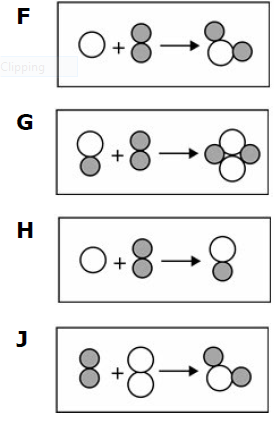
Which of the following demonstrates conservation of atoms?


Which of the following statements is correct?
In a chemical reaction, the total mass of the products is more than the total mass of the reactants.
In a chemical reaction, the total mass of the products is less than the total mass of the reactants.
In a chemical reaction, the total mass of the products is equal to the total mass of the reactants.
In a chemical reaction, the total mass of the products is unrelated to the total mass of the reactants.
Fe + S --> FeS

Which of the following is an example of a precipitate?
liquid evaporating into gas
a solid formed from a frozen liquid
a chunky solid formed from two liquids combining
a liquid solution that contains two substances

Which student correctly recorded all the changes that took place?


The table below describes two experiments.
Experiment 1 shows a physical change because no new substances were produced, and experiment 2 shows a chemical change because a new substance was produced.
Experiment 1 shows a chemical change because bubbles were produced, and experiment 2 shows a physical change because a liquid turned into a solid.
Experiments 1 and 2 show chemical changes because bubbles were produced.
Experiments 1 and 2 show physical changes because no new substances were produced.
What is the difference between a chemical change and a physical change?
A physical change creates a new substance, a chemical change does not.
A chemical change creates a new substance, a physical change does not.
A chemical change makes the substance look different but a physical change does not.
A physical change makes the substance change color where a chemical change does not.
If 20g of sugar is stirred into a beaker containing 100g of water. What would the mass of the dissolved solution be after the sugar is dissolved fully?
20g
100g
80g
120g

How many oxygen atoms are in this chemical formula?
6 oxygen atoms
2 oxygen atoms
3 oxygen atoms
4 oxygen atoms
Which of the following changes is a physical change of matter?
water evaporating
paper burning
a nail rusting
a silver spoon tarnishing
Mg + CuCl2 -->
What is oxidation number of P?
-3
What is the oxidation number of S ?
What is the oxidation number of Ca?
What is oxidation number of Manganese (II) ?

