
 Worksheets
PRACTICE Microscopes Test
Total questions: 56
Worksheet time: 41mins
What are microscopes used for?
To observe tiny objects, such as cells
To determine the mass of tiny objects, such as cells
To make larger objects appear smaller
To measure the volume of cells
Which microscope would be best to observe three-dimensional living organisms?
A dissecting microscope
A light microscope
An electron microscope
No microscope can observe living, three dimensional organisms
Which types of microscopes can observe both living and dead specimens? (select all correct options)
A dissecting microscope
A light microscope
An electron microscope
No microscope can observe both living and dead specimens.
Which type of microscope can magnify a specimen up to 10,000,000 times?
A dissecting microscope
A light microscope
An electron microscope
Both a light microscope and an electron microscope
Which part of the microscope magnifies a specimen?
The body tube
The objectives
The stage
The diaphragm
Which part of a light microscope should you turn to view a specimen with a different objective?
The body tube
The coarse adjustment
The fine adjustment
The nosepiece
Which part of a light microscope controls the amount of light passing through a specimen?
The eyepiece
The stage
The diaphragm
The fine adjustment
Which parts of a light microscope should you hold when carrying it?
The eyepiece and base
The arm and stage
The arm and base
The stage and coarse adjustment
What should you use to clean the lenses of a microscope?
A sponge
A wet paper towel
Lens paper
All of the above
What happens to the size of the field of view as the magnification increases?
The field of view gets bigger
The field of view gets smaller
The size of the field of view doesn't change
How can you minimize the bubbles under the coverslip when preparing a specimen to view with a light microscope?
Press the coverslip over the specimen and against the slide
Quickly drop the coverslip over the specimen
Slowly lower the coverslip over the specimen
Do not use a coverslip

How should you move the slide to center the specimen in the field of view?
Move the slide to the left
Move the slide to the right
Move the slide upward
Move the slide downward

How should you move the slide to center the specimen in the field of view?
Move the slide to the left
Move the slide to the right
Move the slide upward
Move the slide downward

How should you move the slide to center the specimen in the field of view?
Move the slide to the left
Move the slide to the right
Move the slide upward
Move the slide downward

How should you move the slide to center the specimen in the field of view?
Move the slide to the left
Move the slide to the right
Move the slide upward
Move the slide downward
Through which objective should you first look when focusing a specimen?
The scanning objective (4x)
The low power objective (10x)
The high-power objective (40x)
It doesn't matter what objective you first use to look at a specimen
What happens to the amount of light that passes through the lenses of the microscope as the magnification increases?
It increases
It decreases
It doesn't change
What adjustment(s) should you use when observing a cell with the scanning objective (4x)?
Only the fine adjustment
Only the coarse adjustment
The coarse adjustment followed by the fine adjustment
The fine adjustment followed by the coarse adjustment
What is the purpose of a light microscope?
To clean lenses
To carry heavy objects
To control light
To study cells
Which part of a light microscope holds the objectives and can be rotated to change them?
Nosepiece
Stage
Body tube
Eyepiece
Why is it important to use a microscope on a solid and sturdy surface?
To control light
To increase magnification
To clean lenses
To prevent accidents
What should be used to clean microscope lenses?
Cloths
Lens cleaning paper
Paper towels
Water
Which adjustment should you avoid using when using the high-power objective?
Light source adjustment
Diaphragm adjustment
Fine adjustment
Coarse adjustment
What should you do if a slide or coverslip breaks?
Touch the broken glass
Leave it as it is
Throw it away
Inform Mrs. Martin immediately.
What is the purpose of the diaphragm in a light microscope?
To hold the objectives
To control light
To clean the lenses
To support the specimen
What is the function of the fine adjustment knob on a light microscope?
To move the stage up and down
To rotate the objectives
To control the light intensity
To focus the specimen
What would happen if the nosepiece of a light microscope did not rotate?
The specimen would not be illuminated.
The objectives would not change.
The stage would not move.
The eyepiece would not work.
What is the most important rule to follow when carrying a light microscope?
Carry it with one hand
Swing it while carrying
Hold it upside down
Carry it with two hands
Why do scientists use microscopes? (Select all correct answers.)
To visualize cells and their structures.
To study insects.
To magnify dead specimens.
To observe multicellular organisms.
What is used to produce an image with a dissecting microscope?
Light
Glass slide
Tissue slices
Electron beam
What is used to produce an image with an electron microscope?
Light
Glass slide
Tissue slices
Electron beam
What is used to produce an image with a light microscope?
Light
Glass slide
Tissue slices
Electron beam
Which microscope is used to observe cell parts and large protein molecules inside cells?
Scanning electron microscope
Transmission electron microscope
Light microscope
Dissecting microscope
Which part of the microscope moves the stage up and down for focusing and locates the specimen?
Coarse adjustment knob
Arm
Stage clips
Ocular lens

Identify the part labeled as number 1.
Stage
Eyepiece (ocular lens)
Body tube
Diaphragm

Name the part: Number 2
Base
Eyepiece (ocular lens)
Nose piece
Diaphragm

Name the part: Number 3
Scanning objective lens (4x)
Low power objective lens (10x)
High power objective lens (40x)
Oil immersion lens (100x)

Name the part: Number 4
high power objective lens (40x)
scanning objective lens (4x)
low power objective lens (10x)
oil immersion lens (100x)

Name the part: Number 5
scanning objective lens (4x)
low power objective lens (10x)
oil immersion lens (100x)
high power objective lens (40x)

Name the part: Number 6
Arm
Fine adjustment knob
Stage clips
Mirror

Name the part: Number 7
Base
Diaphragm
Eyepiece (ocular lens)
Objective lenses
Identify the part labeled as number 8.
Base
Light source
Eyepiece (ocular lens)
Objective lenses

Name the part: Number 9
diaphragm
base
eyepiece (ocular lens)
objective lenses

Which part of the microscope is labeled 10?
Eyepiece (ocular lens)
Fine adjustment knob
Base
Arm

Which part of the microscope is labeled as 11?
banana
stage
slide
slip
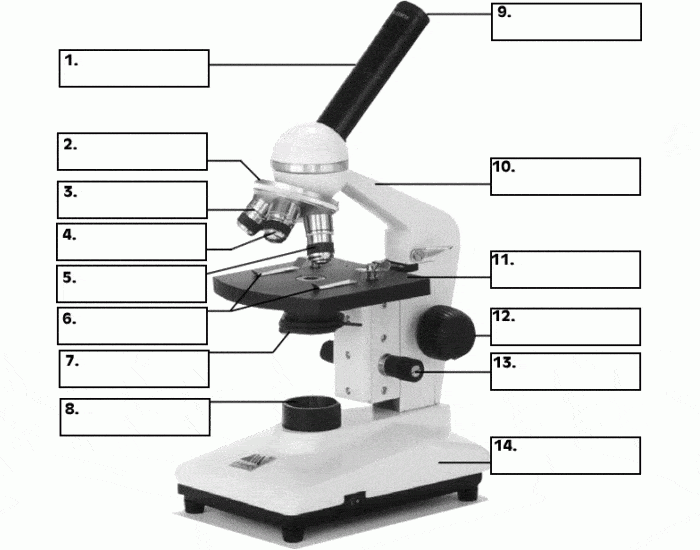
Which part of the microscope is labeled as 12?
Fine adjustment knob
Coarse adjustment knob
Diaphragm
Objective

fine adjustment knob
coarse adjustment knob
stage
diaphragm
Part 14
Fine adjustment knob
Coarse adjustment knob
Base
Diaphragm
Put the following rules in order of importance as given in your study materials (1 extra credit point).
Always carry the light microscope with two hands, one holding the arm and the other under the base.
Use a microscope on a solid and sturdy surface.
Only clean the lenses with the lens cleaning paper.
Do not use the coarse adjustment while using the high-power objective.
If a slide or coverslip breaks, do not touch the broken glass - ask Mrs. Martin for help.
You should always wear safety goggles when using a microscope.
True
False
Match the following
Arm
Side part that is used when carrying
Eyepiece
Look through this to view your specimen
Nose piece
Holds the objective lenses
Body tube
Connects the eyepiece to the objectives
Match the following
Base
The bottom part of the microscope
Objective lenses
Magnify the view of the specimen
Stage Clips
Holds the slide in place
Fine adjustment knob
Slightly moves the stage to adjust focus
Match the following:
Coarse adjustment knob
Moves the stage up and down quickly
Diaphragm
Adjusts the amount of light used
Mirrors/Light Source
Projects light through the specimen
Stage
Supports the slide that is being viewed
Using a 10x objective lens and your 10x eyepiece, what is the TOTAL MAGNIFICATION of your image?
100x
Using a 40x objective lens and your 10x eyepiece, what is the TOTAL MAGNIFICATION of your image?
100x

