
 Worksheets
Changes in the Geosphere
Total questions: 94
Worksheet time: 1hrs 29mins
The process that breaks down rocks and other substances on Earth's surface is called:
erosion
weathering
depostion
all of the above
Which process describes flood waters moving soil from one location to the other?
Weathering
Erosion
Deposition
Which process describes muddy water being carried away by a fast moving river?
Weathering
Erosion
Deposition
Which process describes glaciers scraping rocks across the earth's surface?
Weathering
Erosion
Deposition
Which process describes water getting into cracks, freezing, and breaking the rocks or pavement apart?
Weathering
Erosion
Deposition
Which process describes deltas forming at the mouths of rivers?
Weathering
Erosion
Deposition
Which process describes a mudslide flowing down a steep hill?
Weathering
Erosion
Deposition
Which process describes rain washing away soil from a hill?
Weathering
Erosion
Deposition
Which process describes layers of sediment forming at the bottom of the ocean?
Weathering
Erosion
Deposition
Which process describes waves dropping sand on the beach?
Weathering
Erosion
Deposition
Which process describes wind blowing sand from one place to another?
Weathering
Erosion
Deposition
Which process describes wind blasting sand at rock and carving out arches?
Weathering
Erosion
Deposition
Which process describes rocks being made smooth by tumbling across a streambed?
Weathering
Erosion
Deposition
Which process describes glaciers carrying rock and sand from one location to another?
Weathering
Erosion
Deposition
Which process describes a sand dune being formed by large amounts of sand dropped off by strong winds?
Weathering
Erosion
Deposition
Which process describes a sand bar being formed in the ocean when sand is dropped off by waves?
Weathering
Erosion
Deposition
What three cause slow change to the Earth?
Rock, Sand, Water
Lava, Ice, Sediment, and Glaciers
Weathering, Erosion and Deposition
True or False: The Earth's Surface is Always Changing.
True, weathering, erosion and deposition are always changing the earth's surface.
False, the Earth stays the same forever.
Wind blowing sand from one place to another.
Weathering
Erosion
Deposition

Several layers of rock are illustrated in their unchanged positions. Which of the following conclusions is supported by the data in this illustration?
Rock layer W is the oldest of all the rock layers shown.
Rock layer X was formed just before rock layer Y
Rock layer Y is twice as old as rock layer W.
Rock layer Z is the oldest of all the rock layers shown.

The Andes Mountains in South America contain dozens of fossils of marine animals. How might you have described the landscape of the Andes mountain area long ago? What type of environment was it long ago.
Marine animals lived on land.
The Andes Mountains once were under water.
The Andes Mountains were formed by an earthquake.

Look at the diagram.
Which fossil is the youngest?
A
B
C
D
Look at the diagram.
Which fossil is the oldest?
A
B
C
D

What was the environment for Layer W like?
A forest
Underwater
A desert
A jungle

What living things were fossilized in Layer N?
Dinosaurs
Monkeys
Fish
Plants

Which layer contains fossils of the most recent living organisms?
A
B
C
D
deposition
Which best describes the pattern of earthquakes and volcanoes?
Earthquakes and volcanoes often occur in the same place along boundaries of tectonic plates.
Volcanoes occur on land. Earthquakes occur in the ocean.
Earthquakes occur in the northern hemisphere. Volcanoes occur in the southern hemisphere.
There is no pattern that describes the locations of earthquakes and volcanoes.

April and her family are planning a hike. They study a topographic map of the hike. Which of the following does this topographic map show that will best help them plan their hike?
location of rivers
how wide the trail is
steepness of the trail
where the best views are
What is the Ring of Fire?
an area of earthquakes along the edges of the Pacific Ocean
an area of mountain ranges below the Atlantic Ocean
an area of volcanoes along the edges of the Pacific Ocean
an area of tsunamis along the Indian Ocean

Based on this map, which of the following places has many earthquakes?
the land area making up Australia
the middle part of the Pacific Ocean
the western part of Africa
along a line in the center of the Atlantic Ocean

What do the lines on this map represent?
volcanoes
easrthquakes
plate boundaries
travel routes

Volcanoes and earthquakes tend to occur near what?
mountains
islands
plate boundaries
fault lines

The map shows the location of a volcano. The winds in this area usually blow from west to east. The smoke and ash from a volcano can be blown great distances, and these are harmful to humans. Based on the information given, what is the safest location for humans to build a town?
A
B
C
D


The flat, vast deep-sea ocean floor is called
continental shelf
abyssal plain
ocean trench
erosion
Underwater mountains
Dunes
Deltas
Mountains
Seamounts

A steep drop-off at the edge of the continental shelf is ___________? Use the diagram to help answer the question.
continental shelf
continental slope
crust
continental crust

Label H is
Continental Shelf
Continental Slope
Seamount
Abyssal Plain

Label D is
Mid Ocean Ridge
Rift Valley
Abyssal Plain
Trench

Label F is
Rift Valley
Mid Ocean Ridge
Trench
Seamount

Label G is
Continental Shelf
Mid Ocean Ridge
Rift
Trench

Label B is
Trench
Abyssal Plain
Seamount
Rift Zone

Label A is
Continental Slope
Seamount
Ocean Basin
Rift

Label E is
Mid Ocean Ridge
Continental Shelf
Ocean Basin
Seamount
the sudden moving and shaking of a part of the Earth's crust
volcano
mountain
earthquake
ocean trench


Based on the picture on the left, which of the following is the oldest?
A
B
C
D


Which layer of rock is typically the oldest?
The top
The middle
The bottom
The thinnest


What is letter F pointing to?
continental slope
continental shelf
abyssal plain
sea mount
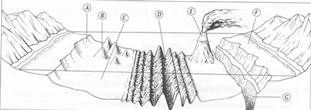
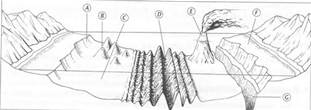
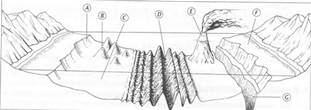
The flattest area of the ocean is known as the _________________________.
Rift Zone
Abyssal Plain
Mid-ocean Ridge
Subduction zone

Where are you walking when you are wading in the ocean?
Ocean Trench
Abyssal Plain
Continental Slope
Continental Shelf
This mushroom rock is created by erosion.
What formed the mushroom rock?
Wind Erosion
Water Erosion
Vegetation Erosion
Ice Erosion
Your science teacher was modeling a type of erosion for you and your classmates to better understand. She used the following materials: an aluminum tin, soil, forks and a watering can filled with water. What type of erosion was she modeling?
Ice Erosion
Wind Erosion
Water Erosion
Vegetation Erosion
Deltas are created when sediment is deposited at the mouth of a river. Which process is this?
Erosion
Weathering
Vegetation
Deposition

What has MOST LIKELY caused a change in the soil in the wheat field shown?
Weathering
Erosion
Deposition
All of the Above
A beach forms when waves deposit sand and gravel along the shoreline. What is the name of this process?
Weathering
Erosion
Deposition
None of the Above

What type of environment was this fossil from?
Ocean
Forest
Grassland
Tundra
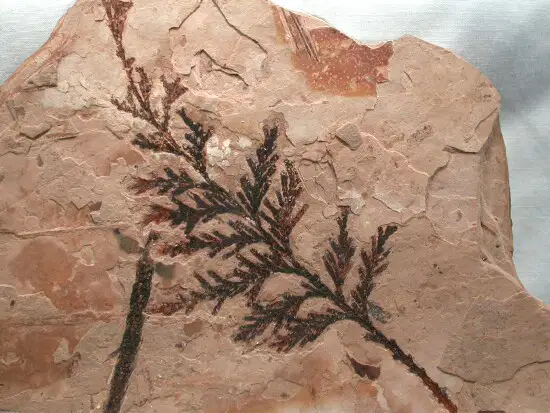
What type of environment was this fossil from?
Ocean
Tundra
Forest
What oceanic landform is similar to the continental landform called a mountain range?
rift
valley
mid-ocean ridge
seamount
What oceanic landform is similar to the continental landform called a trench?
rift
valley
mid-ocean ridge
canyon
What natural disaster is defined as warm water, moist air, great wind speed?
hurricane
tornado
earthquake
landslide
What natural disaster is defined as tectonic plates slide or slip under each other?
tornado
tsunami
landslide
earthquake
What would be the effect on the landscape if the river is running quickly at a steep angle slant?
There would be less erosion since the river is going faster.
There would be less erosion since the river is going slower.
There would be more erosion since the river is going faster.
There would be more erosion since the river is going slower.
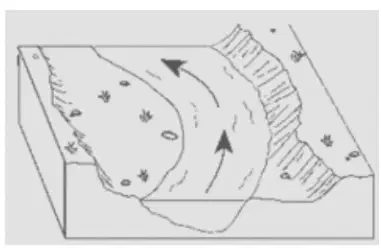
The diagram below shows a section of a meander in a stream. The arrow shows the direction of stream flow. The stream bank on the outside of this meander is steeper than the stream bank on the inside of this meander because the water on the outside of the meander is moving ________________________ .
faster
slower
not moving at all
none of the above

