Wayground logo

Free Printable Worksheets

Font size

S
M
L
XL
Worksheets

Revision Form 2

Total questions: 100

Worksheet time: 2hrs 59mins

Name
Class
Date
1.
  1. Heat is a form of __________________ .
a)

length

b)

energy

c)

degree of hotness

2.

SI unit for temperature is ______________________

a)

Celsius

b)

Fahrenheit

c)

kelvin

3.

Temperature can be measured by using a ___________________________

a)

hot water beaker

b)

thermometer

c)

thermostate

4.

A beaker of water with higher temperature shows the heat energy is __________________________ by ice cubes that are melting in the water.

a)

released

b)

increasing

c)

absorbed

d)

the same

5.

Two beakers, beaker A and beaker B with same volume of water shows the temperature of water in beaker B is higher than beaker A. Therefore the quantity of heat energy in beaker _______ is higher.

a)

B

b)

A

6.

When a beaker of water is heated, the heated water __________ above and the cold water _______________ .

a)

move down, rises

b)

move around, rises

c)

rises, rises

d)

rises, moves down

7.

CONVECTION , Heat is transferred by the movement of fluid. The liquid and gases particles that receive heat energy will __________________ , become less dense and _______________ .

a)

collide more frequently , expand

b)

expand, move faster

c)

be hot, contract

8.

RADIATION . The process of transferring heat without any medium. Heat can propagate through an empty space or ______________ .

a)

air

b)

liquid

c)

solid

d)

water

9.

Materials that allow heat flow are known as _____________________________________________

a)

conductor of electric

b)

conductor of light

c)

conductor of heat

10.

Thermal equilibrium occur when:

- when two objects are in thermal contact

- The heat energy is transferred from a higher temperature object to a ___________________

temperature object.

- finally the two objects will reach the same _______________________________

a)

higher, different

b)

lower, temperature

c)

temperature, lower

d)

lower, heat

11.

Objects will _________________ when they absorb heat energy.

a)

expand

b)

contract

12.

Objects will ________________ when they release heat energy.

a)

expand

b)

contract

13.

Why there is a gap between the metals ?

a)

to allow the trains to move better

b)

to prevent the railway track from cracking

c)

to allow the metal to expand during a hot day

d)

to loosen it during a hot day

14.

A dark and dull surface

a)

can absorb heat at a higher rate

b)

can absorb heat at lower rate

15.

A dark and dull surface

a)

release heat slower than white, shiny objects

b)

release heat faster than white, shiny objects

16.

A bimetallic strip consists of two types of metal strips that have different ________________________ when heated.

a)

sizes of metals

b)

colour of metals

c)

mass of metals

d)

rates of expansion

17.

_______________________ is a metallic liquid used in laboratory thermometers

a)

iron

b)

potassium

c)

mercury

d)

sodium

18.

The liquid in a thermometer must expand and contract _________________________ with temperature

a)

higher rate

b)

different rates

c)

uniformly

d)

faster

19.

The rate of absorption and release of heat depends on _________________________________ and surrounding ________________________________________ .

a)

temperature, heat

b)

type of surface, temperature

c)

type of surface, humidity

d)

material, room

20.

___________________ occur at night, the cool air from the land flows to the sea.

a)

sea breeze

b)

land breeze

21.

What happened when an object is heated ?

a)

The object expands

b)

The object contracts

22.

What happened when liquid is cooled ?

a)

The liquid expands

b)

The liquid contracts

23.

During a hot and sunny day, what colour of shirt is suitable for you to wear?

a)

Black

b)

White

c)

Any colour will be fine

24.

Which material is the best choice to make the handle?

a)

Rubber

b)

Iron

c)

Aluminium

d)

Copper

25.

Which of these is the best heat conductor?

a)
b)
c)
d)
26.

Heat is

a)

A form of energy

b)

A measure of degree of hotness

27.

Temperature is measured in ___________

a)

Joule

b)

Celcius

c)

Degree

d)

Kelvin

28.

The sun transfers heat to the earth through ___________.

a)

convection

b)

conduction

c)

radiation

29.

heat conductor __________ heat to flow through it.

a)

allows让

b)

does not allow

30.

hotter air is ______________

a)

denser

b)

less dense

31.

during the day, the _________ is hotter than the _________

a)

sea, land

b)

land, sea

32.

________________ has small gaps to let them expand in hot day.

a)

bridges

b)

thermometer

c)

railway tracks

d)

fire alarm

33.

In the fire alarm, the bimetallic strip __________ when heated.

a)

breaks

b)

bends

c)

expands

d)

contracts

34.

dark colour ___________ heat and light colour ___________ heat.

a)

absorbs, reflects

b)

reflects, absorbs

35.

vacuum is a __________ heat conductor.

a)

good

b)

poor

36.

A form of energy that flows from a hotter region to a colder region.

a)

Heat

b)

Temperature

37.

the measurement of the degree of hotness or coldness of an object.

a)

Temperature

b)

Heat

38.

take place in solid, heat is transferred through the vibrating particles that are in contact.

a)

Conduction

b)

Convection

c)

Radiation

39.

takes place in fluid and gas, heat is transferred by the moving of convection current.

a)

Conduction

b)

Convection

c)

Radiation

40.

take place is vacuum, heat flows in the form of electromagnetic waves

a)

Conduction

b)

Convection

c)

Radiation

41.
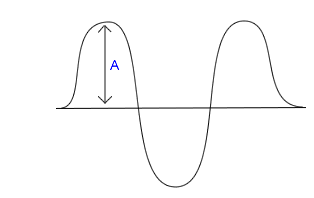
If the distance represented by the letter A were increased, how would it change the way the sound was heard?
a)
The sound would be higher. 
b)
The sound would be lower. 
c)
The sound would be softer. 
d)
The sound would be louder. 
42.
When comparing the two waves that are shown, how would Wave A (green wave) differ than Wave B (black wave)?
a)
Wave A and B have the same amplitude, but wave B (black) has a lower pitch.
b)
Wave A and B have the same amplitude, but Wave A has a lower pitch. 
c)
Wave A and B have the same pitch, but Wave A is a softer sound. 
d)
Wave A and B have the same pitch, but Wave B is a softer sound. 
43.
What does pitch depend on?
a)
amplitude 
b)
frequency
c)
intensity 
d)
volume of sound
44.
A wave with a large wavelength will have a ______ frequency and _____ energy
a)
high, low
b)
high, high
c)
low, high
d)
low, low
45.
When a sound is louder what measurement gets bigger?
a)
Frequency 
b)
Amplitude 
c)
Wavelength 
d)
Crest
46.
A wave that requires a medium through which to travel
a)
mechanical wave
b)
chemical wave
c)
electromagnetic wave
d)
pitch
47.
The number of wavelengths that pass a point each second
a)
crest
b)
amplitude
c)
frequency
d)
pitch
48.
The shorter the wavelength the 
a)
shorter the frequency
b)
higher the freuqnecy
c)
frequency stays the same
d)
less energy
49.
Sound is produced by
a)
music
b)
vibrations of molecules
c)
Electromagnetic Waves 
d)
Transverse Waves 
50.
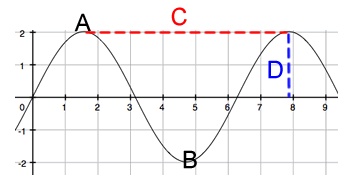
If distance C on the diagram increased, what would happen to the pitch? 
a)
The pitch would be louder. 
b)
The pitch would be softer. 
c)
The pitch would be higher. 
d)
The pitch would be lower. 
51.
Which feature of sound is determined by amplitude?
a)
Pitch
b)
Smoothness
c)
Loudness
d)
A Wave
52.
What is a pitch?
a)
highness or lowness of a sound
b)
the intensity of a vibration
c)
the amplitude of the sound wave
d)
volume of sound
53.
A disturbance that transfers energy from one place to another without transferring matter.
a)
wave
b)
trough
c)
pitch
d)
sound
54.
Sound is a form of _________________ that travels as waves through a ________________.
a)
light/ transparency
b)
energy/ vibration
c)
energy/ medium
d)
frequency/ medium
55.

A transverse wave is traveling through an unknown medium as shown in the diagram. How are the particles of the medium vibrating?

a)

parallel to the y-axis

b)

parallel to region R

c)

Parallel to the x-axis

d)

Parallel to Region Q

56.

Examine the wave.


Which region on this wave would correspond to rarefaction?

a)

W

b)

X

c)

Y

d)

Z

57.

A student listed some properties of waves.


Which properties did the student list incorrectly?

a)

3 and 2

b)

4 and 1

c)

2 and 4

d)

1 and 3

58.

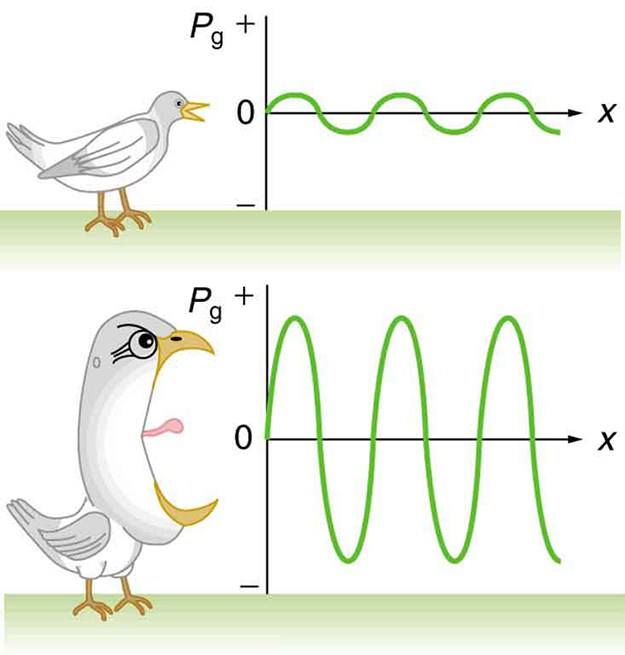
The diagram shows a cartoon of a sound wave produced while a student is speaking.


What happens to the sound wave when the student speaks louder?

a)

The amplitude increases

b)

the wavelength will double

c)

the speed will increase

d)

the amplitude will decrease

59.

What type of waves might experience rarefaction?

a)

rope rays

b)

x-rays

c)

Sound Waves

d)

infrared rays

60.

Through which medium is it impossible to transmit sound waves?

a)

space

b)

rock

c)

air

d)

water

61.
An ________ is a reflected sound.
a)
Vibration
b)
Echo
c)
Pitch
d)
Volume
62.
_____________ is the highness or lowness of a sound.
(Hint: Think about our sound song.)
a)
Amplitude
b)
Pitch
c)
Volume
d)
Vibration
63.
Sound is a form of energy produced by ______________.
a)
vibrations
b)
distances
c)
prisms
d)
Ms. Crews
64.
Sound waves travel the FASTEST through _____________.
a)
gases
b)
liquids
c)
solids
65.
Sound waves travel the SLOWEST through _____________.
a)
gases
b)
solids
c)
liquids
66.
How is sound produced?
a)
By the vibration of particles
b)
By the transfer of particles 
67.
The reflection of sound waves off of a hard surface can create ______.
a)
A wave
b)
An echo 
68.
Soft surfaces _______ sound waves. 
a)
Reflect
b)
Absorb
69.
___________ measures  how close or  far particles are.
a)
Amplitude
b)
Frequency 
70.
________ describes how LOUD a sound is. 
a)
Amplitude
b)
Frequency 
71.
____________ is determined by sound wave's frequency. 
a)
Compression
b)
Pitch 
72.
To make a sound from a stringed instrument louder you must
a)
hit it
b)
pluck it harder
c)
hold it higher
d)
pluck it softer
73.
The highest pitch is made by the _______ instrument.
a)
biggest
b)
wooden
c)
smallest
d)
shiniest
74.
We measure pitch in....
a)
Volume
b)
Decibles
c)
Amplitude
d)
Frequency
75.
When the car moves AWAY from you, its horn seems...
a)
Low pitched
b)
High pitched
c)
Normal
76.
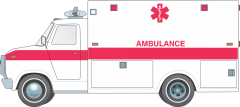
When an ambulance move TOWARD you it sounds ________ pitched. 
a)
high
b)
low
c)
medium
77.
The Doppler effect is seen when a wave-making source moves toward an observer. 
a)
True
b)
False
78.
The Doppler effect occurs when an observer moves towards a wave-making source. 
a)
True
b)
False
79.
What type of energy is stored in an object due to its high position?
a)
Gravitational potential energy
b)
Elastic potential energy
c)
Kinetic energy
d)
Electrical energy
80.
What type of energy is stored in an object that is compressed, stretched or bent?
a)
Gravitational potential energy
b)
Elastic potential energy
c)
Kinetic energy
d)
Electrical energy
81.
What is produced on a balloon after it is rubbed with a woolen cloth?
a)
Electrostatic charges
b)
Electric current
c)
Voltage
d)
Resistance
82.
What happens to a plastic ruler after it is rubbed with a woollen cloth?
a)
Transfer of electrons
b)
Transfer of protons
c)
Transfer of neutrons
d)
Chemical reaction
83.
What instrument can be used to detect electrostatic charges?
a)
Electroscope
b)
Telescope
c)
Microscope
d)
Periscope
84.
Which of the following statements about charges is TRUE?
a)
Same charges repel while opposite charges attract
b)
Same charges repel and opposite charges also repel
c)
Same charges attract and opposite charges also attract
d)
Same charges attract while opposite charges repel
85.
What is the result of the force of attraction that exists between the positive charges on the ground and the negative charges in the clouds?
a)
Lightning
b)
Thunder
c)
Whirlpool
d)
Cyclone
86.
What can be used to produce electric charges at high voltages?
a)
Van de Graaff generator
b)
Resistor
c)
Ammeter
d)
Voltmeter
87.
What type of charges are usually produced on the dome of the Van de Graaff generator?
a)
Positive
b)
Negative
c)
Neutral
d)
It's impossible to detect
88.
What is an ammeter used to measure?
a)
Electric current
b)
Voltage
c)
Resistance
d)
Magnetism
89.
What is a voltmeter used to measure?
a)
Electric current
b)
Voltage
c)
Resistance
d)
Magnetism
90.
What is the unit for electric current?
a)
Ampere
b)
Volt
c)
Ohm
d)
Tesla
91.
What is the unit for voltage?
a)
Ampere
b)
Volt
c)
Ohm
d)
Tesla
92.
What is the unit for resistance?
a)
Ampere
b)
Volt
c)
Ohm
d)
Tesla
93.
Which factor does NOT affect the resistance in an electric circuit?
a)
Surface area of the conductor
b)
Length of the conductor
c)
Type of conductor
d)
Diameter of the conductor
94.
Energy of motion is which type of energy?
a)
Potential
b)
Kinetic
c)
Sound
d)
Gravitational
95.
What kind of energy does this device use?
a)
Chemical
b)
Electrical
c)
Thermal
d)
Chemical
96.
Wind turbines and windmills convert (or change) what energy to another?
a)
Kinetic to electric
b)
Gravitational potential to electric
c)
Mechanical to potential
d)
Thermal to sound
97.
On a roller coaster, where is maximum (or most) potential energy?
a)
At the bottom of a big hill
b)
When going around a corner
c)
When going upside down
d)
At the top of a big hill
98.
When a soccer ball is on a field, the energy it has just before being kicked is called
a)
kinetic energy
b)
potential energy
c)
mechanical energy
d)
chemical energy
99.
The picture shows a microwave oven. As a microwave oven is operated, electrical energy is transformed into all of the following types of energy EXCEPT —
a)
solar
b)
light
c)
heat
d)
mechanical
100.
Potential Energy is:
a)
The energy of motion
b)
always conserved
c)
The energy due to position