wayground logo

Free Printable Worksheets

Font size

S
M
L
XL
Worksheets

HC U4 Ionic covalent Bonding Practice Test

Total questions: 73

Worksheet time: 4hrs 55mins

Name
Class
Date
1.

what is the name of CCl4?

a)

carbon tetrachloride

b)

monocarbon tetrachloride

c)

tetracarbon monochloride

d)

carbon chloride

2.

What is the name of the compound SO2

a)

Monosulfate oxide

b)

Sulfur Dioxide

c)

Monosulfur dioxide

3.

What is the name of the compound P2O5

a)

Pentaphosphorus dioxide

b)

Phoshphide dioxide

c)

Diphosphorus pentoxide

4.

What is the name for MgF2 ?

a)

magnesium fluoride

b)

manganese Phosphide

c)

magnesium(III) fluoride

d)

magnesium fluoride(II)

5.
What is the charge on the calcium ion?
a)
1+
b)
2+
c)
2-
d)
1-
6.
Which is a transition metal?
a)
cesium
b)
iron
c)
helium
d)
tellurium
7.
What is the name for the NO3- ion?
a)
nitrate ion
b)
nitrite ion
c)
nitrogan ion
d)
nitride ion
8.
Select the correct formula for sulfur hexachloride
a)
S2Cl6
b)
S6Cl
c)
SCl6
d)
SF6
9.
Name the compound CaF2
a)
calcium difluoride
b)
calcium (II) fluoride
c)
calcium fluorite
d)
calcium fluoride
10.

NaBr

a)

Bromide sodide

b)

Sodium bromide

c)

Sodium bromate

d)

Sodium bromite

11.
What is the formula for Potassium Fluoride? 
a)
KF
b)
K2F
c)
KF2
d)
none of the above
12.
C3O8
a)
Tricarbon Octoxide
b)
Carbon Octoxide
c)
Carbon Oxide
d)
Carbon (VIII) Oxide
13.
H2O
a)
Dihydrogen Monoxide
b)
Hydrogen Oxide
c)
Hydrogen Monoxide
d)
Water
14.
Zn3P2
a)
Zinc Phosphide
b)
Zinc (II) Phosphide
c)
Trizinc Diphosphide
d)
Zinc Phosphate
15.
What kind of bond forms between a cation and an anion?
a)
Chemical bond
b)
Ionic bond
c)
Covalent bond
d)
Electron bond
16.
What kind of bond forms between two nonmetals?
a)
Chemical bond
b)
Ionic bond
c)
Covalent bond
d)
Electron bond
17.
Name the following compound: SnO2
a)
tin(II) oxide
b)
tin(IV)oxide
c)
tin(II)oxygen 
d)
tin oxide
18.
Name the following ionic compound: Cs2S
a)
cesium sulfide
b)
cesium sulfate
c)
cesium (II) sulfate
d)
cesium (II) sulfide
19.
SeF4
a)
Tetraselenium fluoride
b)
Selenium Fluoride
c)
Selenium tetraflouride
d)
Selenium (IV) Fluoride
20.
P2O5
a)
Phosphorus Oxide
b)
Pentaphosphorus Dioxide
c)
Diphosphorous pentoxide
d)
Phosphoric Oxygen
21.

Which of the following is a binary compound?

a)

H2

b)

HCl

c)

HCN

d)

H2SO4

22.

The correct name for MgF2 is ______________.

a)

magnesium fluoride

b)

magnesium difluoride

c)

manganese difluoride

d)

magnesium (II) fluoride

23.

The correct name for CuS is ____________.

a)

copper sulfide

b)

copper monosulfide

c)

copper (I) sulfide

d)

copper (II) sulfide

24.

Which of these formulas is incorrect?

a)

KCl

b)

K2O

c)

KF2

d)

K3PO4

25.

What is the formula for vanadium (IV) oxide?

a)

VO4

b)

V4O

c)

V2O4

d)

VO2

26.

The correct name for B2H4 is __________.

a)

boron hydride

b)

boron (II) hydride

c)

diboron tetrahydride

d)

dibromine tetrahydride

27.
This is the correct dot diagram for sodium (Na)
a)
true
b)
false
28.
This is a correct dot diagram for oxygen (O)
a)
true
b)
false
29.
This is a correct dot diagram for fluorine (F)
a)
true
b)
false
30.

What are valence electrons?

a)

The innermost electrons

b)

The outermost electrons

31.

What is the octet rule?

a)

Elements can only have 8 electrons in its outermost shell

b)

The elements must form an octopus like structure

32.

How many valence electrons does Carbon have

a)

1

b)

4

33.

How many valence electrons does Argon have

a)

8

b)

11

34.

Electron dot notation is . . . .

a)

A representation of an element in which only valence electrons of an atom are shown

b)

A representation of how compounds are formed.

35.
How many electrons should Helium have around its Lewis dot model?
a)
1
b)
2
c)
7
d)
8
36.
Nonmetals tend to 
a)
gain electrons
b)
lose electrons
37.

Which type of bond is formed from the sharing of electrons?

a)

ionic bond

b)

covalent bond

38.

What set of elements is most likely to form a covalent compound?

a)

Na and O

b)

Na and K

c)

O and C

39.

Which set of elements is most likely to form an ionic compound?

a)

Na and O

b)

C and O

c)

Na and K

40.

Molten or dissolved compound conducts electricity.

a)

ionic compound

b)

covalent compound

41.

Which of the following describes covalent bonds?

a)

Bonds form because of opposite charges

b)

electrons are shared to fill outer electron shells

c)

Electrons are transferred between atoms

d)

Covalent bonds are magical

42.
Ionic Bonding involves...
a)
The transfer of protons
b)
The transfer of nuetrons 
c)
The transfer of electrons
d)
None Of the above
43.
What elements generally make an ionic bond?
a)
metal and nonmetal
b)
2 or more nonmetals
c)
metal
d)
none of the above
44.

Which of the following is a molecular compound?

a)

CaO

b)

NaCl

c)

MgCl2

d)

CH4

45.

Why do all bonds form?

a)

so the number of protons equals the number of electrons

b)

so an atom can become unstable

c)

to fill the outermost energy level

46.

Valence electrons are found

a)

in the innermost energy level of an atom

b)

in the middle energy levels of an atom

c)

in the outermost energy levels of an atom
47.
Covalent bonds are between...
a)
Metal and Non-metal
b)
Non-metal and Non-metal
c)
Metal and Metal
48.
Ionic bonds are between...
a)
Metal and Non-metal
b)
Non-metal and Non-metal
c)
Metal and Metal
49.
Atoms are most stable when their outer shell is complete.
a)
true
b)
false
50.
How are covalent bonds formed?
a)
Sharing of electrons
b)
Transfer of electrons
51.
How are ionic bonds formed?
a)
Transfer of electrons
b)
Sharing of electrons
52.
Why do elements bond?
a)
To be friends
b)
To create a new element
c)
To become stable
53.
What is a valence electron?
a)
The sum of neutrons and protons.
b)
The # of electrons in the last shell.
c)
A type of bond.
d)
A popular compound.
54.
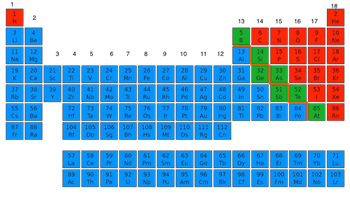
Where are the nonmetals located on the periodic table? 
a)
Blue
b)
Red
c)
Green
55.
Where are metals located on the periodic table?
a)
Blue
b)
Green
c)
Red
56.
Which of the following is an ionic bond?
a)
H3N
b)
CaCl2
c)
NO2
d)
SCl
57.

What do atoms that form positive ions tend to do?

a)

lose electrons

b)

gain electrons

c)

lose protons

d)

gain protons

58.
Atoms that gain electrons become...
a)
negatively charged
b)
positively charged
c)
remain neutrally charged
d)
21
59.
If an oxygen atom has 8 protons (+) and 10 electrons (-), what is it's charge?
a)
O10-
b)
O8+
c)
O2-
d)
O10+
60.

The correct Lewis Structure for the bond between Mg and Cl will contain how many Cl atoms

a)

3

b)

4

c)

1

d)

2

61.
Which of the following is an ionic compound:
a)
CH4
b)
I2
c)
LiBr2
d)
CO
62.
What would be the proper chemical formula for combining Al3+ and Cl- :
a)
AlCl3
b)
Al3Cl
c)
AlCl
d)
Al3Cl3
63.
Name the following ionic compound: BeCl2
a)
beryllium chlorine
b)
beryllium II chloride
c)
beryllium chloride
d)
beryllium dichloride
64.
Name the following ionic compound: LiNO3
a)
lithium nitrate
b)
lithium III nitrate
c)
lithium nitride
d)
lithium oxide
65.
Name the following compound: FeCl3
a)
iron chloride
b)
iron III chloride
c)
iron chlorate
d)
iron III chlorate
66.
Which of the following combinations would need roman numerals in the name?
a)

potassium + fluorine

b)

beryllium + oxygen

c)

boron + iodine

d)

copper + oxygen

67.
Name the ionic compound SnSe2
a)
Tin diselenide
b)
Tin (IV) Selenide
c)
Tin selenide
d)
Tin (II) triselenide
68.
What is the correct formula for Sodium Oxide?
a)
NaO
b)
NaO2
c)
Na2O
d)
Na2O2
69.
An atom that gains or loses electrons is called a _______.
a)
atom
b)
ion
c)
oxidation
d)
metal
70.
When naming an ion containing a transition metal what would be included in the name?
a)
roman numeral
b)
prefix
c)
suffix
d)
superscript
71.
Fe+3   +    S-2
a)
FE+4(S)=3
b)
Fe2S4
c)
Fe2S3
d)
Fe3S2
72.
MgF2
a)
magnesium fluoride
b)
manganese Phosphide
c)
magnesium(III) fluoride
d)
magnesium fluoride(II)
73.
What is the ionic compound formed between Calcium and Oxygen?
a)
CaO
b)
Ca2O
c)
Ca2O2
d)
CaO2