
 Worksheets
Matter Properties Review Qtr2
Total questions: 69
Worksheet time: 1hrs 6mins
Norman and his mother made hummingbird food for their feeder. They mixed water and sugar, and then stirred it until the sugar dissolved. They checked the feeder later and noticed that some of the water had evaporated, and sugar crystals had formed on the feeder. Which type of change took place?
Chemical
Electrical
Physical
Mechanical

The chart shows the composition of an unknown atom.
Proton # 15 Neutron # 16 Electron # 14
What Element(atom) is described in the chart?
Sulfur
Silicon
Nitrogen
Phosphorous

The balance below is measuring the mass of a crumpled piece of aluminum in grams. What would be the mass, in grams, of the piece of aluminum before it was crumpled?
5 g
9 g
2 g
49 g
Shemika is preparing for her birthday party. She made a punch by mixing pineapple juice, orange juice, and seltzer water in a pitcher. She made fruit salad by putting blueberries, apple chunks, and mango chunks in a bowl. Which of the following is true about her snacks?
The punch is a solution, and the fruit salad is a mixture.
The punch and the fruit salad are mixtures.
The punch and the fruit salad are solutions.
The punch is a mixture, and the fruit salad is a solution.
How are water molecules arranged in a liquid?
They are far apart and stay in one place
They are close together and stay in one place
They are far apart and move past each other
They are close together and move past each other
Luster, hardness, color, size, and temperature are all examples of
various phase of matter
physical properties of matter
different examples of matter
chemical properties of matter
Lithium (Li), Sodium (Na), Potassium (K), Rubidium (Rb), Cesium (Cs), and Francium (Fr) are in the same column on the periodic table. Why are these elements in the same column on the periodic table?
They have the same size
They each react with each other
They have similar properties
They have the same number of protons
Mr. Konopka conducted a demonstration for his science students. He used a balance to measure the mass of a burning candle that was placed in a sealed glass container. The size of the candle got smaller as it burned, but the mass on the balance stayed the same.Which of the following can be concluded by this demonstration?
The total mass of the closed system is constant
Energy is converted to mass when the candle is burned
smoke particles have less mass than the molecules of the candle
the mass of the smaller candle has less energy than the larger candle
What is the main principle behind the law of conservation of matter?
Mass does not change phase during a reaction
The total mass does not change during a reaction
heat is added during a reaction for the mass to remain constant
Mass will always remain constant unless a change has occurred.
A pure substance made of one kind of atom is called an
element
compound
mixture
neutron
NaCl (table salt) is an example of a(n)
atom
compound
element
mixture

The diagram below shows the block for cobalt (Co) as seen on the periodic table. What is the atomic number of cobalt?
27
28
58.693
58.933
Which of the following is a physical property of an element?
color
flammability
ability to rust
ability to tarnish
A cubic centimeter is a unit for measuring ____.
length
volume
mass
density
Which of the following is an example of a chemical change?
melting butter
mixing milk and chocolate syrup
breaking glass
burning fuel
Shape, color, luster, and boiling point are all ____.
physical properties
chemical properties
spatial characteristics
substance properties
Iron’s ability to rust when exposed to air is a ____.
classification characteristic
physical property
atomic property
chemical property
An example of a pure substance that cannot be broken down is ____.
water
carbon
fire
dirt
The measure of the force of gravity on an object is ____.
mass
volume
weight
matter
We calculate ____ by multiplying length x height x width.
mass
density
weight
volume
____ states that matter is not created or destroyed in any chemical or physical change.
International System of Units
chemical energy
Atomic Theory
Law of Conservation of Mass/Matter
The total energy of all of the particles in an object is its ____.
temperature
thermal energy/heat
endothermic ability
exothermic ability
A ___________ substance has a definite volume but not a definite shape.
gas
liquid
solid
The particles in a _____________ vibrate, are close together, and do not move freely.
liquid
gas
solid

What is plasma?
has an indefinite shape and indefinite volume
has a definite shape and indefinite volume
has a definite shape and definite volume
a gas like state of matter where atoms have been stripped of electrons
Arjun, Sophia, and Emma are having a debate about the formula for density. Can you help them settle the argument?
Density = Mass x Volume
Density = Mass - Volume
Density = Volume/Mass
Density = Mass/Volume
Ethan, Harper, and Benjamin are having a debate about the pH range for acids. Can you help them settle the argument?
0 to 14
1 to 7
0 to 6.9
7 to 14
Abigail, Zoe, and Kai are having a debate about the pH range for bases. Can you help them settle the argument?
greater than 7
equal to 7
between 0 and 7
less than 7
Kai, Anika, and Samuel are discussing different types of changes in matter. They come across the term 'physical change'. What is a physical change?
A physical change is a change in the form or state of matter without any change in its chemical composition.
A physical change is a change in the color of matter.
A physical change is a change in the taste of matter.
A physical change is a change in the smell of matter.
Imagine Ava, Henry, and Avery are in a science lab. They are experimenting with different substances and suddenly, a new substance is formed! What would you call this process?
This is a chemical change, a process that results in the formation of new substances with the same properties as the original substances.
This is a chemical change, a process that results in the formation of new substances with no properties.
This is a chemical change, a process that results in the formation of new substances with different properties from the original substances.
This is a chemical change, a process that results in the formation of new substances with opposite properties from the original substances.
Nora, Noah, and Jackson are having a debate. Nora says a pure substance is made up of only one type of particle or molecule. Noah thinks it doesn't have any particles or molecules. Jackson believes it's a mixture of different substances. Who is correct?
Nora, who says a pure substance is made up of only one type of particle or molecule.
Noah, who thinks a pure substance doesn't have any particles or molecules.
Jackson, who believes a pure substance is a mixture of different substances.
None of them are correct.
Imagine Mia and David are having a debate. Mia says that when a solid is heated, its particles move further apart and expand. David, however, disagrees. According to him, which of the following could be his argument?
David could argue that the particles in a solid remain in the same position.
David could argue that the particles in a solid break apart and disintegrate.
David could argue that the particles in a solid move closer together and contract.
David could argue that Mia is correct and the particles in a solid do move further apart and expand.
Kai, Avery, and Mia were having a heated debate in their science class. They all agreed that both elements and compounds are pure substances. Do you agree with them?
Yes, I agree with Kai, Avery, and Mia
No, I disagree with Kai, Avery, and Mia
Imagine Benjamin and Scarlett are in a chemistry lab. They decide to mix two or more different elements. Do you think they will end up creating a compound?
Yes, they will
No, they won't
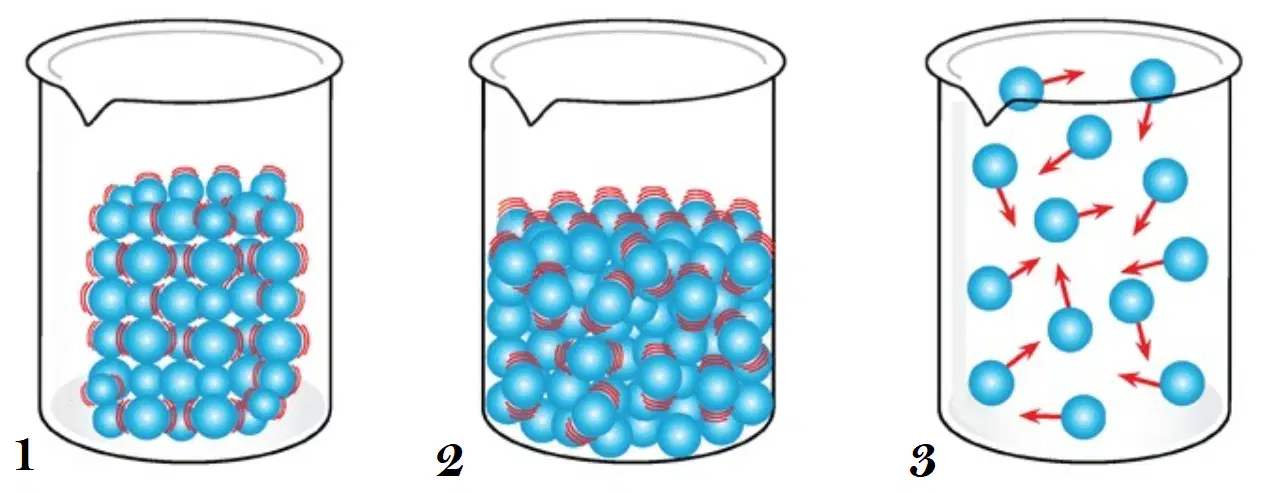
Aiden, David, and Nora are having a debate. They are trying to figure out which model (or models) could be Tyson's artistic representation of particles in a solid. Can you help them settle this?
Model 1
Model 3
Model 2 and Model 3
Model 1, Model 2, and Model 3

Avery, Liam, and Mason are having a friendly competition to see who knows the Periodic Table of Elements the best! They stumbled upon a question that they couldn't agree on. Can you help them out? The question is: Which of the following sets of elements have similar properties?
Pb-82, Sn-50, Kr-36
Ne-10, N-7, O-8
Cl-17, Br-35, 1-53
O-8, S-16, N-7

Ethan, Nora, and Aria are on a thrilling adventure inside an atom model! They noticed several labels pointing to different parts of the atom. Can you help them figure out which label points to the electrons?
A
B
C
D
Imagine Lily, Jackson, and Mason are playing a game of 'Periodic Table Trivia'. They come across a tricky question: 'What do elements in the same group on the periodic table have in common?'
They all have similar chemical symbols.
They all have the same atomic number.
They all have similar chemical properties.
They all have the same average atomic mass.


Mike fills a graduated cylinder with 30 mL of water. He then drops a 50 g rock into the cylinder. The water rose to 35 mL as shown in the picture. What is the density of the rock?
Remember D= m/v
10 g/mL
6 g/mL
15 g/mL
12 g/mL
What is a solvent
A liquid that will dissolve a solid solute
Another word for solution
A thing that make drinks change colour
Usually the solid about to be dissolved
The substance being dissolved in a solution is the?
solution
solute
solvent
mixture
Beaker#1 has 100 mL of water and Beaker#2 has 500 mL of water. In order to identify common physical properties between both substances, both substances were heated to 100 oC. After a few minutes both substances begin to bubble at the same time.
This experiment provides evidence that the boiling point is a property independent of the amount of water.
This experiment provides evidence that the boiling point does change based on sample size.
This experiment provides evidence that the volume remains constant in the samples.
This experiment provides evidence of a change in the volume of the samples.

Which would be the most useful for identifying an unknown substance?
Weight because it does not depend on sample size
volume because it will depend of the size of the sample
mass because it will depend on the size of the sample
density because it does not depend on sample size
which substances could be grouped or sorted based on their physical property of MAGNETISM? Which group would magnetic?
Iron, Nickel, Cobalt
Iron, Nickel, Plastic
Iron, Nickel, Glass
Iron, Nickel Wood



