wayground logo

Free Printable Worksheets

Font size

S
M
L
XL
Worksheets

Rocks, Minerals and Weathering Review

Total questions: 88

Worksheet time: 1hrs 3mins
Name
Class
Date
1.
Formed by heat and pressure
a)
Sedimentary
b)
Metamorphic
c)
Extrusive Igneous
d)
Intrusive Igneous
2.
Formed by cooling & solidification of lava
a)
Sedimentary
b)
Metamorphic
c)
Extrusive Igneous
d)
Intrusive Igneous
3.
Formed by cooling & solidification of magma
a)
Sedimentary
b)
Metamorphic
c)
Extrusive Igneous
d)
Intrusive Igneous
4.
Formed by compacting & cementing of sediments
a)
Sedimentary
b)
Metamorphic
c)
Extrusive Igneous
d)
Intrusive Igneous
5.
Has small or no crystals because of rapid cooling
a)
sedimentary
b)
metamorphic
c)
extrusive igneous
d)
intrusive igneous
6.
Has large crystals because of slow cooling
a)
sedimentary rock
b)
metamorphic rock
c)
intrusive igneous rock
d)
extrusive igneous rock
7.
Formed by melting
a)
magma
b)
sediments
c)
sedimentary rock
d)
intrusive igneous
8.
Formed by weathering & erosion
a)
magma
b)
sediments
c)
sedimentary rock
d)
intrusive igneous
9.
Has wavy bands.
a)
sedimentary rock
b)
metamorphic rock
c)
extrusive igneous rock
d)
intrusive igneous rock
10.
Contains fossils. 
a)
sedimentary rocks
b)
metamorphic rocks
c)
extrusive igneous rocks
d)
intrusive igneous rocks
11.
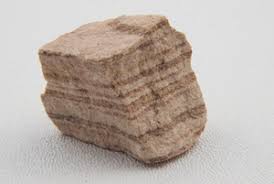
This rock was another type of rock that was heated and compressed over time. What type of rock is this?
a)
Sedimentary
b)
Igneous
c)
Metamorphic
12.

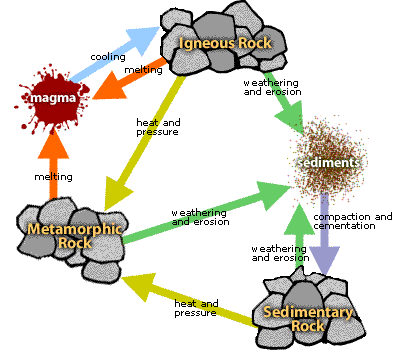
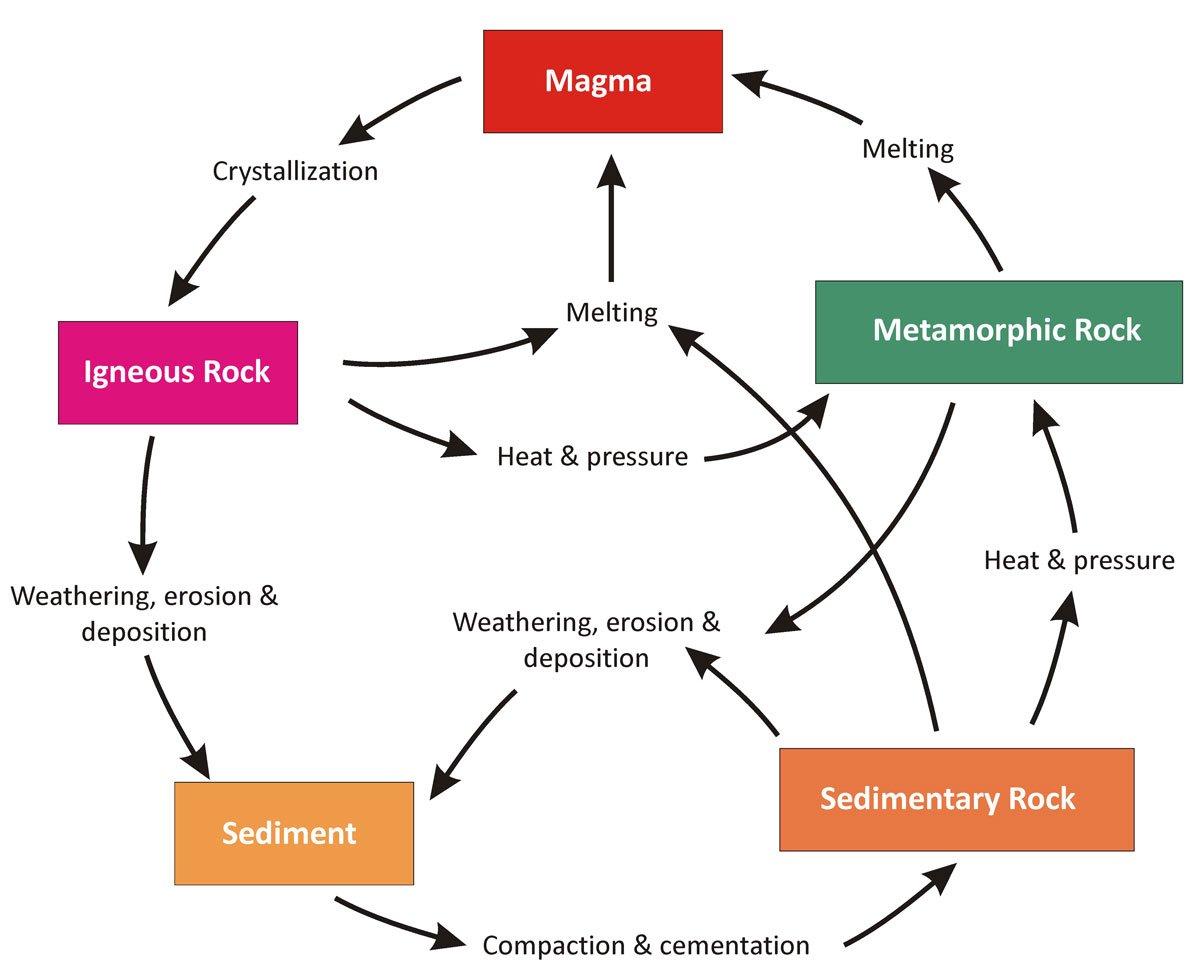
A model that describes the formation, breakdown, and reformation of a rock.

a)

Fall Zone

b)

Weathering/ Erosion/ Deposition

c)

Rock Cycle

d)

Soil Profile

13.

A rock consists of two or more minerals.

a)

True

b)

False

14.

There are ________ different types of rock that all basically come from the same materials.

a)

two

b)

three

c)

four

d)

many

15.

Physical properties of igneous rock include

a)

cementation of smaller rocks

b)

layers

c)

crystals

d)

ribbons

16.

Physical and chemical process that transforms sediments into sedimentary rocks, due to increasing pressure and temperature is:

a)

crystalization

b)

deposition

c)

weathering

d)

lithification

17.

When rocks are deeply buried, placing them under pressure because of the weight of overlying layers, this is called:

a)

lithification

b)

cementation

c)

deposition

d)

compaction

18.

Limestone is a(n) ________ rock.

a)

igneous

b)

sedimentary

c)

cemented

d)

metamorphic

19.

Basalt is a(n) _______ rock:

a)

igneous

b)

sedimentary

c)

cemented

d)

metamorphic

20.
The color of a mineral in powder form is called the mineral's 
a)
hardness
b)
specific gravity
c)
luster
d)
streak
21.
How light reflects off of a mineral is called the mineral's 
a)
luster
b)
streak
c)
cleavage
d)
fracture
22.
Diamond has a hardness of ___ on Mohs Hardness Scale.
a)
1
b)
5
c)
8
d)
10
23.
By definition, a mineral has which of the following characteristic(s)?
a)
definite chemical composition
b)
crystal structure
c)
naturally occuring
d)
all of the above
24.
How do you test the hardness of a mineral? 
a)
Throw it against a wall
b)
Step on it
c)
Scratch Test
d)
Kick it until it breaks
25.
What mineral is used for pencils?
a)
Graphite
b)
Galena
c)
Magnetite
d)
Quartz
26.
What mineral is salt?
a)
quartz
b)
sulfur
c)
halite
d)
calcite
27.
A naturally occurring, inorganic solid with a crystal structure and a definite chemical composition is referring to
a)
density
b)
streak
c)
mineral
d)
non silicate mineral
28.
The solid, geometric form of a mineral produced by a repeating pattern of atoms
a)
crystal
b)
density
c)
element
d)
fracture 
29.
Which mineral smells like rotten eggs?
a)
talc
b)
sulfer
c)
mica
d)
pyrite
30.
What mineral is the softest mineral on Moh's Hardness Scale and the main ingredient in baby powder?
a)
feldspar
b)
talc
c)
gypsum
d)
kaolinite
31.
The mineral halite is formed by 
a)
hot water solutions
b)
cooling of magma
c)
cooling of lava
d)
evaporation
32.
The mineral in the picture has a ____________ luster.
a)
Nonmetallic
b)
Metallic
c)
Pearly
d)
Earthy
33.
A mineral breaks into pieces like are shown in the picture. How would you describe its breakage?
a)
Fracture
b)
Cleavage
c)
Glassy
d)
Waxy
34.
A mineral breaks into pieces like are shown in the picture. How would you describe its breakage?
a)
Fracture
b)
Cleavage
c)
Glassy
d)
Waxy
35.
Which mineral property is being shown here?
a)
luster
b)
hardness
c)
cleavage
d)
streak
36.
Refer to the Mohs Hardness Scale. A mineral with a hardness of 7 can scratch -
a)
orthoclase feldspar, but cannot scratch talc
b)
calcite, but cannot scratch apatite.
c)
topaz, but cannot scratch fluorite
d)
gypsum, but cannot scratch corundum
37.

What is weathering?

a)

When it rains or snows.

b)

Process of breaking down of rocks into smaller pieces.

c)

Process of moving small pieces of rocks.

38.

What types of weathering are there?

a)

mental and astronomical

b)

the rainy kind

c)

sedimentary and metamorphic

d)

chemical and mechanical

39.

What type of weathering is it when acid rain breaks down and changes the rock.

a)

astronomical weathering

b)

chemical weathering

c)

physiological weathering

d)

mechanical weathering

40.

________ is the laying down of sediment carried by wind, water, or ice.

a)

sedimentary

b)

deposition

c)

erosion

41.

Which of these does not cause erosion?

a)

liquid water

b)

sunlight

c)

wind

d)

plants

42.

________ is the process of moving away sediments at the Earth's surface. 4 agents move sediment: Water, Wind, Glaciers, and Mass Wasting (gravity).

a)

deposition

b)

weathering

c)

erosion

43.

How do plants cause erosion?

a)

during photosynthesis

b)

when roots grow into cracks of rocks and expand the rock

c)

when the plant moves water from the roots to the leaves

44.

Flood water pounding against a canyon wall and wearing it down

a)

weathering

b)

erosion

c)

deposition

45.

Acid rain dissolving underground limestone.

a)

weathering

b)

erosion

c)

deposition

46.

Waves dropping sand on the beach

a)

weathering

b)

erosion

c)

deposition

47.

Deltas forming at the mouths of rivers

a)

weathering

b)

erosion

c)

deposition

48.

A mudslide flowing down a steep hill

a)

weathering

b)

erosion

c)

deposition

49.

Muddy water being carried away by a fast-moving river

a)

weathering

b)

erosion

c)

deposition

50.

Flood waters moving soil from one location to another

a)

weathering

b)

erosion

c)

deposition

51.

Ponds filling up with sediment and becoming marshes

a)

weathering

b)

erosion

c)

deposition

52.

Wind blowing sand from one location to another

a)

weathering

b)

erosion

c)

deposition

53.

Glaciers dropping rock and sand to form terminal moraines

a)

weathering

b)

erosion

c)

deposition

54.

Water getting into cracks, freezing, and breaking the rocks or pavement apart

a)

weathering

b)

erosion

c)

deposition

55.

Wind blasting sand at rock and carving out arches

a)

weathering

b)

erosion

c)

deposition

56.

Rocks being made smooth by tumbling across a streambed

a)

weathering

b)

erosion

c)

deposition

57.
As the current in a stream becomes stronger, what will happen to its erosional power?
a)
it will increase
b)
it will decrease
c)
it will stay the same
d)
it will increase then decrease
58.
As the velocity of a stream decreases, what happens to the size particles that it is able to carry?
a)
It's only able to carry larger particles
b)
It's only able to carry smaller particles
c)
It can carry any size particles
59.
Valleys created by downcutting streams are ___- shaped
a)
W
b)
U
c)
V
d)
Y
60.

Deposition is likely to occur in a river

a)

on the outside bank, when the water speeds up

b)

on the outside bank where the water slows down

c)

along the inside bank where the water speeds up

d)

along the inside bank where the water slows down

61.

Which of the following statements is true about the development of a stream?

a)

a stream's slope increases as it approaches base level

b)

water along the sides and bottom of the channel flows more rapidly

c)

deposition is greater in the outside curve of a meander

d)

the velocity of water is greater along the outside of a meander curve

62.

Erosion is most likely greatest at locations

a)

A and B

b)

B and C

c)

C and D

d)

D and A

63.
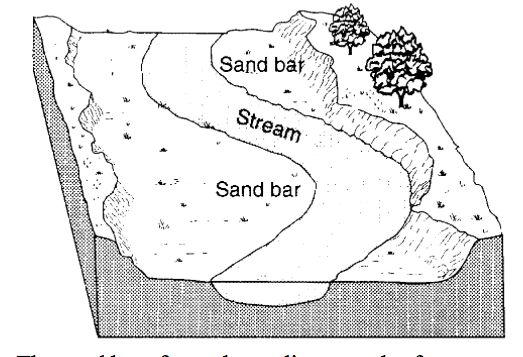
The diagram below shows a portion of a stream. The sand bar formed as a direct result of 
a)
erosion due to a decrease in stream velocity 
b)
erosion due to an increase in stream velocity
c)
deposition due to a decrease in stream velocity
d)
deposition due to an increase in stream velocity 
64.

The landscape feature labeled X is best described as

a)

Floodplain

b)

Delta

c)

Sandbar

d)

Escarpment

65.

Which letter has a higher velocity?

a)

A

b)

B

66.

Which letter is there more deposition occurring?

a)

A

b)

B

67.

What kind of river produces meanders like the ones in the image?

a)

Young

b)

Old

68.

Match the following

a)
1.

river

b)
2.

lake

c)
3.

cliff

69.

An ​ (a)   is land surrounded by water.

Choose from the below words
island
lake
ocean
waterfall
70.

Match the following.

a)
1.

waterfall

b)
2.

ocean

c)
3.

stream

71.

A ​ (a)   is a body of water that is surrounded by land.

Choose from the below words
lake
river
island
72.

What is this picture of?

a)

lake

b)

valley

c)

plains

73.

What is this?

a)

plains

b)

mountain

c)

hills

74.
What land form is this?
a)
valley
b)
plain
c)
volcano
d)
mountain
75.
What is this landform?
a)
mountain
b)
glacier
c)
bay
d)
canyon
76.
What is this landform?
a)
mountain
b)
canyon
c)
coast
d)
cliff
77.
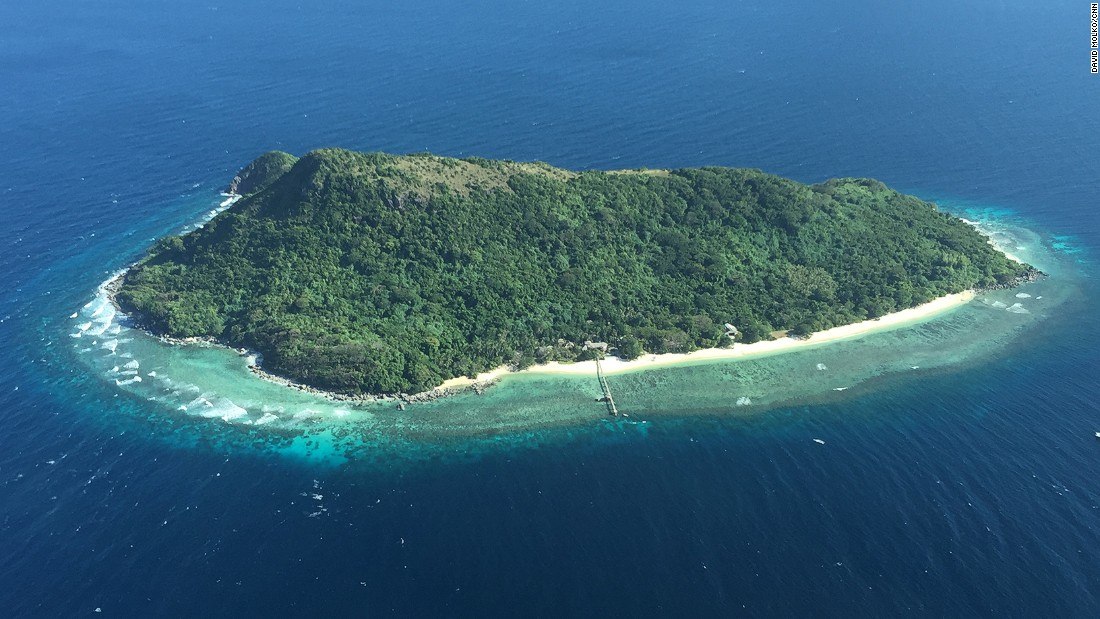
What is this landform
a)
valley
b)
mountain
c)
hill
d)
glacier
78.
What land form is this?
a)
island
b)
valley
c)
plain
d)
mountain
79.
What land form is this?
a)
valley
b)
plain
c)
volcano
d)
canyon
80.
Name this landform
a)
peninsula
b)
plain
c)
river
d)
lake
81.

What Landfrom is this?

a)

River

b)

Lake

c)

Ocean

d)

Cliff

82.

What Landfrom is this?

a)

Hills

b)

Mountains

c)

Volcano

d)

River

83.

What Landform is this?

a)

Archipelago

b)

Basin

c)

Isthmus

d)

Valley

84.

What landform is this?

a)

mountain

b)

strait

c)

cataract

d)

mesa

85.
a)
mountain
b)

island

c)
sinkhole
d)

lake

86.
a)
hill
b)
mountain
c)

delta

d)
valley
87.
a)
hill
b)
island
c)
dune
d)
mountain
88.

What landform?

a)

Lake

b)

Delta

c)

Cave

d)

Island