wayground logo

Free Printable Worksheets

Font size

S
M
L
XL
Worksheets

1st semester 8th grade science review

Total questions: 88

Worksheet time: 1hrs 28mins

Name
Class
Date
1.

Which of the following organisms is a producer?

a)

grass

b)

rabbit

c)

fox

d)

snake

2.

Which of the following organisms is a primary consumer?

a)

grass

b)

rabbit

c)

fox

d)

snake

3.

Which of the following organisms uses photosynthesis to get the energy it needs to survive?

a)

grass

b)

rabbit

c)

fox

d)

snake

4.

Which of the following organisms in competition with the weasel for their food source?

a)

grass

b)

rabbit

c)

fox

d)

snake

5.

Which of the following organisms is a herbivore?

a)

grass

b)

rabbit

c)

fox

d)

snake

6.

What would happen to the rabbit population if the fox population moved out of the area represented by the food web?

a)

The rabbit population would increase

b)

The rabbit population would decrease

c)

The rabbit population would neither increase nor decrease
7.
A consumer that hunts is called:
a)
a producer.
b)
an omnivore.
c)
a predator.
d)
a herbivore.
8.
A frog eats a fly. The frog and fly are demonstrating ________.
a)
mutualism
b)
competition
c)
predator/prey
d)
parasitism
9.
All energy on Earth ultimately comes from what source?
a)
Water
b)
Sun
c)
Consumers
d)
Oxygen
10.
An organism that needs to eat other organisms to obtain energy is known as a:
a)
Autotroph
b)
Producer
c)
Consumer
d)
Mutualist
11.
The arrows in a food chain or web represents what?
a)
They point to the organism that is being eaten.
b)
It shows how sunlight flows within an ecosystem.
c)
They show what direction the energy is flowing between organisms. 
d)
They represent how water is transferred within a habitat.
12.

Which phase of the moon is represented in the diagram?

a)

New moon

b)

Full moon

c)

First quarter

d)

Last quarter

13.

During which moon phase might a lunar eclipse be viewed on Earth?

a)

Full moon

b)

Last quarter

c)

First quarter

d)

New moon

14.

How many days does it take for the moon to complete a full cycle?

a)

28

b)

29

c)

29.5

d)

28.5

15.

Is this a waxing or waning moon?

a)

Waxing

b)

Waning

c)

None of the above

16.

Which moon phase comes after this one?

a)

New moon

b)

Full moon

c)

Waning Gibbous

d)

Third Quarter

17.

What would the moon look like 15 days after this one?

a)

Full moon

b)

Waxing Crescent

c)

Waning Crescent

d)

New moon

18.

What is the name of this moon phase?

a)

First Quarter

b)

Waning Crescent

c)

Half moon

d)

Last Quarter

19.

Approximately how much time passes between the New moon and the Full moon?

a)

One month

b)

Three days

c)

Two weeks

d)

24 hours

20.
How many high tides does a place have each day?
a)
3
b)
4
c)
5
d)
2
21.
What type of tides would this arrangement of earth-moon-sun create?
a)
neap tide
b)
spring tide
c)
new moon tide
d)
full moon tide
22.
Wha type of tide would this arrangement of earth-moon-sun create?
a)
full moon tide
b)
new moon tide
c)
neap tide
d)
spring tide
23.
What causes tides?
a)
gravity
b)
wind
c)
spring
d)
neap
24.
Why does the moon's gravitational pull have more of effect on tides than the sun's gravitational pull?
a)
they are the same
b)
the moon is larger than the sun
c)
tides are not caused by the moon
d)
the moon is closer to the Earth than the sun
25.
Tides are caused mainly by what?
a)
Moon’s gravitational pull
b)
Sun’s gravitational pull
c)
Earth’s gravitational pull
26.
How many times per month does a spring tide occur?
a)
Once
b)
twice
c)
three times
d)
it changes every month
27.
An organism that cannot adapt to changes in the environment will most likely - 
a)
produce more offspring
b)
die
c)
change its traits to survive
d)
store more food
28.

What is an example of how organisms respond to short term changes in the environment?

a)

Animals tend to eat a lot more.

b)

Animals will hibernate.

c)

Animals must be able to adapt to a new environment.

d)

Animals will go extinct or die due to the short term change.

29.

What two environmental changes can be found in this image?

a)

pollution and climate change

b)

climate change and urbanization

c)

deforestation and pollution

d)

urbanization and deforestation

30.

Natural Disasters such as, earthquakes, flooding, and volcanic eruptions can cause ...

a)

short term changes

b)

long term changes

31.

A great amount

a)

abundance

b)

inherited characteristic

c)

variety of life

32.

an inherited characteristic that increases an organism's chance of survival

a)

biodiversity

b)

environmental change

c)

adaptation

33.

Biodiversity is

a)

changes in an environment

b)

variety of life

c)

characteristics of organisms

34.

changes in the genetic material of a cell

a)

mutation

b)

adaptation

c)

variation

35.

no longer living or existing

a)

endangered

b)

mutated

c)

extinct

36.

A natural process resulting in changes to an organism leading to adaptations.

a)

Natural Selection

b)

selective breeding

c)

environmental change

37.

breeding organisms for a desired trait

a)

variation

b)

Natural Selection

c)

selective breeding

38.

differences between members of the same species

a)

variation

b)

selective breeding

c)

abundance

39.
A living or once-living organisms in an ecosystem is a
a)
population
b)
biotic factor
c)
abiotic factor
d)
community
40.
Seasons are caused by...
a)
Earth's tilt and revolution around the sun
b)
earth's rotation
c)
earth spinning 
d)
different lunar phases
41.
What do you notice about the axis in the summer season.
a)
The top of the axis is pointing to the sun
b)
The top of the axis is pointing away from the sun
c)
The top of the axis is shrinking
d)
The bottom is the axis is pointing to the sun.
42.
What do you notice about the axis during the winter season?
a)
The top of the axis is pointing away from the sun
b)
The top of the axis is pointing toward the sun.
c)
The bottom of the axis is pointing away from the sun.
d)
There is no axis
43.
If the northern hemisphere is experiencing summer, what is the southern hemisphere experiencing?
a)
winter
b)
summer
c)
fall
d)
spring
44.
Which season has the longest amount of sunlight?
a)
Summer
b)
Winter
c)
Autumn
d)
Spring
45.
According to the diagram, the southern hemisphere is experiencing summer because
a)
The bottom of the axis is facing the sun receiving more rays of sunlight.
b)
The bottom axis is not facing the sun 
c)
The axis is not tilted
d)
The top of the axis is facing the sun receiving more rays of sunlight.
46.
The earth revolving around the sun gives us.
a)
Day and night
b)
Years
c)
Months
d)
Money
47.
What causes day and night?
a)
Earth orbiting the sun
b)
Earth rotating on its axis
c)
Earth rotation around the moon
d)
The sun going up and down
48.

What is the angle degree of earth's tilt

a)

25.5

b)

32.5

c)

23.5

d)

Earth doesn't have a tile

49.

Which of the following is an example of radiation?

a)

The sun heating up the street

b)

Touching a hot piece of metal

c)

Ocean currents

d)

The earth's core

50.

Which season has the shortest amount of day light hours?

a)

Spring

b)

Summer

c)

Winter

d)

Autumn

51.
A large cloud of gas and dust in interstellar space; the predecessor to stars...
a)
Constellation
b)
Black hole
c)
Nebula
d)
Galaxy
52.
In the diagram given, what happens as we move to the left?
a)
Stars Get Larger
b)
Stars get Colder
c)
Stars get hotter
53.
Compared to the rest of the stars, our sun is considered...
a)
Extremely Large and Cold
b)
Small with a medium temperature
c)
Medium size with medium temperature
54.
All stars start as gas and dust in a(n)
a)
nebula
b)
black hole
c)
red giant
d)
black dwarf
55.

A system of stars, gas, dust, and dark matter bound together by gravity is called -

a)

an asteroid

b)

a moon

c)

a galaxy

d)

a nebula

56.

Which of the following best describes a star? A star is a celestial body -

a)

composed of rock and metal with a very high density.

b)

that is too big to be an asteroid, but too small to be a planet.

c)

that rotates on an axis and revolves around the Sun.

d)

composed of gases that emit light due to nuclear reactions.

57.
The Milky Way Galaxy is a 
a)
spiral
b)
lenticular
c)
elliptical 
d)
irregular
58.
What is not a galaxy?
a)
Optical Galaxy
b)
Spiral Galaxy
c)
Elliptical Galaxy
d)
Irregular Galaxy
59.
Place these objects in order from smallest to largest.
a)
Planets, solar system, universe, galaxy
b)
Solar system, planets, galaxy, universe
c)
Planets, solar system, galaxy, universe
d)
Galaxy, solar system, planets, universe
60.

What holds a galaxy together?

a)

pressure

b)

glue

c)

gravity

d)

planets

61.

Where are we located within our galaxy?

a)

On one of the spiral arms

b)

On the outer edge

c)

In between 2 of the spiral arms

d)

In the center bulge

62.
Which type of electromagnetic radiation has the shortest wavelength?
a)
Radio Waves
b)
Visible Light
c)
Microwaves
d)
Gamma Rays
63.
Which type of visible light has the highest energy?
a)
Red
b)
Yellow
c)
Green
d)
Violet
64.
Which type of radiation has a frequency closest to 105?
a)
Radio
b)
Infrared
c)
Ultraviolet
d)
X-Ray
65.
Which type of electromagnetic radiation has a wavelength near 10-8?
a)
Microwave
b)
Infrared
c)
Visible
d)
Ultraviolet
66.
Which of the following types of radiation has the shortest wavelength and the highest frequency?
a)
Radio Waves
b)
Infrared
c)
Visible
d)
X-Rays
67.

Which wavelength can humans see?

a)

Microwaves

b)

Radio waves

c)

Visible light

d)

Gamma rays

68.
The distance between two crests or two troughs of a wave is called:
a)
frequency
b)
amplitud
c)
wavelength
d)
hertz
69.
Which is the correct order of colors in the rainbow?
a)
AJSKHSH
b)
ROYGEEBIV
c)
ROBBIEBIV
d)
ROYGBIV
70.
A plate boundary where two plates move away from each other is called
a)
Divergent Boundary
b)
Convergent Boundary
c)
Transform Boundary
d)
Subduction
71.
Scientists hypothesize that a super continent existed 200 million years ago.  This continent is called
a)
America
b)
Super Earth
c)
Pangea
d)
Eurasia
72.
A Plate Boundary where two plates move toward each other is called
a)
Convergent Boundary
b)
Divergent Boundary
c)
Transform Boundary
d)
Subduction
73.
_______________ Currents within the mantle cause the earth's plates to move and shift s molten material rises and falls due to density and gravity
a)
Convection
b)
Radiation
c)
Conduction
d)
Wind
74.
Divergent Plate movement can create
a)
Convection Currents
b)
Conduction
c)
Mountains
d)
Rifts and ocean ridges
75.

The movement of the tectonic plates is caused by

a)

the rotation of the Earth.

b)

convection currents in the Asthenosphere

c)

the gravity of the iron-nickel core.

d)

the Moho discontinuity.

76.

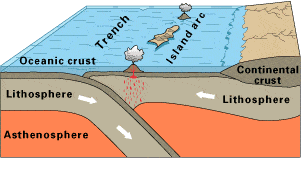
Observe this diagram of a plate boundary. One statement BEST describes what is happening. It is that

a)

the oceanic crust is melting.

b)

the denser ceanic crust is subducting under the less dense oceanic crust

c)

volcanic islands are forming.

d)

the tectonic plates are moving away from each other.
77.
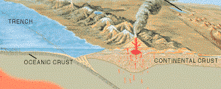
What geological forces might be responsible for this range of mountains?
a)
diverging tectonic plates
b)
erosion of the land by the ocean
c)
converging tectonic plates
d)
deposition of sediments by the ocean
78.

The type of crust that is under the world's oceans.

a)

CONTINENTAL

b)

OCEANIC

79.

Younger and consists mainly of basalt

a)

CONTINENTAL

b)

OCEANIC

80.

Thicker and older part of the Earth's crust

a)

CONTINENTAL

b)

OCEANIC

81.

The major component of this type of crust is granite.

a)

CONTINENTAL

b)

OCEANIC

82.

The process that breaks down rocks and other materials on Earth's surface is called

a)

Weathering

b)

Erosion

c)

Deposition

d)

Decomposition

83.

Over long periods of time, deposition may change the Earth’s surface by _____.

a)

forming new land features.

b)

breaking down large rocks into smaller ones.

c)

washing away beaches.

d)

moving topsoil.

84.

A cliff formed near the ocean. Which statement best describes how this cliff formed?

a)

Warm air melted the rock.

b)

Sun rays evaporated the rock.

c)

Ocean waves washed away rock.

d)

Plant roots pushed away the rock.

85.
What is the process that picks up and moves weathered rocks?
a)
Deposition
b)
Landslide
c)
Weathering
d)
Erosion
86.
Who is the person credited with developing the theory of continental drift?
a)
Harry Hess
b)
Galileo
c)
Alfred Wegener
d)
Newton
87.
What two specific continents fit together most noticeably?
a)
Africa and North America
b)
South America and Europe
c)
South America and Africa
d)
 Antartica and Africa
88.
Why was Wegener's theory not accepted?
a)
He had no proof of how they were moving
b)
He had no evidence
c)
He was married
d)
He was not a Scientist