
Font size
 Worksheets
Physics Term 1 Practice
Total questions: 86
Worksheet time: 1hrs 1mins


The SI unit for time is the __?__.
hours (h)
liter (L)
gram (g)
second (s)
What SI unit is used to measure length?
meters
liters
centimeters
kilograms
What prefix is represented by the following symbol: m
hecto
kilo
milli
mega
A system of units of measure widely accepted by the scientific community (SI for short)
International System of Units
World Wide Weight
Science Instruments
Use These Measures
The SI unit for mass is _________.
Pounds
Inches
Kilograms
Ounces
The SI unit for power is
meters
mass
kilograms
watts
Newton meters is an other term for
Watts
Joules
Kilograms
Seconds
SI unit for weight
Pound
Liter
Newton
Second
What is the SI unit for mass?
ounce
kilograms
9 meters = ___________cm
900 cm
90 cm
0.9 cm
0.09 cm

In the metric system to convert from a smaller unit to a larger unit you should
multiply
divide
add
subtract

In the metric system to convert from a larger unit to a smaller unit you should
multiply
divide
add
subtract
5.21 kilograms is ___ grams
521 g
5,210 g
52.1 g
52,100 g
Mass is
the same as weight
the amount of matter in an object
the amount if weight in an object
the amount of gravity in an object
What is weight
The same as mass
mass * gravity
the same as inertia
Which is always the same no matter what planet you are on:
Mass
Weight
Gravity
What is the formula of weight?
w=m⋅g
w=m+g
w=m÷g
Which statement is true?
Mass is a vector quantity
Weight stays constant in every location
Mass SI unit is kilogram
What is the definition of weight?
Gravitational force that act on an object
Total amount of matter inside an object
It is mass divides by gravity acceleration
Weight is _________.
the quantity of matter in an object.
the measure of an object's inertia.
the force exerted by gravity on an object's mass.
equal to the mass of an object.
What is the main difference between scalar and vector quantities?
Scalar quantities have both magnitude and direction, while vector quantities have only magnitude.
Scalar quantities have only magnitude, while vector quantities have only direction.
Scalar quantities have only direction, while vector quantities have both magnitude and direction.
Scalar quantities have only magnitude, while vector quantities have both magnitude and direction.
Which of the following is a scalar quantity? a) Velocity b) Force c) Acceleration d) Distance
a
b
d
c
Which of the following is a vector quantity? a) Mass b) Temperature c) Time d) Displacement
c
d
b
a
When adding scalar quantities, what operation is used?
subtraction
multiplication
division
addition
When adding vector quantities, what operation is used?
scalar multiplication
vector subtraction
vector division
vector addition
If a car travels 50 km north and then 30 km south, what is the total displacement?
80 km north
30 km north
20 km north
50 km south
direction
A deer running 15 meters per second due west
Wind blowing at 20 knots
Wind blowing at 20 knots
VELOCITY
Scalar
Vector
DISTANCE
Scalar
Vector

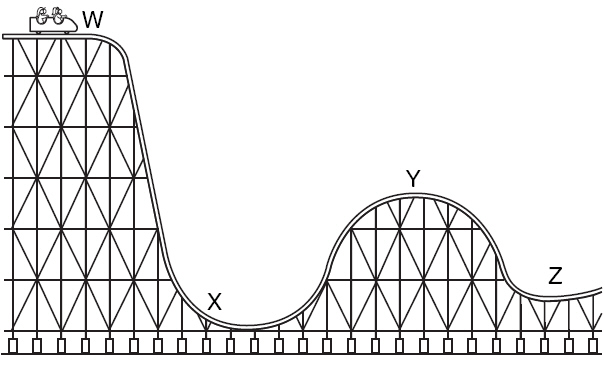
During which segment is the object increasing speed?
X
Y
Z
During which segment is the object decreasing speed?
X
Y
Z
During which segment is the object travelling at constant speed?
X
Y
Z
During segment Y, the object is -
Increasing speed
Decreasing speed
Stationary
Moving at constant speed

If you drive at a constant velocity of 40 miles/hour for 2 hours, your displacement will be
20 miles
40 miles
80 miles
Match the following quantities to their units.
displacement
meters
velocity
m/s
time
sec

What is the best description for the motion in this distance v. time graph?
An object is not moving
An object is moving backward at a constant speed
An object is moving forward at a constant speed
Object is speeding up in the forward direction

What type of force is shown inside of the picture?
Tension
Friction
Elastic
Gravitational


What is the best description of the relationship shown in this graph?
In this graph, the relationship between force and extension is linear.
In this graph, the relationship between force and extension is non-linear.
In this graph, the relationship between force and extension is directly proportional.
In this graph, there is no relationship between force and extension.

The graph shows the relationship between force and extension as a spring is extended. What is another name for point A?
Point A is the elastic limit
Point A is the elastic summet
Point A is the plastic limit
Point A is the extension limit
Which statement most accurately represents Hooke's Law?
a) The stretch of a spring is directly proportional to the force applied.
b) The stretch of a spring is proportional to the number of coils.
c) The stretch of a spring is inversely proportional to the force applied.
d) Thickness of a spring wire is proportional to the force applied.

An unstretched spring becomes longer when a force is applied to it. Which word describes the additional length of the spring gains?
Expansion
Extension
Stretched

Liquid pressure is because of the forces between the liquid particles and the _________ of the container.
Volume
Mass
Surface
Density
The pressure exerted by a liquid
increases with depth.
decreases with depth.
is constant
first increases and then decreases.
The pressure of the water at the bottom of a pond is ___ at the surface of the pond.
either lower or higher
higher than
same
lower than

Diagram shows the design of a dam. Why does the thickness of the dam increase with its depth?
The design of this structure is stronger.
Water pressure increases with depth.
The cost of construction is lower.
Water pressure acts uniformly in all directions.
Hydraulic systems use ________ to transfer force from one point to another.
Air
Liquid
Solid
Gas
What is a hydraulic system?
A system that uses a liquid under pressure to transmit a force to do work.
A system that uses a gas under pressure to transmit a force to do work
Pascal's law.
It uses water to push an object.
Where can you look on your car to see a good example of a basic piston-driven hydraulic system?
The power steering system
The instrument panel
The brake system
The radio system
What is energy?
something that picks up things, like a magnet.
Motion of an object
ability to do work
magic rays of sunshine that come down when you're feeling blue.
When is the kinetic energy maximum?
when potential energy is maximum
when kinetic energy is equal to potential energy
when potential energy is minimum
kinetic energy depends on?
mass
velocity
weight
both mass and velocity


What is potential energy?
The energy an object has due to its atomic structure.
The energy an object has due to its chemical composition.
The energy an object has due to its motion.
The energy an object has due to its position or condition.


When you shout at a friend, you are changing mechanical energy into __________ form.
sound
electrical
thermal
chemical
When you turn on a music player, you are using __________ form of energy to produce sound energy.
light
electrical
nuclear
thermal
When fuel burns, it gives us____ and ____ energy
Choose all that apply
Electrical
Heat
Light
Electromagnetic

Heat (Thermal)
Elastic
Gravitational
Sound

What happens to the energy when you kick a soccer ball?
energy is created
energy is destroyed
energy is transferred to the ball
energy is transferred to your foot
The picture showing the energy conversion
Light → chemical
is:


The picture showing the energy conversion
Chemical → kinetic
is:
The picture showing the energy conversion
Chemical → heat
is:


