wayground logo

Free Printable Worksheets

Font size

S
M
L
XL
Worksheets

Midterm Study Guide

Total questions: 109

Worksheet time: 3hrs 44mins
Name
Class
Date
1.
How long does it take for the Earth to make one full orbit around the Sun?
a)
one day
b)
one week
c)
one month
d)
one year
2.
How long does it take for the Earth to make one full orbit around the Sun?
a)
one day
b)
one week
c)
one month
d)
one year
3.
As the Earth travels around the Sun, it creates a pattern that makes _____
a)
the months
b)
the years
c)
the seasons
d)
day and night
4.
What are the reasons for the season?
a)
Earth's tilt & rotation
b)
Earth's tilt & revolution
c)
Earth's rotation & rovolution
d)
Earth's tilt & resolution
5.
Why does the area around the equator stay the same temperature all year?
a)
The equator rotates slower than the poles 
b)
The equator remains the same distance from the sun.
c)
The equator always receives direct sunlight.
d)
The equator has 18 hour days.
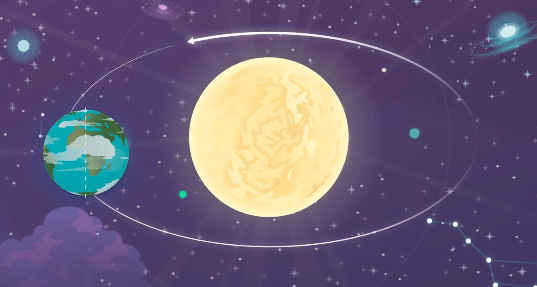
6.
The diagram shows the Earth's movement around the Sun. What is this diagram demonstrating? 
a)
day and night
b)
seasons
7.
The Earth's axis is tilted _____ degrees.
a)
23.5
b)
25.3
c)
30.2
d)
24
8.
What happens when the area in which you live tilts away from the sun?
a)
It is summer.
b)
It is spring.
c)
It is winter.
d)
It is fall.
9.
The Earth's _______ is an imaginary line that goes from the North Pole to the South Pole.
a)
vernal equinox
b)
axis
c)
solar eclipse
d)
solar flare
10.
When the Earth completes a full orbit around the Sun, it has completed _____ rotations or days
a)
7
b)
30
c)
91
d)
365
11.
Why do we experience the changing of the season on the earth?
a)
distance from the sun
b)
rotation of the earth
c)
change in solar output
d)
tilt of the earth's axix
12.
At position A, in the Northern hemisphere it would be _____?
a)
Summer
b)
Winter
c)
Spring
d)
Fall
13.
What happens when the area in which you live tilts away from the sun?
a)
It is summer.
b)
It is spring.
c)
It is winter.
d)
It is fall.
14.
The imaginary line that separates the northern and southern hemispheres is called the....
a)
axis
b)
equator
c)
solstice
d)
equinox
15.

What is an Equinox

a)

Full tilt toward sun

b)

Full tilt away from sun

c)

Shortest day

d)

Equal day and night

16.
What causes the moon's phases
a)
Where you are standing on Earth
b)
the amt of sunlight reflected onto the moon from the sun
c)
The tilt of Earth
d)
how fast the moon is moving
17.
Changes in the moon's appearance are
a)
phases
b)
eclipses
c)
stages
d)
cycle
18.
The Moon orbits Earth in a ________________ direction
a)
clockwise
b)
counterclockwise
c)
upwards
d)
downwards
19.
Define Waxing
a)
Moon is increasing and light part appears to be growing
b)
Completely illuminated
c)
dark side is facing earth
d)
Moon is decreasing and light part appears to be shrinking
20.
Define Gibbous
a)
Less than half of moon visible
b)
More than half of moon visible
c)
All of moon visible
d)
None of moon visible
21.
Define New Moon
a)
None of moon is visible from Earth
b)
All of moon visible from Earth
c)
Moon is 1/2 visible from Earth
d)
Moon is more than Half Visible from Earth
22.
Name this moon phase
a)
Waxing Gibbous
b)
Waxing Crescent
c)
Waning Crescent
d)
Waning Gibbous
23.
The phase of the moon that occurs between the sun and Earth
a)
Full moon
b)
Waxing crescent
c)
Waning Crescent
d)
New Moon
24.
What is the correct order of the moon phases?
a)
new, full, 1st quarter, 3rd quarter
b)
new moon, 1st quarter, full moon, 3rd quarter
c)
1st quarter, 3rd quarter, new moon, full moon
d)
new, 1st quarter, 3rd quarter, full
25.
darkest, innermost part of the shadow
a)
penumbra
b)
umbra
26.
What type of eclipse is this?
a)
Solar eclipse
b)
Lunar eclipse
27.
What type of eclipse is this?
a)
Solar Eclipse
b)
Lunar Eclipse
28.
What moon phase is necessary for a lunar eclipse to occur?
a)
new
b)
full
c)
first quarter
d)
last quarter
29.

True or False:

A total lunar eclipse is an eclipse in which the new moon temporarily blocks part of the Sun’s disk; occurs when the new moon, Earth, and the Sun are not completely aligned and the umbra of the Moon’s shadow falls into space and viewers on Earth are located in the penumbra of the Moon’s shadow.

a)

false

b)

true

30.
The length of time it takes for the moon to go through its whole cycle: 
a)
27 hours
b)
29 days
c)
27 days
d)
29 hours
31.
Is it safe to look directly at a lunar eclipse? 
a)
Yes
b)
No
32.
What phase occurs immediately after a full moon? 
a)
Waxing gibbous
b)
Waxing crescent
c)
Waning gibbous
d)
Waning crescent
33.
Why don't we have a solar eclipse every month? 
a)
The Sun is tilted on its axis
b)
The moon's tilt
c)
The speed of the moon's rotation
d)
The speed of the Earth's rotation
34.
What control does the moon have on Earth? 
a)
It controls waves
b)
It controls Earth's rotation
c)
It controls the speed of revolution
d)
It controls the tides
35.
What is the difference between a gibbous moon and a crescent moon?
a)
The gibbous shows more than half of the bright side of the moon.
b)
The crescent shows more than half of the bright side of the moon.
c)
The gibbous shows less than half of the bright side of the moon. 
36.
Which lunar phase will complete the pattern?
a)
Last quarter
b)
New moon
c)
Full moon
d)
Waxing gibbous
37.

What can you logically conclude about the relationship between full moons and lunar eclipses?

a)

A lunar eclipse never occurs during a full moon. b. c. d.

b)

A lunar eclipse occurs during all full moons.

c)

A lunar eclipse can only occur during a full moon.

d)

A lunar eclipse is the same thing as a full moon.

38.
How much larger is the sun than the moon?
a)
2x
b)
10x
c)
50x
d)
400x
39.
What causes the phases of the moon?
a)
the moon's orbit around Earth
b)
the moon's orbit around the sun
c)
Earth's orbit around the sun
d)
gravity
40.
Why does none of the moon appear lit during a new moon?
a)
The sun's light is blocked by Earth's shadow
b)
Because the moon is between the Earth and the Sun
c)
Because the moon is located at a right angle to Earth, relative to the sun
d)
Part of the moon that is lit faces away from the sun and Earth
41.

What is the correct order of the planets?

a)

Mercury, Earth, Venus, Saturn, Neptune, Uranus, Jupiter, Mars

b)

Mercury, Venus, Earth, Mars, Jupiter, Saturn, Uranus, Neptune

c)

Neptune, Jupiter, Earth, Mars, Saturn, Venus, Mercury, Uranus

42.

What is the correct placement of the objects in our solar system?

a)

The sun revolves around the planets and the moons rotate around the sun

b)

The planets rotate around the moon and the sun rotates around the planets

c)

The planets revolve around the sun and the moons revolve around the planets.

d)

The planets revolve around the sun and the moons revolve around the sun

43.

What is the relationship between gravity and size?

a)

The smaller an object is the more gravity it has.

b)

The larger an object is the less gravity it has.

c)

Size does not matter when it comes to gravity.

d)

The larger an object is the more gravity it has.

44.

What is the relationship between distance from the sun an orbital path?

a)

The further an object is from the sun the shorter its orbital path

b)

The further an object is from the sun the longer its orbital path.

c)

Distance does not affect orbital path.

d)

The closer an object is from the sun the longer its orbital path.

45.

Which of the following best describes a meteor?

a)

Space rock orbiting between Mars and Jupiter

b)

Space rock made or ice that has a tail

c)

Space rock that burns in our atmosphere

46.

What is the relationship between gravity and distance?

a)

The further something is away from an object the less it’s gravity affects it.

b)

The further something is away from an object the more it’s gravity affects it.

c)

The closer something is to an object the less it’s gravity affects it.

47.

How would the planets move if the sun had no gravity?

a)

The planets would move off in a straight line without the sun.

b)

The planets would stop moving without the sun.

c)

The planets would continue to move in orbit without the sun.

48.

The ___________ mass an object has the more gravity it will have.

a)

less

b)

more

49.

The four planets furthest from the sun are known as the

a)

terrestrial planets

b)

gas giants

c)

small planets

d)

land planets

50.

Units of force are

a)

mass

b)

newtons

c)

kilograms

d)

m/s squared

51.

When the mass of objects increase, the gravitational force between the objects _______

a)

stay the same

b)

decrease

c)

increase

d)

speed up

52.

When the distance between two objects increase, the attraction between the objects _________

a)

stay the same

b)

decrease

c)

increase

d)

change directions

53.

The gravitational force exerted on an object

a)

weight

b)

force

c)

mass

d)

friction

54.

The weight of an object on Earth _________ when the object moves a great distance away from the Earth.

a)

resists changes

b)

increases

c)

stays the same

d)

decreases

55.

A force that resists the motion of two surfaces touching

a)

inertia

b)

force

c)

friction

d)

mass

56.

Prevents surfaces from sliding past each other

a)

static friction

b)

force

c)

sliding friction

d)

fluid friction

57.

Opposes the motion of surfaces sliding past each other

a)

static friction

b)

force

c)

sliding friction

d)

fluid friction

58.

An attractive force that exists between all objects that have the same mass.

a)

force

b)

gravity

c)

weight

d)

mass

59.

The combination of all forces acting on an object.

a)

sliding force

b)

balanced force

c)

unbalanced force

d)

net force

60.

The tendency of an object to resist a change in motion

a)

net force

b)

mass

c)

inertia

d)

gravity

61.

Forces that combine and form a net force of zero

a)

balanced forces

b)

potential energy

c)

unbalanced forces

d)

kinetic energy

62.

Balanced forces have what type of energy?

a)

mechanical

b)

potential

c)

electrical

d)

kinetic

63.

Forces that combine and form a net force that is NOT zero

a)

balanced forces

b)

unbalance forces

c)

potential energy

d)

kinetic energy

64.

Unbalanced forces have what kind of energy?

a)

mechanical energy

b)

potential energy

c)

heat energy

d)

kinetic energy

65.

When balanced forces act on an object, the object's _______ does NOT change.

a)

mass

b)

inertia

c)

force

d)

velocity

66.

Forces change an object's motion by changing

a)

mass

b)

speed

c)

direction

d)

speed and direction

67.

If the net force acts in the opposite direction the object is moving, the object will __________.

a)

slow down

b)

speed up

c)

change directions

d)

move

68.

Which of the following will be attracted to each other

a)

N and N

b)

S and S

c)

N and S

d)

N and NE

69.

This picture is

a)

Attraction

b)

Repelling

c)

a magnetic field

70.

This picture is

a)

Attraction

b)

Repelling

c)

a magnetic field

71.

This picture is

a)

Attraction

b)

Repelling

c)

a magnetic field

72.

This picture is

a)

Attraction

b)

Repelling

c)

a magnetic field

73.

This is a/an

a)

Magnetic field

b)

Magnetism

c)

Magnetic material

d)

Electromagnet

74.

Which material listed is the king of magnetism

a)

Iron

b)

Cobalt

c)

Nickle

d)

Gold

75.

Which material listed below is non-magnetic

a)

Iron

b)

Cobalt

c)

Nickle

d)

Gold

76.
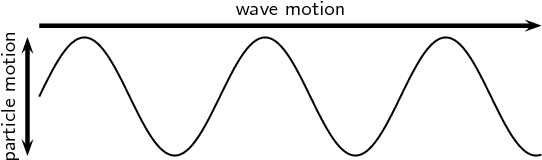
What kind of wave is pictured below?
a)
compressional wave
b)
transverse wave
c)
sound wave
d)
mechanical wave
77.
Waves are a transfer of what?
a)
Heat
b)
Light
c)
Energy
d)
Food
78.

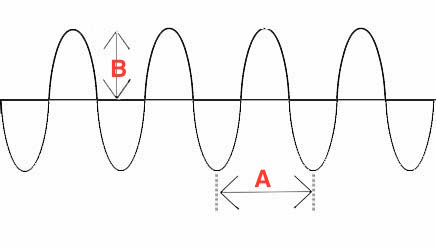
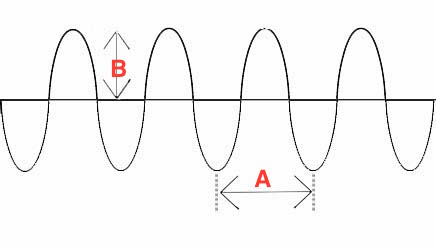
What property of this wave is represented by the letter "A"

a)

amplitude

b)

crest

c)

trough

d)

wavelength

79.
What property of the wave is represented by the letter "B"?
a)
amplitude
b)
crest
c)
trough
d)
wavelength
80.
The number of wavelengths that pass a point each per second is:
a)
frequency
b)
period
c)
longitudinal 
d)
transverse wave 
81.
The type of waves that require medium to pass:
a)
Mechanical Waves
b)
Electromagnetic Waves
82.
Which vocabulary term is used to identify the distance between points C & G?
a)
Amplitude
b)
Crest
c)
Frequency
d)
Wavelength
83.
When the frequency of a wave increases, what happens to the wavelength?
a)
The wavelength is not directly affected by the frequency of a wave.
b)
The wavelength increases.
c)
The wavelength decreases.
d)
More specific information is needed to form a conclusion about the wavelength.
84.
A mechanical wave cannot travel through...
a)
a vacuum(empty space).
b)
water.
c)
air. 
d)
glass.
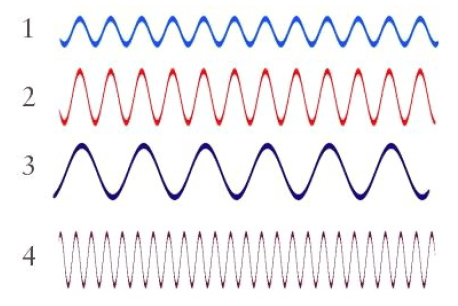
85.
Which wave in the diagram has the greatest frequency?
a)
1
b)
2
c)
3
d)
4
86.
What are the spaced out sections of this wave called?
a)
Reflections
b)
Rarefactions
c)
Compressions
d)
Wavelengths
87.
Which is an example of a longitudinal wave?
a)
light wave
b)
sound wave
c)
visible wave
d)
radio wave
88.
This is what you get when sound waves are reflected, or bounce back, off of a hard surface.
a)
Amplitude
b)
Pitch
c)
Volume
d)
Echo
89.
When a light ray bends as it passes through a lens, what type of behavior does it demonstrate?
a)
reflection
b)
refraction
c)
dispersion
d)
absorption
90.
The action of a wave bouncing off a surface is called __________________.
a)
rarefaction
b)
refraction
c)
reflection
d)
diffraction
91.

What do we call a substance composed of only one type of atom?

a)

coefficient

b)

element

c)

compound

d)

molecule

92.
What do we call a chemical substance made up of 2 or more different types atoms bonded together?
a)
formula
b)
atom
c)
subscript
d)
compound
93.
Bonds between atoms in a molecule form as a result of the sharing  of?
a)
formulas
b)
electrons
c)
atoms
d)
chemicals
94.

2H2O

This number tells how many molecules of a particular compound are present.

a)

coefficient

b)

subscript

c)

compound

d)

element

95.
H2O2← ?
This number tells the number of atoms present.
a)
coefficient
b)
molecule
c)
subscript
d)
atom
96.

2H2O

How many Hydrogen atoms are present in the formula?

a)

2

b)

4

c)

1

d)

10

97.
Which compound has the most atoms?
a)
H2O
b)
O2
c)
C3H6O3
d)
NaCl
98.

Which of the following represent a compound?
a)
Ru
b)
Fe
c)
HO
d)
Pb
99.
Gravitational potential energy depends on the ________ and ________ of the object. 
a)
Height and mass
b)
Friction and movement
c)
Mass and Movement
d)
Height and Friction 
100.
Energy can not be created or destroyed, only converted from one form to another.
a)
true
b)
false
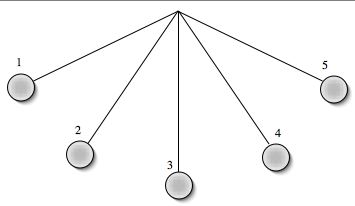
101.
When a pendulum swings, at which point is kinetic energy highest?
a)
1
b)
2
c)
3
d)
4
102.
Explain what happens to the potential energy of a rock as it falls off the side of a cliff.
a)
The kinetic energy decreases as the potential energy increases.
b)
The kinetic energy decreases as the potential energy decreases.
c)
The potential energy decreases as the kinetic energy increases.
d)
The potential energy decreases as the kinetic energy decreases. 
103.

What law of motion says:


An object at rest will remain at rest, and an object at motion will stay in motion unless acted on by an unbalanced force.

a)

Newton's 1st Law of Motion

b)

Newton's 2nd Law of Motion

c)

Newton's 3rd Law of Motion

104.

According to Newton's Third Law of Motion, for every action, there is an equal and opposite

a)

push.

b)

pull.

c)

force.

d)

reaction.

105.
According to Newton’s first law of motion, a moving object that is not acted on by an unbalanced force will
a)
remain in motion.
b)
eventually come to a stop.
c)
change its momentum.
d)
accelerate.
106.
Rockets are launched into space using jet propulsion where exhaust accelerates out from the rocket and the rocket accelerates in an opposite direction.
a)
Newton's 1st Law
b)
Newton's 2nd Law
c)
Newton's 3rd Law
d)
None of them
107.
A magician pulls a tablecloth out from under dishes and glasses on a table without disturbing them.
a)
Newton's 1st Law
b)
Newton's 2nd Law
c)
Newton's 3rd Law
d)
None of them
108.
An empty truck and a fully loaded truck are next to each other at a traffic light. When the light turns green, the lighter truck increases speed more quickly. Which of these best explains this situations
a)
Newton's first law
b)
Newton's second law
c)
Newton's third law
d)
Conservation of momentum
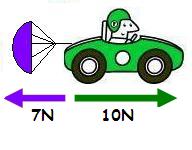
109.
What is the net force?
a)
17 N Right
b)
3 N Right
c)
3 N Left
d)
17 N Left