
 Worksheets
Life Science 2nd Q Summative Test Review
Total questions: 107
Worksheet time: 1hrs 22mins


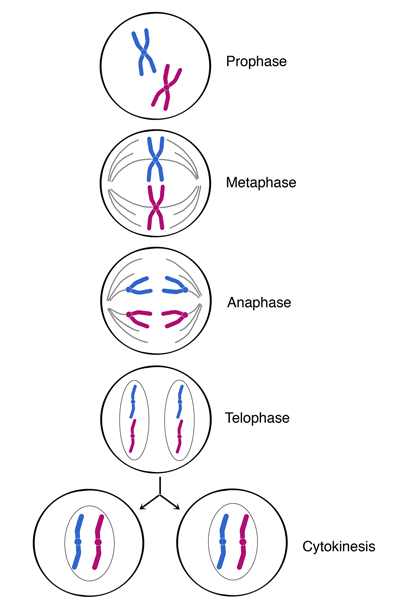


What is the first checkpoint of the cell cycle?
Mitosis checkpoint
G1 checkpoint
G2 checkpoint
A benign tumor differs from a malignant tumor in that a benign tumor
is cancerous
spreads from the original site
does not metastisize
never causes health problems
A ________________is a critical point where stop and go signals can regulate the cycle
tumor
checkpoint
growth factor
oncogene
About what percentage of the population in the US will die from cancer?
10%
15%
20%
25%
The invasion of the bloodstream by a malignant cell that takes up residence in a new location is called.
Metastasis
Metaphase
Benign tumor relocation
cancer relocation
Which type of tumor is worrisome!?
malignant
benign
biopsy
cyclic
Any substance that is known to cause cancer is called a
Pathogen
Biopsy
Carcinogen
Retrovirus
A non-cancerous tumor is
Malignant
Metastatic
Benign
Malign
Cell programmed self destruction is called
Atopic
Apoptosis
Abi-normal
Anticellular
Cancer is
a premature stop in the cell cycle.
uncontrolled mitosis.
programmed cell death.

If two organisms belong to the same order, then they must also belong to the same...
Species
Class
Family
Genus
An organism's scientific name is based on how it is classified. Which of the following levels of classification determine the name?
kingdom & phylum
class & species
domain & order
genus & species
Largest and most general group into which organisms are classified is called...
Species
Class
Domain
Family

Within families, organisms are placed into groups called...
Genus
Kingdom
Class
Phylum
Who created the most commonly used system of taxonomy?
Niels Bohr
Watson and Crick
Charles Darwin
Carl Linnaeus
Which is the correct order?
Kingdom Phylum Order Class
Class Order Family Genus
Domain Phylum Kingdom Species
Order Family Species Genus
Identify the one that is NOT an archaea.
Methanogen
Thermophile
Halophile
Virus
You find a species that seems to be unicellular and is eating smaller cells around it. It has organelles and a nucleus. Which kingdom is it MOST likely a part of?
Fungi
Bacteria
Protists
Plants
Which of the following is NOT a unicellular kingdom?
Prokaryotes
Protists
Archaea
Fungi
Which one is NOT a difference between plants and fungi?
Plants use cellulose but fungi use chitin
Plants are autotrophs but fungi are heterotrophs
Plants have cell walls but fungi don't
Plants make their own food and fungi decompose their food
Which is NOT a eukaryote?
Plants
Animals
Archaea
Protists
What scientific name is correct?
Quercus Alba
Quercus alba
quercus Alba
quercus alba
Canis lupus, the scientific name for a wolf, is in which genus?
Canis
lupus
Animalia
Mammalia

Which category of classification has the largest variety of organisms?
genus
phylum
species
kingdom

Aristotle is said to be the first to classify organisms. Into which two groups did he classify all living things?
fungi and bacteria
humans and animals
living and nonliving
plants and animals

An organism identified with binomial nomenclature includes which two taxa?
class and order
family and genus
genus and species
kingdom and phylum

Type of nutrition that produces its own food
Food
Autotrophic
Heterotrophic
carnivorous

Type of cell with no nucleus
Chloroplast
Bacteria
Eukaryotic
Prokaryotic

What two kingdoms can you see in the picture?
Fungi & Bacteria
Animals & Fungi
Fungi & Plantae
Animals & Plants

CAUSES DISEASE-NO NUCLEUS
FUNGI
BACTERIA
PROTIST

ATHLETES FOOT IS CAUSED BY MEMBERS OF WHAT KINGDOM
PROTIST
FUNGI
EUBACTERIA

APES BELONG TO WHAT KINGDOM
PLANT
ANIMAL
FUNGI
PROTIST

AMOEBA-PARAMECIUM-EUGLENA-DINOFLAGELLATES BELONG TO WHAT KINGDOM
PLANT
PROTIST
FUNGI
ANIMAL
ARCHAEBACTERIA
HOW MANY KINGDOMS ARE THERE?
4
5
6
7
Which of the following is true for both bacteria and viruses?
both contain genetic material
can be killed using antibiotics
have cell organelles
Which statement is true about viruses?
Viruses can eat and metabolize food.
Viruses can reproduce only using a host cell.
Viruses can reproduce on their own at any time.
Medicine used to fight bacterial infections
vaccines
antibiotics
fertilizers
Used to prevent the spread of a virus
vaccines
antibiotics
Aspirin
A bacterium reproduces asexually by dividing to form two new bacterial cells. What is the name of the process by which bacteria reproduce?
meiosis
budding
binary fission
Which of the following is a risk of overusing antibiotics to treat infections>
Bacteria may become resistant to antibiotics.
Antibiotics increase the rate of infection.
Antibiotics cause other diseases to develop.
Bacteria come in which of the following shapes?
rod, cone, spiral
rod, sphere, spiral
rod, sphere, cone
What do viruses need to reproduce?
More viruses
A host cell
Bacteria
Which of the following is a viral infection?
salmonella (food poisoning)
influenza (Flu)
strep throat (streptococcus)
Can a virus be cured with antibiotics?
yes
no
A disease causing microorganism
Pathogen
Mutation
Antibody
Virus that infects bacteria
Spirillium
Bacteriophage
Adenovirus
The common cold is caused by a
Bacteria
Virus
Bacteria are both good and bad
True
False
Prokaryotes that like to live in extreme environments
Eubacteria
Archaea
Bacteriophage
Bacteria that use oxygen
Aerobic
anaerobic
Bacteria are important to the environment because that break down waste materials. They are called _.
Decomposers
Heterotrophs
Autotrophs
Viruses are living organisms
True
False

These characteristics are common between algae and protozoa (three correct answers)
They are eukaryotic
They are always unicellular
They are protoctists
They live in aquatic or moist environments and soils

Protozoa are classified....
According to their color
According to their shape
According to where they live
According to how they move (if they move)

Malaria is a disease caused by...
An alga
A protozoa
A mosquito
A rabbit

Who is more likely to make sugar using sunlight?
Hulk, he's an 'animal'
Groot, he's a 'plant'
Which process converts carbon dioxide, water, and sunlight into sugar and oxygen?
Cell respiration
Nucleus
Chlorosynthesis
Photosynthesis
What are the 2 products of photosynthesis?
Sugar and CO2
sugar and O2
H2O and CO2
H2O and CO2
Which organelle is only in PLANT cells?
Mitochondria
Cell Membrane
Chloroplast
Nucleus

What is the energy transformation that occurs in photosynthesis?
Light energy to Chemical energy
Light energy to Electrical energy
Chemical energy to Light Energy
What are the reactants (inputs) of Cellular Respiration?
Glucose and O2
O2 and H2O
Glucose and CO2
O2 and CO2
Which organelle and process converts chemical energy stored in sugar into ATP?
Chloroplasts via Photosynthesis
Mitochondria via Carbon cycle
Photosynthesis via Chloroplasts
Mitochondria via Cellular Respiration
Which organisms undergo cell respiration?
1. Plants
2. Animals
3. Bacteria
1. Only
1. and 2. Only
3. Only
ALL organisms, 1., 2. and 3.

Process that removes Carbon from the atmosphere:
Photosynthesis
Cell Respiration
Protein Syntesis
Aerobic Cell Respiration
Substance removed by autotrophs from their environment:
CO2
O2
C6H12O6
What are the inputs (reactants) of photosynthesis?
glucose and oxygen
glucose and carbon dioxide
carbon dioxide and oxygen
carbon dioxide and water
Where does photosynthesis take place?
mitochondria
nucleus
chloroplast
ribosome
What is the main pigment in plants?
chlorophyll
glucose
oxygen
carotene
What are the outputs (products) of photosynthesis?
carbon dioxide and water
glucose and oxygen
glucose and carbon dioxide
water and oxygen
What organisms do photosynthesis?
animals
plants
plants and animals
all living things
What are the inputs (reactants) of cellular respiration?
carbon dioxide and water
glucose and water
carbon dioxide and oxygen
glucose and oxygen
Where does cellular respiration take place?
chloroplast
lungs
mitochondria
nucleus
Which of the following is the correct equation for PHOTOSYNTHESIS?
6CO2 + light + 6H2O --> 6O2 + Sugar
6CO2 + sugar + H2O --> 6O2 + light
O2 + light + H2O --> 6CO2 + Sugar
CO2 + 6O2 + H2O --> Light+ Sugar
Which of the following is the correct equation for PHOTOSYNTHESIS?
6CO2 + light + 6H2O --> 6O2 + Sugar
6CO2 + sugar + H2O --> 6O2 + light
O2 + light + H2O --> 6CO2 + Sugar
CO2 + 6O2 + H2O --> Light+ Sugar


