
 Worksheets
untitled
Total questions: 102
Worksheet time: 6hrs 26mins
Which of the following helps enzyme to function well?
Product
Cofactor
Inhibitor
Substrate

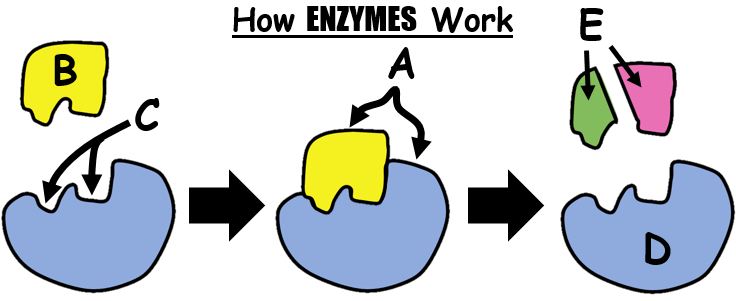
Diagram 5 shows the mechanism of enzyme action.
Which part labelled A, B, C and D represents the substrate?
A
B
C
D

Diagram 5 shows the action of an enzyme on a substrate.
What is S if P is lactase, Q is lactose and R is glucose?
maltose
glucose
fructose
galactose
Which of the following is an enzyme inhibitor?
Iron
Mercury
Penicillin
Vitamin B
Which equation shows the enzymatic reaction in stomach?
Starch + water --Amylase----> Maltose
Protein + water --Pepsin--> Polypeptide
Fat+ water --Lipase---> Fatty acids + Glycerol
Lactose+ water --Lactase---> Glucose + Galactose
Enzymes are
Protiens
Lipids
Carbohydrates
DNA
On an enzyme, the site that attaches to a substrate
Polypeptide
Base
Substrate
Active site


Diagram shows a graph of the optimum pH of enzyme activity.
Which of the curves A,B,C or D represents the activity of pepsin?
A
B
C
D

Diagram is a graph which shows the relationship between the rate of reaction and the substrate concentration when factor Y is varied.
What is factor Y?
pH
Time
Inhibitor
Enzyme concentration


Reactions that build up molecules
catabolic reaction
anabolic reaction
thermal expansion
reactants and products
Reactions that break down molecules
anabolic
burning
catabolic
thermal
Combination of anabolic and catabolic reactions
metastasis
anacatabolism
catabolism
metabolism
Biological catalysts speed up reactions are unchanged by the reaction
firestarters
products
enzymes
fuel
Molecule the enzyme works on
substrate
product
solvent
enzyme
Maltase is the enzyme that breaks apart
maltose
lactose
sucrose
Peptidase
What happens when animals die
Their nitrogen compounds dissipate into the air
Their nitrogen compounds will return to the soil
Their nitrogen compounds produce toxic gas
Their nitrogen compounds combine with oxygen
In which type of Inhibition where the inhibitor binds to the same active site of the substrate?
Uncompetitive
Non competitive
Competitive
All of the above
Which domain of an enzyme is non-protein?
Active site
The stabilizing body
The upper most region
Co-factor
If the temperature is reduced to 27 degree celcius, a reaction rate will ______
increase
decrease
stay the same
If the concentration of a reactant is increased, the reaction rate will ___________.
increase
decrease
stay the same

Graph a is the normal enzyme plot of rate of reaction vs substrate concentration. Graph b and c are the graphs plotted with inhibitors. Graph ____ is a __________ type of inhibition with a lowered Vmax.
b, competitive
b, noncompetitive
c, competitive
c, noncompetitive
In transamination, the NH2 group on one molecule is exchanged with the =O group on the other molecule. The amino acid becomes α-keto acid _____________, and α-keto acid becomes an α-amino acid _____________
(anabolism), (catabolism)
(catabolism), (anabolism)
(anabolism), (biosynthesis)
(catabolism), (breakdown)
Molecule produced by enzymes
catalyst
product
reactant
enzyme
Activation energy
increases the amount of product
increased using a catalyst
lowered using a catalyst
lowers the amount of product
Amino acids joined together form
peptides
pepsi
carbohydrates
phospholipids
Starch molecules are broken up into maltose (2 glucose molecules) before breaking into monomers of
enzymes
phospholipids
amino acids
glucose
Fat molecules are made up of one glycerol molecule and three
energy units
fatty acid molecules
amino acid molecules
enzymes
The arrow in a chemical reactions means
go this way
no reaction takes place
reversible reaction
change into

How do enzymes speed up chemical reactions? Enzymes
lower the activation energy of chemical reactions.
raise the temperature of the cell, speeding chemical reactions.
store ATP, allowing more energy to be used in chemical reactions.
act as miniature "transfer trucks", gathering materials for chemical reactions, and placing them together.

What is the optimum temperature for this enzyme?
20 degrees Celsius
45 degrees Celsius
52 degrees Celsius
64 degrees Celsius
Which suffix (word ending) is used in the names of most enzymes?
-ase
-in
-ine
-ose

What can be inferred using the graph?
Cells can function equally as well at all pH values.
Cells do not function well at pH values that are too high or too low.
Cells function best at high pH values.
Cells function best at low pH values.

In the enzymatic reaction, the __________ is on the left of the arrow, while the products are to the right of the arrow.
enzyme
filtrate
pre-product
reactant
Each enzyme produced by the body is
open - meaning it is able to catalyze a reaction with any molecule.
immature - meaning it cannot catalyze a reaction until many years later.
incomplete - meaning it requires other parts before it is able to bind to a molecule.
specific - meaning it is only able to catalyze a rection with a certain molecule.
Which of the following two factors affect an enzyme's operation the most?
amount of light and temperature
blood glucose and pH
temperature and pH
amount of light and pressure

What substances are formed as a result of this reaction?
hydrogen peroxide and water
water and oxygen
hydrogen peroxide and oxygen
water and ozone

What is the optimum pH for the enzyme salivary amylase?
2
5
6.2
9.1
Enzymes are a type of which macromolecule?
carbohydrate
lipid
protein
nucleic acid
Why are enzymes needed for life?
They speed up all the chemical reactions in living things.
They are the main proteins that make up our body structure.
The provide energy to all living things.
They provide genetic information.
Which would be the enzyme that breaks down the starch amylose?
amylase
maltase
lactase
amylose
What is activation energy?
the energy from the sun
the energy produced by an enzyme
the energy needed to get a reaction going
none of these
What does it mean when an enzyme is denatured?
that there is an acid around
that the enzyme works faster
that it is providing energy for the cell
that the shape is changed of the active site & it no longer works

Which labeled part is the substrate?
letter A
letter B
letter D
letter E

Which labeled part is the enzyme?
letter A
letter B and D
letter D
letter E
Which model describes the active site of the enzyme changing shape slightly to fit the substrate?
'twisted ladder' model
'estimation' model
'induced fit' model
'lock and key' model
Which of the following describes the role that enzymes play in the process of metabolism?
Enzymes carry the genetic instructions required for a cell to initiate metabolism.
Enzymes increase the rate of the chemical reactions carried out during metabolism.
Enzymes provide the chemical energy that is broken down and released during metabolism.
Enzymes store the chemical energy that is used to construct nucleic acids during metabolism.
In the lock-and-key model of enzyme action, the __________ fits into the __________ of the enzyme.
product; substrate
active site; product
substrate; active site
active site; substrate
catalyst =
enzyme used to break down nucleic acids
substance that speeds up the rate of a chemical reaction
minerals that assist in the normal functioning of enzymes
the part of an enzyme where the substrate binds to the enzyme and where the chemical reaction occurs
Where does the substrate bind on an enzyme?
active site
allosteric site
binding site
product site


What is the main energy carrier for life?
Glucose
Adenosine Triphosphate (ATP)
Pyruvate
Lactic Acid
What happens to unusable energy in biological systems?
It is stored for later use
It is converted into usable energy
It is transferred to other organisms
It is released as heat
What is metabolism?
All of the chemical reactions in a cell
The conversion of energy
The transfer of energy
The breakdown of glucose
What is the role of enzymes in metabolic pathways?
They convert energy into ATP
They facilitate the breakdown of glucose
They guide and catalyze each reaction step
They store energy for later use
What is ATP coupling?
The process of coupling ATP hydrolysis with an unfavorable reaction
The process of converting ATP into glucose
The process of hydrolyzing ATP
The process of converting glucose into ATP
Which of the following is an example of energy transfer in the human body?
Breathing air
Thinking
All of the above
Digesting food
What happens to the amount of usable energy available to do work in every energy transfer?
It increases
It decreases
It remains constant
It depends on the type of energy
_____ is defined as the ability to do work.
Enzyme
Energy
Work
Inhibition
____________describes the general process of breaking down large molecules into smaller ones.
Which of the following best explains why enzymes are necessary for reactions in our cells?
The reactions are too slow to meet the needs of the cell if enzymes are missing.
Enzymes supply the oxygen necessary for the reactions.
Enzymes change reactants from solid to liquid during the reactions.
The reactions take up too much space in the cell if enzymes are missing.
Enzymes are _______________ that _____________________ chemical reactions by ____________ the amount of activation energy required to start the reaction.
carbohydrates, slow down, lowering
proteins, speed up, increasing
lipids, speed up, lowering
proteins, speed up, lowering
Which statement is true regarding the catabolic pathway?
Molecules are synthesized using dehydration synthesis
Polymers are broken down into their monomeres
Catabolic pathways are used to construct macromolecules such as carbs, lipids and proteins
Catabolic reactions consume energy
What happens to an enzyme when it is denatured?
Activation energy is lowered
It becomes stronger
It loses its shape
Activation energy is raised
What happens when enzymes are heated to a high temperature?
The shape of the enzyme are changed and it denatures
The enzymes die
The enzymes' amino acid sequence changes
The enzymes remain the same
Releases energy
endothermic reaction
exothermic reaction
Absorbs energy
endothermic reaction
exothermic reaction
Substances that are changed during a chemical reaction
reactants
products
Slows down reaction
temperature
pH
cataysts
competitive inhibitor

