wayground logo

Free Printable Worksheets

Font size

S
M
L
XL
Worksheets

Biology 2nd Semester Final

Total questions: 100

Worksheet time: 2hrs 40mins

Name
Class
Date
1.

The clear, jelly-like material in a cell that supports and protects the cell’s organelles.

a)

Cytoplasm

b)

Cell Membrane

c)

Nucleus

d)

Mitochondria

2.

The part of the cell that makes protein.

a)

Vacuoles

b)

Ribosomes

c)

Golgi Apparatus

d)

Cytoplasm

3.
Breaks down food  to release energy. Known as the power plant of the cell.
a)
Endoplasmic Reticulum
b)
Mitochondria
c)
Ribosomes
d)
Cell Wall
4.
The control center of the cell.
a)
Nucleus
b)
Nuclear Membrane
c)
Chloroplasts
d)
Golgi Aparatus
5.
_______ regulates what enters and leaves a cell.  
a)
Cell Membrane
b)
Nucleus
c)
Mitochondria
d)
Cytoplasm
6.
Complex molecule that carries genetic information that defines an organism's traits. It is stored in the nucleus.
a)
DNA
b)
protein
c)
RNA
d)
glucose nucleic acid (GNA)
7.
How many alleles (letters) do each person carry for a trait?
a)
1
b)
2
c)
3
d)
4
8.
How many alleles (letters) does a child get from each parent for each trait?
a)
1
b)
2
c)
3
d)
4
9.
Dominant alleles are represented by a:
a)
Male gene
b)
lowercase letter
c)
recessive trait
d)
capital letter
10.
Aa, DD, bB, yy are all examples of
a)
genotypes
b)
phenotypes
11.
What you see, or the physical appearance.
a)
Genotype
b)
Phenotype
c)
Homozygous
d)
Heterozygous
12.
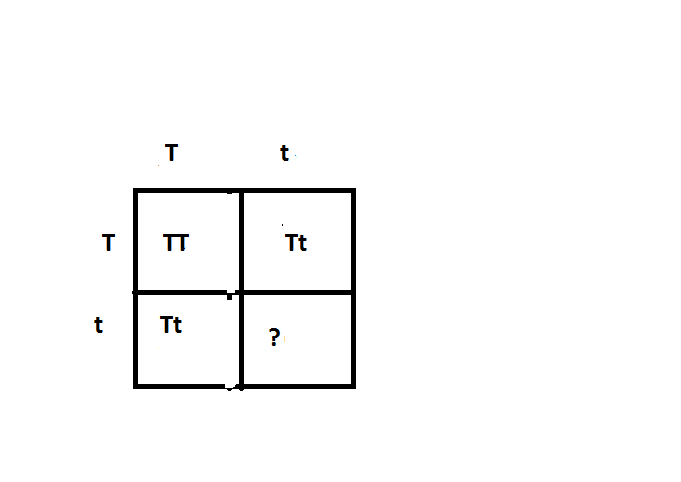
T - tall and t = short
In the punnett square below, what belongs in the missing square
a)
tt
b)
Tt
c)
Bb
d)
TT
13.
AA and Aa always show up as
a)
dominant
b)
recessive
14.
aa always shows up as
a)
dominant
b)
recessive
15.
In a pedigree, what shape represents a male?
a)
circle
b)
square
c)
triangle
d)
diamond
16.
What gender has an X and a Y chromosome?
a)
male
b)
female
c)
transgender 
d)
all of the above
17.
What is a punnett square?
a)
graph used to predict the possible genotypes of offspring in a given cross
b)
a graph used to predict the possible birth rate of offspring.
c)
a graph used to predict the possible behavioral characteristics an offspring could have
d)
None of the above
18.
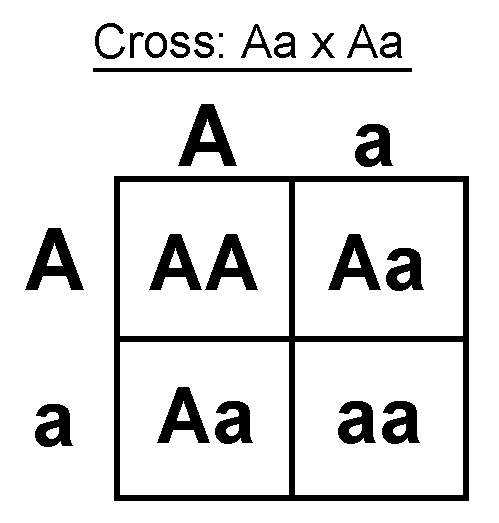
What is the phenotype of the offspring? (A-Brown hair; a-blond hair) 
a)
50 % Brown Hair and 50% Blond Hair 
b)
25 % Brown Hair and 75% Blond Hair 
c)
75 % Brown Hair and 25% Blond Hair 
d)
0% Brown Hair and 100% Blond Hair 
19.

Macromolecule which provides insulation, stores energy and cushions internal organs.

a)

Carbohydrates

b)

Proteins

c)

Lipids

d)

Nucleic Acids

20.
DNA and RNA are examples of...
a)
proteins
b)
nucleic acids
c)
carbohydrates
d)
lipids
21.

In what organelle of plant cells does photosynthesis occur?

a)

mitochondria

b)

centrioles

c)

chloroplast

d)

ribosomes

22.
A structure not found in animal cells
a)
cell wall
b)
cell membrane
c)
nucleus
d)
mitochondria
23.
Which organelle is only found in a plant cell? 
a)
nucleus
b)
chloroplast
c)
mitochondria
d)
cell membrane
24.
Sorts, packages, and ships proteins to their final destination
a)
Ribosome
b)
Lysosome
c)
Endoplasmic Reticulum
d)
Golgi Apparatus
25.
Does NOT contain a nucleus
a)
Eukaryotic
b)
Prokaryotic
c)
All cells
26.
Has ribosomes
a)
Eukaryotic
b)
Prokaryotic
c)
All cells
27.
The cell membrane is selectively permeable, which means...
a)
All materials can enter and leave the cell
b)
Certain things can enter while others cannot
c)
The cell manually sorts through all materials
d)
Only certain cells can interact with the cell.
28.
The rabbit's ORIGINAL source of energy is from the...
a)
plant
b)
sun
c)
ATP
d)
glucose
29.
What is the function of a carbohydrate?
(Why do I need this before a workout?)
a)
Quick energy
b)
Movement
c)
Stores genetic information
d)
Speeds up reactions
30.
Which sequence of DNA bases would pair with this partial strand
ATG TGA CAG
a)
ATG TGA CAG
b)
TAC ACT GTC
c)
GTA AGT GAC
d)
CAT TCA CTG
31.
DNA replication results in two DNA molecules,
a)
each one with two original strands
b)
each one with two new strands
c)
each one with one new strand and one original strand
d)
one with two new strands and the other with two original strands
32.
Fruit fly body cells have 8 chromosomes. After mitosis, you would expect a resulting fruit fly daughter cell to have ...
a)
16 chromosomes.
b)
46 chromosomes.
c)
8 chromosomes.
d)
4 chromosomes.
33.
The stages of mitosis in order
a)
Metaphase, Anaphase, Prophase, Telophase
b)
Prophase, Anaphase, Metaphase, Telophase
c)
Prophase, Metaphase, Anaphase, Telophase
d)
Anaphase, Prophase, Telophase, Metaphase
34.
Why would it be important to replicate DNA before a cell divides in mitosis or meiosis?
a)
In order for genetic information to be transferred into daughter cells.
b)
In order for the cell to be able to increase in size.
c)
In order for the DNA to be contained in the nucleus.
d)
In order for the cell to re-order the DNA sequencing in the new cells.
35.
Before cells can divide, what must be copied?
a)
mitochondria
b)
cytoplasm
c)
DNA
d)
Cell Wall
36.
The image illustrates which process?
a)
Mitosis
b)
Meiosis
37.
Which of the following statements best explains the overall purpose of MITOSIS?
a)
Asexual reproduction of somatic cells
b)
To produce gametes
38.
Which of the following statements best explains the overall purpose of MEIOSIS?
a)
Asexual reproduction of somatic cells
b)
To produce gametes
39.
If a parent cell has 88 chromosomes, following MITOSIS, the daughter cells will have ___ chromosomes.
a)
42
b)
88
c)
Impossible to know
40.

If a parent cell has 88 chromosomes, following MEIOSIS, the daughter cells will have ___ chromosomes.

a)

44

b)

88

c)

Impossible to know

41.
Produces genetically identical daughter cells.
a)
Mitosis
b)
Meiosis
c)
Both Mitosis and Meiosis
42.
Produces genetically varied daughter cells.
a)
Mitosis
b)
Meiosis
c)
Both Mitosis and Meiosis
43.
Process needed for growth and injury repair
a)
Mitosis
b)
Meiosis
c)
Both Mitosis and Meiosis
44.
Takes place all over the body
a)
Mitosis
b)
Meiosis
c)
Both Mitosis and Meiosis
45.
Takes place only in reproductive organs
a)
Mitosis
b)
Meiosis
c)
Both Mitosis and Meiosis
46.
Uncontrollable cell growth is known as _____
a)
obesity
b)
cancer
c)
diabetes
d)
hepatitis
47.
A pair of chromosomes that consists of  XX is  a __________________.
a)
Male
b)
Female
48.
In the S stage of interphase_______________
a)
the cell grows
b)
the nucleus divides
c)
the cell membrane divides
d)
the DNA is replicated
49.
Which of the following is heterozygous?
a)
Hh
b)
gg
c)
HH
d)
GG
50.
Heredity is the passing of traits from _____________________ to _____________________
a)
predators to prey
b)
water to rain
c)
parents to offspring
d)
fungi to protists
51.
Which best describes the process shown?
a)
mutation in which the DNA content of the gene is ltered
b)
segregation of sister chromatids
c)
condensation and segregation of the alleles
d)
crossing-over which alleles are exchanged
52.
What is one advantage of sexual reproduction?
a)
offspring are identical to parents
b)
offspring are resistant to viruses
c)
offspring are born live, rather thna from eggs
d)
offspring inherit a wider variety of genetic information
53.
How much energy is passed on to each trophic level in an energy pyramid?
a)
10%
b)
90%
c)
50%
d)
80%
54.

Living factors or organisms that affect an ecosystem

a)

abiotic factors

b)

species

c)

trophic level

d)

biotic factors

55.

The largest number of individuals in a species that an environment can support long term

a)

carrying capacity

b)

emigration

c)

immigration

d)

population density

56.

Biotic or abiotic things that control the size of a population

a)

Limiting factor

b)

density- dependent factor

c)

density- independent factot

d)

tolerance

57.
The rabbit in this food web would be considered a:
a)
Decomposer
b)
Producer
c)
Secondary Consumer
d)
Primary Consumer
58.
Which biomolecule is made of amino acids?
a)
Nucleic Acid
b)
Carbohydrate
c)
Protein
d)
Lipid
59.
which cell is a eukaryote
a)
only a
b)
only b
c)
a and b
d)
only c
60.
which symbiosis is this 
a)
parasitism 
b)
mutualism
c)
commensalism
d)
nonalism 
61.
symbiotic relationship in which both organisms benefit
a)
competition
b)
Mutualism
c)
nitrogen fixation
d)
energy pyramid
62.
An organism that produces its own food supply from inorganic compounds is called a(an)
a)
heterotroph
b)
consumer
c)
detritivore
d)
autotroph
63.
Which of the following would be the most likely effect, if there were a sudden increase in the cricket population?
a)
There would be a decrease in the small bird population.
b)
There would be a decrease in the grass/flowers population.
c)
There would be a decrease in the mice population.
d)
There would be an increase in the grass/flowers population.
64.
Which of the following is the correct order of organization in living things from most basic (simple) to most complex?
a)
a.  Organism, cell, tissue, organ, organ system
b)
a.  Organ system, organ, tissue, cell, organism
c)
a.  Cell, tissue, organ, organ system, organism
d)
a.  Cell, organ, tissue, organ, organism, organ system
65.
A group of similar cells that come together to perform a specific function is a/an
a)
organ
b)
organism
c)
organ system
d)
tissue
66.
When a group of organs work together to perform a particular function they create a/an
a)
organ system
b)
organism
c)
tissue
d)
organ
67.
The smallest level of organization of life in an organism
a)
tissue
b)
cell
c)
organ
d)
organ system
68.
The cell is the building block of all living things.
a)
True
b)
False
69.
Which is an example of an organism?
a)
a beetle
b)
a lake
c)
a rock
d)
a shell
70.
The basic unit of structure and function in the human body is the....
a)
organ
b)
organ system
c)
cell
d)
tissue
71.
Tissue that works together to perform a function
a)
organ
b)
cell
c)
organ system
d)
organism
72.
Which level of organization is the most complex?
a)
organism
b)
population
c)
community
d)
ecosystem
73.
Multiple organisms of the same species describes a
a)
organism
b)
population
c)
community
d)
ecosystem
74.
What do ecosystems have that the other three levels of organization do not have?
a)
living things
b)
biotic factors
c)
abiotic factors
d)
organisms
75.
A forest full of many kinds of trees and grasses is an example of a
a)
group
b)
organism
c)
population
d)
community
76.
Which of the following units are repeatedly joined together to form a strand of DNA?
a)
amino acids
b)
nucleotides
c)
fatty acids
d)
polysaccharides
77.
The enzyme that unwinds the DNA to prepare for replication
a)
helicase
b)
replicase
c)
polymerase
d)
synthase
78.
A process in which DNA has the unique ability to make an exact copy of itself.
a)
Replication
b)
Translation
c)
Transcription
79.
Which enzyme is responsible for adding nucleotides?
a)
Topoisomerase
b)
DNA Polymerase
c)
Ligase
d)
Primase
80.
What will the first four bases of the new DNA strand look like if copying the template strand?
a)
TGGT
b)
ACCA
c)
GTTG
d)
CAAC
81.
Why does DNA replicate?
a)
To create another copy for the new cell
b)
To create a duplicate copy in case the original gets damaged
c)
To create a new copy to replace the damaged original
82.
Which of the following best describes a DNA molecule?
a)
double helix
b)
contains ribose
c)
made of amino acids
d)
contains Uracil
83.
In a molecule of double-stranded DNA, the amount of Adenine present is always equal to the amount of
a)
cytosine
b)
guanine
c)
thymine
d)
uracil
84.
Guanine bonds with ______________.
a)
Adenine
b)
Guanine
c)
Cytosine
d)
Thymine
85.
Which 2 molecules form the sides (backbone) of the DNA ladder?
a)
deoxyribose sugar and adenine
b)
deoxyribose sugar and a hydrogen bond
c)
deoxyribose sugar and the nucleus
d)
deoxyribose sugar and phosphate
86.
Nitrogenous bases are joined by which type of bond?
a)
polar bonds
b)
ionic bonds
c)
covalent bonds
d)
hydrogen bonds
87.
What are the three components of a nucleotide?
a)
sugar, hydrogen, nitrogen base
b)
sugar, oxygen, nitrogen base
c)
sugar, phosphate, nitrogen base
d)
sugar, phosphate, protein
88.
The haploid number of human chromosomes is
a)
11
b)
12
c)
23
d)
46
89.
The diploid number of human chromosomes is
a)
23
b)
46
c)
92
90.
Each identical side of a chromosome is the 
a)
centromere
b)
chromatin
c)
centriole
d)
chromatid
91.
Autosomes are
a)
chromosomes found in autotrophs, only
b)
chromosomes that automatically correct all errors in the DNA
c)
chromosomes that determine traits other than sex
d)
chromosomes that determine the sex of the individual
92.
The structure that holds two chromosomes together until they separate for cell division is the
a)
chromatid
b)
chromatin
c)
centromere
d)
cytoplasm
93.

Chromosomes are made from protein and what other molecule?

a)

Ammonia

b)

ATP

c)

DNA

d)

Carbon Dioxide

94.

When an area of a chromatid is exchanged with the matching area on a chromatid of its homologous chromosome, _____ occurs.

a)

crossing over

b)

mutagenesis

c)

hybridization

d)

fertilization

95.

_____ determines the number of chromosomes.

a)

The number of centromeres

b)

The number of centrioles

c)

The number of centrosomes

d)

All of these are correct.

96.
Proteins are made of monomers called ___________
a)
Nucleotides
b)
Monosaccharides
c)
Amino Acids
d)
Glycerol and fatty acids
97.
Monosaccharides are monomers of
a)
Carbohydrates
b)
Lipids
c)
Proteins
d)
Nucleic Acids
98.
Waxes, oils and fats are examples of
a)
Carbohydrates
b)
Lipids
c)
Proteins
d)
Nucleic Acids
99.
What are the four macromolecules?
a)
proteins, nucleic acids, carbohydrates, and lipids
b)
monosaccharides, lipids, polysaccaharides, and proteins
c)
RNA, DNA, proteins, and carbohydrates
d)
proteins, DNA, RNA, and steroids
100.
All polymers are made up of...
a)
monosaccharides
b)
monomers
c)
proteins
d)
None of these