
 Worksheets
Biology Final Review
Total questions: 99
Worksheet time: 1hrs 27mins
The cell theory is...
All living organisms are composed of at least one cell.
building blocks of life. All cells come from
All of the above
Cells arise only from previously existing cells.
A prokaryotic cell is...
Cells that don't contain a nucleus but do contain other membrane-bound organelles.
Cells that contain a nucleus but no other membrane-bound organelles.
Cells that contain a nucleus and other membrane-bound organelles.
Cells that don't contain a nucleus or any other membrane-bound organelles.
The cell membrane main purpose is...
Selective Permeability
Energy Production
Locomotive
Looking good
What is the outer most part of a cell?
cell wall
nucleus
cell membrane
cell skin

True or False: The main function of a lipid is to store energy.
True
False
The units of protein are
Amino acids
Glucose
Fatty acid
Peptides
Which process is used to make mRNA from the DNA in the nucleus?
transcription
translation
replication
Transcribe the following DNA sequence into RNA:
AAT TAG GGC TCG
AAT TAG GGC TCG
TTA ATC CCG AGC
UUA AUC CCG AGC
TTU UTC CCG UGC
A mutation is defined as:
A change in the cell's structure
Anything that changes in an embryo
Any change in the physical features of a human
A change in the DNA sequence
Another name for a point mutation is:
Substitution
Frameshift
Insertion
Deletion
ATTTGAGCC- Original
ATTGAGCC - Mutated
The example above is an example of a
Insertion
Point mutation
Deletion
Substitution
This type of mutation involves removing a piece of DNA where it belongs.
Known as a frameshift mutation.
Substitution Mutation
Insertion Mutation
Deletion Mutation
The structure of a protein folding determines its
Function
Properties
Why is mRNA important?
It can leave the nucleus unlike DNA
It is smaller than DNA
It can travel to the golgi apparatus
Where does transcription occur?
The ribosome
The nucleus
The golgi apparatus
Where does tanslation occur
The nucleus
The Ribosome
The Golgi Apparatus
Where must mutations happen in order for them to be passed down to future generations?
In gamete cells
In somatic cells
What are the reactants of photosynthesis:
Water and Carbon Dioxide
Oxygen and Carbon Dioxide
Water and Oxygen
Where does a plant get its mass from?
CO2
Oxygen
Water
Sunlight
What is the job of messenger RNA?
to transfer amino acids
to assemble the protein
to carry genetic information
An organism's ability to maintain stable internal conditions necessary for life
metabolism
stimulus
growth spurt
homeostasis
Which of the following is NOT a characteristic of all living things?
growth and development
response to the environment
ability to have great singing voice
to reproduce
What is the correct equation for cellular respiration?
6C2 + C6H12O6 --> 6CO2+6H20+ Energy
6CO2+6H20-->6O2+C6H1206 +Energy
There are _ pairs of chromosomes in a human body cell.
23
46
43
2018
Which organelle bonds amino acids together to make proteins?
mitochondria
ribosomes
nucleus
Golgi apparatus
Cancer results from gene that control...
Digestion
cell division
respiration
photosynthesis
Which of the following is an autotroph?
cat
tree
mushroom
leopard
True or False: Cellular respiration is called anaerobic process because it requires oxygen
True
False
Prokaryotes lack
cytoplasm
a nucleus
a plasma membrane
genetic material


What is the image above:
Chromosome
Chromotid
Centromere
Centriole

What stage of mitosis is depicted here
Prophase
Metaphase
Anaphase
Telophase

What stage of mitosis is depicted here
Prophase
Metaphase
Anaphase
Telophase
In which phase does a cell spend most of its life?
Interphase
Prophase
Metaphase
Anaphase
Telophase
WHAT DOES MEIOSIS CREATE?
CHROMOSOMES
GAMETES
DNA
TRAITS
THE END RESULT OF MEIOSIS IS...
FOUR UNIDENTICAL GAMETES
FOUR IDENTICAL GAMETES
TWO IDENTICAL GAMETES
TWO UNIDENTICAL GAMETES
THE GAMETES ARE CONSIDERED TO HAVE ONE HALF OF THE GENETIC INFO SO IT IS CALLED
DIPLOID (2N)
DIPLOID (N)
HAPLOID (2N)
HAPLOID (N)


Unicellular organisms that lack a nucleus and other cellular organelles are known as...
Prokaryote
Eukaryote
Heterotroph
Autotroph


If you cross a white flower (pp) with a purple flower (PP), the possible genotypes of the offspring are
PP and pp
All Pp
All PP
All pp
If you crossed a PP (purple) with a pp (white), what would the phenotypes be?
all white
all tall
all purple
1/2 white, 1/2 purple
_____________ describes a trait that covers over, or masks another form of that trait.
recessive
gene
allele
dominant


Produces four cells
Mitosis
Meiosis
Both

In animals, shaggy fur is dominant to short fur. According to the genotypes shown, what percent of offspring will have short fur?
0
25
50
75
100
Hair color, height, eye color and freckles are examples of human traits. What do we call the physical expression of the genetic material of an organism?
genetics
heredity
genotype
phenotype
Heterozygous is when...
the alleles are the same.
the alleles are different.
the alleles are absent.
the alleles are present.
In a heterozygous genotype, the ___________ allele takes over in the phenotype.
recessive
dominant
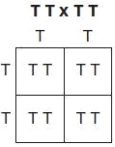
Bb is a ______.
genotype
phenotype
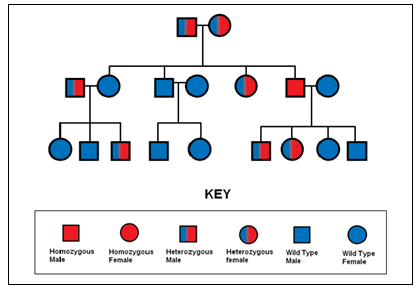
In a pedigree, which shape represents a male?
circle
square

On a pedigree, this symbol represents a ---
not affected female.
not affected male.
affected male.
affected female.

On a pedigree, this symbol represents a ----
not affected male.
not affected female.
affected male.
affected female.

How many individuals are there in the 3rd generation?
1
2
4
6

What is the mode of inheritance shown here?
Recessive because it "skips" a generation
Dominant because it shows up in every generation

On this pedigree, the allele for curly hair is dominant. The couple labeled 2 both have curly hair, but have a daughter who does not have curly hair. Therefore, we can tell from the chart that for the couple labeled 2 -
the male is heterozygous and the female is heterozygous.
the male is homozygous recessive and the female is homozygous dominant.

Why do all the daughters in Generation II carry the colorblind gene?
Because mom passed on the gene.
Because dad passed on the X chromosome.
The large-scale events of speciation are called...
macroevolution
simplification
adaptation
microevolution
Which of the following lines of evidence shows that whales are descended from a land-dwelling, four-legged ancestor?
Whales have bone structures in their forelimbs and pelvis that are similar to those of terrestrial mammals
Whale embyros have similar structure to embryos of land-dwelling mammals, birds, and reptiles.
An analysis of DNA shows that whales' closest living relatives are hippopotamuses.
A, B, and C
During microevolution, a(n) __________________ will become more or less common within a population.
species
allele
ribosome
fossil

The three species pictured do not share a common ancestor, yet have evolved to have a similar anatomy and life style. This is an example of ?
Homologous Structures
Divergent Evolution
Vestigial Organs
Convergent Evolution

The three species pictured share a common ancestor and have adapted so that each lives in a different environment. This is an example of
Law of Superposition
Evolutionary Arms Race
Divergent Evolution
Convergent Evolution
What is the process in evolution that led to development of different kinds of beaks in finches?
mimicry
macroevolution
natural selection
Genetic fitness means that an organism's ability to do what is high?
lift weights really well
reproduce effectively
attract other members of their species
survive environmental disasters
Microevolution happens in
species
individuals
populations
households

The palmarus longus tendon, pictured here, no longer serves a purpose in humans, but provides evidence of our species descendance from tree-dwelling ancestors. The palmarus longus tendon is an example of:
a vestigial structure
a homologous structure
bipedalism
convergent evolution


Many different groups of organisms have wings, even though they do not share a recent common ancestor. This is because they evolved in environments with similar selective pressures. Wings are an example of a(n) ______________ structure.
vestigial
analogous
homologous

In humans, the haploid number of chromosomes is ____.
23
46
69
92
Which of the following is the best definition for MEIOSIS?
the process of two haploid cells uniting
the counting of chromosomes within a diploid cell
a two-step process that reduces the number of chromosomes in half such that there is only one copy of all the chromosomes
the equational division of a cell into two identical copies
Which of the following are CORRECT observations about the differences between MITOSIS and MEIOSIS? (Check all that apply.)
Mitosis produces cells that identical to the parent cell.
Meiosis produces cells that have half the number of chromosomes as the parent cell.
All cells go through INTERPHASE as part of the cell cycle, whether it goes to mitosis or meiosis next.
In both types of cell division, the chromosomes are only duplicated once.
Only in Mitosis, do you see chromosomes pair up to form a tetrad.
The products of MEIOSIS have _______ number of chromosomes.
haploid
diploid

