wayground logo

Free Printable Worksheets

Font size

S
M
L
XL
Worksheets

Semester Review Part 1

Total questions: 112

Worksheet time: 5hrs 34mins

Name
Class
Date
1.
What is the study of the composition, structure, and properties of MATTER?
a)
Chemistry
b)
Biology
c)
Geology
d)
Physics
2.
Anything that takes up space and has mass is known as _______________.
a)
Matter
b)
Molecules
c)
Compounds
d)
Stuff
3.
What are the building blocks of MATTER?
a)
Atoms
b)
Cells
c)
Protons
d)
Neutrons
4.
What are the positively charged particles in an atom?
a)
Protons
b)
Neutrons
c)
Electrons
5.
Electrons have what charge?
a)
Negative
b)
Positive
c)
Neutral
 (No Charge)
6.
Neutrons have what charge?
a)
Negative
b)
Positive
c)
Neutral
 (No Charge)
7.
The nucleus of an atom is made up of...
a)
Protons and Neutrons
b)
Neutrons and Electrons
c)
Protons and Electrons
8.
The image shows the periodic grid for POTASSIUM. What is Potassium's atomic number?
a)
19
b)
39
c)
20
d)
Impossible to tell
9.
The image shows the periodic grid for POTASSIUM. What is Potassium's atomic mass?
a)
19
b)
39
c)
20
d)
Impossible to tell
10.
The image shows the periodic grid for POTASSIUM. How many PROTONS are found in a potassium atom?
a)
19
b)
39
c)
20
d)
Impossible to tell
11.
The image shows the periodic grid for POTASSIUM. How many ELECTRONS are found in a potassium atom?
a)
19
b)
39
c)
20
d)
Impossible to tell
12.
The image shows the periodic grid for POTASSIUM. How many NEUTRONS are found in a potassium atom?
a)
19
b)
39
c)
20
d)
Impossible to tell
13.
A(n) ____________________ is a pure substance made of a single type of atom and cannot be broken down.
a)
Element
b)
Compound
c)
Molecule
d)
Mixture
14.
What does the ATOMIC MASS tell us about an atom?
a)
Protons + Neutrons
b)
Protons + Electrons
c)
Neutrons + Electrons
15.
What holds atoms, molecules, and compounds together?
a)
Chemical Bonds
b)
Electromagnetism
c)
Magnetism
d)
Electricity
16.
A molecule is formed when two or more ____________ chemically join together.
a)
Atoms
b)
Compounds
c)
Mixtures
d)
Solutions
17.
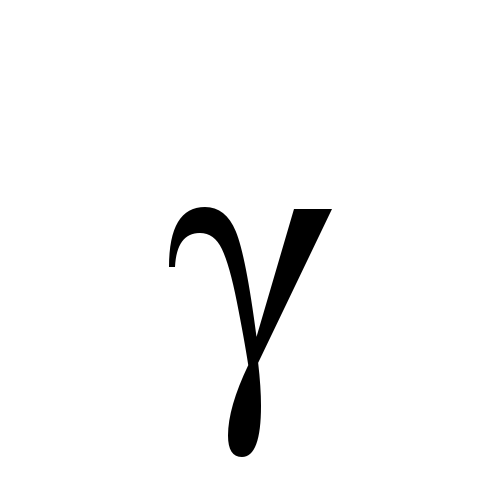
Has the symbol
a)
Alpha
b)
Beta 
c)
Gamma
18.
When an atom loses this particle, the atomic number of the product atom is lower by the two and its mass number is lower by four. 
a)
Alpha 
b)
Beta
c)
Gamma
19.
Has a mass of 0 and a charge of 0
a)
Alpha
b)
Beta
c)
Gamma
20.
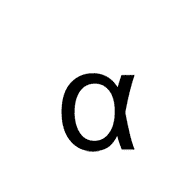
Has the symbol
a)
Alpha
b)
Beta
c)
Gamma
21.
An energized electron resulting from the breaking apart of a neutron in an atom.
a)
Alpha
b)
Beta
c)
Gamma
22.
Has a moderate penetrating power.  It can penetrate 4 mm into body tissue and can be stopped by metal foil.
a)
Alpha
b)
Beta
c)
Gamma
23.
Electromagnetic radiation made of high-energy photons.
a)
Alpha 
b)
Beta
c)
Gamma
24.
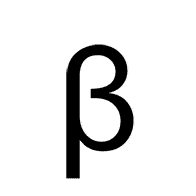
Has the symbol
a)
Alpha
b)
Beta
c)
Gamma
25.
Has a mass of 4 and a charge of +2
a)
Alpha
b)
Beta
c)
Gamma
26.
Has the lowest penetrating power.  Can only penetrate 0.05 mm into the body and can be stopped by a piece of paper or clothing.
a)
Alpha
b)
Beta
c)
Gamma
27.
Has the highest penetrating power.  Can penetrate our body.  Even several cm thick of lead or several meters thick of concrete cannot stop all of it.
a)
Alpha
b)
Beta
c)
Gamma
28.

How many types of radiation are there?

(a)  

29.

Which type of radiation has no mass?

a)

Alpha

b)

Beta

c)

Gamma

30.

Which type of radiation is blocked by paper?

a)

Gamma

b)

Alpha

c)

Beta

31.

Which type of radiation is blocked by plastic or aluminum?

a)

Gamma

b)

Alpha

c)

Beta

32.

Which type of radiation can be reduced by lead, but not blocked?

a)

Beta

b)

Alpha

c)

Gamma

33.

Which type of radiation has no energy? 

a)

Beta

b)

Gamma

c)

Alpha

34.

Which symbol represents alpha radiation?

a)

β\beta   

b)

α\alpha  

35.

Which type of radiation is negatively charged?

a)

Gamma

b)

Beta

c)

Alpha

36.

In a process where some substances spontaneously emit radiation is called

a)

Radiation

b)

Radioactive Decay

c)

Radioactivity

37.

Which type of radiation is positively charged?

a)

Gamma

b)

Beta

c)

Alpha

38.

Match the symbol to each type of radiation

a)
1.

alpha particle

b)
2.

beta particle

c)

00γ

3.

gamma ray

39.

Rank the follow radioactive decay types from lowest to highest energy. 1 is lowest.

a)

alpha decay

b)

beta decay

c)

gamma decay

1)
2)
3)
40.

Each type of radioactive decay particle can be stopped by different materials. Match the particle with the type of material needed to stop its movement.

a)

paper

1.

alpha particle

b)

aluminum

2.

beta particle

c)

lead/concrete

3.

gamma ray

41.
When a nucleus undergoes nuclear decay by gamma rays, the atomic number of the element....
a)
remains the same
b)
  decreases by one.
c)
increases by one.
d)
increases by two.
42.
A helium nucleus with two protons and two neutrons is called a(n) ____.  
a)
alpha particle
b)
electroscope
c)
beta particle
d)
gamma ray
43.
In the equation,  146C --> 147N + 0-1B, the _______ decay of radioactive carbon-14 results in the creation of a new nitrogen-14 atom.
a)
Radioactive
b)
Beta
c)
Alpha
44.
Solve this equation for beta decay.
2760Co = ___ + -10e
a)
2556Mn
b)
2860Ni
c)
2358V
d)
2759Co
45.
Solve this equation for beta decay.
614C = ___ + -10e
a)
410Be
b)
714N
c)
210He
d)
613C
46.
Solve this equation for alpha decay.
85209At = ___ + 24He
a)
83205Bi
b)
86209Rn
c)
81207Tl
d)
85208At
47.
Solve this equation for alpha decay.
88226Ra = ___ + 24He
a)
86222Rn
b)
89226Ac
c)
84224Po
d)
88225Ra
48.
Gamma rays have a _____ charge
a)
0
b)
+1
c)
-1
d)
+2
49.
Balance the following equation:
146C --> 0-1e + ________
a)
145B
b)
146C
c)
147N
d)
42He
50.
If Gadolinium-150 goes through alpha decay, the resulting element has a new atomic mass of _____.
a)
150
b)
148
c)
146
51.

If we start off with element 5024X after an gamma decay we get an element(product) that looks like...

a)

5124X

b)

5023X

c)

5024X

d)

5025X

52.
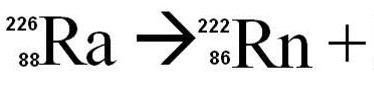
Complete the nuclear equation and determine the type of decay that is occurring in this reaction. 
a)
alpha
b)
beta
c)
gamma
d)
none
53.
Solve this equation for alpha decay.
85209At = ___ + 24He
a)
83205Bi
b)
86209Rn
c)
81207Tl
d)
85208At
54.
Solve this equation for beta decay.
614C = ___ + -10e
a)
410Be
b)
714N
c)
210He
d)
613C
55.
What particle completes this reaction?
a)
alpha particle
b)
beta particle
c)
gamma particle
d)
neutron
56.

24094Pu —› ____ + 42He

a)

23692U

b)

24796Cm

c)

24493Np

d)

24295Am

57.
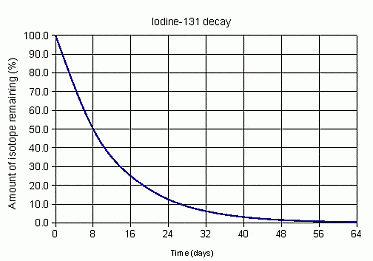
What is the half-life of iodine-131?
a)
32 days
b)
8 days
c)
16 days
d)
24 days
58.

The % of the parent isotope remaining after 1 Half Life.

a)

50%

b)

25%

c)

12.5%

d)

6.25%

59.

The % of the parent isotope remaining after 2 Half Lives.

a)

50%

b)

25%

c)

12.5%

d)

6.25%

60.

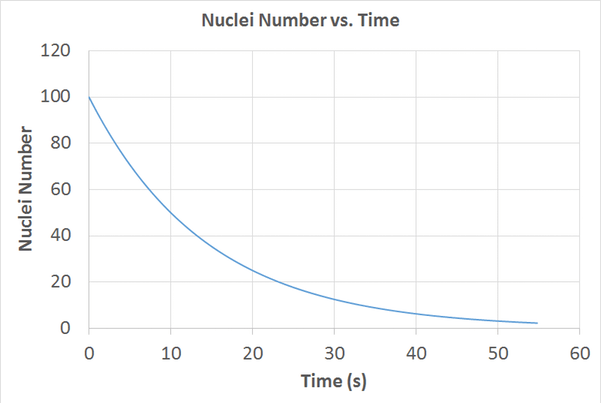
What is the Half life of this isotope?

a)

5 seconds

b)

10 seconds

c)

15 seconds

d)

20 seconds

61.

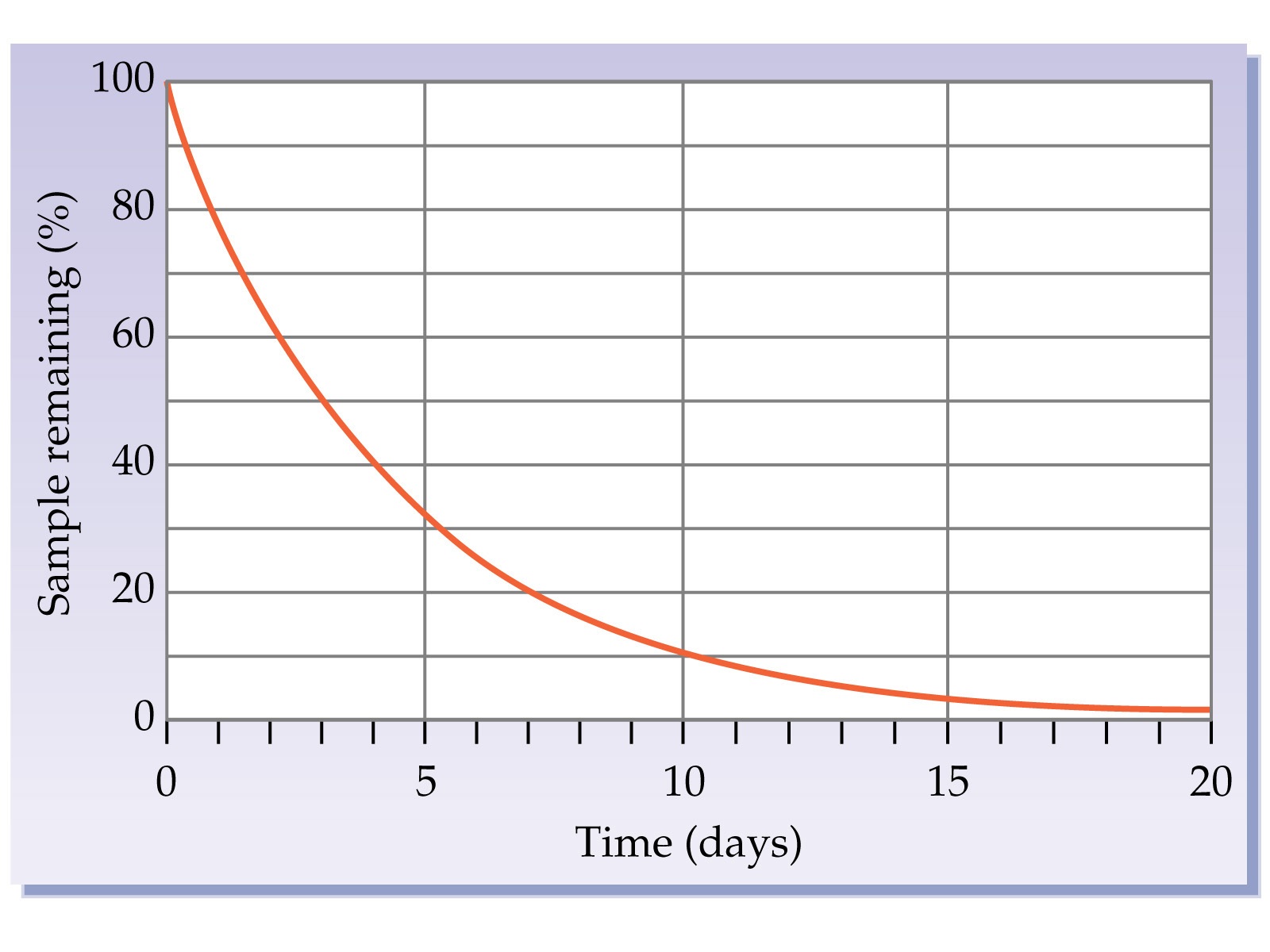
What is the Half Life of this isotope?

a)

3 days

b)

5 days

c)

8 days

d)

10 days

62.
What is Half-life?
a)
The amount of time it takes for some of the nuclei in a sample of the isotope to decay
b)
The amount of time it takes for half the electrons in a sample of the isotope to decay
c)
The amount of time it takes for half the nuclei in a sample of the isotope to decay
d)
the amount of time it takes to double the nuclei in a sample of the isotope to decay
63.
If one-fourth of the carbon-14 is remaining then how many half-lives have passed?
a)
1
b)
2
c)
3
d)
4
64.

Why do some elements have half-lives?

a)

they radioactively decay

b)

half of their atom gets stolen

c)

They are Twizzlers that break in half

65.

What is the only difference between two different isotopes of the same element?

a)

Number of neutrons

b)

Number of protons

c)

Number of electrons

d)

Size of atom

66.

After the third half-life, how much of the sample is left?

a)

1/2

b)

1/3

c)

1/16

d)

1/8

67.
If 10 mg of iodine 131 is given to a patient, how much is left after 24 days? The half-life of iodine-131 is 8 days.
a)
1.25mg
b)
1.25g
c)
10g
d)
10mg
68.
The half-life of strontium-90 is 25 years. How much strontium-90 will remain after 100 years if the initial amount is 4.0 g?
a)
3.0g
b)
0.25mg
c)
0.3g
d)
0.25g
69.
If the half-life of uranium-232 is 70 years, how many half-lives will it take for 10 g of it to be reduced to 1.25 g?
a)
1 half-life
b)
2 half-lives
c)
3 half-lives
d)
4 half-lives
70.
You have 100 grams of radioactive C-14. The half life of C-14 is 5730 years. 
How many grams are left after 1 half life? 
a)
100 grams
b)
25 grams
c)
2 grams
d)
50 grams
71.
When nuclei decay, massive amounts of __________ is released.
a)
energy
b)
jello
c)
protons
d)
neutrons
72.

What percentage of rubidium-87 atoms will be left after four half lives?

a)

25.0%

b)

12.5%

c)

6.25%

d)

3.125%

73.
The half-life of strontium-90 is 25 years. How much strontium-90 will remain after 100 years if the initial amount is 4.0 g?
a)
3.0g
b)
0.25mg
c)
0.3g
d)
0.25g
74.

Geologist use the time it takes for a radioactive isotope to decay to half its original mass called a___________.

a)

radioactive decay

b)

isotope

c)

half-life

d)

carbon dating

75.

Barium-122 has a half-life of 2 minutes. A fresh sample weighing 80 g was obtained. If it takes 10 minutes to set up an experiment using barium-122, how much barium-122 will be left when the experiment begins?

a)

0.25g

b)

2.5g

c)

25g

d)

80g

76.

The half-life of Element X is 2 years.


How long has passed if Element X has reduced by half 5 times?

a)

2 years

b)

4 years

c)

6 years

d)

8 years

e)

10 years

77.

What is the name for the central area of an atom, where most of the atom's mass is located?

a)

Neutron

b)

Electron

c)

Proton

d)

Nucleus

78.

What is the name for the central area of an atom, where most of the atom's mass is located?

a)

Neutron

b)

Electron

c)

Proton

d)

Nucleus

79.

If an element has an atomic number of 23 and an atomic mass of 50.89, how many neutrons must it have in it's nucleus?

a)

38

b)

28

c)

17

d)

29

80.
How many electrons does potassium K contain? 
a)
19
b)
39
c)
20
d)
40
81.

What are valence electrons?

a)

electrons in the second orbit/energy level

b)

electrons in the outermost orbit/energy level

c)

the atomic number

d)

electrons in the first orbit/ energy level

82.

How many valence electrons does this element have?

a)

2

b)

3

c)

5

d)

10

83.

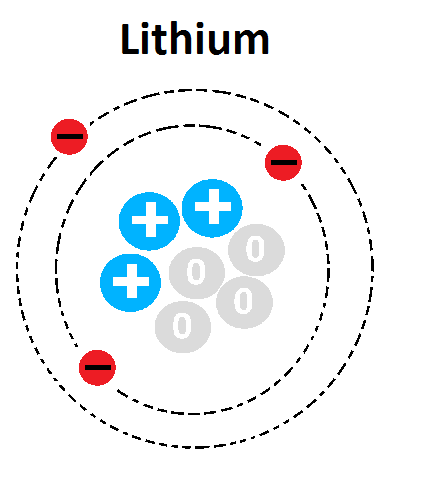
What element is represented in this Bohr-Rutherford model?

a)

Carbon

b)

Hydrogen

c)

Aluminum

d)

Lithium

84.

Which element is shown in the Bohr-Rutherford model in the picture?

a)

Boron

b)

Carbon

c)

Nitrogen

d)

Lithium

85.

Which element is shown in the Bohr-Rutherford model in the picture?

a)

Lithium

b)

Boron

c)

Carbon

d)

Neon

86.

Which element is shown in the Bohr-Rutherford model in the picture?

a)

Helium

b)

Hydrogen

c)

Argon

d)

Silver

87.

The "X" in the picture represents an unknown element. Using what you know about Lewis dot diagrams which element could this be the dot diagram of?

a)

Mg

b)

Cl

c)

C

d)

O

88.

How many electrons should sodium, atomic number 11, have around its Lewis dot model?

a)

1

b)

2

c)

3

d)

4

89.

Which of these is the correct Lewis Dot diagram for the element Magnesium?

a)
b)
c)
d)
90.

Which of these is the correct Lewis Dot diagram for the element Boron?

a)
b)
c)
d)
91.

Which of these is the correct Lewis Dot diagram for the element Neon (Ne)?

a)
b)
c)
d)
92.

Which of the following is the a correct Lewis dot diagram for nitrogen (N)?

a)
b)
c)
d)
93.
Subatomic particles with a positive charge
a)
neutrons
b)
atomic mass
c)
protons
d)
isotopes
94.

Calculation used to find the number of neutrons in an atom

a)

Mass Number - Atomic Number

b)

Atomic Number - Atomic Mass

c)

Atomic Mass - Electrons

d)

none of these

95.
These particles have a mass of 1 amu
a)
protons and neutrons
b)
protons and electrons
c)
neutrons and electrons
96.
What subatomic particles are located in the electron cloud?
a)
quarks
b)
protons
c)
electrons
d)
neutrons
97.
Which is an electron?
a)
A
b)
B
c)
C
98.
Which item on this element square is the chemical symbol?
a)
Copper
b)
29
c)
Cu
d)
63.546
99.
What is the number of protons that the element in this image contain?
a)
14
b)
7
c)
15
d)
18
100.
An atom of the element with atomic number 6 always has _____.
a)
six protons in its nucleus
b)
an atomic mass of six
c)
more than six neutrons
d)
six electron clouds
101.
What are subatomic particles? 
a)
the nucleus 
b)
electron cloud
c)
positive charge
d)
electrons, protons, and neutrons
102.
How many protons does an atom with an atomic number of 28 and a mass number of 40 have?
a)
28
b)
68
c)
12
d)
40
103.
The following element has _______________ neutrons.
a)
15
b)
16
c)
31
d)
46
104.
The Bohr model below depicts which element?
a)
Scandium
b)
Titanium
c)
Calcium
d)
Potassium
105.
Subatomic particles that are neutral in charge
a)
Neutrons
b)
Protons
c)
Nucleus 
d)
Electrons
106.
What is the mass number of this atom?
a)
1
b)
3
c)
4
d)
7
107.
What group does this element belong to?
a)
Group 1: Alkali metals
b)
Group 18: Noble Gases
c)
Group 2: Alkaline-Earth Metals
d)
Group 17: Halogens
108.
Carbon-12 has 6 protons and 6 neutrons. How many electrons will orbit the nucleus?
a)
12
b)
6
c)
3
d)
18
109.
What is the atomic number of this atom?
a)
2
b)
4
c)
6
d)
none of the above
110.
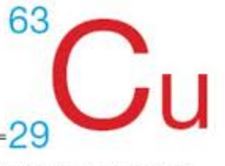
How many electrons does a Copper atom have?
a)
63
b)
29
c)
92
d)
34
111.

How many neutrons does this isotope of beryllium have?

a)

9

b)

5

c)

4

d)

2

112.
How many valence electrons?
a)
2
b)
3
c)
5
d)
10