
NEW
Font size
 Worksheets
Earth Science: Geologic Time Review
Total questions: 71
Worksheet time: 2hrs 51mins
Which of these is the best indication of the relative age of a rock layer?
The chemical make-up of the layer
The thickness of the layer
The position of the layer compared to another layer
The distance of the layer extending over Earth



This picture shows light-colored granite and darker diorite (igneous). Which statement is true?
Granite (light) is younger because it is more continental.
Granite is younger because it crosscuts the diorite.
Diorite is older because its weathered surfaces are darker.
All of these statements are true.

Which of the following geologic events would have happened most recently?
rock formation of 3
rock formation of 6
rock formation of 2
rock formation of 1

Which layer is the oldest?
layer M
layer D
layer B
layer A

What is the correct age order of the rocks from OLDEST to YOUNGEST
A,B,C,D,E
B,C,D,E,A
All are the same age
A,E,D,B,C

What fossil would make a good index fossil?


Carbon 14 has a half life of 5,730 years. If there is 50% of it left, how old is the sample?
5,730
11,460
2,685
17,190

Of the layers listed here, which is the oldest ?

Place the layers in order from oldest to youngest.
1, 2, 3, 4, 5, 6, 7
7, 6, 5, 4, 3, 2, 1
1, 2, 3, 7, 4, 5, 6
1, 2, 4, 3, 7, 5, 6

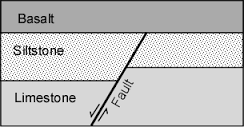
What is the oldest feature?
A
Fault
L
Q
D

Which layer is OLDER? Intrusion M or Layer D?
Intrusion M
Layer D
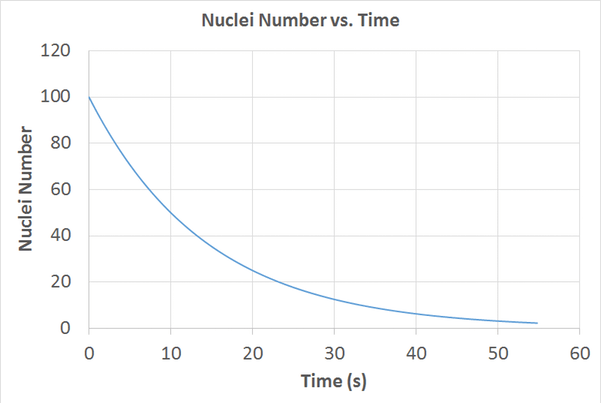
What is the Half life of this isotope?
5 seconds
10 seconds
15 seconds
20 seconds
The element that is the product of radioactive decay is known as the...
daughter element
half-life
parent element
carbon-14
A break in the geologic record that is made when rock layers are ERODED over a long period of time
superposition
relative dating
unconformity
cross-cutting

Is intrusion V older or younger than layer W?
younger
older
Unstable atoms that decay (change) and are considered radioactive
Isotope
Half-Life
Absolute Dating
Radiometric Dating
You have 100 grams of radioactive C-14. The half life of C-14 is 5730 years.
How many grams are left after 1 half life?
100 grams
25 grams
2 grams
50 grams
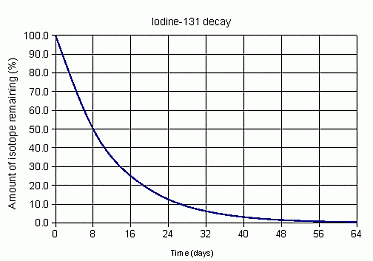
If 10 mg of iodine 131 is given to a patient, how much is left after 24 days? The half-life of iodine-131 is 8 days.
1.25mg
1.25g
10g
10mg
If the half-life of uranium-232 is 70 years, how many half-lives will it take for 10 g of it to be reduced to 1.25 g?
1 half-life
2 half-lives
3 half-lives
4 half-lives
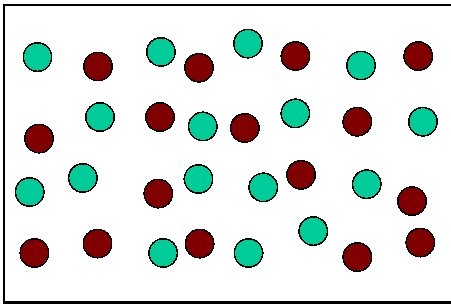
The diagram shows 32 atoms.
16 of the Red are parent isotopes
16 of the Green are daughter isotopes
How many half-lives have occurred?
0
1
2
3
Trilobites came before dinosaurs because they were found in a lower rock layer
absolute dating
relative dating

Which Era was mainly dominated by dinosaurs?
Cenozoic
Jurassic
Mesozoic
Paleozoic

Which Era has the most complex organisms?
Cenozoic
Mesozoic
Paleozoic
Quaternary

Which period is closest to present day?
Cambrian
Devonian
Triassic
Tertiary

What type of environment do you think was present during the Devonian Period?
mostly land
land with some water
mostly water
water with some land
How many years ago did the Mesozoic Era begin?
245 years
245 million years
65 years
65 million years

Mammals are a dominant group in which era?
Cenozoic
Mesozoic
Paleozoic
Cambrianozoic

What type of event usually marks the end of an Era
A Mass Extinction
A Quinceanera
An earthquake
A Volcanic Eruption

What are the four eras in order from OLDEST to NEWEST?
Pre-Cambrian, Paleozoic, Mesozoic, Cenozoic
Pre-Cambrian, Mesozoic, Paleozoic, Cenozoic
Cenozoic, Mesozoic, Paleozoic, Pre-Cambrian
Mesozoic, Pre-Cambrian, Cenozoic, Paleozoic

What era did trilobites, fishes, and other marine organisms dominate?
Precambrian
Paleozoic
Mesozoic
Cenozoic

The dinosaurs and reptiles were dominant in which Era?
Precambrian
Mesozoic
Paleozoic
Cenozoic

90% of Earth’s history occurred during which era?
Precambrian
Paleozoic
Mesozoic
Cenozoic

At the end of this era, multi-cellular organisms like sponges, jellyfish and worms filled the oceans.
Precambrian Era
Paleozoic Era
Mesozoic Era
Cenozoic Era
The second broadest category of geologic time is______________?. The Cenozoic is one of them.
era
eon
epoch
period
The period of geologic time when the biodiversity of life on the planet increased dramatically was
Jurassic
Triassic
Permian
Cambrian

The period when huge land plants were dominant and eventually became the coal and oil we use today.
Cambrian
Carboniferous
Jurassic
Miocene

_____ is the Age of the Reptiles.
Paleozoic
Mesozoic
Cenozoic
Archean
What are the names of ALL parts of the geologic time scale in correct order from broadest to narrowest?
era, period, eon
eon, era, period, epoch
era, eon, epoch, period
eon, era, epoch, period

This change in life marked the beginning of the paleozoic era and took us out of precambrian time.
hard parts and exoskeletons
soft parts and exoskeletons
oxygen and soft parts
oxygen and one celled organisms
True or False. The permian extinction wiped out nearly 95% of all life on Earth 251 million years ago.
True
False

When did the first birds appear?
Cambrian
Permian
Cretaceous & Triassic
Mesozoic and Jurassic
The break up of this super continent at the end of the mesozoic era, created large amounts of diversity on Earth
pangea
panthalsia
gondwana
laurasia

During which periods did the first land plants, vertebrates, and insects appear?
Triassic
Silurian
Cambrian
Devonian
Which type of fossil would look just like the body part of a once-living thing?
mineral
footprint
cast
petrified wood
Which type of rock are most fossils found?
sedimentary rock
metamorphic rock
igneous rock
fossils
What replaces the wood of a once-living thing to form petrified wood?
amber
cast
mold
minerals

This type of fossil forms when a mold is filled with sand or mud that hardens into the shape of the organism.
Mold
Cast
Trace
Petrified

These fossils are distinguishable from other fossils because they were scattered over a large region, very common, and lived during a short span of geologic time
Mold
Cast
Trace
Index

What type of fossil is pictured?
Cast
Mold
Trace
Petrified


Replaced remains

