
 Worksheets
Semester Exam Review 8th Grade
Total questions: 150
Worksheet time: 3hrs 36mins

Air moves in circular patterns called _______ cells.
convection
prison
solar
What are the 2 conditions for hurricanes to form?
cold water and low pressure
warm water and low pressure
warm air and high pressure
cold air and high pressure
What is an explanation for consistent temperatures of the Earth?
Wind and ocean currents help distribute the sun's energy.
Rotation causes even distribution.
The different season's distribute the temperatures evenly.
Winds moving from West to East distribute temperatures evenly.
Which area of the world do most hurricanes form?
The North Pole
The Equator
The South Pole
The Tropic of Cancer
What conditions will decrease the strength of a hurricane?
High pressure
Land
Cold water
All of the above
High pressure systems have what type of weather?
Cloudy skies
Rainy
Clear and Sunny skies
thunderstorms
Low pressure systems typically have what type of weather?
Clear and sunny skies.
Cloudy with a chance of meatballs.
Cloudy rainy skies with very humid air.
low humidity.
More dense air, sunny clear skies and clockwise direction
Low Pressure
Warm Front
High Pressure
Cold Front
Less dense air, cloudy rainy skies, counter-clockwise direction
Low pressure
Warm Front
High Pressure
Cold Front
Ocean currents affect weather patterns by -
regulating when tides occur in coastal areas
trapping heat at the equator to regulate the global climate
distributing heat from the uneven absorption of solar energy
increasing the rate of evaporation to transport water to areas experiencing droughts
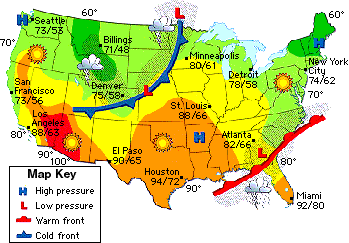

Why would St. Louis have the possibility of having thunderstorms in the next 24 hours?
It is in a high-pressure area
A cold front and low pressure are approaching
It is not located near an ocean
It recently experienced a warm front

What would be true if the rabbit population increased?
The bacteria population will decrease
The hawk population would increase
There may be increases in wolves, hawks, and snakes.
Grasshopper populations would increase

What could be changed about the food web to make it more accurate?
Remove bacteria because they are not in the forest
Change arrows to go in opposite direction
Show arrows going from all organisms to fungi and bacteria
Draw arrows from the Sun to all organisms
Prairie dogs live in complex tunnels underground and compete with other herbivores in the ecosystem. Which is the abiotic factor in this situation?
Prairie dogs
Underground habitat
Other herbivores
Grasses
Which abiotic factor(s) do plants compete for in order to make their own food?
water ONLY
sunlight ONLY
wind ONLY
water AND sunlight
Which is NOT an example of an abiotic factor?
Sunlight
Wind
Fungi
Water from a stream
Which is a true statement?
Biotic factors only rely on abiotic factors to survive.
Abiotic factors include all living things in the ecosystem.
Abiotic factors include sun, water, and plants.
Biotic and abiotic factors are both necessary for a sustainable ecosystem.
Which is the most likely outcome to the organisms in an ecosystem near the site of a nuclear disaster?
Organisms could develop mutations in their DNA
Animals will move to another location
All animals will become extinct
Animals will be impacted but plants will not
What is the most likely adaptation for a rabbit population which once lived in the snow but now lives in shrubs and rocks due to increased global temperatures?
They will see an increase in fur production
They will become better swimmers
They will grow longer ears
Their coats will be darker
Controlled forest fires are often used to clean up the underbrush of an ecosystem to promote a healthier ecosystem. How would they impact the organisms in the ecosystem?
Organisms may have to temporarily move
All organisms will die in the fire
Only plants and trees will be impacted
All organisms will increase in population in the first month after the fire
How are phytoplankton similar to small trees?
Both grow in soil
Both conduct photosynthesis
Both are about the same size
Both are at the top of the food chain

Which is MOST likely to happen if a large number of phytoplankton are killed from runoff entering the ocean?
The number of zooplankton would increase
The number of salmon would probably decrease
The number of porpoises would probably stay the same
The Sun would probably not emit as much energy
Which is MOST likely to happen if a large number of phytoplankton are killed from runoff entering the ocean?
The number of zooplankton would increase
The number of salmon would probably decrease
The number of porpoises would probably stay the same
The Sun would probably not emit as much energy

What conclusion could you make based on the graph?
Nitrogen is NOT a problem in the Gulf of Mexico
Corn and soybeans are the only sources of Nitrogen pollution
Most nitrogen pollution found in the Gulf comes from farming crops.
Nitrogen that comes from the atmosphere is most harmful.

Which relationship is true according to the food web?
Phytoplankton prey on crayfish
Flamingos are predators of crayfish
Shrimp get nutrients from zooplankton
Shrimp have three predators.

Trees grow taller to compete for -
soil
air
sunlight
good temperature range

The diagram shows Earth in its orbit around the sun when very little light is visible at Earth's South Pole. Which statement is true when Earth is in the position shown?
It is August in the northern hemisphere. It is April in the southern hemisphere.
It is summer in the northern hemisphere. It is winter in the southern hemisphere.
The number of hours of daylight is greater in the Southern Hemisphere than in the Northern Hemisphere.
Spring begins earlier in the year in the Southern hemisphere than it does in the Northern hemisphere.

Students make a model using a globe and a flashlight. Which answer choice best explains the change from daytime to nighttime on Earth?
The Sun stops sending light to Earth at night.
Earth moves farther away from the Sun at night.
The tilt of the Earth causes less light to reach the Earth at night.
Earth rotates and causes different parts of the Earth to experience night.
Which diagram models a hypothetical situation in which every location on Earth would have 12 hours of daylight and 12 hours of darkness per day?


The beginning of autumn in North American is in September, but the beginning of autumn in South America is in March. The diagram shows a picture of the Earth, the sun, and the moon on one day in September and another in March. Why does autumn start in different months of the year in North America and South America?
Earth's orbit around the sun is not a perfect circle.
North America has a larger landmass than South America.
The moon has a greater pull on South America than North America.
Earth's axis has a 23.5 degree tilt.

Students in a science class in Marfa, Texas, made a poster with a diagram to represent seasonal change in the Northern hemisphere. Which statement best describes conditions for Earth at position 1 in the diagram?
There are an equal number of hours of daylight and nighttime in the Northern hemisphere, and the north pole is tilted away from the Sun.
The Northern hemisphere has the fewest hours of daylight, and the Earth's axis does not tilt at this position.
There are an equal number of daylight and nighttime hours in this position because the Earth is not tilted in this position.
The Northern hemisphere has the fewest hours of daylight, and the north pole is tilted away from the Sun.
Which of these changes would likely occur if the rate of Earth's rotation on its axis increased?
The length of the seasons would be longer.
The length of the seasons would be shorter.
The length of a day would be shorter.
The length of a day would be longer.

The model shows Earth is several positions relative to the sun. In which position is it winter in North America?
Position 1, because North America receives the most sun.
Position 2, because North America is tilted toward the sun.
Position 3, because North America is parallel to the sun.
Position 4, because North America is tilted away from the sun.

A student wants to use a spinning basketball to model the day-and-night cycle on Earth. What should the student do in order to best model the cause of the day-and-night cycle?
Spin the ball in different directions
Tilt the ball while it is spinning
Paint one half of the ball black and the other half white
Shine a bright light on the side of the ball

In the summer many people enjoy going to the beach. The photograph shows a beach in Argentina, which is located in the Southern Hemisphere. Which diagram shows the position of Earth when it is summer in Argentina?


A student draws the model shown below. Which of these best compares the conditions at Location X and Location Y?
It is day at Location X and night at Location Y
It is winter at Location X and summer at Location Y
There are more hours of daylight at Location X than at Location Y
The moon is brighter when viewed from Location X than when viewed from Location Y

The diagram below shows four positions in Earth's orbit around the sun. The Northern hemisphere experiences the beginning of spring when Earth is in-
Position 1
Position 2
Position 3
Position 4

Which of these locations on Earth experiences the least change in the number of daylight hours throughout the year?
Equator
North Pole
Tropic of Cancer
Tropic of Capricorn

Earth would not have seasons if it-
no longer tilted on its axis
stopped rotating on its axis
took an additional month to orbit the sun
revolved around the sun in the opposite direction

What moon phase will be observed after the waning crescent?


Where would the Sun need to be in this diagram to cause these phases of the moon?
At the Bottom
At the Left
At the Top
At The Right

What phase occurs on the designated part of the graph?
Waxing Crescent
Waxing Gibbous
Waning Crescent
Waning Gibbous

What phase occurs on the 28th of the month?
Waxing Gibbous
1st Quarter
3rd Quarter
Waning Gibbous

Name the phase that the selected images represent.
Waxing Gibbous
Waxing Crescent
1st Quarter
3rd Quarter

What phase would come 2 weeks after this one?
Third Quarter
Full Moon
New Moon
First Quarter

What phase occurs on the designated part of this graph?
New Moon
Full Moon
Waning Crescent
Waxing Crescent


What will the phase of the moon be in the diagram?
new moon
waning gibbous
first quarter
full moon

What phase of the moon is shown in the picture?
first quarter
new moon
full moon
last quarter

Use the calendar to predict the moon phase on March 30th.
New Moon
Full Moon
Third Quarter
First Quarter
Use the calendar to predict the moon phase on March 9th.
New Moon
Full Moon
Third Quarter
First Quarter


Wha type of tide would this arrangement of earth-moon-sun create?
full moon tide
new moon tide
neap tide
spring tide


Area M
Area X
Area P
Area Z
The universe has many different components. Which list places four components of the universe in the most likely order from smallest to largest?
Planets, Stars, Galaxies, Nebulae
Nebulae, Stars, Planets, Galaxies
Galaxies, stars, planets, nebulae
Planets, stars, nebulae, galaxies
The Milky way galaxy is described as a disk of stars orbiting a central point on the disk. Which of these best explains why people on Earth cannot see the entire shape of the Milky way?
Earth is a part of this galaxy
Many more stars exist outside of the galaxy
The stars in the center of the galaxy are extremely small
The center of the galaxy consists of a dense cluster of stars

Barnard's star is less bright than the sun, has a surface temperature below 3,800 K , and is red.
Barnard's star is less bright than the sun, has a surface temperature above 3,800 K and is red.
Barnard's Star is brighter than the sun, has a surface temperature below 5,300 K and is yellow.
Barnard's Star is brighter than the sun, has a surface temperature above 5,300 K, and is yellow.

Deneb is a supergiant star
Deneb is a giant star
Deneb is a white dwarf
Deneb is located in the main sequence.

Betelgeuse is hotter than Spica
Betelgeuse is cooler than Spica
Spica and Betelgeuse is the same temperature

Polaris is dimmer than the sun
Polaris is brighter than the sun
Polaris and the sun have the same luminosity

What kind of galaxy is the Milky Way?
Spiral
Irregular
Elliptical

It is a low-mass red dwarf.
It is a low-mass supergiant.
It is a high-mass giant star
It is a high-mass white dwarf

Main-Sequence Stars
Giants
White dwarfs
Supergiants

microwaves
visible light
x-rays
gamma rays

a main-sequence star in spectral class B
a supergiant in spectral class K
a main-sequence star in spectral class K or M
a White dwarf in spectral class B
There are four groups of stars on the HR Diagram. About 90% of all stars are in the ________.
Supergiants
Giants
White dwarfs
Main sequence

Based on the data, which star would you presume would have the greatest mass? Hint: The larger the apparent brightness, the brighter the star appears.
Star X
Star Y
Star Z

How can you rearrange the words to match the diagram correctly in terms of sizes in space?
Solar systems in the largest circle, then galaxies, followed by the universe in the smallest circle.
Universe in the largest circle, then galaxies, followed by the solar systems in the smallest circle.
Galaxies in the largest circle, then universe, followed by the solar systems in the smallest circle.
The diagram is already correct.

Analyze this HR Diagram. Which group of stars is considered to have a lower than average luminosity as well as a higher than average temperature?
Giants
Main Sequence
White Dwarfs
Supergiants
Analyze this HR Diagram. Which group of stars is considered to have a higher than average luminosity as well as a lower than average temperature?
Giants
Main Sequence
White Dwarfs
Supergiants
A collection of dust and gas where stars can form is called a...
universe
nebula
black hole
supernova
Our sun is located near the edge of a ______ galaxy, named the _______.
Spiral shaped; Milky Way
Spiral shaped; Solar System
Elliptical shaped; Milky Way
Elliptical shaped; Solar System
Stars are classified on the HR Diagram by...
luminosity and brightness.
temperature and absolute magnitude (or luminosity).
temperature and apparent magnitude.
temperature and distance.
Stars radiate thermal energy through space by a process called _____ where the element _____ is converted into helium.
nuclear fusion; hydrogen
nuclear fusion; lithium
nuclear transfer; hydrogen
nuclear transfer; boron
Which of the following best describes the sun's position in the Milky Way galaxy?
The sun is a giant yellow star located close to the galactic core.
The sun is a medium yellow star located approximately 2/3 of the way down one of the galaxy's spiral arms.
The sun is a dwarf star located at the end of one of the spiral arms.
The sun is a medium yellow star located one light year from the galactic core.

F
G
H
J


F Oceanic plate is being created.
G Continent is being destroyed.
H Island is forming.
J Oceanic crust is being destroyed.

A beach erosion
B island arcs
C formation of new ocean floor
D small mountains with frequent earthquakes
F Radiation
G Convection currents
H Geothermal
J Conduction

A The crust
B Volcanoes under the ocean floor
C Masses of land to either side of the ocean
D The mantle just beneath Earth’s crust


A The plates are all moving in the same direction.
B The plates are all the same size.
C Plates and continents are different.
D Where two plates meet, they always move apart.

F Mountain
G Trench
H Subduction zone
J Mid-ocean ridge

A Convergent
B Divergent
C Transform
D Emergent
F Plates resist change as in Newton’s law of inertia.
G The greater the force, the greater rate of acceleration as in Newton’s law of acceleration.
H Volcanoes form from cooled magma as in Newton’s law of acceleration.
J Plates exert a force on each other in opposite directions as in Newton’s law of action-reaction.
The theory that continents were once connected but have drifted apart.
Continental Drift
Plate Tectonics
Pangaea
wingardium leviosa
Who was the German scientist that used fossil evidence and the shape of continents to support his hypothesis for Continental Drift?
Alfred Wegener
Harry Hess
Which of the following was NOT an evidence that Wegener used to support Continental Drift?
Shape of Continents
Geologic evidence
Fossil evidence
Convection currents
How did Wegener explain that fossils of the same land dwelling reptile appeared on the coastlines of two distant continents?
The continents were once joined together. As they separated, they took the dinosaur fossils with them.
The dinosaurs evolved independently on multiple continents.
The land reptile walked across land bridges that stretched across the Atlantic ocean.
The land reptile swam across the Atlantic ocean.
What is the name of the supercontinent that Wegener theorized existed 250 million years ago?
Pangaea
Titan
Cambria
The OASIS
What was the name of the Navy officer that was one of the "founding fathers" of the unifying theory of plate tectonics?
Harry Hess
Alfred Wegener
One of the largest mountain ranges in the world is at the bottom of the ocean. It is an example of a -
mid-ocean ridge
rift valley
trench
volcanic island chain
The process in which a denser plate is pushed beneath a less dense plate when the two plates converge.
subduction
polarity reversal
convection
seafloor spreading
Which one of the following was NOT a reason that Hess used to support his theory of plate tectonics?
Rugged topography of ocean floor
Seafloor spreading and subduction
Symmetrical pattern of polarity stripes
Climate change
Why are there no fossils on the ocean floor that are more than 300 million years old?
Seafloor spreading and subduction
Reversal of polarity
Climate change
Oil companies drilling for petroleum
Which type of crust is the MOST dense?
Oceanic
Continental
They always have the same density.
Which type of crust is the LEAST dense?
Oceanic
Continental
They always have the same density.
By mapping the locations of earthquakes and volcanoes, scientists have been able to -
locate the boundaries of Earth’s tectonic plates
determine where NOT to build cities
understand why tectonic plates move
understand climate change
Cool, rigid, outermost layer of Earth that is divided into enormous pieces called tectonic plates; consists of the crust and the rigid uppermost part of the mantle.
Lithosphere
Asthenosphere
Mantle
Atmosphere
The solid layer with plasticity in the upper mantle; tectonic plates “float” and move on this layer.
Asthenosphere
Lithospere
Mantle
Crust
A cyclical motion occurs because of density differences in the mantle. Heated, less dense lower regions of the fluid mantle rise, and denser, cooler regions sink due to gravity. The combined motions serve as the engine for crustal plate movement.
convection currents
subduction
density circles
seafloor spreading
Which of the following is not a type of tectonic plate boundary?
Convergent
Divergent
Transform
Volcanic Ridge
Plates move apart from each other at which type of boundary?
Convergent
Divergent
Transform
Plates move toward each other at which type of boundary?
Convergent
Divergent
Transform
Plates slide horizontally or vertically past each other in opposite directions at which type of boundary?
Convergent
Divergent
Transform
When continental plates are involved, what type of boundary creates large mountain chains, such as the Himalayas?
Convergent
Divergent
Transform
What type of boundary creates deep ocean trenches and volcanoes?
Convergent - oceanic and continental
Divergent - oceanic and oceanic
Transform - continental and continental
Convergent - continental and continental
What process provides the magma for volcanoes?
subduction
mountain building
ocean tides
erosion
Which two types of crustal features can be created at a divergent boundary?
Mid-ocean ridges
Rift valleys
Trenches
Ocean shorelines
Islands
Seafloor spreading starts at a mid-ocean ridge where magma rises between two plates and creates igneous rocks. Where would the oldest oceanic crust be located?
At the center of the mid-ocean ridge
Near the mid-ocean ridge, but not in the center
Near a trench
Halfway between the trench and the mid-ocean ridge

What is occuring at point A?
subduction
convection
divergence
new crust formation

What feature is at point A?
Mid-ocean ridge
Trench
Rift valley
Seafloor spreading
What process is occuring at point B?
Mid-ocean ridge
Trench
Rift valley
Seafloor spreading
What feature is at point C?
Mid-ocean ridge
Trench
Rift valley
Seafloor spreading
What happens at a mid-ocean ridge?
plates move apart and create new crust
plates move together and destroy old crust
plate move horizontally in opposite directions
one plate subducts and forces the second plate up, thereby creating vast underwater mountain ranges
Seafloor spreading starts at a mid-ocean ridge where magma rises between two plates and creates igneous rocks. Where would the youngest oceanic crust be located?
At the center of the mid-ocean ridge
Near the mid-ocean ridge, but not in the center
Near a trench
Halfway between the trench and the mid-ocean ridge

