Wayground logo

Free Printable Worksheets

Font size

S
M
L
XL
Worksheets

Science 5 Quiz

Total questions: 87

Worksheet time: 2hrs 31mins

Name
Class
Date
1.
Heat will always move from
a)
hot to cold
b)
cold to hot
c)
cold to warm
d)
warm to hot
2.
Heat movement resulting from particles hitting each other is
a)
convection 
b)
conduction
c)
radiation
d)
resisting
3.
A convection current occurs in:
a)
solids
b)
liquids
c)
gases
d)
liquids and gases
4.
A convection current carries heat from:
a)
cold areas to warm areas
b)
warm areas to hot areas
c)
hot areas to cold areas
d)
one cold area to another
5.
A thermal air current occurs when
a)
 air gets colder and sinks towards the ground
b)
cold air rises and brings warmer air with it
c)
warmer air rises and cooler air rushes in to fill the space
d)
a thunderstorm forms
6.
A thermal air current is an example of heat movement called
a)
convection
b)
conduction
c)
radiation
d)
insulation
7.
Convection currents occur in the mantle. They are caused by
a)
the crust being too heavy and sinking
b)
the top of the mantle being hotter than the bottom of the mantle
c)
the bottom of the mantle being hotter than the top of the mantle
d)
the Earth's core being liquid
8.
In a convection current, heat moves 
a)
as particles carry it
b)
as radiation
c)
as waves
d)
as nuclear energy
9.
Space is said to be a vacuum (so there are no particles). Heat from the sun moves through space by
a)
conduction
b)
convection
c)
radiation
d)
conduction and radiation
10.

The flow of heat due to a temperature difference is called...

a)

Heat Transfer

b)

Conduction

c)

Convection

d)

Radiation

11.

Heat transfer is also called...

a)

Thermal Energy

b)

Conduction

c)

Convection

d)

Radiation

12.

When heat energy moves in a solid it is called....

a)

Conduction

b)

Convection

c)

Radiation

13.

When the motion of particles in the hotter part transfer their energy through vibrations to nearby ones it is what type of heat transfer...

a)

Conduction

b)

Convection

c)

Radiation

14.

Touching a hot stove is an example of...

a)

Conduction

b)

Convection

c)

Radiation

15.

This picture is an example of...

a)

Conduction

b)

Convection

c)

Radiation

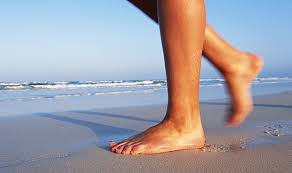
16.

Walking without shoes on a hot day is an example of...

a)

Conduction

b)

Convection

c)

Radiation

17.

When heat energy moves in a liquids or gases it is called...

a)

Conduction

b)

Convection

c)

Radiation

18.

The rising and sinking in fluids is called a

a)

Conduction

b)

Convection Current

c)

Radiation

19.

Boiling water is an example of...

a)

Conduction

b)

Convection

c)

Radiation

20.

This picture is an example of...

a)

Conduction

b)

Convection

c)

Radiation

21.

This picture is an example of...

a)

Conduction

b)

Convection

c)

Radiation

22.

When heat energy can travel in space by infrared or thermal radiation it is called...

a)

Conduction

b)

Convection

c)

Radiation

23.

A type of heat transfer that does not rely on physical contact of substances is called...

a)

Conduction

b)

Convection

c)

Radiation

24.

This picture is an example of...

a)

Conduction

b)

Convection

c)

Radiation

25.

This picture is an example of...

a)

Conduction

b)

Convection

c)

Radiation

26.

The higher the temperature the higher the...

a)

Kinetic Energy

b)

Potential Energy

c)

Sound Energy

d)

Chemical Energy

27.

The more heat the more the particles...

a)

Stay in a fixed psoition

b)

Vibrate

28.

This picture is an example of

a)

Conduction

b)

Radiation

c)

Convection

d)

All of the above

29.
Hot coffee is stirred with a spoon; the spoon gets hot due to
a)
conduction
b)
convection
c)
radiation
30.
Near the ceiling of a room the air is warmer; the warm air rises because of
a)
conduction
b)
convection
c)
radiation
31.
Warm air over the beach rises while cooler, dense air from the ocean rushes in due to
a)
conduction
b)
convection
c)
radiation
32.
Warm air rises and the cool air sinks demonstrates this type of heat transfer. 
a)
conduction
b)
convection
c)
radiation
d)
Insolation 
33.
The way the heat is moving from the hot coffee is called...
a)
convection
b)
radiation
c)
insulation
d)
conduction
34.
Carole owns a two story house with a heating and cooling unit on each floor. In the winter she mostly uses the downstairs unit because the volume of warm air __________ and __________ warming the whole house through __________.
a)
expands, rises, convection
b)
expands, sinks, conduction
c)
contracts, rises, conversion
d)
contracts, sinks, contraption
35.
A toaster toasting bread is an example of 
a)
condensation
b)
conductio
c)
convection
d)
radiation
36.
In how many ways does heat move around the universe?
a)
One
b)
Three
c)
Two
d)
Ten
37.
Molecules in cold things move more _________
than in hot things.
a)
quickly
b)
slowly
c)
happily
d)
merrily
38.
In heat transfer, heat always flows from the _______________ substance to the _______________ substance.
a)
Hotter to colder
b)
Colder to hotter
c)
Hotter to hotter
d)
Colder to colder
39.
The type of heat transfer that happens through direct contact of molecules or particles with each other is ___________________.
a)
Convection
b)
Conduction
c)
Radiation
d)
insulation.
40.
The kind of heat transfer that travels through space in electromagnetic waves is ______________________.
a)
insulation.
b)
Radiation
c)
Conduction
d)
Convection
41.
Which statement is true?
a)
The quicker a molecule moves, the colder it is.
b)
The slower a molecule moves, the warmer it is.
c)
The quicker a molecule moves, the warmer it is
d)
The movement on molecule don�t affect its temperature
42.
Which of the following is the best example of conduction?
a)
A light bulb warming a lampshade
b)
An egg cooking in a frying pan
c)
Water boiling in a pot
d)
Gases circulating in the atmosphere
43.
What kind of heat transfer happens when the sun is heating your body?
a)
Conduction
b)
Radiation
c)
Convection
d)
Density
44.
Walking on the warm sand sand with your bare feet demonstrates this type of heat transfer. 
a)
conduction
b)
convection
c)
radiation
45.
You get sunburned due to __________ from the sun.
a)
conduction
b)
convection
c)
radiation
46.
Select the temperature in °F
a)
90°F
b)
100°F
c)
40°F
d)
30°F
47.
What is the measurement of the average kinetic energy of a substance?
a)
Kinetic energy
b)
Temperature
c)
Thermal energy
d)
Potential energy
48.
What is a substance that does NOT conduct heat well?
a)
Conductor
b)
Insulator
c)
Convector
d)
Radiator
49.
What is a substance that DOES conduct heat well?
a)
Conductor
b)
Insulator
c)
Convector
d)
Radiator
50.
When the temperature of matter decreases the particles ...
a)
speed up and move farther apart
b)
speed up and move closer together
c)
slow down and move farther apart
d)
slow down and move closer together
51.

What is something that prevents heat, electricity, sound, light...to pass through it?

a)

insulator

b)

conduction

c)

heat transfer

d)

conductor

52.

What is something that readily conducts heat, electricity, sound...

a)

insulator

b)

conduction

c)

thermal equilibrium

d)

conductor

53.
You buy a lava lamp from the store. As the lamp heats up, blobs of liquid rise to the top then sink back down to the bottom. This process continues because of _?_.
a)
conduction
b)
convection
c)
radiation
54.
You are doing your homework at a desk that is underneath a lamp. You start to feel hotter because of _?_ from the lamp.
a)
conduction
b)
convection
c)
radiation
55.
Your best friend has a bunk bed. You move from the bottom bunk to the top bunk and notice that the air is warmer. The warm air rises because of _?_.
a)
conduction
b)
convection
c)
radiation
56.

You are in science class and want to see if the hot plates were used recently. You place your hand near the side of the hot plate. Without touching the hot plate, your hand feels warmer. Heat is transferred to your hand by _?_.

a)

conduction

b)

convection

c)

radiation

57.
You are roasting marshmallows at a campfire. The metal skewer (stick) that you’re cooking your marshmallow on burns your hand because of _?_.
a)
conduction
b)
convection
c)
radiation
58.
What happens when ice cubes melt in a glass?
a)
Heat travels from the ice to the warmer water.
b)
No energy is transferred.
c)
Heat is transferred from the warmer water to the ice cubes.
59.

In heat transfer, heat always flows from the _?_ substance to the _?_ substance.

a)

hotter to colder

b)

colder to hotter

c)

hotter to hotter

d)

colder to colder

60.

The candle will slowly heat the metal and transfer the heat directly to the mans hand. This is an example of _?_.

a)

conduction

b)

convection

c)

radiation

61.
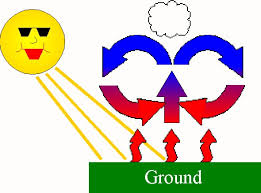
What causes the circulation of air in the atmosphere?
a)
Air in the atmosphere is heated by the sun and sinks to the ground.
b)
The ground is heated by the sun and then heats the air, causing the air to rise.
c)
Air loses heat to the ground and then rises upward to obtain more energy.
d)
The sun heats the clouds which forces the cooler air to move away and sink.
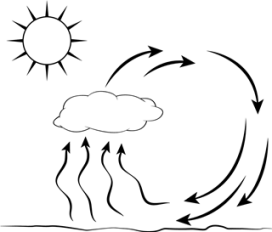
62.

The moving of air in the image is an example of _?_.

a)

radiation

b)

convection

c)

conduction

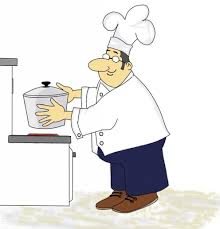
63.
The man goes to take the hot pot off the stove with his bare hands.
a)
conduction
b)
convection
c)
radiation
64.
Johnny accidentally grabbed the handle of the hot pot.
a)
conduction
b)
convection
c)
radiation
65.
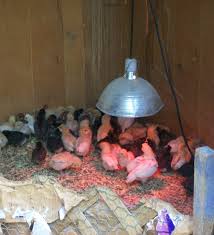
The baby chickens are kept warm from the heat lamps demonstrates this type of heat transfer. 
a)
conduction
b)
convection
c)
radiation
66.
An aluminum plate and a plastic plate have been in the freezer all night long.  When you remove them the next morning, 
a)
the plates have the same temperature.
b)
the plastic plate has a higher temperature.
c)
the plastic plate has a lower temperature.
d)
the aluminum plate has a lower temperature.
67.
Why do we wear sweaters in cold weather?
a)
To keep cold out.
b)
To generate heat.
c)
To reduce heat loss.
d)
All of the above.
68.
Near the ceiling of a room the air is warmer; the warm air rises because of
a)
conduction
b)
convection
c)
radiation
69.
A house burns down. The vinyl siding of the house next door warps due to
a)
conduction
b)
convection
c)
radiation
70.
What types of charges attract?
a)
Positive and Positive
b)
Positive and Neutral
c)
Negative and Neutral
d)
Positive and Negative
71.
What charge does a proton have?
a)
negative (-)
b)
positive (+)
c)
neutral or no charge (0)
72.
What charge does an electron have?
a)
negative (-)
b)
positive (+)
c)
neutral or no charge (0)
73.
If a substance has a higher number of electrons than protons on its surface, what type of charge does it have?
a)
A positive charge.
b)
A negative charge.
c)
A neutral charge
d)
No charge at all
74.
Which of the following is caused by static electricity?
a)
a stove getting hot when it is turned on
b)
a magnet being attracted to a refrigerator
c)
a lightning strike during a storm
d)
a light bulb coming on when a switch is turned on
75.
An object becomes postiively charged when which of the following occurs?
a)
loses electrons
b)
gains electrons
c)
loses protons
d)
gains neutrons
76.

The difference between attraction and repulsion is that to attract is to pull something closer and repel is to push something away.

a)

True

b)

False

77.
What types of charges attract?
a)
Positive and Positive
b)
Positive and Neutral
c)
Negative and Neutral
d)
Positive and Negative
78.
In a neutral atom, the number of electrons is equal to the number of _______.
a)
Neutrons
b)
Orbits
c)
Protons
d)
subatomic particles
79.
An object becomes charged when the atoms in the object gain or lose
a)
electrons
b)
protons
c)
neutrons
d)
all of the above
80.
If two charges repel each other, the two charges must be
a)
Positive and neutra
b)
Positive and negative
c)
positive and neutral
d)
negative and negative
81.
If you rub a glass rod with a piece of silk, the rod becomes positively charged. This means that
a)
friction destroyed electrons in the rod.
b)
the silk has become negatively charged.
c)
protons have moved to the rod.
d)
glass attracts more protons.
82.
Objects that have opposite charges
a)
are attracted to each other, and the force between the objects pulls them together.
b)
are attracted to each other, and the force between the objects pushes them apart.
c)
are repelled by each other, and the force between the objects pulls them together.
d)
are repelled by each other, and the force between the objects pushes them apart.  
83.
A region around a charged particle that can exert a force on another charged particle is called an
a)
electric pulse.
b)
electric charge.
c)
electric force.
d)
electric field.
84.
Charging by ____ occurs when electrons are transferred from one object to another by direct contact.
a)
reduction
b)
induction
c)
conduction
d)
friction
85.
When you pull a cotton sweater off your skin, electrons are transferred from the ___________________ (cotton, skin) to the __________________ (cotton, skin). As a result, your body acquires a ___________ (+ , -) charge and the cotton sweater acquires a ___________ (+ , -) charge.
a)
skin, cotton, +, -
b)
cotton, skin, +, -
c)
skin , cotton, -, +
d)
cotton, skin, -, +
86.

Electricity happens with the flow of

a)

electrons

b)

water

c)

sand

87.

What's one example of a powerful electrical charge?

a)

lightening

b)

fire

c)

tornado

d)

flashlight