
 Worksheets
Biology OL Midterm Review
Total questions: 101
Worksheet time: 51mins
Which of the following biomolecules typically contains both nitrogen and phosphate?
Lipid
Protein
Nucleic Acid
Carbohydrate
Carbohydrates are more easily metabolized than lipids. However, on a gram-for-gram basis lipids provide cells with more…
Nitrogen
Proteins
Structure
Energy
Smaller units called ------------- join together to form polymers.
Biomolecules
Macromolecules
Inorganic compounds
Monomers
----------------------- is the MAIN source of energy for cells.
Proteins
Carbohydrates
Lipids
Nucleic Acids
Starch is a -----------------; it contains many sugar molecules.
Monosaccharide
Disaccharide
Polysaccharide
Protein
----------------- contain monomers joined by peptide bonds.
Protein
Lipids
Carbohydrates
Nucleic Acid
The chemical formula for glucose is
C6H12O8
C8H6O8
C12H6O6
C6H12O6
The different forms of a gene (brown eyes, blue eyes, green eyes) are called _________.
alleles
factors
chromosomes
chromatids
------------------------------------- store and transmit genetic information.
Nucleic Acid
Protein
Carbohydrates
Lipids
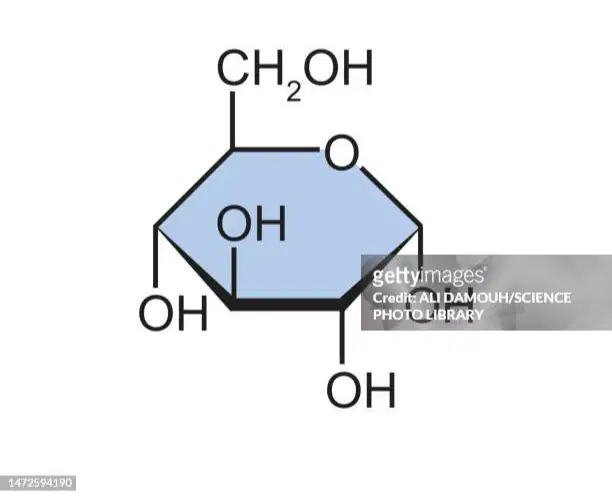
This represents what molecule?
Polymer
Amino Acid
Nucleotide
Glucose
Phospholipids
contain elements C, H, O
Make up the cell membrane
20 different kinds
mades from nucleotides
Lipids
make up cell membrane
20 different kinds
made from nucleotides
monomer = fatty acids
Nucleic acids
make up cell membrane
20 different kinds
made from nucleotides
monomer = fatty acids
carbohydrates
contain elements C, H, O
1:2:1 ratio of elements
main source of energy for cells
all of the above
Amino Acids
20 different kinds
building blocks of proteins
joined by peptide bonds to make proteins
all of the above
which is not part of cell theory?
all living things composed of cells
cells are the basic unit of living things
cells are produced from existing cells
cells are either prokaryotes or eukaryotes
nucleus
contains genetic matter
storage sacs
used for digestion and waste removal
produce proteins
ribosomes
make proteins
stores genetic information
are used for digestion and waste removal
storage sacs for water, salt, etc
endoplasmic reticulum
contains genetic information
may or may not contain ribosomes
makes proteins
storage sacs for water
lysosomes
contain genetic matter
storages sacs for water, etc.
used for digestion and waste removal
produce proteins
vacuoles
contain genetic matter
storage sac for water, salt, etc.
used for digestion and waste removal
produce proteins
The movement of any particle from an area of higher concentration to an area of lower concentration is:
Hypertonic
Hypotonic
Passive transport
Active transport
"cell eating"
exocytosis
active transport
phagocytosis
passive transport
movement across the cell membrane requiring no energy
exocytosis
active transport
phagocytosis
passive transport
requires energy from cell to move particles against concentration gradient
exocytosis
active transport
phagocytosis
passive transport
cell used to expel wastes
exocytosis
active transport
phagocytosis
passive transport
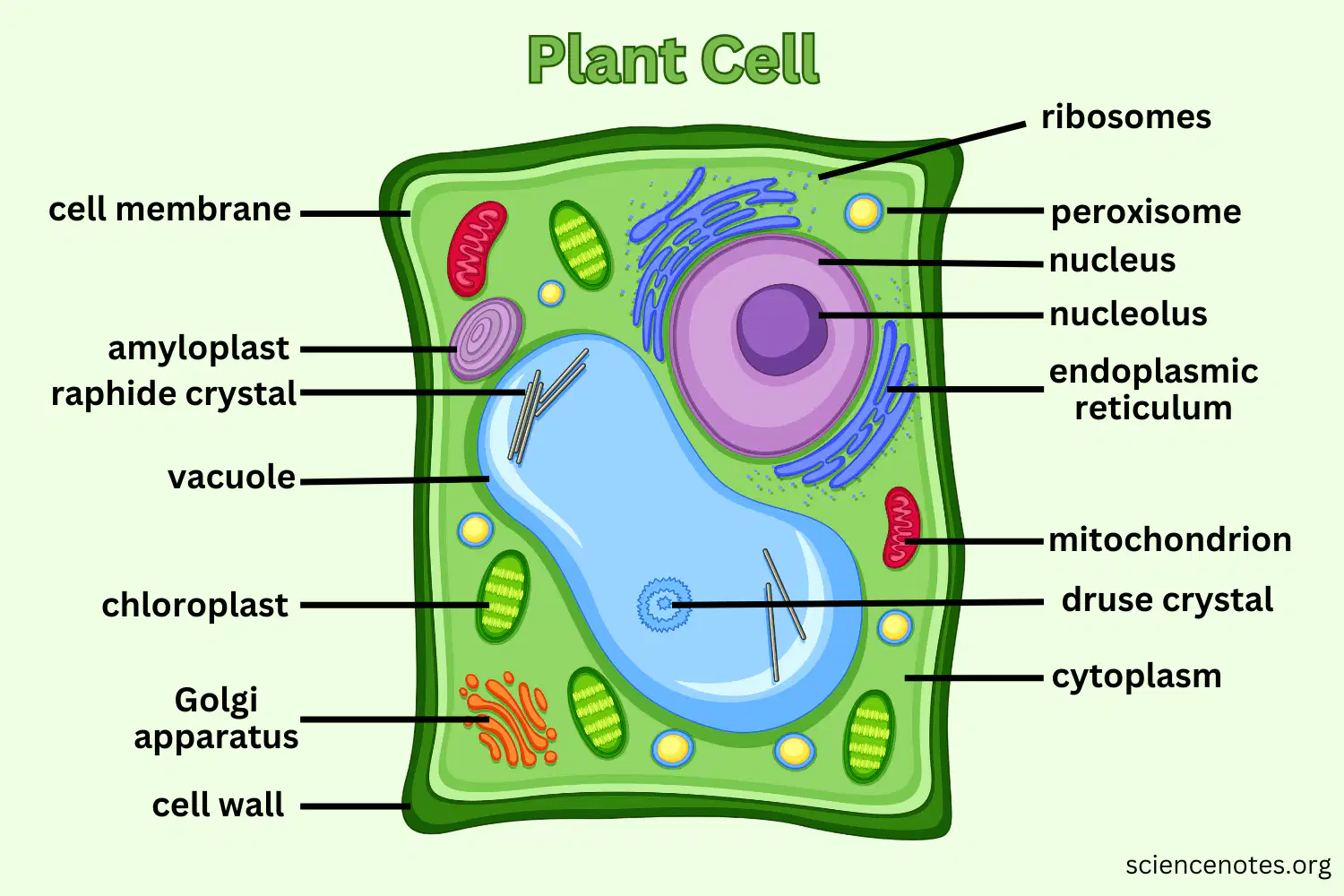
Eukaryote
Prokaryote

Eukaryote
Prokaryote
The movement of WATER across a membrane is _______.
Osmosis
Diffusion
Hypertonic
Isotonic
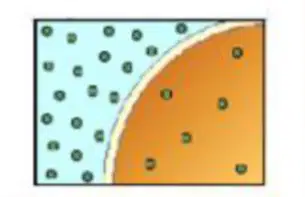
The cell is in an environment that is
hypotonic
hypertonic
isotonic
can't be determined
What is the complete formula for photosynthesis?
C6H1206 + 602 + light --> 6C02 + 6H2O
6C02 + 6H20 + light --> C6H1206 + 602
C6H1206 + 602 --> 6C02 + 6H2O +ATP
6C02 + 6H20 --> C6H1206 + 602 +ATP
______ is required by organisms for building, repairing, growing and reproducing.
E. Lactic Acid
A. Chlorophyll
C. CO2
D. Fermentation
B. Energy
The main pigment used to absorb the sun's energy is called ______.
A. Chlorophyll
B. Energy
C. CO2
D. Fermentation
E. Lactic Acid
The stacks of thylakoids found inside a chloroplast are called ______.
C. CO2
AB. Grana
D. Fermentation
B. Energy
A. Chlorophyll
________ is the process where cells release energy in the absence of oxygen.
A. Chlorophyll
D. Fermentation
C. CO2
B. Energy
E. Lactic Acid
A product of respiration and fermentation in the form of a gas is called _______.
E. Lactic Acid
D. Fermentation
B. Energy
A. Chlorophyll
C. CO2
Humans get sore muscles after vigorous exercise because ________ builds up in the muscles.
D. Fermentation
B. Energy
A. Chlorophyll
E. Lactic Acid
C. CO2
During respiration:
light energy breaks apart the atoms of the reactants
oxygen produced in the burning of food must be released
glucose is not exposed to oxygen
carbon dioxide and water are made
In order to release stored energy from respiration:
a phosphate group must be added to ADP
a phosphate group must be broken off from an ATP
a phosphate group must be added to an ATP
a phosphate group must be broken off of ADP
Autotrophs go through the process of _____ to make their own food.
Photosynthesis
Cellular Respiration
Alcoholic fermentation
Lactic acid fermentation
Where in the cell does cellular respiration take place?
Chloroplast
Rough ER
Nucleus
Mitochondria
Anaerobic means _______.
With oxygen
Without oxygen
With energy
Without energy
Enzymes are proteins that help increase the rate of chemical reactions inside cells. These proteins are composed of many simpler molecules called amino acids. Which of the following suggests that the shape of an enzyme determines the enzyme's function?
Enzymes are specific to a substrate.
Enzymes can operate in a wide range of conditions.
Enzymes are activated by neighboring molecules.
Enzymes can be found in all life-forms.
What things can denature an enzyme?
High temperatures and acids/bases
High temperatures only
High temperatures and substrates
Substrates only
How do enzymes speed up chemical reactions?
By increasing the activation energy
By lowering the activation energy
By acting on many different types of substrates
By increasing the number of active sites
What do plants do with the glucose they make?
Use some for cellular respiration
Store some as starch to provide energy later
Build cell walls of cellulose
All of the above
When mRNA is used to make a protein, the process is called:
Replication
Translation
Manipulation
Transcription

A strand of mRNA containing the sequence AAG CGC AAG CGC could code for which of the following amino acids?
Lys-arg-glu-lys
Ser-ser-glu-glu
Lys-arg-lys-arg
Lys-met-lys-glu
What is the corresponding mRNA sequence for the following DNA strand: TAC-GGC-ATA-GCA-TTT-CAC-TAA
ATG-CCG-TAT-CGT-AAA-GTG-ATT
AUG-CCG-UAU-CGU-AAA-GUG-AUU
UAC-GGC-AUA-GCA-UUU-CAC-UAA
ATG-CCG-TAT-CGT-AAA-GTG-TAA
If one nucleotide is omitted in DNA, which of the following has happened?
deletion
substitution
insertion
segregation
The molecule that delivers amino acids to the ribosomes is ________.
mRNA
tRNA
DNA
rRNA
How many codons does the following strand of mRNA contain? AUG UAG CCG AUU
1
4
8
12
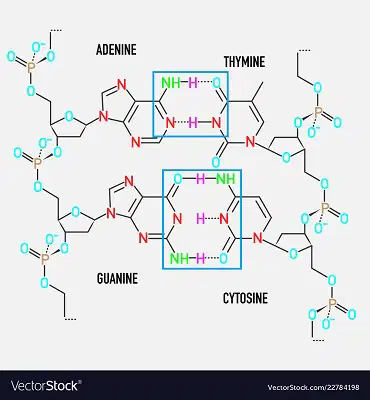
A model of a DNA molecule is shown below. The arrow indicates:
The bond between adjacent phosphate and deoxyribose molecules.
Peptide Bonds
Hydrogen bonds between complementary nucleotides.
The junction of a codon and a DNA triplet.
Adding or deleting a nitrogen base from a DNA sequence may result in ______?
Insertion
Deletion
Substitution
Frame shift
Which part of a DNA molecule is responsible for the direct coding of specific traits in an organism?
The number of hydrogen bonds that hold the strands of DNA together.
The number of carbons in the DNA molecule.
The sequence of nucleotide bases in the DNA molecule.
The sequences of phosphates along each DNA strand.
At birth Himalayan rabbits are usually white over their entire bodies. But when parts of their bodies reach temperatures below 35C, a pigment that causes these parts to turn black is produced. Which of the following is most likely the cause of this phenomenon?
Poor blood circulation
Infection caused by cold temperatures
Gene expression that is regulated by temperature.
A trait that is both sex-linked and hormone-dependent
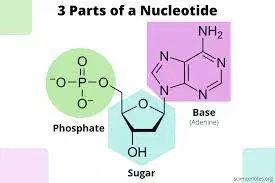
What is the molecule to the right, and what are the numbered parts?
Amino acid; 1= phosphate, 2= glucose, 3= nitrogen base
Nucleotide; 1= phosphate, 2= glucose, 3= nitrogen base
Amino acid; 1= phosphate, 2= deoxyribose, 3= nitrogen base
Nucleotide; 1= phosphate, 2= deoxyribose, 3= nitrogen base
There are ___ strands in DNA and ___ strands in RNA
1, 2
2, 1
1, 1
2, 2
The sugar in DNA is _______ and the sugar in RNA is _____.
ribose, deoxyribose
deoxyribose, ribose
ribose, ribose
deoxyribose, deoxyribose
DNA contains bases _____ and RNA contains bases _____.
ATCG,
AUCG
AUCG,
ATCG
AT,
CG
AU,
CG
The shape of DNA is called a _____, and the sides are made of ______.
twisted ladder, nitrogen bases
double helix, nitrogen bases
twisted ladder, sugars and phosphates
double helix, sugars and phosphates
What is RNA polymerase and what does it do?
enzymes, makes protein
enzymes, makes mRNA
nucleic acid, makes protein
nucleic acid, makes mRNA

What is the name of the molecule that transports the amino acid to the corresponding codon?
mRNA
tRNA
rRNA
siRNA
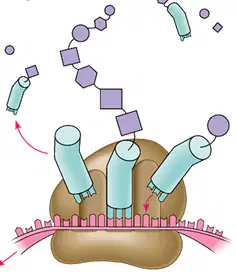
Which nucleic acid is fed through a ribosome and read codon by codon
tRNA
mRNA
rRNA
siRNA
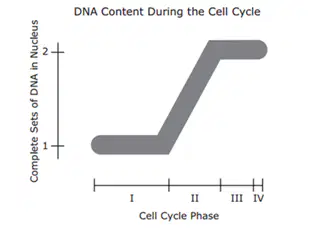
The model represent the change in the DNA content of a cell during the cell cycle. Which part represents S phase?
I
II
III
IV
There are ____ total chromosomes in a human sex cell (gamete)
2
23
46
36
Spindle fibers
connect sister chromatids
uncontrolled cell division
structure that helps separate chromosomes
process of separating a cell into two daughter cells
cytokinesis
control sister chromatids
uncontrolled cell division
structure that help separates chromosomes
process of separating a cell into two daughter cells
centromere
connects sister chromatids
uncontrolled cell division
structures that help separate chromosomes
process of separating a cell into two daughter cells
cancer
connects sister chromatids
uncontrolled cell division
structures that help separates chromosomes
process of separating a cell into two daughter cells
In certain chickens black feathers (B) are co-dominant with white feathers (W). Heterozygous chickens have both black and white feathers. Cross two heterozygous chickens and give genotype ratio.
1:1:1:1
4:1
2:2
1:2:1
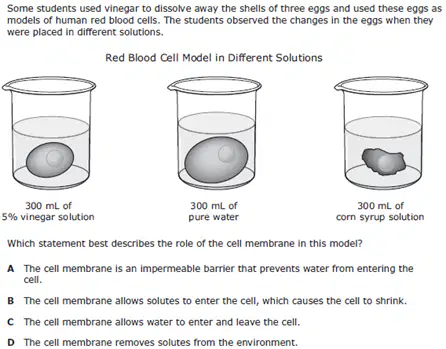
A
B
C
D
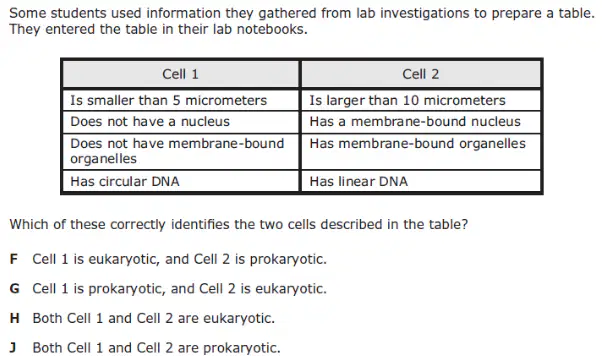
F
G
H
J
Cells pass through a G2 checkpoint before entering mitosis. Ideally, if DNA damage is detected, the cells do not enter mitosis until the damage is repaired. Why is DNA damage repaired before cells enter mitosis?
So that another round of DNA synthesis does not have to take place.
So that the chromosomes can align at the metaphase plate during mitosis.
So that the cytoplasm can be divided equally between the two daughter cells.
So that healthy daughter cells are produced, allowing the organism to continue growing.
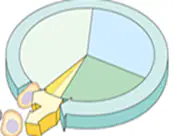
The diagram below represents the cell cycle. When cells leave the cell cycle, they exit during G1 phase and then enter G0 phase, a resting period. Most normal cells can leave G0 phase and reenter the cell cycle at G1 phase before entering S phase. Cancer cells are different because they cannot enter G0 phase and are likely to do which of the following?
Fail to complete S phase
mutate during G1 phase
repeat the cell cycle continuously
die after completing mitosis

What phase is the cell in?
prophase
metaphase
anaphase
telophase
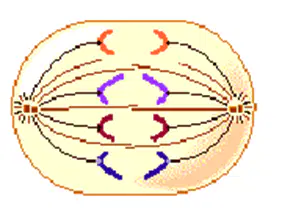
What phase is the cell in?
Prophase
Metaphase
Anaphase
Telophase

What phase is the cell in?
Prophase
Metaphase
Anaphase
Telophase
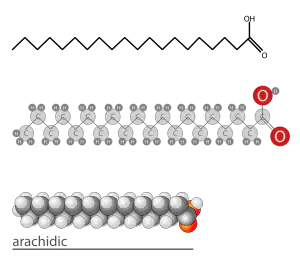
What biomolecule is this?
Lipid
Carbohydrate
Protein
Nucleic Acids
What kind of bonds hold DNA strands together?
Covalent bonds
ionic bonds
peptide bonds
hydrogen bonds
Protein molecules are made up of smaller molecules called
monosaccharides
nucleotides
amino acids
lipids
_____ is the enzyme that unwinds the DNA and separates the strands, while the enzyme _____ copies the DNA through base-pairing.
DNA polymerase, helicase
helicase, DNA polymerase
Helicase, RNA polymerase
DNA polymerase, RNA polymerase
Cell division in prokaryotes (bacteria) is called
mitosis
cytokinesis
binary fission
bacteriosis
during asexual cell division, daughter cells are produced that are
genetically the same as each other
genetically the same as the parent
have the same number of chromosomes as the parent cell
all of the above
Cytokinesis differs between plant and animal cells. During cytokinesis, plant cells form _____ and animal cells have _____.
Cell plate; furrow
Furrow; cell plate
Centrioles; spindle fibers
Spindle fibers; centrioles
sister chromatids separate
prophase
metaphase
anaphase
telophase
interphase
two nuclei reform and chromosomes relax into chromatin
interphase
prophase
metaphase
anaphase
telophase
cells grow and replicates DNA
interphase
prophase
metaphase
anaphase
telophase
Meiosis produces what type of cells?
gametes
sex cells
eggs
sperm
all of the above
Which of the following increases genetic variation in meiosis?
crossing over
zygote formation
mitosis
dominant allele
If a frog has a diploid (2N) cell with 26 chromosomes, how many chromosomes are in the gametes?
26
52
13
6
In radishes, the gene that controls color exhibits incomplete dominance. Pure-breeding red radishes (RR) crossed with pure-breeding white radishes (WW) make purple radishes (purple is heterozygous- RW). Cross a purple radish with a white radish, and give genotype ratio.
3:1
4:1
2:2
1:1:1:1
In humans, brown eyes (B) are dominant to blue eyes (b), and free earlobes (E) are dominant to attached earlobes (e). Cross a mother that is homozygous dominant for both traits with a father that is homozygous recessive for both. What is the phenotype ratio?
4:4:4:4
6:6:2:2
16:0
9:3:3:1
In toads, long tongues (T) are dominant to short tongues (t). Cross a homozygous recessive female toad with a heterozygous male toad for this trait. What is the genotype ratio?
1:1:1:1
2:2
3:1
4:0
Situation when one allele is not completely dominant over another and you see blending.
incomplete dominance
co-dominance
sex-linked
dominant/recessive
Sex-linked traits are found on the ____.
X chromosome
Y chromosome
autosomes
any chromosome
When one gene in a pair hides the other, we say that the gene being hidden is
dominant
recessive
heterozygous
visible
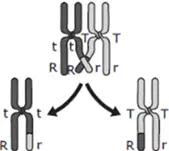
Which process is this that increases genetic diversity?
crossing over
nondisjunction
anaphase
independent assortment
Humans contain two copies of each chromosome. They are the same size and shape, and contain the same gene sequence. What are these copies called?
Homologous chromosomes
chromatin
mitosis
all of these
The observed trait in an organism is
allele
genotype
phenotype
karyotype
Fertilized egg is called
ova
embryo
zygote
polar body

