
 Worksheets
Unit 2 - Final Test Prep
Total questions: 117
Worksheet time: 4hrs 31mins
What is the process of water droplets in clouds becoming heavy and falling back to earth?
evaporation
condensation
precipitation
transpiration
____________ is water from precipitation that moves across the ground surface before ending up in a stream, creek, or bayou.
watershed
groundwater
runoff
aquifer
A barrier, such as a ridge, hill or mountain, separating one watershed land area from another.
Runoff
Divide (or watershed boundary)
Aquifer
Permeable
Water that collects in cracks and pores in underground soil and rock layers.
Groundwater
Surface Water
Permeable
Impermeable
An area of land where the surface water and groundwater drain into a particular body of water like a lake or pond is called a(n):
Watershed
Drainage Divide
Erosion
Aquifer
A measure of a change in elevation over a certain distance is called a:
porosity
gradient
permeability
recharge zone
discharge zone
An area where groundwater becomes surface water is called the:
gradient
porosity
permeability
recharge zone
discharge zone
The area of land that is drained by a river system into a lake or pond is called
tributary
surface water
watershed
groundwater
The path that a steam follows is called a(n):
aquifer
channel
water table
stream load
An area where water trickles down into the ground and reaches the water table and enters an aquifer to replenish the aquifer is called:
discharge zone
recharge zone
permeability
porosity
The percentage of the rock that is composed of pore space is referred to as
porosity
permeability
recharge zone
discharge zone
The measure of how easily water can flow through an aquifer is called
permeability
porosity
discharge zone
recharge zone
A body of rock or sediment that stores groundwater and allows it to flow is called a(n)
channel
aquifer
water table
stream load
Water above Earth's surface is called
tributary
surface water
watershed
groundwater
A smaller stream that feeds into a river and eventually into a river system is called a(n)
groundwater
surface water
tributary
watershed
The ___________ is the upper boundary, or surface, of groundwater.
stream load
amount of materials carried by a stream
water table
upper boundary, or surface, of groundwater
channel
the path that a stream follows
aquifer
body of rock that stores groundwater
permeability
how easily water can flow in an aquifer
Materials carried by a stream are called
water table
channel
aquifer
stream load
A ridge or an area of higher ground that separates two watersheds is called a(n)
divide
gradient
tributary
aquifer


Well sorted soil with lots of spaces between rocks...

An underground layer of permeable rock, sediment, or soil that stores water is call a(n) __________.
cave
divide
aquifer
well

Water found beneath the Earth's surface is called _____.
groundwater
storm water
surface water
wastewater

Water that flows along Earth's surface is called ___.
groundwater
runoff
storm water
surface water

This is the direction that water flows on the surface of the ground.
any direction
downhill
sideways
upward

An area of land where all the water drains to the same body of water is called a(n) _____.
aquifer
divide
wetland
watershed

This type of pollution does NOT have one identifiable source because runoff moves over or through the ground.
nonpoint source
point source

When precipitation hits the ground, the path it takes is determined by ...
what it hits (rock, asphalt, or soft dirt)
gravity
topography (shape of the land)
All of these.

The surface water system includes:
streams and rivers
lakes
oceans
All the above.

This type of pollution comes from a specific source or site that can be identified.
nonpoint source
point source

An aquifer contains _____ which can be extracted for use.
groundwater
storm water
surface water
wastewater

Which of the following are examples of nonpoint source pollutants?
trash and dirt
fertilizer and pesticides
chemicals and sediment from construction sites
All the above.

This is an example of _____ pollution.
nonpoint source
point source

Acid rain is a _____ pollutant.
nonpoint source
point source

Which of the following is a negative effect of human activity on groundwater?
It supplies water to nearly half of US households.
It is the primary source of irrigation water for US agriculture.
It can get contaminated by substances released on the ground.
All the above.
What is the main source of groundwater?
(a)
morning dew collecting on the surface of shrubs and grasses
precipitation falling into man-made wells
saltwater flowing into fault lines at the ocean floor
How are groundwater and surface water related?
Groundwater can become surface water, but surface water cannot become groundwater.
Surface water can become groundwater, but groundwater cannot become surface water.
All surface water is also groundwater, and all groundwater is also surface water.
Surface water can seep down into the ground to become groundwater.
What is the interaction between surface water and groundwater in a watershed?
Groundwater and surface water are separated by a layer of rock called a watershed.
Groundwater and surface water drain away from watersheds.
Groundwater discharges into a watershed, where it becomes surface water.
Surface water collects in a watershed and seeps into the ground.
When wetlands add water to the groundwater system, they are recharging the groundwater. When wetlands take water from the groundwater system, the groundwater discharges.
Use this information to select the true statement.
Groundwater sometimes discharges into a stream or lake.
Groundwater never discharges into streams or lakes.
Groundwater seeks an imbalance, discharging more than it is recharge
Groundwater cannot discharge, it can only be recharged.
When the ground becomes saturated in a rain storm and the excess cannot be soaked up, the water will travel along the ground until it hits a low-lying area or a larger body of water. The water that is not absorbed into the ground, including the larger body of water, is _______.
Fertilizer
Surface Water
A puddle
Groundwater
Region X has been experiencing a prolonged drought, while region Y has received rain daily for the last month. Assuming all other factors are the same, which of the following will occur if both regions experience a steady rainfall today and receive the same amount of precipitation?
Region X will have more water seep into the ground and less surface runoff than region Y.
Region Y will have more water seep into the ground and less surface runoff than region X.
Region Y will have less water seep into the ground and less surface runoff than region X.
Region X will have less water seep into the ground and less surface runoff than region Y.
When precipitation falls on land surfaces, it begins to flow toward sea level. The water is more likely to flow toward sea level as groundwater if
the surface is not porous and there are lots of interconnected spaces underground.
the surface is porous and there are lots of interconnected spaces underground.
the surface is porous and there are few interconnected spaces underground.
the surface is not porous and there are few interconnected spaces underground.
When water infiltrates the ground, the water tends to move downward until it reaches what?
the other side of the Earth
the Earth's core
a depth of 100 feet
the water table
The Fox river is a smaller river that empties into a larger river, the Illinois river. The Fox river is an example of what?
An Ocean
A Tributary
Batavia
Lets talk Groundwater. You have a bunch of water hiding underground. What do you call the top level of that underground water?
The top
The bottom
The water table
The water floor
What is an example of a divide? Remember a divide separates a water shed.
A river
A mountain
A busy street
What is an aquifer? Check all that are true!
Ground water
Water that is stored underground
Water that is held under the Earth's surface
Water that is sitting in a lake
The amount of space between the rocks in an aquifer is called what?
Permeability
Porosity
Big
If water is "flowing" or moving underground, it can move slow or fast. What is a word for how water flows underground?
Porosity
Permeability
Aquifer
Porosity is the amount of _________ in an aquifer.
Space
Dirt
People

What will happen to the warm water in this lab?
the warm water will stay at the bottom
the warm water will move upwards

Why does the warm water move upwards?
it is more dense
it is less dense
In which lab did the water not move?


Why did the warm and cold water stay in the same place?
because warm water is less dense and the cold water is more dense
cold water is less dense and warm water is more dense
What 2 factors both affect the density of ocean water?
temperature and the sun
temperature and ice
temperature and salinity
salinity and ice

The measure of the amount of dissolved salt in a given amount of water is called _____.
solubility
salinity
density
proximity

As the depth of ocean water increases, the temperature
increases.
decreases.
fluctuates depending on the pressure.
stays the same.

When temperature decreases, the density of liquid water _________________.
increases
decreases
stays the same

The curving of moving objects from a straight path due to the Earth's rotation is called
a continental deflection.
the Coriolis effect.
a pressurized deflection.
a rotational deflection.

Earth's Oceans carry more than just water. They carry matter (good and bad) and energy all over the globe.
True
False
Salinity is
The salt content of a substance
The Pepper content of a substance
The circulation of hot and cold matter
the weather pattern of a region


________________ changes water into water vapor.
States of matter
Solid
Liquid
Condensation
Water changing from a liquid to a gas is called _______________.
evaporation
condensation

Which picture shows material that is more dense?
The picture of the left
The picture on the right
Why does ice float?
Due to convection currents
It is more dense than water.
It is less dense than water.
What is transpiration?
Excess water being released from the aerial parts of plants in the form of water vapor
Excess sugar being released from the leave
The way a plant makes its food
When the plant uses sugar for energy
fats and oils
sugar molecules
salt molecules
Water has _____ specific heat. Meaning, it takes a _____ time to warm up a large amount of water.
high/ long
high/ short
low/long
low/ short

What is the chemical formula of water?
H2O
CO2
O2
N2
Hydrogen bonding occurs because of the ____ between the positive hydrogen and the negative oxygen
attraction
repulsion
The oxygen atom in water is slightly ____.
negative
positive
The attraction between molecules of the same substance is ___.
adhesion
cohesion
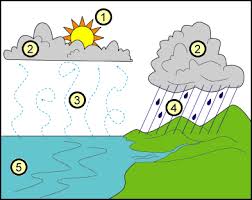

Attractions between water molecules are called ....
Covalent bonds
Ionic bonds
Polar bonds
Hydrogen bonds


The tendency of molecules of different substances to stick to one another is called .....
water vapor given off by plants
runoff
transpiration
evaporation
condensation
What do water droplets form?
condensation
humidity
clouds
runoff
What is the primary energy source that drives the Earth’s water cycle between the atmosphere, oceans, and land?
Wind
Sunlight
Ocean currents
Rotation of Earth
Water gains energy during evaporation. During what process in the water cycle is this energy released?
Infiltration/percolation through the soil
Transpiration from plants
Runoff into the lake and ocean
Condensation that forms clouds
Which of the following is NOT a way that water moves from the land to the atmosphere?
Evaporation
Precipitation
Sublimation
Transpiration
Match the steps of the water cycle to the correct box.
Evaporation
Condensation
Precipitation
Ocean Circulation
Occurs when ice gains energy and turns directly into a gas.
Water in its gas form is called ____________________,
water vapor
precipitation
ice
air

