
 Worksheets
ICP Semester 1 exam practice
Total questions: 77
Worksheet time: 4hrs 51mins
In which step of the scientific method is information obtained through the senses?
a. drawing conclusions
b. making observations
c. analyzing data
d. revising a hypothesis
What happens when the data in an investigation do not support the original hypothesis?
a. The scientist gives up and starts an investigation on a new topic.
b. The data must be incorrect and are thrown out.
c. The hypothesis is revised.
d. The data are altered so that they support the original hypothesis.
What is a statement that summarizes a pattern found in nature?
a. scientific law
b. a fact
c. a hypothesis
d. a scientific theory
Which of the following statements is true about scientific theories?
a. Scientific theories become scientific laws.
b. Scientific theories are never proven.
c. Scientific theories become hypotheses.
d. Scientific theories summarize patterns found in nature.
What is a physical or mental representation of an object or an event?
a. theory
b. a model
c. a hypothesis
d. a scientific law
What are 6 centimeters equal to?
a. 600 meters
b. 6 of a millimeter
c. 60 millimeters
d. 600 millimeters
Which of the following conversion factors would you use to change 18 kilometers to meters?
a. 1000 m/1 km
b. 1 km/1000 m
c. 6 of a millimeter
d. 1 km/100 m
Timers at a swim meet used four different clocks to time an event. Which recorded time is the most precise?
a. 55.25 s
b. 55 s
c. 55.254 s
d. 55.2 s
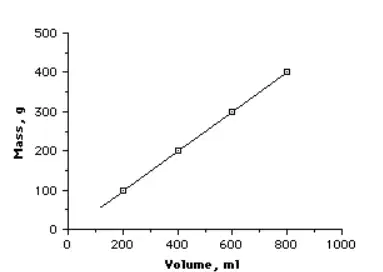
This graph represents a ____ relationship.
a. direct
b. indirect
6.5 mm = ____ cm
a. 65
b. 0.65
c. 650
d. 0.065
53 000 000 000 = _____ put in proper scientific notation.
a. 5.3 x 10⁹
b. 53 x 10⁹
c. 5.3 x 10⁹
d. 5.3 x 10¹⁰
One kilometer equals 1000 meters. What does the prefix kilo- mean?
a. 1
b. 10
c. 100
d. 1000
A person walks 1 mile every day for exercise, leaving her front porch at 9:00 am. and returning to her front porch at 9:25 am. What is the total displacement of her daily walk?
a. 1 mile
b. 25 minutes
c. none of the above
d. 0 miles
A person drives north 6 blocks, then turns west, and drives 6 blocks. The driver then turns south and drives 6 blocks. How could the driver have made the distance shorter while maintaining the same displacement?
a. by driving west 6 blocks from the starting point
b. by driving north 4 block and west 7 blocks
c. by driving south 6 blocks from the starting point
d. by driving back to the starting point by the same route
The slope of a line on a distance-time graph is
a. distance
b. time
c. speed
d. displacement
A horizontal line on a distance-time graph means the object is
a. moving at a constant speed
b. moving faster
c. slowing down
d. at rest
What is the speed of a bobsled whose distance-time graph indicates that it traveled 100 m in 25 s?
a. 2500 m/s
b. 100 m/s
c. 0.25 m/s
d. 4 m/s
Suppose you increase your walking speed from 1 m/s to 3 m/s in a period of 1 s. What is your acceleration?
a. 2 m/s²
b. 5 m/s²
c. 4 m/s²
d. 3 m/s²
As you push a cereal box across a tabletop, the sliding friction acting on the cereal box
a. acts in the direction of motion
b. acts in the direction opposite of motion
c. equals the weight of the box
d. is usually greater than static friction
What is instantaneous acceleration?
a. how fast a speed is changing at a specific instant
b. how fast a velocity is changing at a specific instant
c. how fast a direction is changing at a specific instant
d. all of the above
The forces acting on a falling leaf are
a. air resistance and fluid friction
b. gravity and air resistance
c. gravity and static friction
d. weight and rolling friction
The property of matter that resists changes in motion is called
a. friction
b. gravity
c. inertia
d. weight
The product of an object's mass and velocity is its
a. centripetal force
b. momentum
c. net force
d. weight
If a force of 12 N is applied to an object with a mass of 2 kg, the object will accelerate at
a. 0.17 m/s²
b. 6 m/s²
c. 24 m/s²
d. 12 m/s²
What force is responsible for the repulsion between two positively-charged particles?
a. centripetal
b. electric
c. magnetic
d. strong nuclear
Which universal force acts only on the protons and neutrons in a nucleus?
a. electric
b. gravitational
c. magnetic
d. nuclear
A hammer drives a nail into a piece of wood. Identify an action-reaction pair in this situation.
a. The hammer exerts a force on the nail; the nail exerts a force on the hammer.
b. The nail exerts a force on the hammer; the hammer exerts a force on the wood.
c. The hammer exerts a force on the nail; the hammer exerts a force on the wood.
d. The hammer exerts a force on the nail; the wood exerts a force on the nail.
Suppose the force of friction on a sliding object is 25 N. The force needed to maintain a constant velocity is
a. more than 25 N
b. less than 25 N
c. 25 N
Which of the following has the greatest momentum?
a. a tortoise with a mass of 275 kg moving at a velocity of 0.55 m/s
b. a hare with a mass of 2.7 kg moving at a velocity of 7.5 m/s
c, a turtle with a mass of 91 kg moving at a velocity of 1.4 m/s
d. a roadrunner with a mass of 1.8 kg moving at a velocity of 6.7 m/s
The object with the most inertia is the object with
a. the most speed
b. the most mass
c. the most volue
d. the most momentum
In order to calculate pressure exerted on a surface, what quantity is divided by the surface area?
Altitude
Force
Mass
Volume
What is the SI unit of pressure?
a. g/cm³
b. m/s²
c. meter
d. the pascal
The pressure of a fluid at a specific depth
a. depends only on the type of fluid.
b. is exerted only in the downward direction.
c. varies with the total volume of the fluid.
d. all of the above.
Atmospheric pressure is caused by
air currents
the weight of the atmosphere above a particular location
clouds
the altitude above sea level
The hydraulic system of a dump truck is designed to multiply
distance
force
pressure
speed
The upward force acting on the wing of an airplane in flight is called
drag
lift
thrust
weight
Which of the following statements is true about an airplane wing during flight?
Air above the wing travels faster than air below the wing.
Air below the wing travels faster than air above the wing.
The wing exerts pressure equally in all directions.
The lift acting on the wing reduces the weight of the wing.
The upward force acting on an object submerged in a fluid is called
buoyant force
drag
pressure
weight
The buoyant force on an object in a fluid is equal to the weight of the
fluid
fluid surrounding the object
fluid displaced by the object
object
The relationship between buoyant force and weight of a displaced fluid was first stated by
Archimedes.
Bernoulli.
Newton.
Pascal.
A force acting on an object does no work if
a machine is used to move the object.
the force is not in the direction of the object’s motion.
the force is greater than the force of friction.
the object accelerates.
What is the unit of work?
Joule
Newton/meter
watt
all of the above
The power of a machine measures
its rate of doing work.
its strength.
the force it produces.
the work it does.
A 750-W motor might also be rated as a
a. 0.5-horsepower motor.
b. 1-horsepower motor.
c. 2-horsepower motor.
d. 10-horsepower motor.
The relationship between buoyant force and weight of a displaced fluid was first stated by
a. Archimedes.
b. Bernoulli.
c. Newton.
d. Pascal.
Which of the following statements is true?
To increase power, you can decrease the amount of work you do in a given amount of time, or you can do a given amount of work in less time.
To increase power, you can decrease the amount of work you do in a given amount of time, or you can do a given amount of work in more time.
To increase power, you can increase the amount of work you do in a given amount of time, or you can do a given amount of work in less time.
To increase power, you can increase the amount of work you do in a given amount of time, or you can do a given amount of work in more time.
A machine is a device that can multiply
force
power
work
all of the above
When a machine does work, it cannot do which of the following?
change the direction of a force.
increase a force and change the distance a force moves.
increase the distance a force moves and change the direction of a force.
increase a force and increase the distance a force moves an object.
The actual mechanical advantage of a machine
cannot be less than 1
decreases as the input distance increases.
increases with greater friction.
is less than the ideal mechanical advantage of the machine.
Reducing friction in a machine
decreases its actual mechanical advantage.
decreases the work output.
increases its efficiency.
increases its ideal mechanical advantage.
The efficiency of a machine is always less than 100 percent because
a machine cannot have an IMA greater than 1.
some work input is lost to friction.
the work input is too small.
the work output is too great.
An inclined plane reduces the effort force by
increasing the distance through which the force is applied.
increasing the work.
reducing the effort distance.
reducing the work.
Which of the following is an example of a wheel and axle?
hammer
an automobile steering wheel
a jar lid
a pencil
The ideal mechanical advantage of a pulley system is equal to the
distance the load has to move.
length of the rope.
number of rope segments supporting the load.
weight of the object being lifted.
Fossil fuels currently account for the majority of the world’s energy use because they are
distributed evenly throughout the world.
nonpolluting.
relatively inexpensive and readily available.
renewable energy resources.
A mechanical wave generally does NOT
move the medium from one place to another.
move through a medium.
move through solids.
disturb the medium.
Which type of mechanical wave needs a source of energy to produce it?
a transverse wave
a longitudinal wave
a surface wave
all of the above
Which wave causes the medium to vibrate only in a direction parallel to the wave’s motion?
a transverse wave
a surface wave
a longitudinal wave
none of the above
A disturbance sends ripples across water in a tub. These ripples are an example of a
rarefaction.
longitudinal wave.
compression.
surface wave.
A period is the length of time it takes for
a disturbance to start a wave.
two complete wavelengths to pass a fixed point.
a wave to travel the length of a rope.
one complete wavelength to pass a fixed point.
To find amplitude, measure
from a trough to the rest position.
from a crest to the rest position.
neither A nor B
either A or B
How does reflection differ from refraction and diffraction?
Reflection is the only process in which the wave does not continue moving forward.
Reflection is the only process that involves a change in the wave.
Reflection affects all types of mechanical waves, but refraction and diffraction do not.
Reflection is the only process that changes the direction of a wave.
In refraction, when a wave travels from one medium to another, it
changes speeds.
stays in step.
always moves in the same direction.
travels in the opposite direction.
Suppose two waves collide and the temporary combined wave that results is smaller than the original waves. What term best describes this interaction?
diffraction
destructive interference
standing wave formation
constructive interference
An ambulance siren sounds different as it approaches you than when it moves away from you. What scientific term would you use to explain how this happens?
ultrasound
diffraction
rarefaction
the Doppler effect
The part of the ear that sends coded nerve signals to the brain is
the outer ear.
the inner ear.
the middle ear.
the eardrum.
Electromagnetic waves vary in
the speed they travel in a vacuum.
wavelength and frequency.
the way they reflect.
the orientation of their electric and magnetic fields.
To calculate the frequency of an electromagnetic wave, you need to know the speed of the wave and its
wavelength
intensity
refraction.
amplitude
An electromagnetic wave in a vacuum has a wavelength of 0.07 m. What is its frequency?
a. f= 3.0 x 10^8 m/s
b. f 4.3 x 10^9Hz
c. f= 3.0 x 10^9Hz
d. f= 4.3 x 10^6m/s
Infrared rays have a shorter wavelength than
a. ultraviolet rays.
b. X-rays.
c. gamma rays.
d. radar waves.
The full range of frequencies of electromagnetic radiation is called
a. visible light.
b. radio waves.
c. the electromagnetic spectrum.
d. invisible radiation.
The visible light spectrum ranges between
radar waves and X-rays.
television waves and infrared rays.
ultraviolet rays and gamma rays.
infrared rays and ultraviolet rays.
Work is a transfer of
energy
force
mass
motion
The energy of motion is called
kinetic energy
potential energy
elastic energy
work
A 4-kilogram cat is resting on top of a bookshelf that is 3 meters high. What is the cat's gravitational potential energy relative to the floor if the acceleration due to gravity is 9.8 m/s²?
a. 7 J
b. 12 J
c. 29 J
d. 118 J
The total potential and kinetic energy of all the microscopic particles in an object make up its
chemical energy
electric energy
nuclear energy
thermal energy
Which of the following statements is true according to the law of conservation of energy?
a. Energy cannot be created.
b. Energy cannot be destroyed.
c. Energy can be converted from one form to another.
d. all of the above

