wayground logo

Free Printable Worksheets

Font size

S
M
L
XL
Worksheets

Midterm Biology Review

Total questions: 67

Worksheet time: 1hrs 15mins

Name
Class
Date
1.
In the energy pyramid here, which organisms have the most energy available?
a)
Producers
b)
Carnivores
c)
Herbivores
d)
Top Predator
2.
In the energy pyramid below, which organism has the least amount of energy available?
a)
Producers
b)
Herbivores
c)
Carnivores
d)
Top Predator
3.
If there is 1000 Kcal available in the producers in trophic level 1, how much energy is available in the herbivores in trophic level 2?
a)
10 Kcal
b)
1 Kcal
c)
100 Kcal
d)
1000 Kcal
4.
Which is the smallest level of an ecosystem?
a)
organsism
b)
population
c)
community
d)
ecosystem
5.
a system of food chains that shows the transfer of energy  is termed
a)
food web
b)
food chain
c)
prey
d)
predator
6.
Biodiversity is 
a)
the variety of species within an ecosystem
b)
a large number of the same species in an ecosystem
c)
an abundant amount of the same primary consumers 
d)
the ability to have an abundant source from the same species
7.
An organism that needs to eat other organisms to obtain energy is known as a:
a)
Autotroph
b)
Producer
c)
Consumer
d)
Mutualist
8.
The rabbit in this food web would be considered a:
a)
Decomposer
b)
Producer
c)
Secondary Consumer
d)
Primary Consumer
9.
Where an organism lives
a)
habitat
b)
niche 
c)
heterotrogh
d)
biosphere
10.
The nonliving aspects of an ecosystem.
a)
Abiotic factors
b)
Biotic factors
11.
The living portions of the ecosystem.
a)
Biotic factors
b)
Abiotic factors
12.
A collection of organisms that make up a community as well as all of the nonliving aspects of the environment.
a)
Population
b)
Community
c)
Habitat
d)
Ecosystem
13.
Cattle egrets forage (feed) in fields among cattle. The egret gets easy access to flying insects stirred up by the cattle, and the cattle don't care if they are there or not.
a)
mutualism
b)
commensalism
c)
competition
d)
parasitism
14.

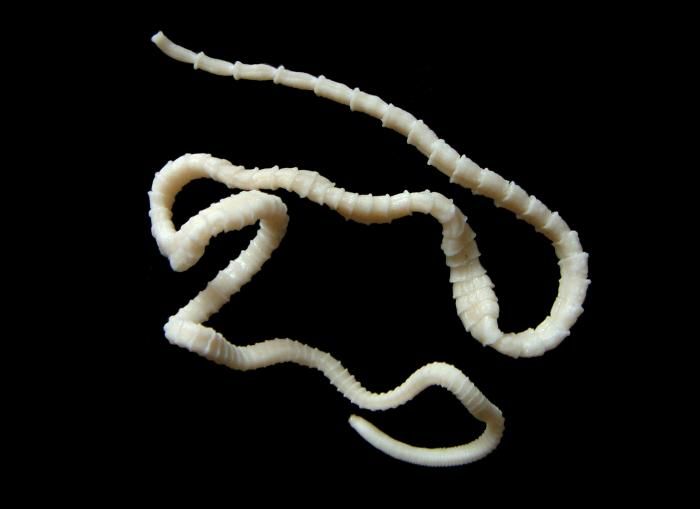
A tapeworm lives in the intestine of a cat absorbing nutrients through its skin. A tapeworm and a cat have this type of relationship.

a)

mutualism

b)

parasitism

c)

commensalism

d)

competition

15.
A relationship between two organisms in which both organisms benefit. 
a)
Mutualism 
b)
Competition
c)
Parasitsm 
d)
Commensalism 
16.

Clown fish live among anemones, acting as a lure for the sea anemone's prey. The clown fish get protection and shelter from the anemone. This is an example of which type of symbiosis?

a)

Commensalism

b)

Mutualism

c)

Parasitism

17.
What kind of factor: disease?
a)
density-independent
b)
density-dependent
18.
What kind of factor: flood?
a)
density-independent
b)
density-dependent
19.
What kind of factor: predation?
a)
density-independent
b)
density-dependent
20.
What kind of factor: temperature?
a)
density-independent
b)
density-dependent
21.
What is the carrying capacity of this population?
a)
100
b)
200
c)
300
d)
400
22.

Two species of fish hunt the same prey in the same bay, one of them declines over time until it is no longer in the bay. This is an example of

a)

overshoot

b)

competitive exclusion

c)

resource partitioning

d)

community partitioning

23.
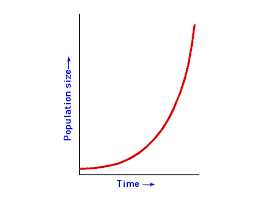
What type of growth is shown in the diagram?
a)
exponential growth
b)
logistic growth 
c)
predator-prey cycle
d)
boom-bust curve
24.
Largest number of individuals of a population that the environment can support...  
a)
carrying capacity
b)
population crash
c)
lag phase
d)
mutualism
25.
What do you call a period of rapid growth?
a)
exponential growth
b)
logistic growth
c)
emigration
d)
predator-prey cycle
26.
Type of growth that occurs under ideal conditions?
a)
predator-prey cycle
b)
logistic
c)
exponential
27.
Limiting factors are sometimes helpful because they can keep the population from getting too large.
a)
True
b)
False
28.
Any thing or organism that regulates the size of a population of another organism is known as __________.
a)
a limiting measure
b)
a limiting factor
c)
factorization
d)
materialization of precipitation
29.
TRUE or FALSE?
All of the carbon in existence is continually recycled in the carbon cycle.
a)
True
b)
False
30.
Carbon can be found in...
a)
The atmosphere
b)
Soil
c)
Fossil fuels
d)
All of the above
31.
Which of the following removes carbon from the atmosphere?
a)
Combustion
b)
Respiration
c)
Photosynthesis
d)
Death
32.
Combustion is another word for __________.
a)
Transportation
b)
Respiration
c)
Fossil Fuels
d)
Burning
33.
Respiration is the process by which animals take in _____ and release _____. 
a)
photosynthesis, air
b)
carbon, oxygen
c)
oxygen
d)
oxygen, carbon dioxide
34.
What process occurs when coal (fossil fuel) is used for energy?
a)
Decomposition
b)
Combustion
c)
Pressurization 
d)
Respiration 
35.

How do animals get carbon?

a)

By eating plants and or other animals.

b)

They absorb it from the atmosphere.

c)

From the ground

d)

They do not get carbon from anywhere.

36.

Which of the following are fossil fuels?

a)

Coal, water, oil

b)

Oxygen, coal, oil

c)

Coal, Oil, Natural Gas

d)

None of the above

37.
.What is the effect of deforestation on the carbon cycle? 
a)
 Increase in the amount of CO2 in the atmosphere  
b)
Decrease in the amount of CO2 in the atmosphere 
c)
Increase in the amount of photosynthesis 
d)
Deforestation has no impact on the carbon cycle 
38.
When humans burn fossil fuels, most of the carbon quickly enters the                       as carbon dioxide.
a)
Water
b)
Atmosphere
c)
Sun
d)
Air
39.
Why is the ocean important to the carbon cycle?
a)
It keeps sediment containing carbon underwater for millions of years
b)
The ocean gives out more carbon then it takes in (increases global warming)
c)
The ocean isn't important to the carbon cycle.
40.
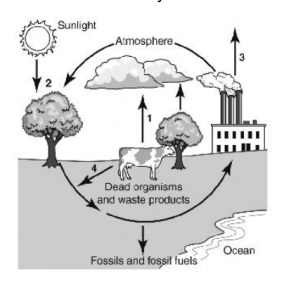
What is happening at 1?
a)
respiration: releasing CO2
b)
decomposing COin the soil
c)
photosynthesis: absorbing CO2
d)
turning CO2 from the atmosphere into organic molecules
41.

Where does photosynthesis occur?

a)

mitochondria

b)

chloroplast

c)

animal cells

d)

ribosomes

42.

What is the name of the pigment molecule that absorbs light energy and makes plants green?

a)

chloroplast

b)

glucose

c)

mitochondria

d)

chlorophyll

43.

What is the purpose of photosynthesis?

a)

To release energy

b)

To create glucose

c)

To grow

d)

To get oxygen for respiration

44.

Which of these are limiting factors for photosynthesis? Choose 3 answers.

a)

Light intensity

b)

CO2 concentration

c)

Temperature

d)

Light

e)

CO2 low levels

45.

What are the products of photosynthesis?

a)

Oxygen and Energy

b)

Carbon Dioxide and Glucose

c)

Glucose and Oxygen

d)

Oxygen and Water

46.
Where do the light reactions happen?
a)
mitochondria membrane
b)
thylakoid membrane
c)
stroma
d)
central vacuole
47.

The Calvin Cycle occurs in the

a)

Thylakoid

b)

Grana

c)

Inner membrane of chloroplast

d)

Stroma

48.
What are the two products of the light reactions that are needed for the calvin cycle?
a)
NAD and NADPH
b)
NADP + and Glucose
c)
NADPH and ATP
d)
Oxygen and NADPH
49.
What is the ultimate ORIGINAL source of energy for living things
a)
Sugar
b)
Sun
c)
Moon
d)
Carbon Dioxide
50.
What is the pigment in chloroplasts that performs photosynthesis?
a)
Chlorosynthesis
b)
Chlorophyll
c)
ADP
d)
Electron Transport
51.
The interior space of the chloroplast is called:
a)
Lamellae
b)
Grana
c)
Stroma
d)
Thylakoids
52.

Which of the following equations represents the overall chemical reaction for photosynthesis?

a)

6O2+ 6H2O → C6H12O6+ 6O2

b)

C6H12O6 + 6H2O→ 6O2+ 6O2

c)

6CO2+ 6H2O→ C6H12O6+ 6O2

d)

6O2 + 6H2O→ C6H12O6 + 6CO2

53.

What are the three stages of cellular respiration?

a)

1- glycolysis

2- cellular respiration

3- fermentation

b)

1- glycolysis

2- krebs cycle

3- electron transport chain

c)

1- krebs cycle

2 - calvin cycle

3- electron transport chain

d)

1- electron transport chain

2- krebs cycle

3- glycolysis

54.

The process of glycolysis requires oxygen

a)

TRUE

b)

FALSE

55.

The Krebs Cycle takes place in the

a)

cytoplasm

b)

mitochondria

c)

cell membrane

d)

golgi bodies

56.

The second stage of cellular respiration is

a)

the calvin cycle

b)

the carbon cycle

c)

the krebs cycle

d)

the kelvin cycle

57.

The third stage of cellular respiration is

a)

mitochondria

b)

glycolysis

c)

electron transport chain

d)

pyruvate

58.

What label should be written in spot B

a)

cytoplasm

b)

cellular respiration

c)

glycolysis

d)

krebs cycle

59.

What label should be written in spot D

a)

cytoplasm

b)

cellular respiration

c)

glycolysis

d)

krebs cycle

60.

What label should be written in spot E

a)

electron transport chain

b)

cellular respiration

c)

glycolysis

d)

krebs cycle

61.

What are the reactants of cellular respiration?

a)

CO2 + H2O

b)

H2O + O2

c)

C6H12O6 + O2

d)

C6H12O6 + H2O

62.

How can photosynthesis be related to cellular respiration?

a)

What's produced by one is needed for the other

b)

They both produce the same products

c)

They both have the same reactants (need the same things)

d)

These 2 processes have nothing in common

63.

Which of the following are reactants of photosynthesis?

a)

water (H2O) and glucose (C6H12O6)

b)

glucose (C6H12O6) and carbon dioxide (CO2)

c)

carbon dioxide (CO2) and water (H2O)

d)

oxygen (O2) and water (H2O)

64.

Which of the following are products of photosynthesis?

a)

water (H2O) and glucose (C6H12O6)

b)

glucose (C6H12O6) and carbon dioxide (CO2)

c)

carbon dioxide (CO2) and water (H2O)

d)

oxygen (O2) and glucose (C6H12O6)

65.
This is referred to as the energy currency of the cell
a)
ADP
b)
ATP
c)
Mitochondria
d)
Nucleus
66.
Aerobic respiration is different from anaerobic respiration in that aerobic respiration needs...
a)
chlorophyll
b)
carbon dioxide
c)
glucose
d)
oxygen
67.
The mitochondria is responsible for ...
a)
photosynthesis
b)
anaerobic respiration
c)
aerobic respiration
d)
fermentation