Worksheets
Unit 3 Review - Planet Earth
Total questions: 127
Worksheet time: 6hrs 21mins

What layer of the Earth is labeled A?
inner core
outer core
mantle
crust
Which layer is the HOTTEST?
Crust
Mantle
Outer Core
Inner Core
What state of matter is the inner core?
Solid
Solid but flexible
Liquid
Which of the following represents physical layers of Earth?
core, mantle, crust
core, mantle, oceanic crust, continental crust
inner core, outer core, mesosphere, asthenosphere, lithosphere
inner core, outer core, mantle, oceanic crust, continental crust
Which layer is best described as liquid iron and nickel?
inner core
outer core
mantle
crust
The lithosphere is ______ and the asthenosphere is _______.
both brittle
brittle, plastic/flexible
plastic/flexible, brittle
both plastic/flexible
Which layer exists as a collection of tectonic plates?
asthenosphere
mantle
lithosphere
outer core
Convection currents in the ______ create Earth's magnetic field.
asthenosphere
inner core
mantle
outer core

This zone is rigid and solid. It contains the crust and the upper mantle
atmosphere

The layer of the earth where convection currents happen and move plates is known as the?
Outer Core
Asthenosphere

What is area 7?
Asthenosphere
Outer Core
Inner Core
The Gray Zone

The part of the crust that is thin, dense, young, and made of Basalt is known as the?

Which plate is # 13?
Hurricane Plate
Antarctic Plate
Siberia Plate
North American Plate

Which Plate is # 8?
Dinner Plate
North American Plate
Eurasian Plate
African Plate

Which Plate is # 2?
Paper Plate
Australian Plate
African Plate
Pacific Plate

What causes the plates to move?
Will Power
Conduction
Nothing, they don't really move
Convection
The earth's outer shell is divided into slabs of rock called ______ .
continental plates
crustal plates
trench plates
tectonic plates

Place each label in the correct category.
older
granite
less dense
younger
basltic
recycles
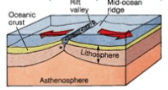
divergent
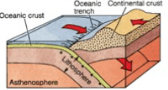
convergent
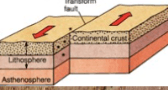
transform
At which plate boundary is new crust formed?
divergent
convergent
continental
transform
What type of crusts are involved with one plate subducting beneath another?
continental and continental
Oceanic and continental
oceanic and divergent
continental and convergent
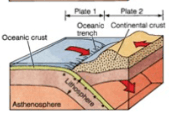
What is the WHOLE AREA called where the oceanic crust goes beneath the continental crust?
subtraction zone
section zone
secondary zone
subduction zone
At which boundary is crust neither consumed or created?
divergent
convergent
transform
oceanic

The majority of the world's earthquakes and volcanoes occur along the _ .
(a)
All of the continents were joined together in a supercontinent that Wegener called
Pangaea
Gondwanaland
Based on evidence from land features, fossils and climate, Wegener concluded that continents
sink
rise
move

In sea-floor spreading, new crust is added at a
mid-ocean ridge
magnetic stripe

Which features form the longest mountain ranges on Earth?
the mid-ocean ridges
the deep-ocean trenches
the Rockies
the Andes
Which process adds more crust to the ocean floor?
suction
sea-floor spreading
subduction
magnetic strip

Where does subduction occur?
along the middle of the ocean floors
down the middle of the mountain ranges
on continents
at deep-ocean trenches
Which process or processes change the size and shape of the oceans?
subduction only
sea-floor spreading only
both subduction and sea-floor spreading
both drilling for samples and subduction

Which theory describes the motion of and force driving Earth's plates?
first law of motion
third law of motion
continental drift
plate tectonics

The San Andreas fault is an example of which kind of boundary?
transform
divergent
oceanic
convergent

A valley along the ocean floor beneath which oceanic crust slowly sinks toward the mantle is?
deep-ocean trenches
mid-ocean ridges
sea-floor spreading
subduction

Boundary where two plates slip past each other, moving in opposite directions are?
divergent
transform
convergent
How many cities do scientists read seismograms from to determine the epicenter of an earthquake?
1
2
3
4
Select all that apply for a surface-wave
most destructive wave
least destructive wave
comes after the p-wave
slowest wave
less destructive than a surface wave

USe the picture to answer your question. How long did it take for the p-wave to arrive to the city?
0 minutes
4 minutes
8 minutes
8:50 minutes

What is the instrument used to measure earthquakes?
Seismograph
Seismologist
Scale
Seismogram

Which city is closest to the epicenter?
A
B
C
5. Which type of wave travels the fastest?
Primary Wave
Secondary Wave
Long Wave
This is created by earthquakes that occur on the ocean floor.
longshore current
gulf stream
tsunamis
high tide
_________ are created and found in soil, in rocks, in seashells, or deep in the earth.
Minerals
Crystals
A/An ___________ is a solid that has flat sides and edges arranged in a pattern that repeats to form a three-dimensional shape.
element
crystal
A mineral's __________ color may be different than its surface color.
streak
fracture
When you describe a mineral as being shiny or dull, you are talking about its ___________.
cleavage
luster
A mineral's __________ is its ability to resist being scratched.
hardness
density
Rocks that form when magma cools and hardens above or below the earth's surface are called ___________ rocks.
metamorphic
index
sedimentary
igneous
form
_____________ rocks form when sediment compacts or cements in layers on the earth's surface without heat or pressure.
metamorphic
index
sedimentary
igneous
form
_____________ rocks form when heat and pressure change the structure, texture, and appearance of rocks.
metamorphic
index
sedimentary
igneous
form
__________ fossils are the same type of fossil found in the same rock layer all over the world.
metamorphic
index
sedimentary
igneous
form
Which of the follow is not a physical property that must be tested when identifying a mineral?
color
luster
shape
streak
hardness
The two types of igneous rocks are intrusive and extrusive.
True
False
Which of the following is not a type of sedimentary rock?
clastic
instrusive
chemical
organic
The two types of metamorphic rocks are foliated and nonfoliated
False
True


Using your ESRT, find the mineral that has a metallic luster, can scratch glass and contains sulfur.
Garnet
Galena
Magnetite
Pyrite
If a mineral can scratch glass, that tells us that the hardness is
equal to glass
less than glass
more than glass
does not tell us anything
Which mineral would Fluorite be able to scratch?
Calcite
Pyroxene
Olivine
Garnet

Which property is being tested in Test B?
Luster
Hardness
Streak
Breakage

A mineral has a Metallic luster, has a colored streak and does not scratch glass. What is it's mineral letter?
B
C
D
H

Which mineral is non-metallic, has a clear streak and can scratch glass - Which mineral letter?
A
E
F
G

Which mineral property is this picture showing?
Luster
Cleavage
Streak
The use of the mineral
Which mineral listed on your ESRT is non-metallic, has bumpy edges and CANNOT scratch glass.
Sulfur
Pyrite
Amphibole
Olviine

Which mineral could this be (on your ESRT)?
Garnet
Olivine
Pyrite
Pyroxene

Small islands made of sediment called deltas form at the end of rivers. This is a form of
Mechanical Weathering
Chemical Weathering
Erosion
Deposition

Acid rain "melts" the features of a statue
Mechanical Weathering
Chemical Weathering
Erosion
Deposition
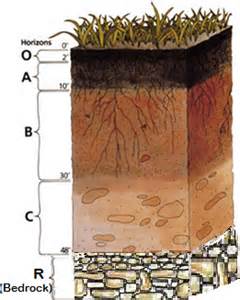
Which horizon is made up of partially weathered rocks?
Horizon A
Horizon B
Horizon C
Horizon D


A rock containing iron is soft, crumbly, reddish in color. It's been chemically weathered by__.
Carbon Dioxide
Oxygen
Nitrogen
Sulfer

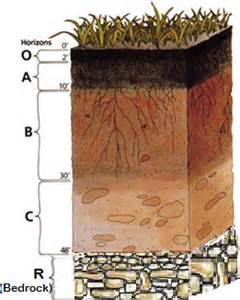
Horizon referred to as topsoil.
C
A
B
E

What is the name of Horizon 4?
Subsoil
Topsoil
Bedrock
Weathered Parent Rock

What is HUMUS made from?
The remains of decayed plants.
Both
The remains of decayed animals.

Which soil layer consists of clay, iron oxides, and other components that came form the zone of leaching?
E horizon
A Horizon
B Horizon
O Horizon

40 % Sand
50% Silt
10% Clay
Clay
Clay Loam
Silt Loam
Sandy Loam

70 % Sand
15% Silt
15% Clay
Sandy Loam
Clay
Silt Loam
Clay Loam

35 % Sand
15% Silt
50% Clay
Clay Loam
Sandy Loam
Silt Loam
Clay

30 % Sand
40% Silt
30% Clay
Clay
Sandy Loam
Clay Loam
Silt Loam

What is the Texture for Silt Based on the Texture: SILTY CLAY:
5% SAND
50% CLAY
45%
38%
36%
55%

What is the Texture for CLAY Based on the Texture: Clay Loam
27% SAND
35% SILT
33%
45%
38%
55%

What is the Texture for Silt Based on the Texture: SILT
10% SAND
7% CLAY
45%
83%
55%
5%

What is the Texture for SAND Based on the Texture: Sandy Clay Loam:
21% SILT
27% CLAY
7%
40%
21%
52%
When an area can become desert like due to plants being unable to grow in infertile soil.
Soil Conservation
Desertification
Erosion
Salinization
When wind, water, or gravity transports soil and sediment from one place to another.
Soil Conservation
Desertification
Erosion
Salinization
In what soil conservation technique might a farmer plant corn one year and soybeans the next to replenish the soil with nitrogen?
Contour Planting
Cover Crops
Crop Rotation
No-Till Farming
Terraces
In what soil conservation technique do the roots from the prior years crop help to hold the soil in place and prevent erosion?
Contour Planting
Cover Crops
Crop Rotation
No-Till Farming
Terraces
Which statement about weathering and erosion is true?
Weathering moves the eroded material.
Erosion moves the weathered material.
Weathering is faster and erosion is slower.
Erosion is faster and weathering is slower.
The removal of trees from forested lands.
salinization
compaction
deforestation
contamination
The seeping of chemicals, oil, and other substances into the land.
salinization
compaction
deforestation
contamination
The altering of land by building roads, houses, offices, factories, and other structures.
soil erosion
desertification
alkalization
construction
A lowering of the quality of soil or the loss of soil productivity.
soil degradation
saltation
geologic erosion
sediment
Soil deposited on the bottom of streams and rivers.
soil degradation
saltation
geologic erosion
sediment
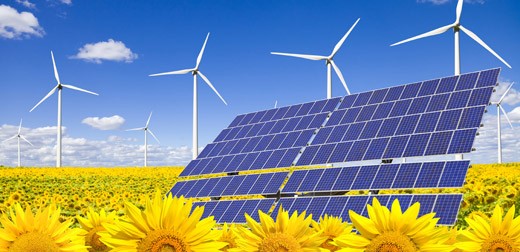
What type of resources are considered finite and cannot be replenished in a short amount of time?
Renewable Energy
Nonrenewable Energy
All Energy
Generational Energy
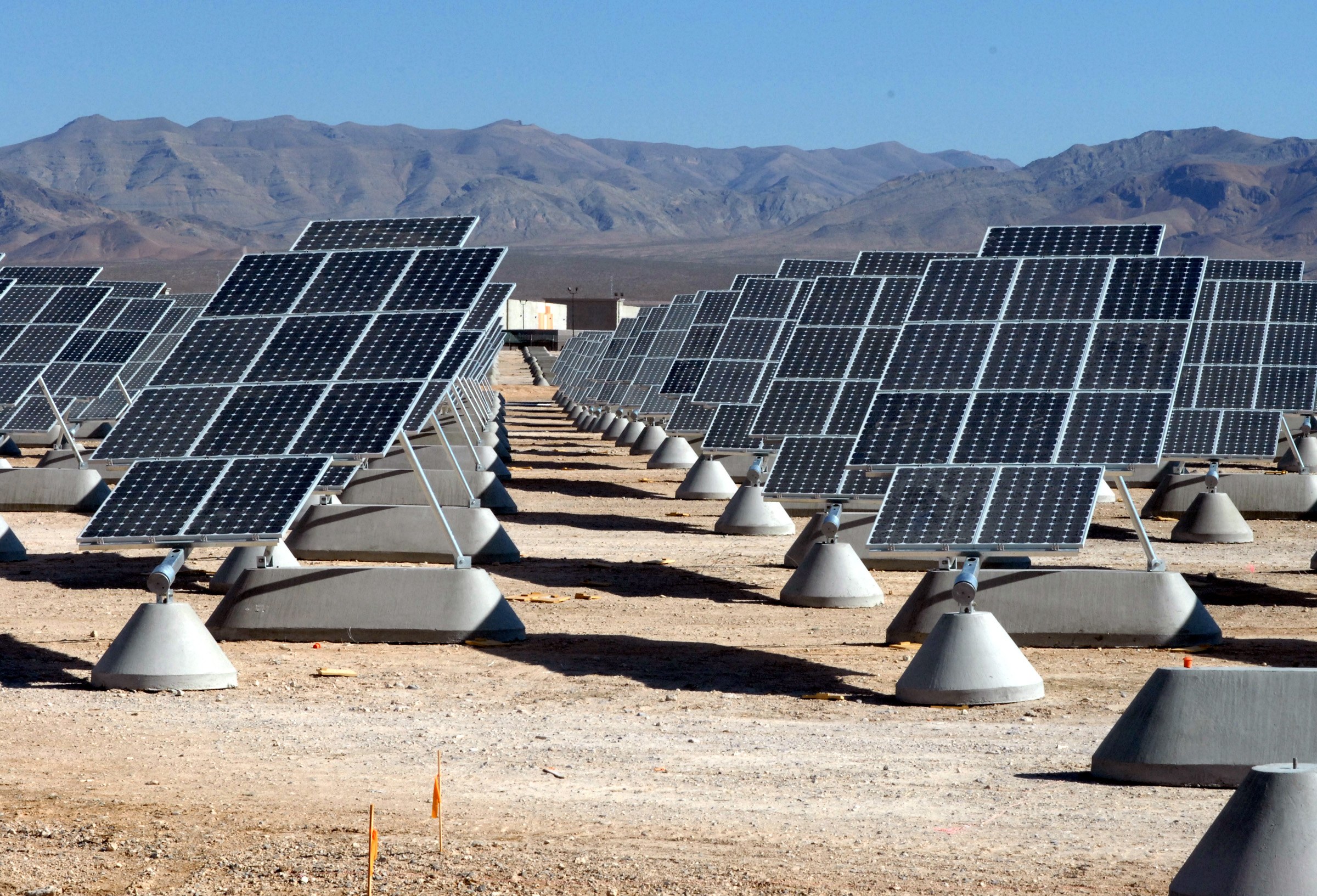
What type of energy is able to be regenerated in a short amount of time or are continuous?
Renewable Energy
Nonrenewable Energy
All Energy
Generational Energy
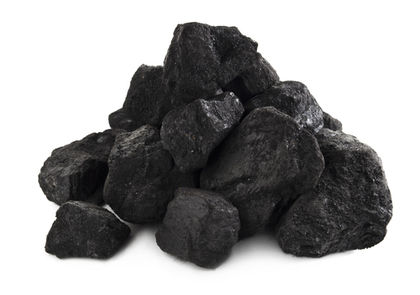
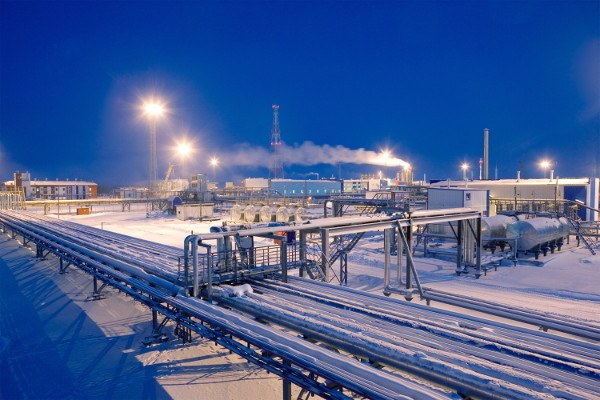
Which of the following are fossil fuels? (Select all that apply.)
Coal
Oil
Natural Gas
Nuclear Energy