
Font size
 Worksheets
AP Chemistry Cumulative Units 1-3
Total questions: 130
Worksheet time: 32hrs 16mins

What is the total # of covalent bonds carbon can form when drawing a Lewis structure?
12
6
4
8

What is the bond angle in BF3?
90
120
109.5
180
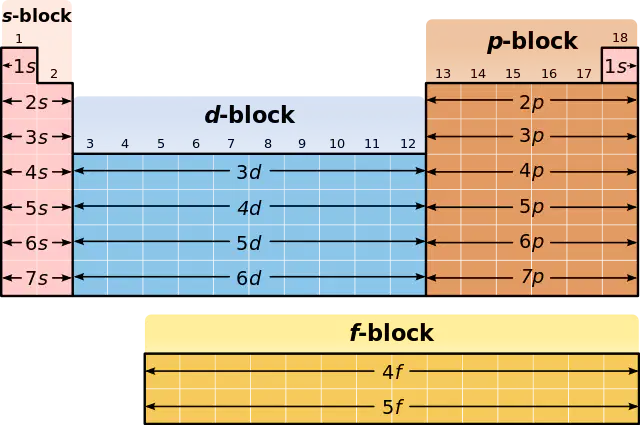
Which orbital is filled after 4p?
5s
4s
3d
4p
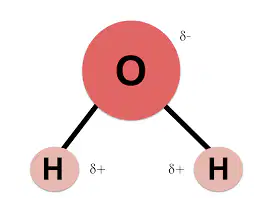
What is the bond angle in H2O? (Hint: It is a bent structure at 109.5, but 2 sets of lone pairs push the bonds.)
120
90
180
104.5

Fill in the blanks: silicon is a ________________, hydrogen is a _________________ and uranium is a ________________
metal, non-metal, metalloid
metalloid, non-metal, metal
non-metal, metal, metalloid

Are asymmetrical molecules polar or nonpolar?
Polar
non-polar
neither
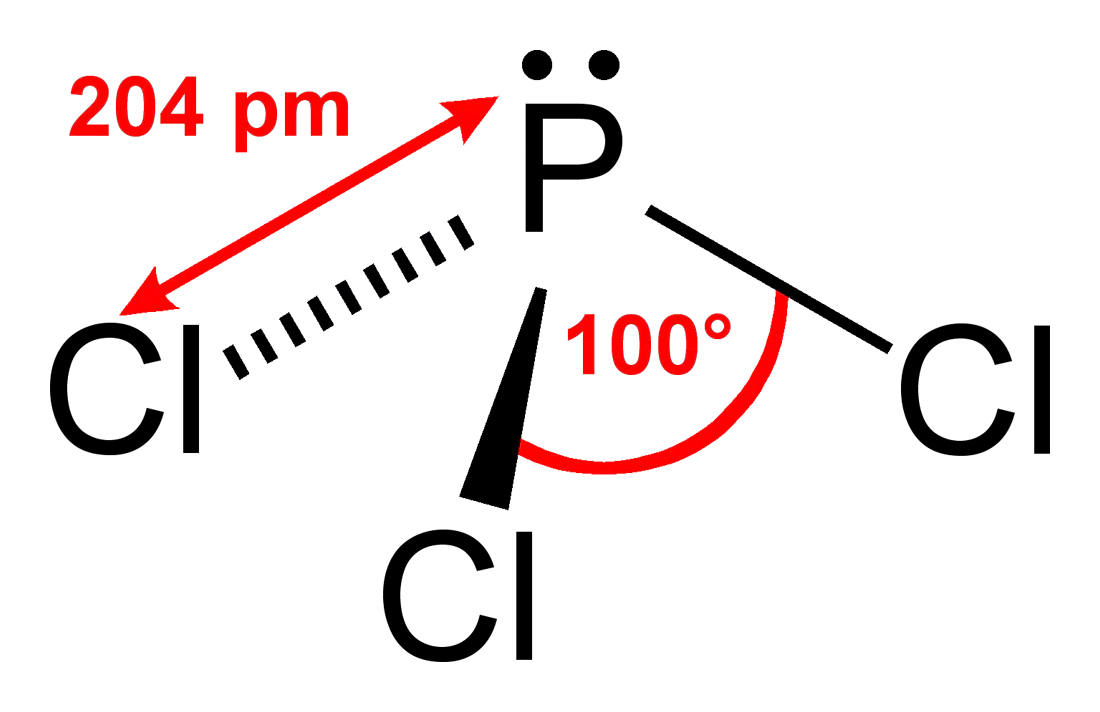
List ALL the Intermolecular forces that exist in PCl3
hydrogen bonding, london dispersion
london dispersion, hydrogen bonding, dipole dipole
london dispersion, dipole dipole
london dispersion
“More polarizable” refers to which intermolecular force? (Hint: Think about polarizable being temporary dipoles.)
hydrogen bonding
london dispersion
dipole dipole
What is an example of a covalent network solid?
Salt
Diamond
Sugar
Water
Scarlett, Noah, and Lily are studying the properties of different substances. They noticed that as the intermolecular forces of a substance increase, a certain property decreases. Can you name this property?
Vapor pressure
Conductivity
Melting point
Solubility
Noah, Grace, and Maya are planning a trip to the mountains. They are packing a bag of chips for the journey. They know that as they ascend, the atmospheric pressure decreases. How would this change in pressure affect the volume of the chips bag?
The bag would inflate (increase in volume)
The bag would deflate (decrease in volume)
Anika, Zoe, and Jackson are in a science class learning about gases. They learned that the greater the molar mass of a gas, the _________________ it moves. If they were to release helium and argon into the air, which one would move slower?
slower; Helium
slower; Argon
faster; Helium
faster; Argon
Average kinetic energy (KE) is proportional to _____________.
Heat
Temperature
Pressure
Activation energy
Real gases behave most like an ideal gas at what conditions of temperature and pressure?
High T, Low P
High P, Low T
High V, Low T
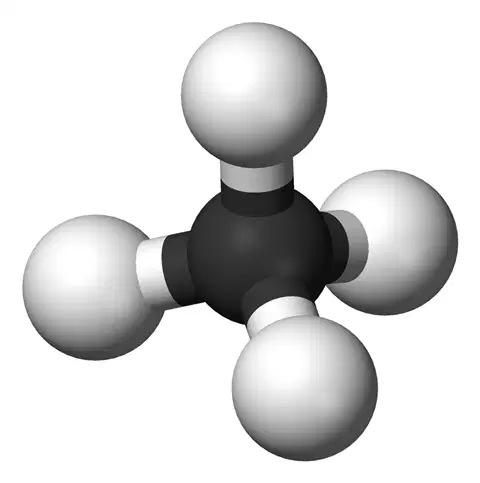
What is the hybridization of carbon in CH4?
sp3
sp
sp2
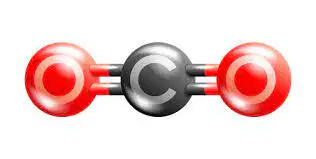
What is the hybridization for carbon in CO2
sp3
sp
sp2

Count the number of sigma and pi bonds in this molecule:
13 sigma, 1 pi
14 sigma, 2 pi
1 sigma, 14 pi
2 sigma, 13 pi
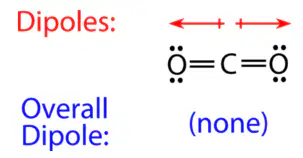
Why are symmetrical molecules nonpolar?
If they have dipoles, they do not cancel.
If they have dipoles, they cancel.
Name a property that increases as intermolecular forces increase.
Vapor pressure
Conductivity
Melting point
Solubility

Zoe, Avery, and Maya are conducting a science experiment where they are melting a salt crystal. According to their observations, what breaks when the salt crystal melts?
Intermolecular forces
Intramolecular bonds

Imagine Grace is studying the structure of an atom in her science class. She learns that when an electron is at a higher energy level, it is farther away from the nucleus. This means it has less Coulombic attraction to the nucleus and is therefore easier to remove and has a lower first ionization energy. Is this statement true or false?
True
False
Elijah, Lily, and Jackson are studying chemistry. They come across the concept of isotopes. Elijah says that isotopes of an element have the same number of protons, but different numbers of electrons. Is Elijah's statement correct?
Yes
No
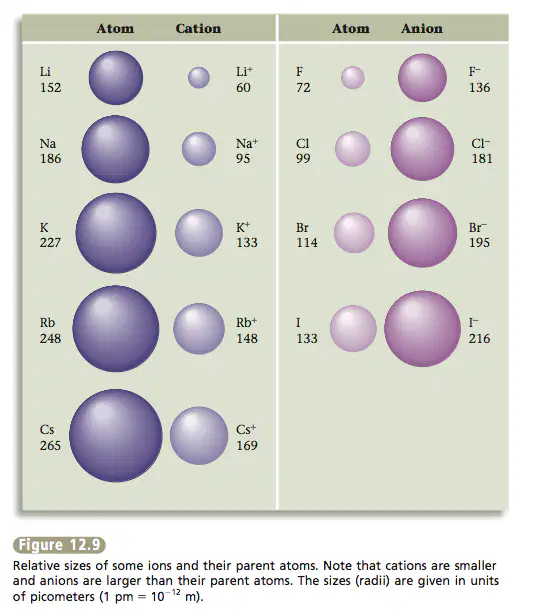
Cations (+) are smaller than their atoms since you are removing valence electrons that are farther from the nucleus and anions (−) are larger than their atoms since adding extra electrons increases electron-electron repulsions.
True
False
James and Evelyn are studying chemistry together. James says that the greater the electronegativity difference between 2 atoms in a molecule, the more polar the bond becomes. Evelyn is unsure about this. Is James correct?
Yes
No
Anika, Benjamin, and Isla were having a debate. Anika said that when discussing gas laws, if Benjamin heats his birthday balloon, it will expand because temperature and volume are directly related. Is this statement true?
Yes
No
A single bond is composed of
1 sigma bond
1 pi bond
1 sigma and 1 pi bond
no sigma or pi bonds
A triple bond is composed of
1 sigma bond
1 pi bond
2 pi bonds
1 sigma and 2 pi bonds
Which is the strongest IMF?
LDF
Dipole dipole
Hydrogen bonding
Ion-dipole
Mia, Harper, and Noah are studying chemistry and discussing about Intermolecular Forces (IMFs). They are comparing different compounds and wondering which one would have the strongest IMFs. Can you help them identify the compound with the strongest IMFs from the following options?
CH4
C2H2
C4H8
C8H14
SiO2 (quartz), graphite, and diamonds are ____________________, and they have very high boiling/melting points.
covalent network solids
ionic solids
molecular solids
interstitial alloys
______________ alloys are made when a smaller atom fits into the gaps between larger atoms of a metallic crystal.
Interstitial
Substituitonal
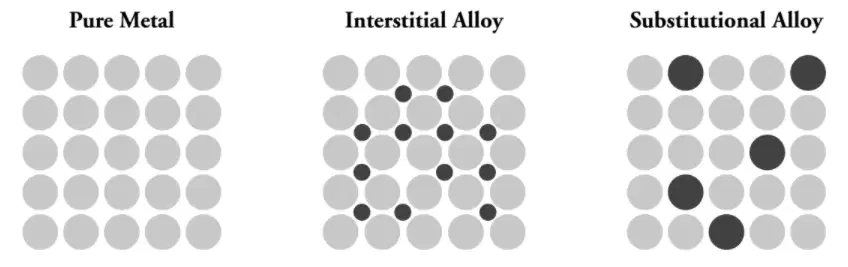
What type of alloy is made when the radii of the atoms are similar in size?
interstitial
substitutional

Ava, Emma, and Sophia are studying chemistry together. They come across a molecule of Hydrogen Fluoride (HF). Sophia asks, 'Which atom has the negative dipole in this molecule?'
Hydrogen
Fluorine
Neither
What type of bond forms between hydrogen and chlorine?
polar covalent
non-polar covalent
ionic
hydrogen bond

What type of alloy is this?
Interstitial
Substitutional

Which statement is correct according to the Kinetic Molecular Theory of gases?
Gas particles are stationary.
Gas particles have significant volumes.
Gas particles move in a random, straight-line motion.
Gas particles have strong intermolecular forces.

When particles in real gases are in close proximity, they are ___
repelled from each other
attracted to each other
without mass
transformed into mystical vapors

What happens to a real gas at high pressure that makes it become less ideal?
particles lose energy and so exert less pressure
particles gain energy and so exert more pressure
container volume decreases so particles occupy significant volume
container volume increases so particles occupy significant volume
During a science experiment at school, Nora, Scarlett, and Maya are testing the velocity of different gases at 25°C. Which gas will they observe to have the greatest velocity?
He
CO2
CH4
N2
What is the term for the substance that does the dissolving in a solution?
Solute
Solvent
Solution
Miscibility
During a science experiment, Harper, Scarlett, and Daniel were given three different gases: CH4, CO2, and NH3. They were asked to determine which gas would be the MOST soluble in water. Which gas should they conclude as the most soluble?
CH4
CO2
NH3
1.85 mole of NaCl is dissolved to make a 1.250 L of solution. What is the molarity?
1.48 M
0.675 M
0.025 M
How many grams of NaCl are required to make 200 ml of a 0.750 M solution?
8.75 g
9375 g
9.38 g
Ethan is working in a lab and he has 3.0 L of a 0.23 M NH3. Mia asked him how many moles of NH3 are in that solution. What should Ethan tell Mia?
0.69 mol
13 mol
0.077 mol

This is a representation of a hydrogen bond.
True
False

This is a representation of a hydrogen bond.
True
False
What formula do we use for dilution calculations?
M1V1=M2V2
D=m/V
V1=M2
Total Volume/Partial Volume
What is the electron configuration of Phosphorus?
1s2 2s2 2p6 3s2 3p3
1s2 2s2 2p6 3s2
1s2 2s2 2p6 3s2 4p3
1s2 2s2 2p6 3s2 3p5
What is the equation for calculating the density of a substance?
D=m/v
m=D/v
D=v*m
D=v/m
When reading a PES (Photoelectric Spectroscopy) graph, what does the height of a peak represent?
The number of electrons
The number of protons
The mass or the isotope
The amount of energy the electron has
Isotopes of an element have the same number of __________, but different number of __________.
protons, neutrons
neutrons, protons
protons, electrons
electrons, protons
When reading a PES (Photoelectron Spectroscopy) graph, a larger binding energy means that the electrons are _________________ the nucleus?
Closer to
Farther from
Distillation separates mixtures based on differences in what property?
Solubility
Boiling Point
Particle Size
State of Matter
Why do atoms get smaller moving across a period (L to R) on the periodic table?
More protons (q) to attract the electrons
Fewer protons (q) to attract the electrons
More energy shells (r) so it can't attract the electrons
Fewer energy shells (r) so it attracts the electrons closer
When an electron is in a lower energy level, it has a ________________ 1st ionization energy
Higher
Lower
Same
Chromatography separates mixtures based on what property?
particle size
intermolecular forces
boiling points
state of matter
Zoe & David are conducting a paper chromatography experiment in their chemistry class. They use hexane, a nonpolar substance, as the solvent. Which type of substance will travel the farthest up the paper?
polar substance
non polar substance
List the 4 Intermolecular forces from weakest to strongest
hydrogen bonding, ion-dipole, london dispersion, dipole dipole
london dispersion, hydrogen bonding, ion-dipole, dipole dipole
london dispersion, dipole dipole, hydrogen bonding, ion-dipole
dipole dipole, hydrogen bonding, ion-dipole, london dispersion
What type of solid will not conduct electricity until it is liquid or aqueous?
Ionic Solid
Covalent Network Solid
Molecular Solid
Metallic Solid
What causes gas pressure?
large space between the molecules
random motion of particles
collisions with the walls of the container & other particles
How many molecules of AlCl3 are in 9.44 moles of AlCl3?
5.68 molecules
5.68x1024 molecules
0.705 molecules
1.25x10²³ molecules

Analyze the Mass Spectrum Graph. Calculate the average atomic mass of the unknown element.
10.2 amu
10.5 amu
10.8 amu
11.0 amu
Analyze the Mass Spectrum Graph. What is the most likely identity of the element?
Sodium
Neon
Carbon
Boron
The atomic weight of a newly discovered element is 10.600 amu. It has two naturally occurring isotopes. One has a mass of 10.000 and a natural abundance of 70.000%. What is the isotopic mass of the other isotope?
12.00 amu
10.60 amu
11.50 amu
11.00 amu
What is the noble gas electron configuration for an atom of iodine in the ground state?
[Kr]5s24d105p5
[Xe]5s24d105p5
[Kr]5s25d105p5
[Xe]5s24d105p5
What is the electron configuration of V2+?
[Ar] 4s23d3
[Ar] 4s13d4
[Ar] 3d3
[Ar] 4s23d1
Sodium chloride is used as table salt. Select the electron configuration of the ion that would form an ionic bond with a chloride ion with a salty taste like sodium chloride.
1s22s2
1s22s22p5
1s2
1s22s1
Which two particles are attracted to each other?
Two neutrons
A proton and an electron
Two protons
An electron and a neutron
A repulsive force exists between which two particles?
Two neutrons
An electron and a neutron
An electron and a proton
Two protons

What does r2 the stand for in this formula?
Coulomb constant
Electric Force
Charge on object 1
Charge on object 2
distance between the centers of the charges of mass (squared)
Elements in the same __________ have similar chemical and physical properties.
group/family
period
In a PES graph, if two peaks are the same height, it means that they ...
have the same number of electrons
are in the same energy level
have the same amount of binding energy
are isotopes of the same element
In a PES graph, 1s electrons will have a _______ binding energy than 2s electrons.
higher
lower
same
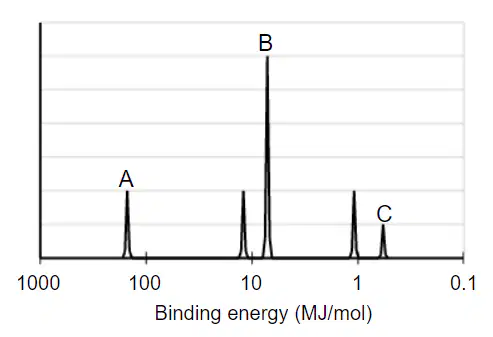
In this PES graph, which electrons are closest to the nucleus?
A
B
C
They are all at an equal distance
N or C?
Name the following compound - (NH4)2SO4
ammonium (I)
sulfate
ammonium (II)
sulfate
ammonium sulfate
hydronium sulfate
Determine the formula for the compound - nickel (III) sulfide
Ni3S2
NiS
Ni2S3
Ni2(SO4)3
Determine the formula for the compound - phosphorus trichloride
Determine the formula for the compound - dinitrogen pentoxide
N2O5
NO5
N5O2
N2O6
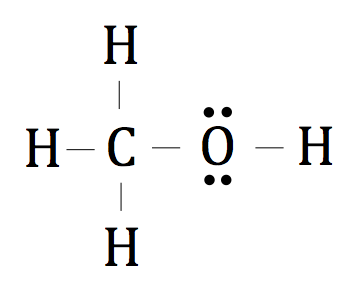
Is the following molecule polar or non-polar?
polar
non-polar
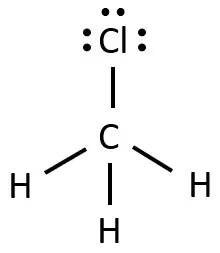
Polar molecules can have non-polar covalent bonds.
True
False
More electronegative atoms in covalent compounds are likely to have:
Partial positive charge
Partial negative charge
In a polar covalent bond, the electrons gather around...
The atom with the Greatest Electronegativity
The atom with the Lowest Electronegativity
Each atom Equally
None of the Above
In a nonpolar covalent bond, the electrons gather around...
The atom with the Greatest Electronegativity
The atom with the Lowest Electronegativity
Each atom Equally
None of the Above
The polarity of a bond is determined by...
The sum of the electronegativities of the two atoms
The difference in the electronegativities of the two atoms
The charges of the atoms
None of the Above
A diatomic molecule like O2 is always _____ because electrons are shared _____
nonpolar; unequally
polar; equally
nonpolar; equally
polar; unequally
Order the types of bonds based on the charge of their molecules. (lowest amount of charge to greatest)
Polar Covalent --> Ionic --> Nonpolar Covalent
Ionic --> Nonpolar Covalent --> Polar Covalent
Ionic --> Polar Covalent --> Nonpolar Covalent
Nonpolar Covalent --> Polar Covalent --> Ionic
Which substance has the weakest intermolecular forces?
Substance A, boiling point of 75 °C
Substance B, boiling point of 105 °C
Substance C, boiling point of 25 °C
Substance d, boiling point of 45 °C

Intermolecular forces for: CO2
Dispersion Force
Dipole dipole
Hydrogen bonding
Intermolecular forces are attractions between ______.
Cations and anions
Atoms within a molecule
Neighboring molecules
Protons and electrons
Which intramolecular force has the greatest strength?
ionic bond
nonpolar covalent
polar covalent
How is a supersaturated solution made?
Heat to high temperature, saturate, then slowly cool.
Saturate, slowly heat to high temperature, then rapidly cool.
Cool to a low temperature, saturate, then slowly heat.
Slowly heat to high temperature, saturate, then rapidly cool.
As you put in more solute in the solution, the concentration of the solution will...
increase
decrease
stay the same
Which of the following ONLY has the effect on the solubility of 'gas'?
Pressure
Temperature
Molarity
Volume
Two liquids or gases that will not dissolve in each other are called
miscible
immiscible
suspension
emulsion
Which of these is NOT a factor that affects solvation?
agitation/stirring
increasing temperature
increasing surface area
adding dye
Saltwater is a
If I have 18 M H2SO4 and I want to make 500 mL of a 1 M H2SO4 solution, what do I do?
What volume, in milliliters, of 10.0 M NaOH is needed to prepare 300.0 mL of 2.00 M NaOH by dilution?
0.067 mL
100 mL
60.0 mL
125 mL
What percentage of the total atomic mass of magnesium bromide (MgBr2) is composed of magnesium?
13%
43%
63%
87%
What is the empirical formula of a compound that is 63.52% iron and 36.48% Sulfur?
Fe2S
FeS2
FeS
Fe3O2
Determine the empirical formula of a compound containing 63.50 % silver, 8.25 % nitrogen, and the remainder oxygen.
AgNO3
Ag2NO3
AgNO2
Ag2N2O5


