wayground logo

Free Printable Worksheets

Font size

S
M
L
XL
Worksheets

Biology - Midterm Review - Ch. 1, 2, 7, 10, 11, 12,13, and 14

Total questions: 120

Worksheet time: 3600secs

Name
Class
Date
1.

Note the following experiment: Spending time with a cat or dog decreases the amount of stress someone is feeling and allows them to perform better on tests. In this experiment, spending time the a dog or cat is the
a)
Dependent Variable
b)
Independent Variable
c)
Control
d)
Negative Control
2.

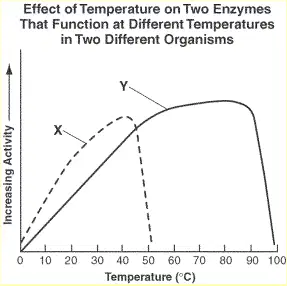
In the graph below, which of the following enzymes would be found near a volcanic vent?

a)
Neither enzyme
b)
Both enzymes
c)
Enzyme X
d)
Enzyme Y
3.

Which of the following is NOT a monomer?

a)
A monosaccharide
b)
An amino acid
c)
A protein
d)
A nucleotide
4.

What is the term used to describe the energy needed to get a reaction started?

a)
Adhesion energy
b)
Activation energy
c)
Cohesion energy
d)
Chemical energy
5.

Enzymes affect the reaction rates in living cells by changing the

a)
Products of the reaction
b)
Temperature of the reaction
c)
Speed of the reaction
d)
pH of the reaction
6.

What term is used to describe a fatty acid that has only single bonds between all the carbon atoms and a maximum number of hydrogen atoms?

a)
Saturated lipid
b)
Unsaturated lipid
c)
Low fat
d)
Tertiary lipid
7.

Which of the following is NOT a function of proteins?

a)
Help fight disease
b)
Control the rate of reactions and regulate cell processes
c)
Build bone and muscle tissue
d)
Store and transmit genetic information
8.

The property of water that allows water molecules to stick to other water molecules is

a)
Cohesion
b)
pH
c)
Adhesion
d)
Surface tension
9.

The substance upon which an enzyme acts is called a(n)

a)
Product
b)
Substrate
c)
Reactant
d)
Polymer
10.

The monomer that consists of a 5-carbon sugar, a phosphate group, and a nitrogenous base is a(n)

a)
Monosacchride
b)
Amino acid
c)
Nucleotide
d)
Glycerol
11.

An organic molecule differs from an inorganic molecule in that an organic molecule

a)
Contains carbon
b)
Contains 2 or more atoms
c)
Has more double bonds
d)
Is more acidic
12.

Which one of the following is a monomer of a carbohydrate?

a)
Galactose
b)
Fructose
c)
Glucose
d)
All of the above
13.

Which of the following is NOT a function of lipids?

a)
They store lots of energy
b)
They help make up a cell membrane
c)
They dissolve in water
d)
They make up hormones
14.

What is the major difference between a saturated lipid (fat) and an unsaturated lipid?

a)
None- they are the same
b)
Saturated fats are solids at room temperature and unsaturated fats are liquids at room temperature
c)
Saturated fats are much more healthy than unsaturated fats
d)
Saturated fats are biological catalysts
15.

Stomach acid has a pH of 1 and Lye has a pH of 13. Which one of the two is the most caustic to human skin?

a)
Stomach acid
b)
Lye
c)
They are both equally caustic because they are both 6 pH levels from the neutral 7
d)
Neither of them are as caustic as pure water
16.

Which of the properties allows insects and lizards to "walk on water"?

a)
Adhesion
b)
Specific gravity
c)
pH
d)
Surface tension
17.

You eat some sucrose (table sugar) and the enzyme sucrase breaks the sucrose into fructose and glucose. The sucrose in this scenario is the

a)
Substrate
b)
Monomer
c)
Disaccharide
d)
Active site
18.

Why do enzymes lose their ability to catalyze reactions in extreme pH and temperature environments?
a)
They dissolve
b)
They melt
c)
They change shape (denature) so the substrate(s) no longer fit in the active site
d)
It lowers the activation energy even more
19.

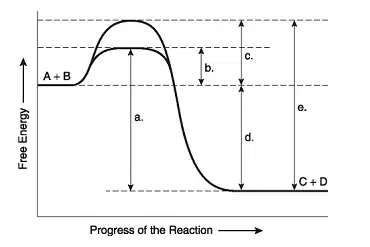
Which of the following letters in the energy diagram represents the activation energy of a reaction WITH an enzyme?

a)
A
b)
B
c)
C
d)
D
20.

Which subatomic particles are found in the nucleus of an atom, making up almost all of the mass of an atom?
a)
electrons and protons
b)
protons and neutrons
c)
electrons and neutrons
d)
electrons, protons, and neutrons
21.
Which type of microscope uses two lenses to form an image?
a)
Scanning Electron Microscope
b)
Transmission Electron Microscope
c)
Compound Light Microscope
d)
High-beam Laser Microscope
22.
While looking under a microscope, a student notices that a cell has a cell wall, ribosomes, and DNA, but it lacks a nucleus and membrane-bound organelles. The cell is most likely a(n)
a)
Plant cell
b)
Prokaryotic cell
c)
Animal Cell
d)
Fungal cell
23.
Which organelle's function is to break down warn out organelles or break down the contents of a food vacuole?
a)
Lysosome
b)
Golgi apparatus
c)
Endoplasmic reticulum
d)
Mitochondria
24.
Which organelle's function is to produce ATP from sugars?
a)
Lysosome
b)
Golgi apparatus
c)
Endoplasmic reticulum
d)
Mitochondria
25.
Which organelle's function is to modify, package, and ship out functional proteins?
a)
Lysosome
b)
Golgi apparatus
c)
Endoplasmic reticulum
d)
Mitochondria
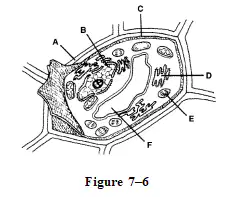
26.
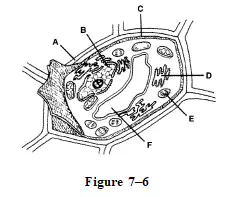
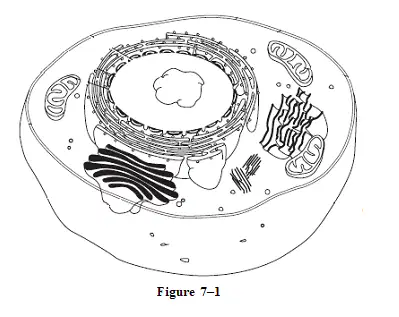
Based on the shape and the organelles inside, the cell below is most likely which type of cell?
a)
Plant cell
b)
Animal cell
c)
Prokaryote
d)
This is not a cell
27.
What is the function of nucleus?
a)
Store and transmit DNA
b)
Store sugars
c)
Break down cell parts
d)
Make proteins
28.
Which of the following organelles is responsible for storing water, salts, and sugars?
a)
B
b)
C
c)
E
d)
F
29.
The function of structure A would most likely be
a)
To make sugar from sunlight
b)
Support and protection
c)
To make proteins from DNA instructions
d)
To store and transmit genetic information
30.
The cell membrane contains channels and pumps that help move material from one side to the other. What are these channels and pumps made of?
a)
Carbohydrates
b)
Lipids
c)
Genetic material
d)
Proteins
31.
What is the term that is used to describe the movement of materials from one side of a cell membrane to the other WITHOUT the expenditure of energy?
a)
Active transport
b)
Passive transport
c)
Free transport
d)
Phagocytosis
32.
What is the term that is used to describe the movement of materials from one side of a cell membrane to the other while using energy (ATP)?
a)
Active transport
b)
Passive transport
c)
Free transport
d)
Osmosis
33.
The diffusion of water across a selectively permeable membrane is called?
a)
Phagocyctosis
b)
Active transport
c)
Facilitated diffusion
d)
Osmosis
34.
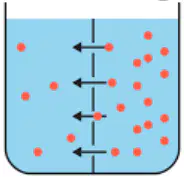
The process depicted in the figure below is representing which type of movement across a cell membrane?
a)
Diffusion
b)
Facilitated diffusion
c)
Active transport
d)
Osmosis
35.
The process below will continue to happen until
a)
All of the molecules move to the left side
b)
Until there are equal amount of molecules on both sides (equilibrium)
c)
All of the molecules move to the right side
d)
The molecules dissolve
36.
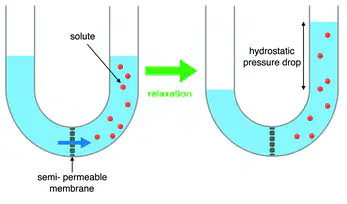
The process in the figure below happens because
a)
of gravity.
b)
the concentration on the left side is more concentrated than the right side and the solute must move to the left.
c)
the concentration on the left side is less concentrated than the right, so water will move to the right by osmosis
d)
of active transport.
37.
Which of the following is the correct order of the levels of organization?
a)
cell, tissue, organ, organ system, organism
b)
organism, cell, tissue, organ, organ system
c)
organ system, organism, cell, tissue, organ
d)
organ, organ system, organism, cell, tissue
38.
What is the term that is used to describe how an organism maintains a constant internal condition?
a)
Unicellular
b)
Equilibrium
c)
Level of organization
d)
Homeostasis
39.
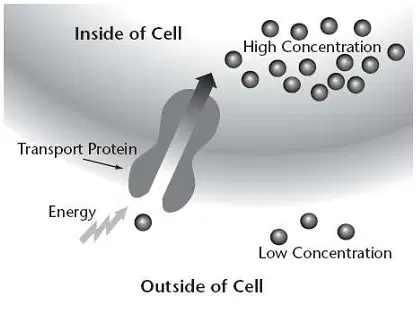
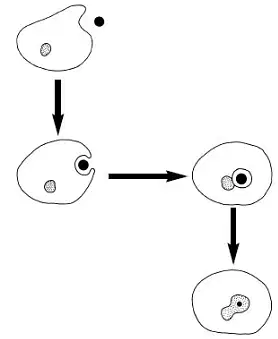
Which means of particle transport is shown in the figure below?
a)
Facilitated diffusion
b)
Exocytosis
c)
Endocytosis
d)
Protein pump
40.
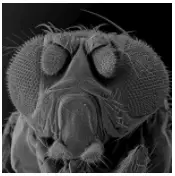
The image below is a detailed picture of the surface of a fly's face. This image was created by which type of microscope?
a)
Scanning electron microscope
b)
Transmission electron microscope
c)
Compound light microscope
d)
Phase contrast microscope
41.

As a cell becomes larger, its

a)
volume increases faster than its surface area
b)
surface area increases faster than its volume
c)
volume increases, but its surface area stays the same
d)
surface area stays the same, but volume decreases
42.

All of the following are problems that growth causes for cells EXCEPT

a)
more demands on the DNA
b)
excess oxygen
c)
obtaining enough food
d)
expelling wastes
43.

The process by which a somatic cell divides into two daughter cells is called

a)
cell division
b)
metaphase
c)
interphase
d)
cancer
44.

When during the cell cycle are chromosomes visible?

a)
only during interphase
b)
throughout the entire cell cycle
c)
only during mitosis
d)
only during G1 phase
45.

In which part of the cell cycle does the DNA replicate itself?
a)
G1 phase
b)
S phase
c)
G2 phase
d)
Cell division
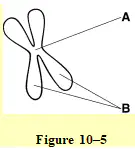
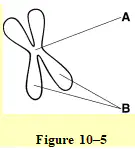
46.

The portion of the chromosome labeled A in figure 10-5 is called the
a)
spindle
b)
centriole
c)
sister chromatid
d)
centromere
47.

The portion of the chromosome labeled B in figure 10-5 is called the
a)
spindle
b)
centriole
c)
sister chromatid
d)
centromere
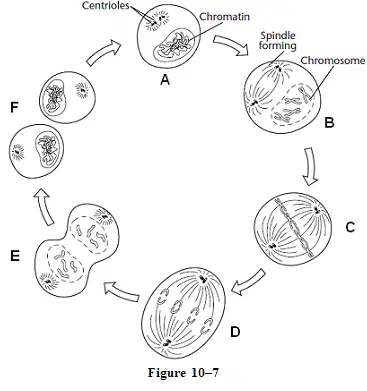
48.

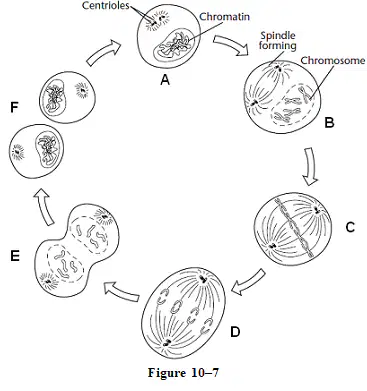
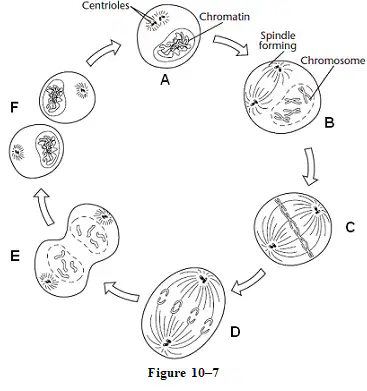
In figure 10-7, which of the following depicts metaphase?
a)
B
b)
C
c)
D
d)
E
49.

In figure 10-7, which of the following depicts telophase (and cytokinesis)?
a)
B
b)
C
c)
F
d)
E
50.

In figure 10-7, which of the following depicts anaphase?

a)
B
b)
F
c)
D
d)
E
51.

Cancer cells form masses of cells called
a)
cyclins
b)
growth factors
c)
spindle fibers
d)
tumors
52.

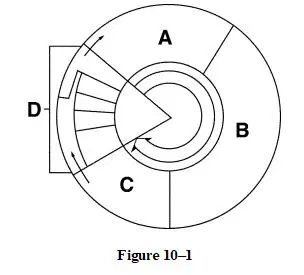
Cell division is represented in Figure 10–1 by the letter

a)
A
b)
B
c)
C
d)
D
53.

Which of the following is a phase of mitosis?

a)
cytokinesis
b)
interphase
c)
prophase
d)
S phase
54.

The two main stages of cell division are called

a)
mitosis and interphase.
b)
synthesis and cytokinesis.
c)
the M phase and the S phase.
d)
mitosis and cytokinesis.
55.

Right after a bone breaks, cells at the edge of the injury

a)
stop dividing.
b)
begin to divide rapidly.
c)
form a thin layer over the edge of the injury.
d)
develop a defect in a gene called p53.
56.

Which of the following is a factor that can stop normal cells from growing?

a)
contact with other cells
b)
growth factors
c)
a cut in the skin
d)
cyclin that has been taken from a cell in mitosis
57.

In eukaryotic cells, the timing of the cell cycle is regulated by

a)
the centrioles.
b)
cyclins.
c)
the spindle.
d)
all of the above
58.

Cancer affects

a)
humans only.
b)
most unicellular organisms.
c)
multicellular organisms.
d)
unicellular organisms.
59.

What is the role of the spindle during mitosis?

a)
It helps separate the chromosomes.
b)
It breaks down the nuclear membrane.
c)
It duplicates the DNA.
d)
It makes the chromosomes visible.
60.

One difference between cell division in plant cells and in animal cells is that plant cells have
a)
centrioles.
b)
centromeres.
c)
a cell plate.
d)
chromatin.
61.
Gregor Mendel used pea plants to study
a)
flowering.
b)
gamete formation.
c)
the inheritance of traits.
d)
cross-pollination.
62.
Gregor Mendel concluded that traits are
a)
not inherited by offspring.
b)
inherited through the passing of factors from parents to offspring.
c)
determined by dominant factors only.
d)
determined by recessive factors only.
63.
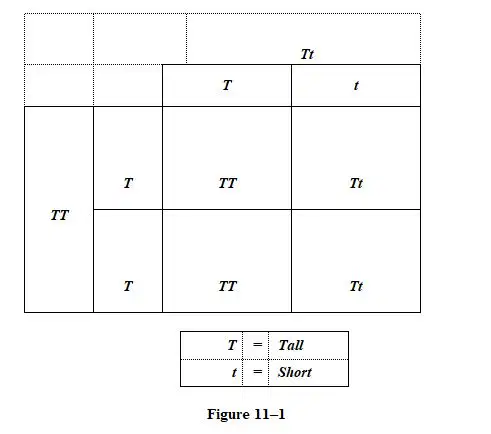
In the Punnett square shown in Figure 11–1, which of the following is true about the offspring resulting from the cross?
a)
About half are expected to be short.
b)
All are expected to be short.
c)
About half are expected to be tall.
d)
All are expected to be tall.
64.
A cross of a black chicken (BB) with a white chicken (WW) produces all speckled offspring (BW). This type of inheritance is known as
a)
incomplete dominance.
b)
polygenic inheritance.
c)
codominance.
d)
multiple alleles.
65.
Variation in human skin color is an example of
a)
incomplete dominance.
b)
codominance.
c)
polygenic traits.
d)
multiple alleles.
66.
A male and female bison that are both heterozygous for normal skin pigmentation (Aa) produce an albino offspring (aa). Which of Mendel’s principles explain(s) why the offspring is albino?
a)
dominance only
b)
independent assortment only
c)
dominance and segregation
d)
segregation only
67.
If an organism’s diploid number is 12, its haploid number is
a)
12.
b)
6.
c)
24.
d)
3.
68.
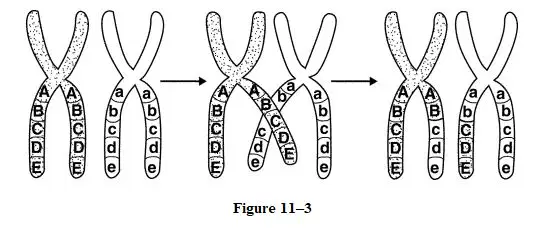
What is shown in Figure 11–3?
a)
independent assortment
b)
anaphase I of meiosis
c)
crossing-over
d)
replication
69.
Crossing-over rarely occurs in mitosis, unlike meiosis. Which of the following is the likely reason?
a)
Chromatids are not involved in mitosis.
b)
Tetrads rarely form during mitosis.
c)
A cell undergoing mitosis does not have homologous chromosomes.
d)
There is no prophase during mitosis.
70.
Which of the following assort independently?
a)
chromosomes
b)
genes on the same chromosome
c)
multiple alleles
d)
codominant alleles
71.
Unlike mitosis, meiosis results in the formation of
a)
two genetically identical cells.
b)
four genetically different cells.
c)
four genetically identical cells.
d)
two genetically different cells.
72.
Chromosomes form tetrads during
a)
prophase I of meiosis.
b)
metaphase I of meiosis.
c)
interphase.
d)
anaphase II of meiosis.
73.
Gametes are produced by the process of
a)
mitosis.
b)
meiosis.
c)
crossing-over.
d)
replication.
74.
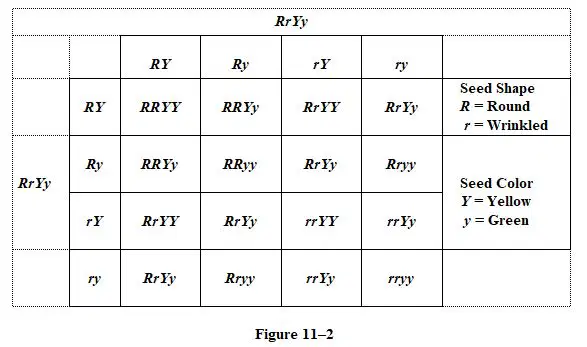
The Punnett square in Figure 11–2 shows that the gene for pea shape and the gene for pea color
a)
assort independently.
b)
are linked.
c)
have the same alleles.
d)
are always homozygous.
75.
Offspring that result from crosses between parents with different traits
a)
are true-breeding.
b)
make up the F2 generation.
c)
make up the parental generation.
d)
are called hybrids.
76.
A heterozygous tall pea plant is crossed with a short plant. The probability that an F1 plant will be tall is
a)
25%.
b)
50%.
c)
75%.
d)
100%.
77.
Organisms that have two identical alleles for a particular trait are said to be
a)
hybrid.
b)
homozygous.
c)
heterozygous.
d)
dominant.
78.
What principle states that during gamete formation genes for different traits separate without influencing each other’s inheritance?
a)
principle of dominance
b)
principle of independent assortment
c)
principle of probabilities
d)
principle of segregation
79.
Situations in which one allele for a gene is not completely dominant over another allele for that gene are called
a)
multiple alleles.
b)
incomplete dominance.
c)
polygenic inheritance.
d)
multiple genes.
80.
Linked genes
a)
are never separated.
b)
assort independently.
c)
are on the same chromosome.
d)
are always recessive.
81.
What did Avery conclude caused transformation?
a)
DNA was the transforming factor.
b)
A protein was the transforming factor.
c)
A carbohydrate was the transforming factor.
d)
A lipid was the transforming factor.
82.
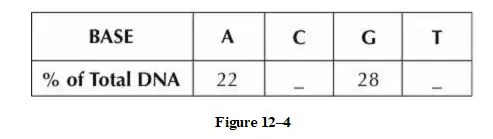
The table in Figure 12–4 shows the percentages of bases in a DNA sample. How much Thymine should you expect to find in the sample?
a)
22%
b)
24%
c)
28%
d)
44%
83.
DNA replication results in two DNA molecules,
a)
each with two new strands.
b)
one with two new strands and the other with two original strands.
c)
each with one new strand and one original strand.
d)
each with two original strands.
84.
Which of the following is a chromosomal mutation?
a)
inversion
b)
insertion
c)
point mutation
d)
substitution
85.
Which of the following statements is true about gene regulation in prokaryotes?
a)
Promoters determine whether a gene is expressed.
b)
Expressed genes make more DNA.
c)
DNA-binding proteins determine whether a gene is expressed.
d)
RNA polymerase regulates gene expression.
86.
Which two bases pair together in DNA?
a)
adenine and guanine
b)
guanine and thymine
c)
thymine and cytosine
d)
cytosine and guanine
87.
During DNA replication, a DNA strand that has the bases CTAGGT produces a strand with the bases
a)
TCGAAC
b)
GATCCA
c)
AGCTTG
d)
GAUCCA
88.
Which is the correct sequence of the transfer of information in most organisms?
a)
protein to DNA to RNA
b)
RNA to DNA to protein
c)
DNA to RNA to protein
d)
RNA to protein to DNA
89.
When a chromosome undergoes a deletion mutation, information is
a)
repeated
b)
lost
c)
reverse
d)
transferred
90.
The purpose of gene therapy is to
a)
treat genetic disorders
b)
determine the sequences of genes
c)
remove mutations from genes
d)
change dominant alleles to recessive
91.
The Scottish scientist Ian Wilmut cloned a
a)
bacterium.
b)
sheep.
c)
plant.
d)
cow.
92.
A recombinant plasmid gets inside a bacterial cell by
a)
inducing mutations.
b)
injecting itself into the cell.
c)
transformation.
d)
recombining with the cell.
93.
Genetic engineering involves
a)
reading a DNA sequence.
b)
editing a DNA sequence.
c)
reinserting DNA into living organisms.
d)
all of the choices
94.
What has been an advantage of producing transgenic plants?
a)
increasing the food supply
b)
using more pesticides
c)
producing clones
d)
studying human genes
95.
Which of the following is NEVER a frameshift mutation?
a)
substitution
b)
insertion
c)
deletion
d)
point mutation
96.
Why is Dolly a clone?
a)
The source of her DNA was a single body cell.
b)
The DNA molecules in all her cells are identical.
c)
She was produced using the DNA from an adult’s egg cell.
d)
She is genetically identical to her offspring.
97.
What kind of cell or cells were used to make Dolly?
a)
body cell only
b)
egg cell only
c)
egg cell and sperm cell
d)
body cell and egg cell
98.
What kind of technique do scientists use to make transgenic organisms?
a)
hybridization
b)
inbreeding
c)
inducing of mutations
d)
genetic engineering
99.
Knowing the sequence of an organism’s DNA allows researchers to
a)
reproduce the organism.
b)
mutate the DNA.
c)
study specific genes.
d)
cut the DNA.
100.
Mutations are useful in selective breeding because they
a)
help maintain the desired characteristics of animal breeds.
b)
are usually found in hybrids.
c)
are usually beneficial.
d)
are occasionally beneficial.
101.
Which of the following can be observed in a karyotype?
a)
a change in a DNA base
b)
an extra chromosome
c)
genes
d)
alleles
102.
A pedigree can be used to
a)
determine whether a trait is inherited.
b)
show how a trait is passed from one generation to the next.
c)
determine whether an allele is dominant or recessive.
d)
all of the above
103.
The Human Genome Project is an attempt to
a)
make a DNA fingerprint of every person’s DNA.
b)
sequence all human DNA.
c)
cure human diseases.
d)
identify alleles in human DNA that are recessive.
104.
If nondisjunction occurs during meiosis,
a)
only two gametes may form instead of four.
b)
some gametes may have an extra copy of some genes.
c)
the chromatids do not separate.
d)
it occurs during prophase.
105.
The formation of a Barr body
a)
causes the genes on one of the X chromosomes in a female cell to be switched off.
b)
always causes the same X chromosome in a female’s cells to be switched off.
c)
switches on the Y chromosome in a male cell.
d)
none of the above
106.
Colorblindness is more common in males than in females because
a)
fathers pass the allele for colorblindness to their sons only.
b)
the allele for colorblindness is located on the Y chromosome.
c)
the allele for colorblindness is recessive and located on the X chromosome.
d)
males who are colorblind have two copies of the allele for colorblindness.
107.
The long stretches of repetitive DNA in chromosomes 21 and 22 are unstable sites
a)
that contain genes.
b)
that do not code for proteins.
c)
that cause genetic disorders.
d)
that do not allow crossing-over to occur.
108.
People who are heterozygous for sickle cell disease are generally healthy because
a)
they are very likely to get malaria.
b)
they usually have some normal hemoglobin in their red blood cells.
c)
their abnormal hemoglobin usually doesn’t cause their red blood cells to become sickle shaped.
d)
they do not produce abnormal hemoglobin.
109.
In cystic fibrosis, a change in a single gene causes the protein called CFTR to
a)
become less soluble.
b)
fold improperly.
c)
destroy the cell membrane.
d)
transport sodium ions instead of chloride ions.
110.
If a man with blood type A and a woman with blood type B produce an offspring, what might be the offspring’s blood type?
a)
AB or O
b)
A, B, or O
c)
A, B, AB, or O
d)
AB only
111.
Which of the following is caused by a dominant allele that expresses itself late in a person’s life?
a)
cystic fibrosis
b)
sickle cell disease
c)
PKU
d)
Huntington disease
112.
A person who has PKU
a)
inherited the recessive allele for the trait from one parent.
b)
inherited the recessive allele for the trait from both parents.
c)
is heterozygous for the trait.
d)
will not pass the allele for the trait to his or her offspring.
113.
Which of the following genotypes result in the same phenotype?
a)
IAIA and IAIB
b)
IBIB and IBi
c)
IBIB and IAIB
d)
IBi and ii
114.
Sickle cell disease is caused by a
a)
change in one DNA base.
b)
change in the size of a chromosome.
c)
change in two genes.
d)
change in the number of chromosomes in a cell.
115.
Most sex-linked genes are located on
a)
the autosomes.
b)
the X chromosome only.
c)
the Y chromosome only.
d)
both the X chromosome and the Y chromosome.
116.
The failure of chromosomes to separate during meiosis is called
a)
nondisjunction.
b)
X-chromosome inactivation.
c)
Turner’s syndrome.
d)
Down syndrome.
117.
Because the X chromosome contains genes that are vital for normal development, no baby has been born
a)
with one X chromosome.
b)
with three X chromosomes.
c)
without an X chromosome.
d)
with four X chromosomes.
118.
Scientists test for alleles that cause human genetic disorders by
a)
making karyotypes.
b)
making DNA fingerprints.
c)
detecting the DNA sequences found in those alleles.
d)
making pedigrees.
119.
The process of DNA fingerprinting is based on the fact that
a)
the most important genes are different among most people.
b)
no two people, except identical twins, have exactly the same DNA.
c)
most genes are dominant.
d)
most people have DNA that contains repeats.
120.
The purpose of gene therapy is to
a)
cure genetic disorders.
b)
determine the sequences of genes.
c)
remove mutations from genes.
d)
change dominant alleles to recessive alleles.