
 Worksheets
Physics 1 Review
Total questions: 125
Worksheet time: 3hrs 5mins
____________- A quantity that has only a magnitude (number or value)
Scalar
Vector
____________- A quantity that has both a magnitude and a direction
Scalar
Vector
Scalar =
A quantity that has only a magnitude (number or value)
A quantity that has both a magnitude and a direction.
Vector =
A quantity that has only a magnitude (number or value)
A quantity that has both a magnitude and a direction.
5 meters (Scalar or Vector?)
Scalar
Vector
30 meters/ second East (Scalar or Vector?)
Scalar
Vector
Billy runs 400 meters to Andy's house, turns around, and runs 400 meters back home. What is Billy's displacement?
0 meters
400 meters
800 meters
1600 meters
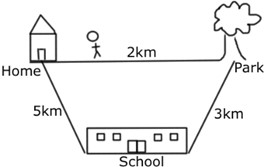
Jerry walked from home to school, then from the school to the park. What is his total displacement?
2 km
5 km
8 km
10 km

From the figure, what is the displacement?
20 meters
25 meters
15 meters
25 meters NE

Which of the following is correct?
Initial Position = -5 m
Final Position = -5 m
Distance = 22 m
Displacement = 0 m
Initial Position = -5 m
Final Position = -5 m
Distance = 0 m
Displacement = 22 m
Initial Position = -5 m
Final Position = 6 m
Distance = 22 m
Displacement = 0 m
Initial Position = -5 m
Final Position = 6 m
Distance = 0 m
Displacement = 22 m

What was the displacement of object C?

What was the displacement of object B?


Jerry walked from home to school, then from the school to the park. What is his total distance?
2 km
5 km
8 km
10 km
What is the formula for calculating average acceleration?
ΔtΔvf−Δvi
v×t
tv
v+t
If a car's velocity changes from 10 m/s to 30 m/s in 5 seconds, what is its average acceleration?
2 m/s²
4 m/s²
5 m/s²
6 m/s²
Which of the following units is used to measure acceleration?
m/s
m/s²
km/h
m²/s
A cyclist increases his speed from 5 m/s to 15 m/s in 2 seconds. What is his average acceleration?
3 m/s²
5 m/s²
10 m/s²
15 m/s²
If an object is at rest and reaches a velocity of 20 m/s in 4 seconds, what is its average acceleration?
4 m/s²
5 m/s²
6 m/s²
8 m/s²
What is the average acceleration of an object whose velocity changes from 0 m/s to 50 m/s in 10 seconds?
2 m/s²
4 m/s²
5 m/s²
10 m/s²
A train's velocity changes from 20 m/s to 60 m/s in 8 seconds. Calculate the average acceleration.
4 m/s²
5 m/s²
6 m/s²
8 m/s²
If a runner's speed increases from 2 m/s to 10 m/s in 4 seconds, what is the average acceleration?
1 m/s²
2 m/s²
3 m/s²
4 m/s²
A car accelerates from 0 to 25 m/s in 5 seconds. What is the average acceleration?
3 m/s²
4 m/s²
5 m/s²
6 m/s²
What is the average acceleration if a vehicle's velocity changes from 15 m/s to 45 m/s in 10 seconds?
2 m/s²
3 m/s²
4 m/s²
5 m/s²
A skateboarder increases his speed from 0 m/s to 12 m/s in 3 seconds. What is his average acceleration?
2 m/s²
3 m/s²
4 m/s²
5 m/s²
If a plane's velocity changes from 100 m/s to 200 m/s in 20 seconds, what is the average acceleration?
4 m/s²
5 m/s²
6 m/s²
7 m/s²
A boat accelerates from 5 m/s to 25 m/s in 5 seconds. Calculate the average acceleration.
2 m/s²
3 m/s²
4 m/s²
5 m/s²
What is the average acceleration of a car that goes from 30 m/s to 60 m/s in 6 seconds?
4 m/s²
5 m/s²
6 m/s²
7 m/s²
If a rocket's velocity changes from 0 m/s to 100 m/s in 10 seconds, what is the average acceleration?
8 m/s²
9 m/s²
10 m/s²
11 m/s²
Which of the following would NOT be considered a projectile?
a cannonball thrown straight up
a cannonball rolling down a slope
a cannonball rolling off a table
a cannonball thrown in the air
The horizontal component of a projectile's velocity is independent of...
its range
time
the vertical component
none of these
In the absence of air resistance, the angle at which a thrown ball will travel the farthest is
15o
30o
45o
60o

A textbook is dropped from a second floor window and falls to the ground. What happens to the acceleration as the book falls to the ground
the acceleration increases
the acceleration decreases
the acceleration remains constant

A baseball is thrown up into the air. What happens to the velocity as the ball rises in the air?
the velocity increases
the velocity decreases
the velocity remains constant

A baseball is thrown up into the air. What happens to the acceleration as the ball rises in the air?
the acceleration increases
the acceleration decreases
the acceleration remains constant
A baseball is thrown up into the air. What direction is the velocity of the ball?
upward
downward
A baseball is thrown up into the air. What direction is the acceleration of the ball?
upward
downward

A textbook is dropped from a second floor window and falls to the ground. What direction is the acceleration?
upward
downward
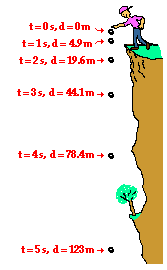
In Newtonian physics, ________________ is any motion of a body where gravity is the only force acting upon it.
kinematics
free fall
mechanics
velocity
The standard acceleration due to gravity (or standard acceleration of free fall),is the nominal gravitational acceleration of an object in a vacuum near the surface of the Earth. It is defined by standard as:
9.8 m/s.
9.8 m.
9.8 m/s2.
9.8 s.
If an object is free falling onto the Moon, which of the following would be correct?
It would accelerate at 9.8 m/s2
It would not encounter any air resistance.
It would not fall because the Moon has no gravity.
It would impact the surface and bounce back into space.

It takes more force to accelerate the iron man on the left than the iron man on the right because the iron man on the left has more mass. This best describes
Newton's first law
Newton's second law
Newton's third law, the law
The law of universal gravitation
Newtons 3rd Law of Motion states:
An object at rest will remain at rest unless acted upon by an outside force.
For every action, there is an equal and opposite reaction
The greater the mass of an object, the more force it will take to accelerate the object
When you push a boat off from the dock, you are demonstrating Newton's 3rd Law of Motion. It simply states that for every action there is an equal and opposite _______________?
Motion
Reaction
Change
Push
An object in motion stops when.....
It falls of an edge.
it is acted upon by an outside force.
It is eaten
It never stops
A push or pull on an object is called...
Acceleration
Mass
Inertia
Force
A fireman turns on his hose and is knocked backwards is an example of...
Newton's 1st Law
Newton's 2nd Law
Newton's 3rd Law
Newton's 4rth Law
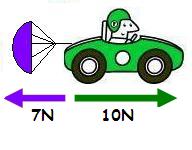
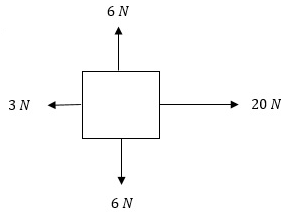
What is the NET FORCE of this diagram?
17 N, right
17 N, left
23 N, right
12 N, up

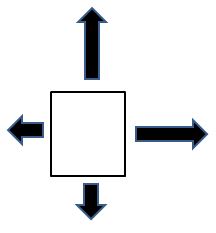
This object would be moving (pick all that are correct):
up
down
left
right
The down-arrow in this diagram is most-likely:
gravity
normal
a push or pull
friction
The force that keeps objects on top of surfaces instead of letting them sink into the surface is known as:
normal
abnormal
static
inertia
Whenever an object is moving, there is always this force opposing the motion:
inertia
momentum
friction
applied force
the force of kinetic friction (Fk) = ?
the normal force (Fn) multiplied by the coefficient of kinetic friction
the normal force (Fn) divided by the coefficient of kinetic friction
the normal force (Fn) multiplied by the coefficient of static friction
mass x gravity
_______ Is defined as the ability to do work or make things happen.
Work
Energy
Power
Forces
______ Is done when a force (N) causes an object to move a certain distance (m).
Energy
Work
Power
Force
The formula for Kinetic Energy is:
KE = ½ mv2
KE = FD
KE = 1/2 FD2
KE = M x A


What type of energy transformation takes place when you plug in a lamp and turn it on?
electrical to radiant
electrical to mechanical
chemical to radiant
mechanical to thermal
The SI Unit for Energy is
Joule
Newton
Calorie
Watt
The ability to do work or cause change:
work
energy
momentum
power
Energy in the form of motion.
mechanical energy
potential energy
kinetic energy
momentum
Stored energy in the form of position or condition.
potential energy
kinetic energy
momentum
mechanical energy
A student needs 10 Newtons of force to lift a box to the top of a 2 meter shelf. How much work do they do?
12 J
8 J
20 J
5 J
A worker climbs a ladder and does 8 J of work on a 2 N object. What is the distance they lift the object?
18 m
4 m
10 m
6 m
Two workers use 100 N of force to move a sofa 2 meters in 2 seconds. How much power is required?
100 watts
400 watts
104 watts
50 watts
If a 1300-kg car has been lifted so it has 19500 J of potential energy, it was lifted up ---.
1.5 m
150 m
15 m
0.67 m
What is the potential energy of a 3kg ball that is on the ground?
0 J
3 J
9.8 J
29.4 J

If the mass of the cart is 15kg, how much is the potential energy of the cart?
0J
1.2J
6J
58.8J
The equation for work is
work = power x mass
work = power / time
work = force x distance
work = distance x time
The equation for POWER is
power = mass x time
power = work / time
power = time / work
power = work x time
The equation for POTENTIAL ENERGY is
PE = mass x gravity x height
PE = gravity x weight
PE = height / work
PE = work / time
The unit of power (aka Joule per second)
Joule
Minute
Watt
Pound


What is the kinetic energy of a 4 kg rock falling through the air at 5 m/s?
10 J
50 J
20 J
200 J

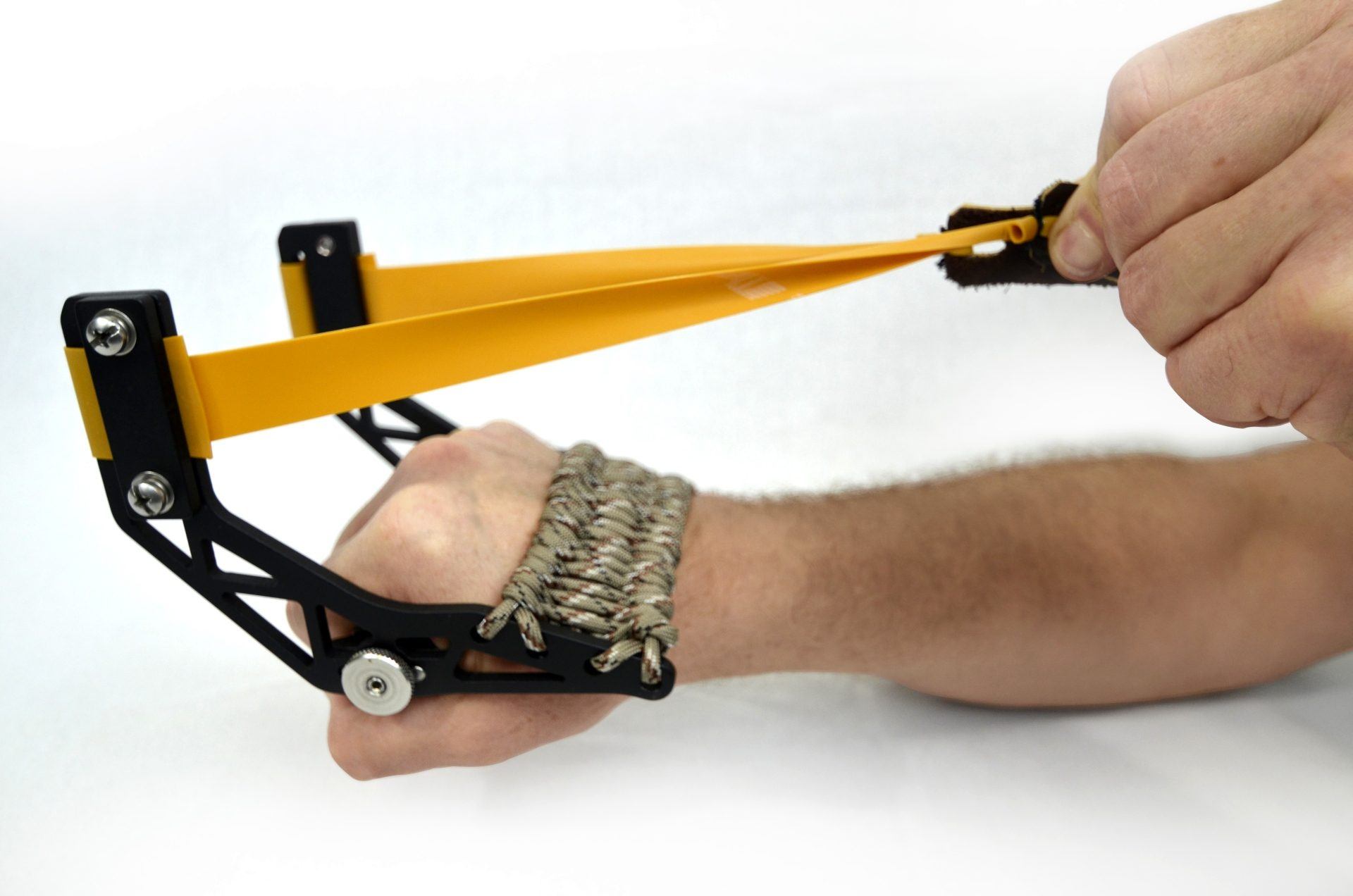


What is energy?
the ability to do work
the movement of electrons
UPS global services

what is thermal energy?
cool
moving parts
heat
True or False: The Work-Energy Theorem says that the work done on an object is equal to that objects change in energy.
True
False
The Δ symbol means
change in
total
sum
product
If a car starts with 7,000J of energy and increases it's energy to 8,000J, how much work did the engine do on the car?
1,000J
15,000J
7,000J
8,000J
An object weighs 7kg and has a height of 12m. What is the GPE?
GPE = 1029.6 J
GPE = 1372.8 J
GPE = 411.84 J
GPE = 823.7 J
What is the formula for KE?
The mass of the ball is 7kg and the velocity is 4.3 m/s. What is the KE?

