wayground logo

Free Printable Worksheets

Font size

S
M
L
XL
Worksheets

meteorology final exam

Total questions: 94

Worksheet time: 1hrs 6mins

Name
Class
Date
1.
What is the name of the atmospheric layer we live in?
a)
troposphere
b)
mesosphere
c)
stratosphere
d)
thermosphere
2.
Which layer of the atmosphere contains the ozone layer, which protects us from the sun's harmful rays?
a)
troposphere
b)
mesosphere
c)
stratosphere
d)
thermosphere
3.
What tool is used to measure air pressure?
a)
thermometer
b)
anemometer
c)
psychrometer
d)
barometer
4.
The earth receives heat energy from the sun by _______________, which is the transfer of energy as electromagnetic waves?
a)
radiation
b)
convection
c)
conduction
d)
greenhouse effect
5.
What is the term for the conditions in the atmosphere over a long period of time?
a)
 Stratosphere
b)
 Climate
c)
 Weather
d)
 Wind
6.
Compared to the ocean, land heats up and cools down
a)
Faster
b)
 Slower
c)
 Equally
d)
Gradually
7.
What kind of weather does a stationary front bring?
a)
 Light rain followed by clear weather
b)
 Many days of cloudy wet weather
c)
 Severe thunderstorms and rain
d)
 Cold and dry weather
8.
What is a warm front?
a)
 Warm air mass becomes caught between cold air masses
b)
two air masses meet and stay separate
c)
 Warm air moves over cold air and replaces it
d)
 Cold air moves under warm air and pushes it up
9.
What forms when two air masses meet?
a)
 Flood
b)
 Cloud
c)
Front
d)
Climate
10.
What is the effect on the air due to unequal heating rates of heating and cooling between water and land?
a)
different density (high & low pressure)
b)
ocean and land breezes
c)
convection currents
d)
all choices
11.
Which global wind pattern is responsible for moving weather fronts across the Unites States?
a)
Polar Easterlies
b)
Trade Winds
c)
Prevailing Westerlies
d)
Doldrums
12.
Distinct weather patterns on Earth's surface are created by __________ and the Coriolis Effect.
a)
unequal heating
b)
magnetic fields
c)
increased temperature
d)
increased air pressure
13.
What increases air's ability to hold more water vapor?
a)
increased wind speed
b)
decreased temperature
c)
increased temperature
d)
increased air pressure
14.
What is dew point?
a)
Temperature when gas become a liquid
b)
water vapor
c)
relative humidity
d)
humidity
15.
What is the cause of Earth's change of seasons throughout the year?
a)
Rotation of the Earth
b)
Revolution of the Earth
c)
Tilt of the Earth's axis
d)
Earth's temperature & weather
16.
What kind of weather does a cumulonimbus cloud bring?
a)
clear and sunny
b)
light rain
c)
hurricane
d)
thunderstorm
17.
When the northern hemisphere is in the winter season, temperatures are lower because _________________.
a)
it is further from the sun
b)
the sun's rays are indirect & less intense
c)
it is closer to the sun
d)
the sun's rays are direct & more intense
18.
What causes changes in the weather?
a)
air masses move and come together
b)
water evaporates
c)
the air gets more humid
d)
clouds form
19.
In an atmospheric convection current, cool air ____ and warm air ____.
a)
sinks, sinks
b)
rises, sinks
c)
sinks, rises
d)
rises, rises
20.
What will happen to a hurricane if it crosses into cooler water or moves onto land?
a)
It will strengthen and destroy everything in its path.
b)
It will cause damage to coastal areas but eventually lose strength.
c)
It will change direction and head south.
d)
All of these could happen.
21.
What air mass is forming at point F in the map?
a)
cP
b)
cT
c)
mT
d)
mP
22.
What air mass is forming at point A in the map?
a)
cP
b)
cT
c)
mT
d)
mP
23.
What type of air will the air mass shown at point E bring?
a)
warm and humid air
b)
warm and dry air
c)
cold and humid air
d)
cold and dry air
24.
Which statement is true about the relationship between thunder and lightning?
a)
Lightning rapidly heats the air, causing it to expand. The sound created is thunder.
b)
Thunder rapidly heats the air, causing it to expand. The light created is lightning.
c)
Thunder and lightning are created by the hail that forms in storm clouds.
d)
You hear thunder before you see lightning.
25.
Which statement is TRUE about this weather symbol?
a)
This symbol points in the direction the front is moving.
b)
This symbol represents a cold front.
c)
The symbol shows that thunderstorms are likely ahead of the front.
d)
All of these are true about this symbol.
26.
What provides the "fuel" for a hurricane?
a)
warm water evaporating from oceans
b)
cool water condensing to form rain
c)
warm water condensing to form clouds
d)
cool water moving through deep currents
27.
When is "tornado season"?
a)
June - November
b)
October - March
c)
spring - early summer
d)
winter - early spring
28.
Where are do most of Earth's tornadoes form?
a)
over the Atlantic ocean
b)
in the valleys of Europe
c)
in the rainforests of Brazil
d)
over the continental US
29.
What weather conditions will an area most likely experience if this symbol is shown over it on a weather map?
a)
Due to high pressure air rising, it will most likely have a warm front.
b)
Due to low pressure air rising, it will experience tornadoes.
c)
Due to high pressure air that doesn't rise, it will have clear skies.
d)
Due to low pressure air rising, it will experience hot weather.
30.
What is the "eye" of a hurricane?
a)
The calm center of a hurricane with little to no winds
b)
The most violent part of a hurricane that brings massive flooding
c)
The wall of high winds around the center of a hurricane
d)
The outer band of winds and rain that a hurricane brings.
31.
What will the weather forecast most likely be for the next 48 hours in the northwestern part of the United States?
a)
Slow-moving light rain ahead of a warm front, followed by clearer, warmer weather.
b)
Possible fast-moving thunderstorms ahead of a cold front, followed by cooler temperatures and clear skies.
c)
Heavy snowfall ahead of the occluded front followed by a hurricane.
d)
Days of heavy rain and possible flooding due to the stationary front.
32.
What is the most destructive part of a hurricane?
a)
Its high speed winds
b)
Its calm eye
c)
Its storm surge
d)
Its high pressure
33.
What is a key similarity among thunderstorms, tornadoes, and hurricanes?
a)
Each weather event can last up to a week over an area.
b)
All three weather events have the highest wind speeds ever recorded.
c)
High pressure created from cool, dry air sinking are used to create all three.
d)
Low pressure created from warm, humid air rising is needed for their formation.
34.
What type of front is being shown?
a)
a cold front
b)
a warm front
c)
a stationary front
d)
an occluded front
35.

What season would it be at position A in the northern hemisphere?

a)

winter

b)

spring

c)

summer

d)

fall

36.

Why is the sun important to the water cycle?

a)

The sun is the source of energy that powers the water cycle.

b)

The sun gives light so that people can see the water cycle happening.

c)

The sun's gravity causes the tides which are important to the water cycle.

d)

The sun isn't important to the water cycle.

37.

As you go higher in the atmosphere the molecules

a)

Are closer together

b)

Are farther apart

c)

Stop moving

38.

As you go higher in the troposphere (the layer of the atmosphere that is closest to Earth) the temperature

a)

Increases

b)

Decreases

c)

Stays the same

d)

first decreases then increases

39.

Which is caused by differences in air pressure?

a)

Snow

b)

Rain

c)

Clouds

d)

Wind

40.

Which of the following is not a type of severe weather?

a)

Blizzard

b)

Tsunami

c)

Severe Thunderstorm

d)

Drought

41.

Why does sand heat up faster than water during the daytime, and then cool off faster at night?

a)

Water has a higher heat capacity than sand.

b)

Water moves around more.

c)

Water starts of colder than sand.

d)

Water evaporates allowing it to cool.

42.

Climate is different than weather because

a)

Weather is short term, climate is over long periods of time

b)

Weather deals with precipitations, climate with temperature

c)

Climate deals with precipitations, weather with temperature

d)

Weather and climate are the same

43.

A continental air mass is always fairly

a)

dry

b)

damp

c)

cold

d)

hot

44.
What types of air masses form over oceans?
a)
Maritime
b)
Continental
c)
Polar
d)
Tropical
45.
What front is being forecast for this state?
a)
Cold Front
b)
Warm Front
c)
Stationary Front
d)
Occluded Front
46.
It is a cloudy and rainy day in Connersville; what type of weather system are we having?
a)
High-Pressure
b)
Low-Pressure
c)
Medium-Pressure
d)
No Pressure
47.
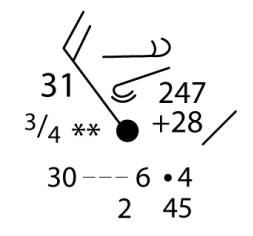
A record of weather data for a particular site at a particular time is a(n) ____.
a)
station model
b)
topographic map
c)
isopleth model
d)
climate map
48.

Which of the following gases is represented by letter A?

a)

Nitrogen

b)

Oxygen

c)

Carbon Dioxide

d)

Argon

49.

Which letter represents oxygen?

a)

A

b)

B

c)

C

d)

D

50.

Which of the following layers is represented by letter C?

a)

Troposphere

b)

Stratosphere

c)

Mesosphere

d)

Thermosphere

51.

Which list shows atmospheric layers in the correct order upward from the Earth’s surface?

a)

thermosphere, mesosphere, stratosphere, troposphere

b)

troposphere, stratosphere, mesosphere, thermosphere

c)

stratosphere, mesosphere, troposphere, thermosphere

d)

thermosphere, troposphere, mesosphere, stratosphere

52.
Which air pollution is human induced?
a)
Sea salt
b)
Dust
c)
Fossil fuel burning
d)
Bolide impact
53.
Air pressure is expressed on maps using _______.
a)
Contour lines
b)
Thermalbars
c)
Isobars
d)
Isoparabolic intervals
54.
All affect climate except ________.
a)
Elevation
b)
Latitude
c)
Longitude
d)
Proximity to oceans
55.
What does this symbol indicate on a weather map? 
a)
High pressure system
b)
Low pressure system
c)
Cold front
d)
Warm front
56.
Rain, snow, sleet, and hail are all forms of _____.
a)
precipitation
b)
condensation
c)
evaporation
d)
climate
57.
The amount of water vapor present in the air is called ________________.
a)
weather
b)
humidity
c)
air mass
d)
dew point
58.
What does this symbol on a weather map indicate? 
a)
High pressure system
b)
Low pressure system
c)
Cold front
d)
Warm front
59.
The atmosphere is composed of
a)

mostly oxygen

b)

all hydrogen

c)

a mixture of gases

d)

H20

60.
Air that has a 100 percent relative humidity is said to be
a)

stable

b)

dry

c)

saturated

d)

unstable

61.
On a weather map, what are the lines that connect points of equal temperature called?
a)

isobars

b)

contour lines

c)

isotemps

d)

isotherms

62.
Stratus clouds formed at ground level are called what?
a)

fog

b)

sleet

c)

snow

d)

freezing rain

63.
Air flow will go from _____ to _____ pressure areas.
a)

Low to High

b)

High to Low

64.

What is the MOST intense type of thunderstorm?

a)

Cumulonimbus

b)

Dissipating thunderstorm

c)

MCC

d)

Supercell

65.

How do tornadoes form?

a)

it forms when moist, warm air meets cool, dry air head on.

b)

it forms when cool, moist air meets warm, dry air head on.

c)

it forms when a warm front and a cold front meet.

d)

it forms when two air masses collide.

66.

How do scientists calculate the distance of a thunderstorm?

a)

The difference between the storm system and the rain

b)

The difference between the winds and the rain

c)

The time difference between the thunder and the lightning

d)

The time difference between the lightning and the hail

67.

How warm must ocean water be for a hurricane to form?

a)

68°F

b)

80°F

c)

85°F

d)

92°F

68.

A tropical storm is upgraded to a hurricane when wind speeds reach at least

a)

115 mph.

b)

39 mph.

c)

15 mph.

d)

74 mph.

69.

Tornadoes are;

a)

a rapidly moving tunnel of air

b)

a large movement of a cloud mass

c)

always at least a mile wide

d)

less destructive than thunderstorms

70.

Tornado damage is measured by:

a)

the fujita scale

b)

the tornado scale

c)

the catagory scale

d)

the damage scale

71.

An EF 5 tornado causes damage equal to:

a)

a major thunderstorm

b)

an atomic bomb

c)

the removal of roofs from houses only

d)

major flooding

72.

The scale used to measure the size of hurricanes is called the __________.

a)

Saffir-Simpson Scale

b)

Cal-Ripkin Scale

c)

Richter Scale

d)

Bart-Simpson Scale

73.

The most dangerous type of hurricane has a score of __________.

a)

Category 1

b)

Category 3

c)

Category 5

d)

Category 4

74.

Each hurricane gets its own __________.

a)

song

b)

poem

c)

number identification code

d)

name

75.

In the northern hemisphere of the earth hurricanes circle __________.

a)

clockwise

b)

counter-clockwise

c)

up and down

d)

front to back

76.

The Greenhouse Effect is….

a)

created when heat escapes the earth's atmosphere

b)

a process that occurs when the earth rotates on its axis

c)

a structure that supports plant life

d)

a process that occurs when gases in Earth's atmosphere trap the Sun's heat

77.

_____ is the most prevalent greenhouse gas worldwide.

a)

Methane

b)

Nitrogen

c)

Carbon dioxide

d)

Natural

78.

Meteorology is...

a)

the amount of water vapor present in the air.

b)

a boundary between two air masses of different density, moisture, or temperature.

c)

the study of weather.

79.
What happens to the air pressure the higher up in space you go?
a)
the air pressure increases
b)
the air pressure decreases
c)
the air pressure stays the same
d)
there is no air pressure
80.
what type of cloud is shown?
a)
cumulus
b)
cirrus
c)
stratus
81.
These clouds are the closest to the ground. Their name means layer- or sheet like. They bring rain or snow and cover most of the sky. 
a)
Cirrus
b)
Stratus
c)
Cumulonimbus
d)
Cumulus
82.
What is the barometric pressure at this station?
a)
247 millibars
b)
924.7 millibars
c)
1024.7 millibars
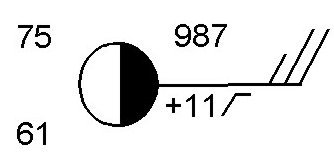
83.
What is the temperature at this station
a)
75 degrees
b)
61 degrees
c)
987 degrees
d)
11 degrees
84.
What is the dew point at this station?
a)
75 degrees
b)
61 degrees
c)
987 degrees
d)
11 degrees
85.
The NWS will issue a blizzard warning if what four conditions are met?
a)
1 inch of snow, winds 35 mph, visibility 1/4 mile, lasts for 2 hours
b)
Blowing snow, winds 35 mph, visibility 1/4 mile, lasts 3 hours
c)
Falling snow, winds 30 mph, visibility 1/4 mile, last 3 hours
d)
Blowing snow, winds 25 mph, visibility 1/4 mile, last 3 hours
86.
What is the name of Woody's owner in Toy Story?
a)
Andy
b)
Ryan
c)
Mark
d)
Andrew
87.

This type of thunderstorm can cover several hundred miles and feature a "bow echo" which makes the storm look bowed in the middle.

a)

Single cell

b)

Multicell cluster

c)

Squall line

d)

Supercell.

88.

This is the upward movement of air in a thunderstorm, which gives the storm fuel (energy).

a)

convection

b)

low pressure system

c)

updraft

d)

downdraft

89.
On a cold, cloudy day, the local weather forecaster predicts that a high pressure system will be moving into the area in the next 24 hours. Which weather conditions will this system most likely bring to the area?
a)
stormy
b)
sunny
c)
snowy
d)
hot
90.

Large areas of air with similar characteristics

a)

Front

b)

Air masses

c)

Anemometer

d)

Moisture

91.
What does carbon dioxide in the atmosphere do?
a)
it absorbs heat energy 
b)
it provides a place for water vapor to condense
c)
it absorbs harmful uv radiation 
d)
It protects from the solar wind
92.
A cold front is approaching Minneapolis. What will happen to the air temperature?
a)
stay the same
b)
increase
c)
decrease
93.

A warm front is moving north through North Carolina. What weather would be the forecast for the eastern half of North Carolina once the warm front passes?

a)

Warmer with few to no clouds and a SW wind

b)

Warmer with clouds, precipitation likely and a NW wind

c)

Cooler, no clouds and a NW wind

d)

Cold, clouds, precipitation and a SW wind

94.
Which city can expect to see an increase in temperatures over the next 24 hours?
a)
Billings, Montana
b)
Atlanta, Georgia
c)
Minneapolis, Minnesota
d)
Miami, Florida