
 Worksheets
Biology Fall 2023 Final Exam
Total questions: 69
Worksheet time: 39mins
Which processes contribute to the carbon cycle by releasing carbon dioxide into the atmosphere?
Photosynthesis and decomposition
Cellular respiration and combustion
Photosynthesis and combustion
Cellular respiration and photosynthesis
Grace, Avery, and Priya are studying the atmosphere for their science project. They are particularly interested in how Nitrogen gas gets removed from the atmosphere. Can you help them understand this process?
Through the process of photosynthesis
Through the process of cellular respiration
Through the process of nitrogen fixation
Through the process of decomposition
What is the role of nitrogen-fixing bacteria in the nitrogen cycle?
They convert atmospheric nitrogen into a form that plants can use
They convert fixed nitrogen into a form that plants cannot use
They convert atmospheric nitrogen into a form that plants cannot use
They convert fixed nitrogen into a form that plants can use
Lily, Anika, and Oliver are conducting a science experiment. They are trying to understand how plants produce ATP. They know that ATP is made using the energy from a certain molecule. Can you help them identify that molecule?
CO2
H2O
Sunlight
Glucose
How many ATP molecules are generated in the process of Glycolysis during cellular respiration?
2
4
32-34
36-38
Which of the following is a byproduct of cellular respiration that is used as a reactant in photosynthesis?
Glucose
Oxygen
Carbon dioxide
Water
Which of the following best represents energy conversion during cellular respiration?
C6H12O6 + O2 → bonds broken → ATP + H2O + CO2
H2O + CO2 → bonds formed → ATP
ATP + C6H12O6 → bonds broken → H2O + O2 + CO2
H2O + CO2 → bonds formed → C6H12O6
How do plants obtain the simple molecules necessary to do photosynthesis and make glucose?
Plants take in carbon dioxide from the roots and take in water through the atmosphere.
Plants take in carbon dioxide from the atmosphere and take in water through the roots.
Plants make carbon dioxide through the roots and make water from the atmosphere.
Plants make carbon dioxide through the atmosphere and make water through the roots
Which of the following best describes the chemical equation shown below?
C6H12O6 + 6O2 → 6H2O + 6CO2 + ATP
Respiration: lipids and water are used, carbon dioxide and glucose are produced.
Respiration: glucose and oxygen are used, carbon dioxide and water are produced.
Photosynthesis: carbon dioxide and water are used, glucose and oxygen are produced.
Photosynthesis: proteins and oxygen are used, carbon dioxide and water are produced.
What process removes carbon from the atmosphere?
Combustion
Photosynthesis
Respiration
Decay

Two substances, X and Y, are used by a plant cell in a process that forms the products shown below. What substances are represented by X and Y?
William and Mia are working on a science project about cells. They are discussing about an organelle that converts sugars into energy. Can you tell them which organelle performs this function?
nucleus
ribosome
mitochondria
endoplasmic reticulum
Oliver is studying plants and he learns that photosynthesis happens in the chloroplast. He then wonders, cellular respiration happens in which part of the cell?
cytoplasm
nucleus
mitochondria
ribosomes
What is the result of breaking a phosphate bond in ATP?
Formation of ADP and release of energy
Formation of ADP without release of energy
Formation of ATP and release of energy
Formation of ATP without release of energy
What is the impact of the surface area of the inner membrane in mitochondria on ATP production?
A larger surface area of the inner membrane enhances ATP production.
A larger surface area of the inner membrane reduces ATP production.
A smaller surface area of the inner membrane reduces ATP production.
A smaller surface area of the inner membrane enhances ATP production.
Put the steps of cellular respiration in the correct sequence
Glycolysis
The Krebs Cycle
Electron Transport Chain
Which statements best describe the relationship between photosynthesis and cellular respiration?
Photosynthesis produces ATP that is used to make glucose in cellular respiration.
Photosynthesis produces glucose that is used to make ATP during cellular respiration.
Photosynthesis and cellular respiration both produce glucose.
Photosynthesis and cellular respiration both use light energy to produce ATP.
In what part of the chloroplast does the Light Reactions occur?
Which step of cellular respiration produces the MOST energy?
Which of the following biomolecules is the main energy supply for cellular work?
Carbohydrate
DNA
Which of the following would NOT be considered an essential atom for living things?
All of the following are functions of protein EXCEPT:
Act as a main source of energy for cells
Defend the body from harmful microorganisms
Control chemical reactions in a cell
Build structures such as muscle
What type of molecule is created when two sugars are bonded together?
What is the protein that aids in digestion and respiration by speeding up the rate of the reaction?
Which of the following biological macromolecules is correctly paired with one of its functions?
Proteins → provide short term energy to cells
Carbohydrates → store genetic information
Nucleic acids → provide cell structure
Lipids → provide long term energy to cells
What makes carbohydrates different from lipids?
Lipids have less oxygen, in comparison to carbon and hydrogen, than carbohydrates
Lipids have more oxygen, in comparison to carbon and hydrogen, than carbohydrates
Lipids have less carbon, in comparison to oxygen and hydrogen, than carbohydrates
Lipids have more carbon, in comparison to oxygen and hydrogen, than carbohydrates
A population reaches the carrying capacity when the resources ________________.
When the settlers arrived in New England, many forests were turned into fields. Eventually, some fields were abandoned and then grew back into forests. This is best described as:
Primary Succession
Secondary Succession
Tertiary Succession
Old Growth Succession

Refer to the graph below. Which time period shows exponential growth of the population?
A
B
C
D
The carrying capacity would be determined by which region in the graph
A
B
C
D
Each of the following is an abiotic factor in a pond ecosystem EXCEPT:
plant life
soil type
water
temperature
How much energy is available to organisms from one trophic level to the next?
A snake that eats a frog that has eaten an insect that fed on a plant is a…
How many calories are available to a chicken from 2,500 calories of grain?
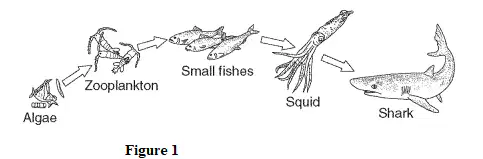
The algae at the beginning of the food chain in Figure 1 is a…
consumer
decomposer
autotroph
heterotroph
Which statement BEST describes why the amount of energy is greater at the bottom than at the top of the energy pyramid?
Smaller organisms require more energy than larger organisms.
Consumers are unable to use energy sources from lower levels.
Primary producers store 95% of the available energy.
Organisms at each level “lose” energy in the form of heat to the environment.

Match the organism with their role in the food web
frog
secondary consumer
wolf
tertiary consumer
tree
Primary producer
rabbit
Primary consumer
The wetland plant purple loosestrife was imported to North America from Europe. Since its introduction, the loosestrife has spread, which has resulted in a dramatic decline in the biological diversity of native wetland plants. A likely reason for the spread of the purple loosestrife is that it can:
Successfully compete with native herbivores for food.
Serve as an excellent food source for native herbivores.
Successfully compete with native plants for space.
Prevent the migration of native plants.
Which diagram, A or B, most accurately represents interactions between abiotic and biotic factors in a forest environment?

What would most likely happen to one other population in this food web if all the squirrels and rabbits were suddenly killed by a viral disease?
The grouse population would increase.
The oak tree population would decrease.
The cougar population would increase.
The fox population would decrease.
If this forest community experienced a severe lack of rain throughout the spring and summer seasons, what effect would this drought have on the grouse population?
Increase in grouse numbers
Decrease in grouse numbers
The populations of grouse would remain unchanged.
The deer population would increase.
Identify one possible reason why the deer population could remain relatively constant, even though the number of berry bushes and berries varies from year to year.
deer also eat other plants
the fluctuation of the cougar population
Energy rich berries provide substantial energy
An increase in grouse helps the deer survive
What is the pioneer species in secondary succession?
moss
grass
trees
bushes
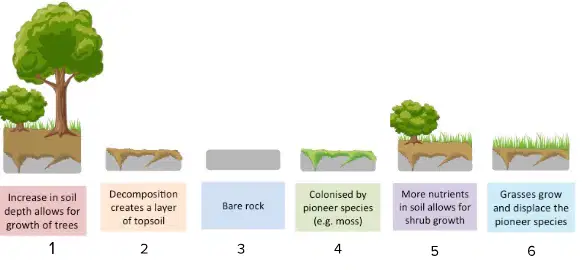
What is the correct order of events for the primary succession of a forest?
3
4
2
6
5
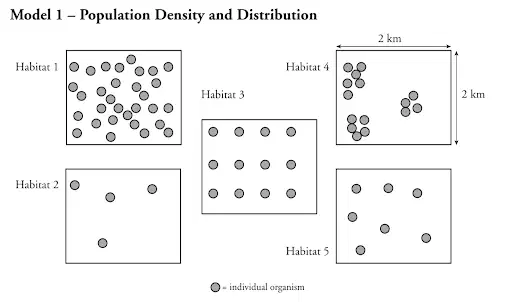
What is the population density for Habitat #3?
1/KM2
2/KM2
3/KM2
4/KM2
What is the population distribution for Habitat #1?
random
uniform
clumped
none of the above
Herds of animals and schools of fish are examples showing a clumped (clustered) population distribution. What is one advantage that animals have in being distributed this way?
Increased competition for resources
Decreased potential for mating
Decreased protection from predators
Increased protection from predators
Which of the following is a density-dependent factor?
Fire
Flood
Disease
Tornado

At which lamp distance is photosynthesis occurring at the fastest rate?
15 cm
30 cm
45 cm
60 cm
75 cm
At which lamp distance is photosynthesis occurring at the slowest rate?
15 cm
30 cm
45 cm
60 cm
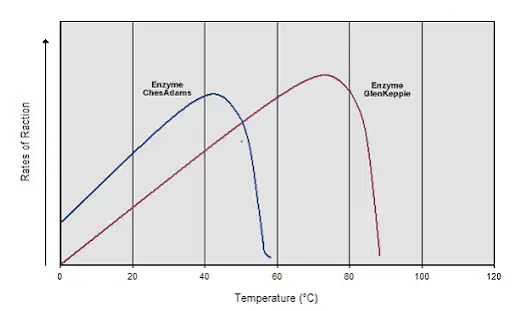
At approximately what temperature do both enzymes have equal reaction rates?
40°C
50°C
60°C
70°C
80°C
At approximately what temperature does GlenKeppie have maximum activity rate?
40-45°C
60-65°C
70-75°C
50-55°C
Which enzyme is better suited to work in humans and why? (Human Body Temperature = 37°C)
Enzyme ChesAdams because the optimum temperature is not the same as the human body temperature.
Enzyme ChesAdams because the optimum temperature is the same as the human body temperature.
Enzyme GlenKeppie because the optimum temperature is the same as the human body temperature.
Neither of them would function in humans because they would both denature.
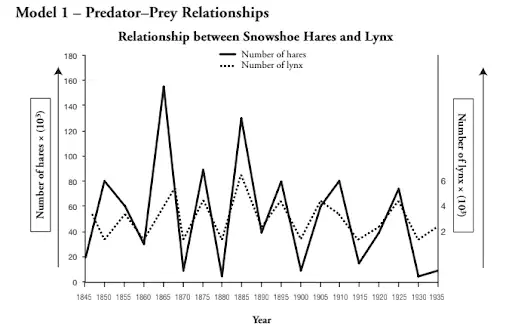
What does the x axis on the bottom of Model 1 represent?
Number of hares
Number of lynx
Time
The relationship between hares and lynx
What does the y axis on the right of Model 1 represent?
Number of hares
Number of lynx
Time
The relationship between hares and lynx
What was the approximate population of snowshoe hares in 1865?
60
150
60,000
150,000
What was the approximate population of lynx in 1865?
60
4,000
60,000
150,000
Which of the following is a TRUE statement?
When the population of hares increases, the population of lynx decreases
When the population of hares decreases, the population of lynx increases
When the population of lynx increases, the population of hares decreases
When the population of lynx decreases, the population of hares decreases
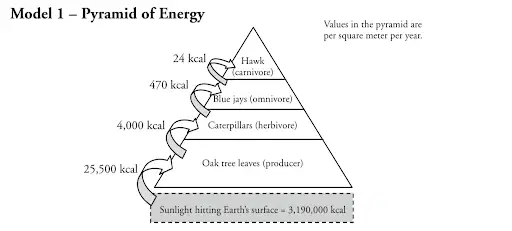
How much energy does the original source of energy provide to a square meter of the Earth per year?
3,190,000 kcal
25,500 kcal
4,000 kcal
No way to determine
What organisms are primary consumers in this energy pyramid?
Oak tree leaves
caterpillars
blue jays
hawks
What organisms are primary consumers in this energy pyramid?
0.8%
5%
12%
16%
An observation is a conclusion based on evidence and reasoning.
True
False
Decomposers are typically not represented in an energy pyramid.
True
False
Soil is an abiotic factor.
True
False
Proteins are the ideal source of energy for the body.
True
False
An organic compound is a compound that contains both carbon and hydrogen.
True
False
Photosynthesis produces glucose that is used to make ATP in cellular respiration.
True
False
Both plant and animal cells use the process of photosynthesis to make glucose.
True
False
Fermentation is the process that is used when there is no oxygen present.
True
False

