
 Worksheets
Final Exam Review
Total questions: 138
Worksheet time: 3hrs 38mins

What is the structure that contains DNA and directs the cell?
endoplasmic reticulum
central vacuole
cell wall
nucleus


The structure labeled "H" is responsible for breaking down the energy in glucose and converting it to ATP. What is the name of structure "H"?
chloroplast
mitochondria
nucleus

This organelle packages and ships materials around the cell. What is the name of this organelle?
vacuole
ribosome
endoplasmic reticulum
Golgi apparatus

A cell has trouble breaking down waste in the cytoplasm. Which cell structures are likely faulty?
mitochondria
lysosomes
chloroplasts
smooth endoplasmic reticulum
Human muscle cells use quite a bit of energy. Due to this function, which organelle would be found in large amounts in muscle cells?
chloroplasts
mitochondria
nucleus
ribosomes
What body system transports nutrients & oxygen to and carbon dioxide and waste from the cells?
Cardiovascular System
Nervous System
Digestive System
Respiratory System
What body system takes oxygen into the body and releases carbon dioxide?
Circulatory System
Digestive System
Respiratory System
Nervous System
The digestive system is made up of which of the following organs?
Brain, nerves and spinal cord
Lungs, trachea and mouth
Esophagus, stomach, small intestine and large intestine
Brain, cells and large intestine
What organs make up your nervous system?
Mouth, esophagus, stomach
Brain, stomach, small intestine
Brain, spinal cord and nerves
Lungs, diaphragm and stomach
What is a major role of the endocrine system?
release hormones to control many body functions
digest and absorb food
transport nutrients through the blood
first line of defense from infection
Which system provides structure and support for the body?
skeletal
muscular
digestive
excretory
Which system enables movement of the body?
skeletal
nervous
muscular
respiratory
Which organ system is responsible for filtering out waste from blood?
urinary
digestive
respiratory
cardiovascular
Which organ system collects and responds to sensory information?
cardiovascular system
respiratory system
immune system
nervous system
Which organ system defends and destroys pathogens that make their way INTO the body?
cardiovascular system
respiratory system
immune system
nervous system
Which organ system acts as a barrier to protect the body from the OUTSIDE world?
immune system
integumentary system
urinary system
digestive sytem
A body part said to be furthest from point of attachment to trunk is said to be
proximal
distal
lateral
medial
Closest point to the attachment of the trunk is called
proximal
distal
cranial
caudal
Your skin is ___________ to your bones
deep
lateral
superficial
dorsal
The location on our body that is directly down the middle of your body splitting your body into left and right is called
cranial
superior
inferior
midline
Toward the midline of the body is called
medial
lateral
inferior
deep
Away from the midline of the body is called
medial
lateral
proximal
distal
Toward the head or above is what we describe as
inferior
superior
distal
proximal
In front of; toward the surface is known as
posterior
dorsal
anterior
inferior
In back of; toward the back surface is known as
cranial
caudal
anterior
posterior
Which of these does not occur when in Anatomical Position
Face forward
Feet forward
Palms facing backward
Palms facing forward

Which side is facing you?
Anterior
Posterior
Lateral
Medial
The chin is _____ to the eye.
superior
deep
inferior
lateral


Which bone is labeled O?
Femur
Tibia
Fibia
RibCage

What is the name for bone "2" above?
occipital
temporal
frontal
parietal
What is the name for bone "11" above?
occipital
temporal
frontal
parietal
What is the name for bone "4" above?
occipital
temporal
frontal
parietal
What is the name for bone "1" above?
occipital
temporal
frontal
parietal

Which bone is labeled G?
Humerus
Ulna
Femur
Pelvis

Which bone is labeled H?
Clavicle
Scapula
Rib Cage
Sternum

What bone is in red?
carpals
humerus
radius
ulna

What bone is shown in red?
clavicle
humerus
scapula
ulna

What bone is shown in red?
clavicle
humerus
scapula
ulna

What bone is shown in red?
femur
fibula
patella
tibia
Red bone marrow functions to
produce fat
produce blood cells
store cells
produce new bone cells
What connects bones to other bones?
Joint
Tendon
Ligament
Cartilage
What connects bones to muscles?
Joint
Tendon
Ligament
Cartilage
What do we call the place where two bones meet?
skeleton
joint
muscle
rib

What is the name for the connector that attaches bone to bone?
ligament
tendon
joint
cartilage
The sternum is an example of a _ bone.
flat
long
sesamoid
irregular
Which of these is a type of long bone?
carpals
tarsals
skull
femur

What type of fracture goes through the skin?
Comminuted
Open
Closed
Spiral
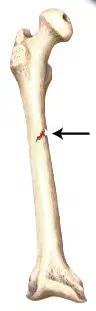
What type of fracture is shown in the image?
Partial
Complete


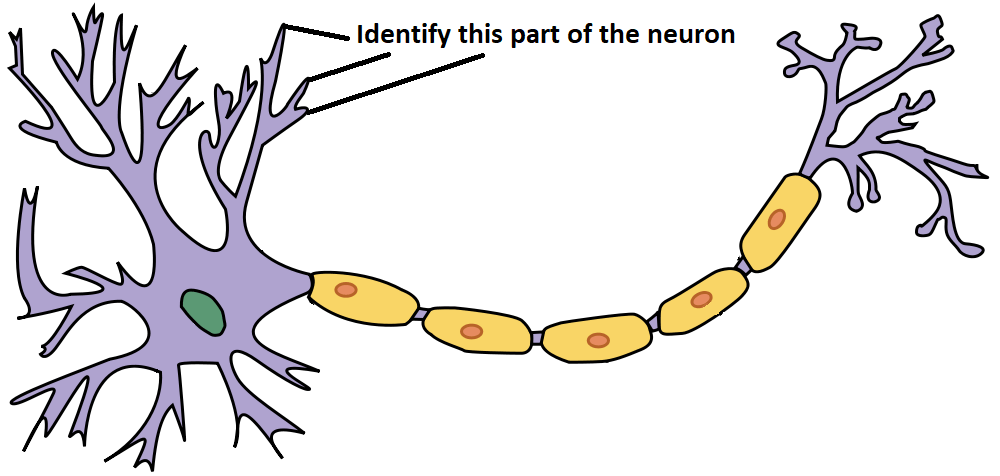
Dendrites
Axon Terminals
Myelin Sheath
Schwann Cells
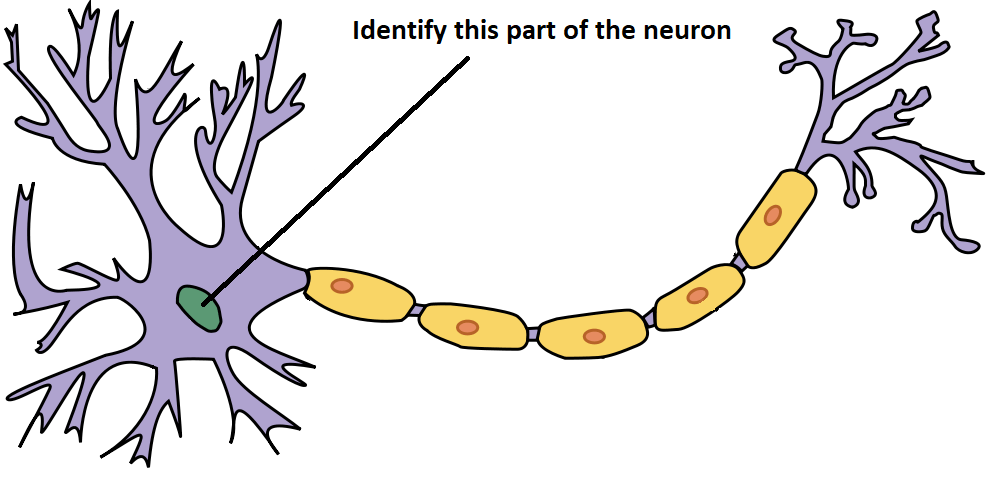
Nucleus
Cell Body
Axon
Node of Ranvier
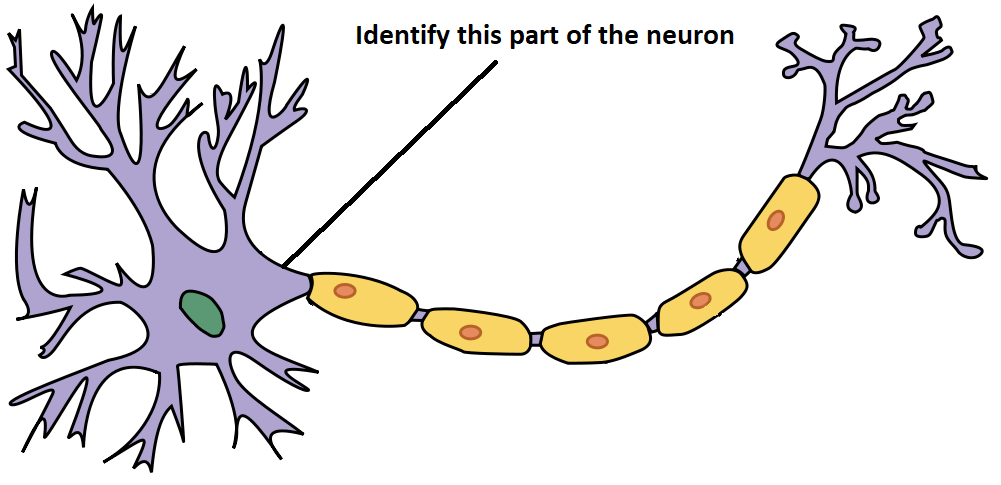
Nucleus
Cell Body
Axon
Node of Ranvier
What do Dendrites do?
Receives information from other neurons via neurotransmitters
Produces fatty tissue for the Myelin Sheath
Sends information to the next cell
Controls the speed of electrical signal through the axon
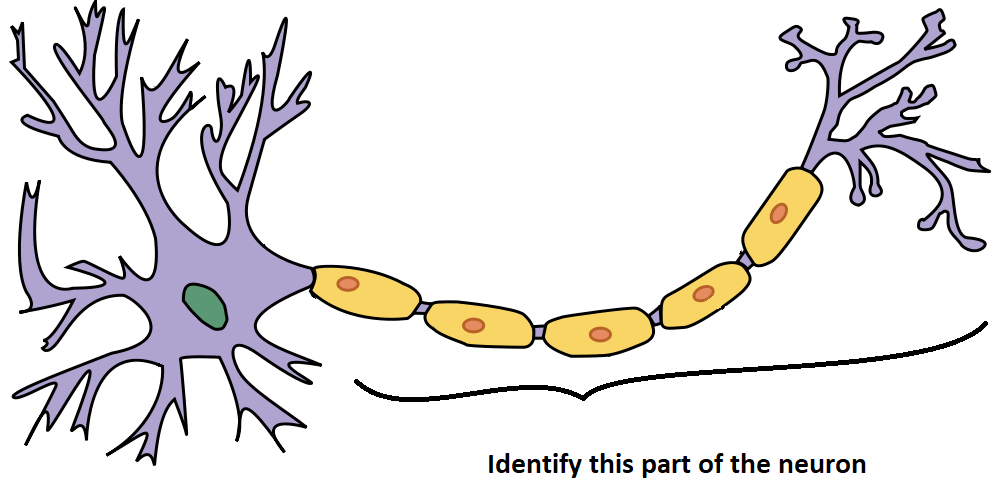
Nucleus
Cell Body
Axon
Node of Ranvier

Letter C represents the
Cerebrum
Cerebellum
Medula
Letter A represents the
Cerebrum
Cerebellum
Brain Stem
Letter B represents the
Cerebrum
Cerebellum
Medula
What is the main function of the nervous system?
to inhale oxygen and exhale carbon dioxide
to break down food consumed by a person for nutrients
to control the body's activities by relaying messages
to control the body's movements

These are tiny blood vessels where the cells and the blood exchange nutrients, oxygen and waste.
capillaries
arteries
veins

What type of muscle tissue makes up the heart
skeletal muscle
large muscle
cardiac muscle
Match part of the blood with its job
red blood cells
carry oxygen and nutrients
white blood cells
fight off germs
platelets
clot the blood
In which order does the blood pass from the body through the heart chambers?
Left atrium – left ventricle – lungs – right atrium – right ventricle
Left atrium – right atrium – lungs – left ventricle – right ventricle
Right atrium – left atrium – lungs – right ventricle – left ventricle
Right atrium – right ventricle – lungs – left atrium – left ventricle


What chamber of the heart is number 2?
right atrium
left atrium
right ventricle
left ventricle

Which chamber of the heart is number 3?
right atrium
left atrium
right ventricle
left ventricle

What is the function of the cardiovascular system?
Break down food for nutrients.
Carry materials like gasses, nutrients, and waste around the body.
Movement of body parts.
Collect information and respond with electrical messages.
Which component of blood helps deliver oxygen with the protein hemoglobin?
Platelet
White Blood Cell
Red Blood Cell
Plasma
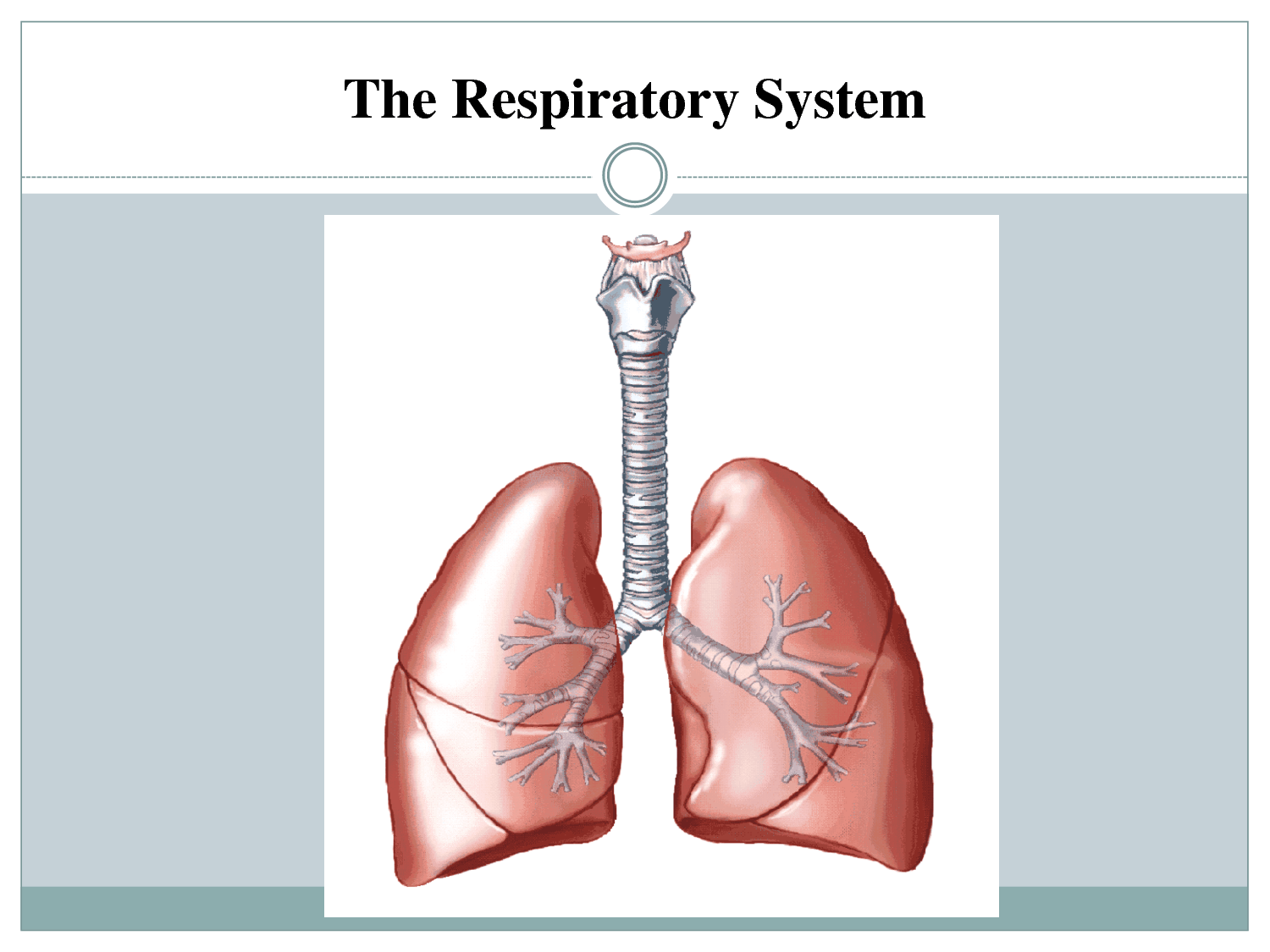
What is the main function of the respiratory system?
to provide oxygen and remove carbon dioxide from the body
to break down food and absorb nutrients
to remove oxygen from the body and deliver carbon dioxide
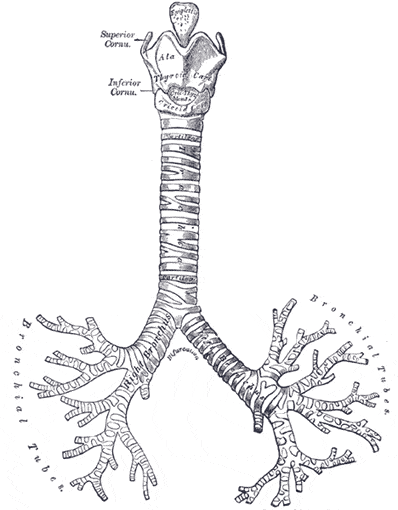

Flap of tissue that covers the opening to the windpipe during swallowing
Pharynx
Trachea
Epiglottis
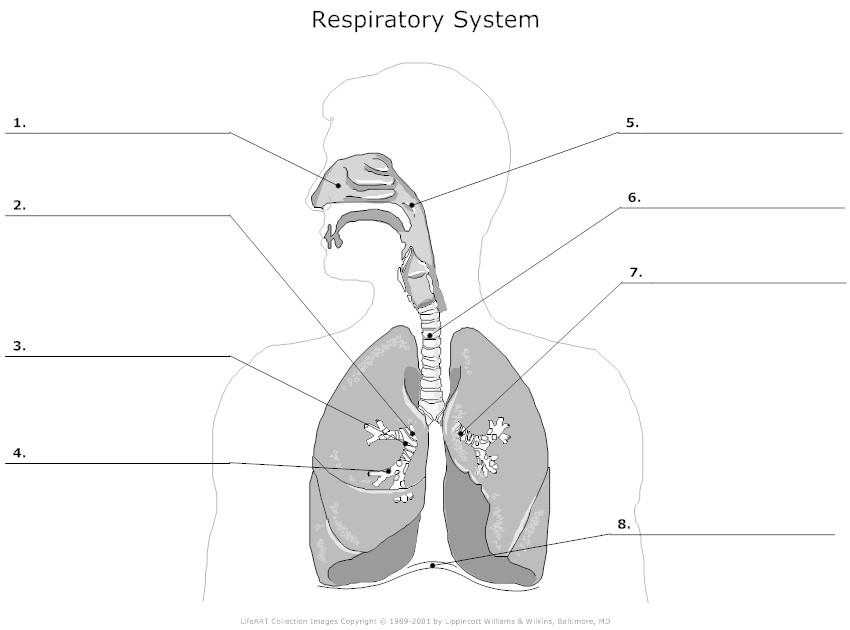
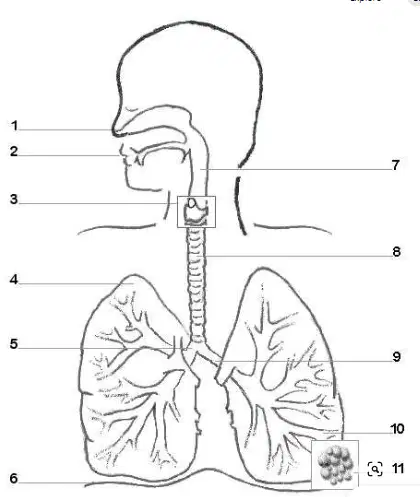
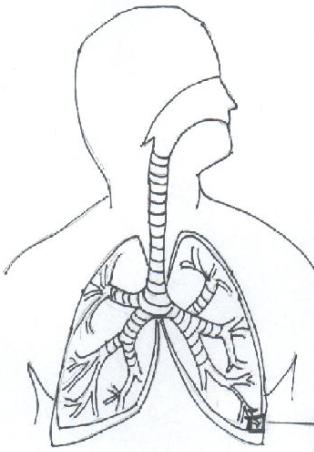
What is the name of the structure labeled "9"?
trachea
pharynx
bronchi
epiglottis
What is the name of the structure labeled "11"?
trachea
pharynx
alveoli
epiglottis

What is the name of the iron-containing protein that carries oxygen to the body tissues?
Chewing food is an example of which type of digestion?
chemical
mechanical
False
TRUE or False: Accessory organs do not have food pass through them.
True
False
The salivary glands secrete saliva. This saliva contains enzymes that start breaking food down. This is an example of which type of digestion?
chemical
mechanical
What is the term for the series of muscle contractions that moves food through the esophagus?
peristalsis
osmosis
diffusion
Put the following terms in order, starting from ingestion.
mouth
pharynx
esphagus
stomach
small intestine
Match the following
Contains villi; site of the majority of digestion and nutrient absorption
small intestine
opens to allow elimination to occur
anus
produces pancreatic juice and insulin
pancreas
carries out chemical digestion with gastric juices and mechanical digestion with churning
stomach
Match the following
full of helpful bacteria and absorbs water
large intestine
stores bile and dumps it into the small intestine
gall bladder
the throat; splits into the esophagus and trachea
pharynx
site of ingestion
mouth
Match the following
creates saliva, which contains enzymes and moistens food
salivary glands
muscular tube that moves food into the stomach
esophagus
aids in the process of mastication
tongue
produces bile which helps break down fats
liver
What are the main organs of the urinary system?
The main organs of the urinary system are the heart, lungs, and brain.
The main organs of the urinary system are the kidneys, ureters, bladder, and urethra.
The main organs of the urinary system are the liver, stomach, and intestines.
The main organs of the urinary system are the spleen, gallbladder, and pancreas.
What is the function of the urinary system?
The function of the urinary system is to produce hormones.
The function of the urinary system is to filter waste products from the blood and excrete them as urine.
The function of the urinary system is to transport oxygen to the cells.
The function of the urinary system is to regulate body temperature.
What is the primary function of the kidneys?
Filter waste products from the blood and excrete them in the form of urine.
Regulate body temperature
Produce insulin for the body
Produce red blood cells
What is responsible for returning filtered blood to the body?
pulmonary artery
pulmonary vein
renal artery
renal vein
What is the role of the ureters in the urinary system?
Store urine in the bladder.
Transport urine from the kidneys to the bladder.
Produce urine in the kidneys.
Filter blood in the kidneys.
What is the function of the urinary bladder?
The function of the urinary bladder is to filter urine.
The function of the urinary bladder is to produce urine.
The function of the urinary bladder is to store urine.
The function of the urinary bladder is to transport urine.
What is the name of stretchy, muscular organ responsible for holding urine until you decide to use the bathroom?
Kidneys
Urethra
Ureter
Bladder

Identify the structure labelled "A" in the diagram.
Kidney
Ureter
Bladder
Urethra
Identify the structure labelled "B" in the diagram.
Kidney
Ureter
Bladder
Urethra
Identify the structure labelled "C" in the diagram.
Kidney
Ureter
Bladder
Urethra
The top layer of the skin is called the ---
dermis
oil gland
subcutaneous fat
epidermis
Which layer contains accessory structures such as sweat glands, sebaceous glands, and hair follicles?
epidermis
dermis
subcutaneous fat
hyperdermis
Oil glands that are found all over the skin are called ---
merocrine glands
sebaceous glands
apocrine glands
sweat glands
Sweating and shivering are your body's way of regulating its ---
Water loss
Temperature
Hair growth
Vitamin D absorption

#2 on this diagram is the ---
epidermis
dermis
subcutaneous fat/hypodermis
follicle


Any organism that causes disease like a virus or bacteria is called:
Antibiotics
Antibody
Pathogen
Phagocyte
What is the body's first line (non-specific) of defense against infection by foreign organisms?
antibodies
lymph nodes
white blood cells
the skin
The innate immune system is...
Always working and doesn't require any special preparation
Needs to be "primed" before it can work to its full effectiveness
Very specific and only defends against a specific pathogen
Not very effective at preventing intruders
This type of immunity is acquired during one's lifetime. It is induced by antigens that invade the body.
innate immunity
adaptive immunity
nonspecific immunity
normal microbiota
This type of immunity can be called nonspecific and refers to the bodies defenses that are present since birth.
resistance
adaptive immunity
acquired immunity
innate immunity
Hormones from this gland control other endocrine glands
Pituitary
Thymus
Hypothalamus
Pancreas
What is the function of the thymus?
makes insulin which regulates blood sugar
produces estrogen and progesterone
helps with immune system
What is the function of the pineal gland?
makes insulin to regulate blood sugar
releases melatonin and regulates sleep
produces testosterone
What is the function of the thyroid gland?
make melatonin
regulates metabolism
help breakdown sugar


Squamous

Cuboidal

Columnar


This involuntary type of muscle tissue is found lining the digestive system. What type of muscle tissue is this?
cardiac
skeletal
smooth
What type of muscle makes up your heart?
cardiac
skeletal
smooth
cardiac and skeletal
Which of the following muscle types are involuntary?
skeletal and smooth
cardiac and skeletal
smooth and cardiac
skeletal

What muscle type is this?
cardiac
skeletal
smooth
Epithelial Tissues may be classified according to?
Location and Direction
Color and Shape
Number of cell layers and cell shape
It depends
Which epithelial tissue has more than one layer of flattened cells?
simple squamous
stratified squamous
transitional
simple columnar
A single layer of tall, skinny epithelial cells would be best described as
simple cuboidal epithelium
simple columnar epithelium
simple squamous epithelium
stratified columnar epithelium

