wayground logo

Free Printable Worksheets

Font size

S
M
L
XL
Worksheets

IPC Final - Soto

Total questions: 121

Worksheet time: 2hrs 50mins

Name
Class
Date
1.

Your lab partner accidently splashes a chemical in his/her eye. What would you use to help them?

a)

Shower

b)

Sink

c)

Fire Blanket

d)

Eye Wash

2.

When a substance burns, it is showing a ______ change.

a)

Density

b)

Chemical

c)

Physical

d)

Viscosity

3.

A ________ mixture is well-mixed and has particle so small they cannot be seen.

a)

Homogeneous

b)

Heterogeneous

c)

Chemical

d)

Compound

4.

A _____ happens when a change does not produce a new substance, but the physical properties only are changed.

a)

chemical change

b)

physical change

c)

burning

d)

rusting

5.

A _____ mixture is made of different materials that are distinct.

a)

Homogeneous

b)

Heterogeneous

c)

Solution

d)

Compound

6.

Sharpening a pencil is a ___________ change.

a)

Chemical

b)

Physical

c)

Viscosity

d)

Density

7.
Is freezing juice a physical or chemical change?
a)
Physical Change
b)
Chemical Change
8.

If burned during the lab,

a)

Use the safety shower for 15 minutes

b)

rinse the area with cold water

c)

ignore it

d)

tell the teacher

9.
What two types of measurements make up DENSITY
a)
Mass and Volume
b)
Temperature and Mass
c)
Grams and Centimeters
d)
Volume and Weight
10.
Look at this image.  Which object has the LOWEST density in water? How
a)
The Ping Pong Ball because it floats to the top 
b)
The bolt because it has sunk to the bottom
c)
The soda cap because it is not just full of air like the Ping Pong ball
11.
Jack has a rock. The rock has a mass of 14g and a volume of 2cm3. What is the density of the rock?
a)
7 mL
b)
7 g/cm3
c)
28 g/cm3
d)
1/7 g/cm3
12.
What subatomic particles would you find in the nucleus of an atom?
a)
Protons only
b)
Protons and Neutrons
c)
Neutrons and Electrons
d)
Protons and Electrons 
13.
Which subatomic particles contribute the most to the mass of an atom?
a)
Protons, Neutrons, Electrons
b)
Protons only
c)
Protons and Electrons
d)
Protons and Neutrons
14.
What is the number of protons that the element in this image contain?
a)
14
b)
7
c)
15
d)
18
15.
Protons and Electrons balance the charge of an atom.
a)
True
b)
False
16.
Which letter represents a proton?
a)
A
b)
B
c)
C
d)
D
17.

How are the elements arranged on the periodic table today?

a)

By atomic mass

b)

By number of electrons

c)

By atomic number

d)

By alphabetic order

18.
A horizontal row of elements in the periodic table.
a)
column
b)
group
c)
period
19.
Most of the elements on the periodic table are classified as _____.
a)
Metals
b)
Nonmetals
c)
Metalloids
d)
Periods
20.
This class of elements are sometimes called "semiconductors."
a)
Metals
b)
Nonmetals
c)
Metalloids
d)
Groups
21.
The yellow atoms are called 
a)
metals
b)
nonmetals
c)
metalloids
d)
noble gases
22.
Elements in the same ________ are more chemically similar.
a)
group
b)
period
c)
club
d)
table
23.
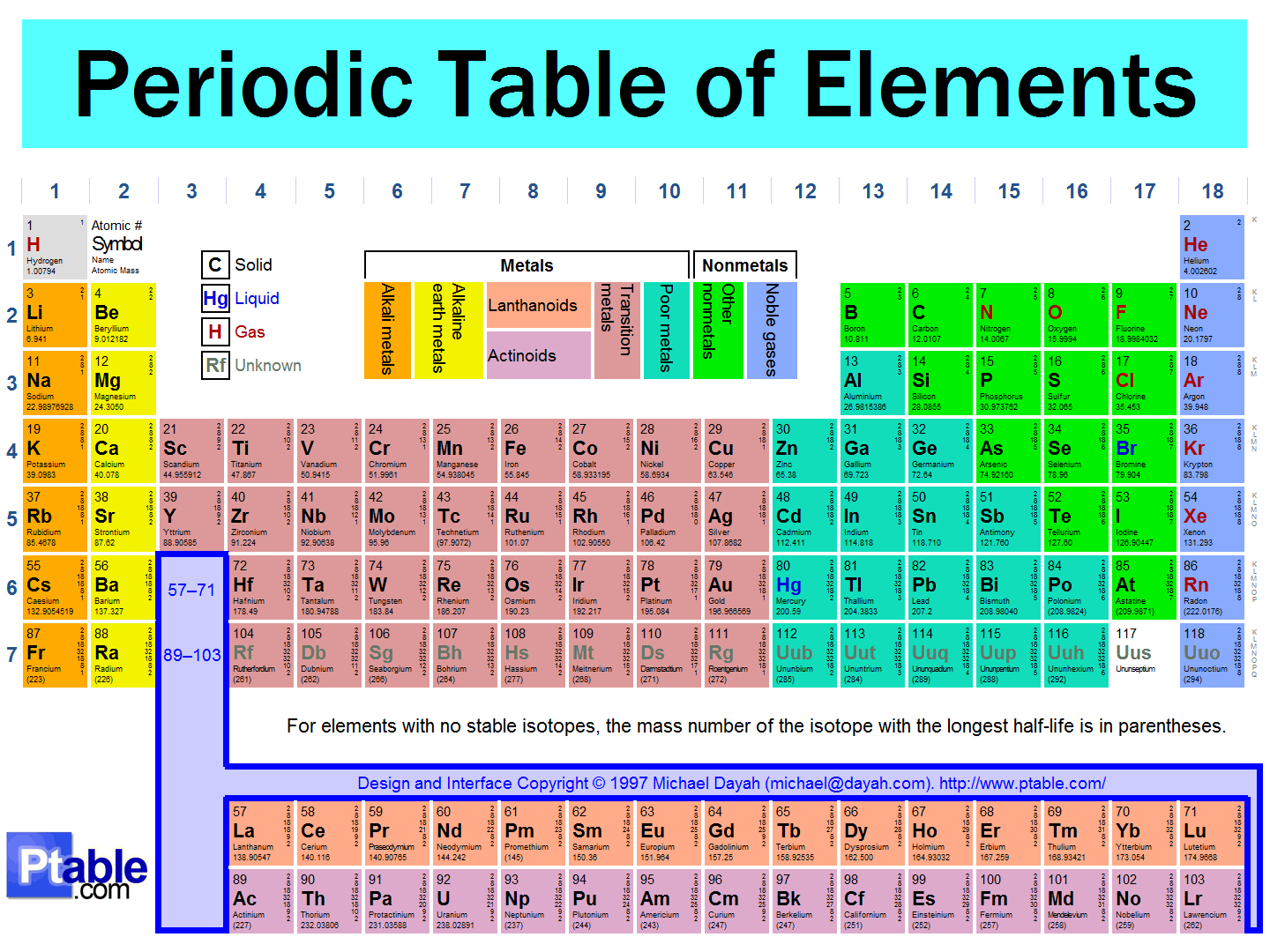
What period and group is Silver (Ag)? 
a)
Period 2, Group 1
b)
Period 3, Group 16
c)
Period 5, Group 11
d)
Period 2, 14
24.
The elements in this group have 5 valence electrons and include elements N, P, and As.
a)
Group 5
b)
Group 1
c)
Group 18
d)
Group 15
25.
The elements in this group only have 1 valence electron and include Li, Na, and K. 
a)
Group 11
b)
Group 1
c)
Group 3
26.
How many electrons do atoms need to be stable?
a)
1
b)
2
c)
6
d)
8
27.
Ionic Bonding involves...
a)
The transfer of protons
b)
The transfer of nuetrons 
c)
The transfer of electrons
d)
None Of the above
28.
What do atoms that form positive ions tend to do?
a)
Tend to lose electrons 
b)
Tend to lose protons
c)
Tend to gain electrons
d)
Tend to gain protons
29.
What usually forms the positive ion?
a)
Metal
b)
Non Metals
c)
None
30.
What usually forms the negative ion?
a)
nonmetals
b)
metal
c)
none
31.
Covalent compounds
a)
Share electrons
b)
transfer electrons
c)
contain a sea of electrons
d)
conduct electricity
32.
Is Hydrogen considered a metal or a non-metal?
a)
Metal
b)
Non-metal
33.
What is the tiniest particle in the entire universe?
a)
cells
b)
gases
c)
atoms
d)
liquids
34.
Which part of an atom is POSITIVELY charged?
a)
protons
b)
neutrons
c)
electrons
d)
atoms
35.
What is the name of a single type of atom?
a)
cell
b)
proton
c)
element
d)
atom
36.

Group 18 are the noble gases.

a)

true

b)

false, halogens

37.

The noble gases are stable and do not like to bond.

a)

true

b)

false, they bond with all atoms

38.

Alkali metals have __ valence electrons

a)

1

b)

2

c)

3

d)

4

39.

Groups 3-12 are the

a)

akali metals

b)

alkaline earth metals

c)

transition metals

40.
Which of the following will have the highest melting point?
a)
compounds with metallic bonds
b)
compounds with ionic bonds
c)
compounds with covalent bonds
d)
covalent molecules
41.
Condensation occurs when —
a)
a solid gains energy to become a liquid
b)
a liquid gains energy to become a gas
c)
a gas loses energy to become a liquid
d)
a gas loses energy to become a solid
42.
As liquid carbon dioxide freezes, its molecules —
a)
absorb heat energy and move farther apart
b)
release heat energy and move closer together
c)

absorb heat energy and move closer together
d)

release heat energy and move farther apart
43.

Which one of the following is a true statement?
a)
Liquids do not change shape easily.
b)
Gas molecules move more slowly as they are heated.
c)
Gas molecules move around freely
d)
Solids change shape easily.
44.
Substance A is a liquid, Substance B is a gas, and Substance C is a solid.  All of the substances are at the same temperature and pressure.  Which of the following shows the correct relationship between the strength of the forces of attraction between the particles in each substance?
a)
A > B > C
b)
C > A > B
c)
B > A > C
d)
C > B > A
45.

What is the volume of a 100 gram block with a density of 2 g/cm 3?

46.

Water is a _________ molecule due to _________ sharing of electrons

a)

neutral ; equal

b)

neutral ; unequal

c)

polar ; equal

d)

polar ; unequal

47.

The combustion of diesel in an engine is a ​ (a)   change. The absorption of water by a sponge is a ​ (b)   change.

Choose from the below words
physical
chemical
48.

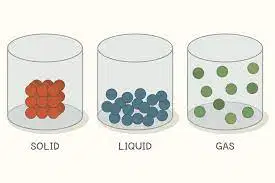
The state of matter with indefinite volume and indefinite shape

a)

solid

b)

liquid

c)

gas

49.

State of matter with definite volume and indefinite shape

a)

solid

b)

liquid

c)

gas

50.

Molecules in a gas move more quickly because gases have ...

a)

less thermal energy

b)

more thermal energy

c)

less space

d)

more space

51.

Match the following

a)

lithium

1.

2 energy levels

b)

helium

2.

1 energy level

c)

aluminum

3.

3 energy levels

d)

bromine

4.

4 energy levels

e)

strontium

5.

5 energy levels

52.

which 2 elements have the same properties like families

a)

Ne

b)

He

c)

Fe

d)

Mg

53.

The element symbol for iron includes the number 55.845. What is this number called?

a)

atomic number

b)

atomic mass

c)

atomic configuration

d)

atomic element

54.

Why are the elements in Group 8A (18) called Noble gases?

a)

They were discovered by the royal family.

b)

They are more valuable than other gases.

c)

They rarely take part in a reaction.

d)

They are highly reactive.

55.

Which group does Bromine belong to?

a)

Alkali Metals

b)

Alkaline-Earth Metals

c)

Halogens

d)

Noble Gases

e)

Transition Metals

56.

Which group does calcium belong to?

a)

Alkali Metals

b)

Alkaline-Earth Metals

c)

Halogens

d)

Noble Gases

e)

Transition Metals

57.
Which elements have the most similar chemical properties?
a)
K and Na
b)
K and Ca
c)
K and Cl
d)
K and S
58.

Which element is a halogen?

a)

Helium

b)

Chlorine

c)

Oxygen

d)

nitrogen

59.
How many Valance electrons does Iodine Have?
a)
6
b)
16
c)
7
d)
17
60.
How many energy shells does Barium (Ba) have?
a)
1
b)
2
c)
5
d)
6
61.
How many neutrons are in an atom of zinc if its atomic number is 30 and its mass number is 65?
a)
25
b)
30
c)
35
d)
65
62.

USE THE PERIODIC TABLE

How many valence electrons does Phosphorus have?

a)

31

b)

5

c)

15

d)

4

63.

The properties of Carbon are expected to be similar to those of ...

a)

phosphorus

b)

silicon

c)

boron

d)

aluminum

64.

Why did Mendeleev leave spaces in the table he developed?

a)

he knew more elements would be discovered

b)

he did not know what belonged in those spaces

c)

he wanted the table to look well-designed

d)

he didn't know the names of all the elements

65.

What group of nonmetals is the MOST reactive?

a)

Noble Gases

b)

Nitrogen Group

c)

Halogens

d)

Lanthanides

66.

What family is yellow in the picture?

a)

Boron Group

b)

Carbon Group

c)

Transition Metals

d)

Noble Gases

67.

How many electrons can go in the first energy level?

a)

2

b)

8

c)

18

d)

32

68.

How many electrons can go in the Second energy level?

a)

2

b)

8

c)

18

d)

32

69.

What is a Lewis Dot Structure?

a)

It shows all of the particles in the atom.

b)

Contains protons and neutrons

c)

Only shows the element symbol and it's outer most electron shell

d)

Contains protons and electrons

70.

What is the atom called when there is adding or removing electrons creates atoms with (+) or (-) charges?

a)

isotopes

b)

ions

c)

neutral

d)

stable

71.

What is an isotope?

a)

changing the number of neutrons; same atom with different weights.

b)

adding or removing electrons creates atoms with (+) or (-) charges

c)

par;cle inside nucleus, does not have a charge

d)

resists changing, stays the same

72.

What element is this?

a)

Nitrogen

b)

Chlorine

c)

Argon

d)

Phosphorous

73.

Which Bohr model represents Be?

a)
b)
c)
d)
74.

Is this a correct dot diagram for fluorine (F)

a)

Yes

b)

No

75.
How many electrons should Nitrogen have around its Lewis dot model?
a)
1
b)
3
c)
4
d)
5
76.

What is the mass number of this atom of Chlorine?

a)

17

b)

18

c)

35

d)

35.453

77.

This could be the dot diagram of

a)

Mg

b)

Cl

c)

C

d)

O

78.

This is a correct dot diagram for neon (Ne)

a)

true

b)

false

79.
This could be the dot diagram of
a)
P
b)
Ar
c)
Na
d)
B
80.
Most elements will gain or lose electrons so that they end up with _______ valence electrons.
a)
2
b)
6
c)
8
d)
10
81.
This could be the dot diagram of 
a)
Ne
b)
Si
c)
Al
d)
Be
82.

Why is salad not a solution?

a)

because it's an element

b)

because it's a compound

c)

because it's a heterogeneous mixture

d)

because it's a homogeneous mixture

83.

Why is water not a solution?

a)

because it's an element

b)

because it's a compound

c)

because it's a heterogeneous mixture

d)

because it's a homogeneous mixture

84.

Why is carbon not a solution?

a)

because it's an element

b)

because it's a compound

c)

because it's a heterogeneous mixture

d)

because it's a homogeneous mixture

85.

Which part of the solution does the dissolving?

a)

solute

b)

solution

c)

solvent

86.

Which part of the solution is dissolved?

a)

solute

b)

solution

c)

solvent

87.
How many grams of K2Cr2O7, are soluble in 100 g of water at 95 ºC?
a)
83 grams
b)
75 grams
c)
40 grams
d)
12 grams
88.
Which substance is MOST soluble at 0 ºC?
a)
KI
b)
NaNO3
c)
NaCl
d)
Ce2(SO4)3
89.
The amount of solute actually dissolved in a given amount of solvent.
a)
dilution
b)
concentration
c)
saturated solution
d)
supersaturated mixture
90.

A mixture with more solute dissolved in the solvent than is usually soluble is called:

a)

concentrated

b)

supersaturated

c)

saturated

d)

unsaturated

91.
When 20 grams of KNO3 is dissolved in 100 grams of water at 80 ºC, the solution can be correctly described as:
a)
supersaturated
b)
saturated
c)
unsaturated
92.
When 50 grams of KCl is dissolved in 100 grams of water at 50 ºC, the solution can be correctly described as:
a)
supersaturated
b)
unsaturated
c)
saturated
93.

The substance being dissolved is called the ________

a)

solvent

b)

solid

c)

solute

d)

solvate

94.
A cation is a ____ ion.
a)
negative
b)
positive
c)
neutral
d)
ficticious
95.

Nitrogen, N, will form which of the following ions?

a)

N

b)

N-3

c)

N-5

d)

N+5

96.
In the compound aluminum oxide, which is the cation?
a)
Al+3
b)
Al
c)
O-2
d)
O
97.
Which of the following would produce an anion?
a)
Ca
b)
Al
c)
K
d)
F
98.
Write the formula for barium + nitrogen
a)
Ba2N3
b)
Ba3N2
c)
BaN
d)
BaN3
99.
Write the correct chemical formula for Ag  and  Br -
a)
AgBr
b)
silver bromide
c)
Ag2Br2
d)
gold bromide
100.

What will be the charge of a bromine ion?

a)

+7

b)

-7

c)

-1

d)

+1

101.

Which element below would have a 3+ charge as an ion?

a)

nitrogen (N)

b)

boron (B)

c)

silicon (Si)

d)

argon (Ar)

102.
The chemical formula of sulfur hexabromide is
a)
SBr₆
b)
S₆Br
c)
S(VI)Br
d)
S6Br
103.

What is the formula for diphosphorus pentoxide?

a)

P2O5

b)

PO5

c)

P5O2

d)

P2O6

104.
What is the correct name for NO?
a)
Mononitrogen Monoxide
b)
Nitrogen Monoxide
c)
Mononitrogen Dioxide
d)
Nitrogen Oxide
105.

Which formula is for phosphorus trichloride?

a)

KCl3

b)

PCl3

c)

K3Cl

d)

P3Cl

106.
How many electrons are shared in a double bond?
a)
2
b)
4
c)
6
d)
8
107.

What is the correct formula for when Mg and I bond?

a)

MgI

b)

Mg2I

c)

MgI2

d)

Mg2I3

108.
What is the formula for aluminum fluoride?
a)
AlF
b)
Al2F3
c)
AlF3
d)
Al3F2
109.
What do Roman Numerals represent in the name of a transition metal compound?
a)
how many atoms of the metal there are
b)
the oxidation number of the nonmetal
c)
the oxidation number of the metal
d)
the mass number
110.
The name for CrN:
a)
Chromium nitride
b)
Chromium (I) nitride
c)
Chromium (III) nitride
d)
Chromium nitride (III)
111.
The oxidation number for copper in Cu2S:
a)
+1
b)
+2
c)
-1
d)
-2
112.
What oxidation number is Roman Numeral (IV)?
a)
5
b)
4
c)
1
d)
3
113.
What is the oxidation number for Gold in the formula AuO2?
a)
+2
b)
+1
c)
+4
d)
(II)
114.
The name of Cu₃N₂ is
a)
copper (III) nitride
b)
copper (II) nitride
c)
copper nitride
d)
tricopper dinitride
115.

What is the formula for this ionic compound: Tin I Nitrate

a)

SnNO3

b)

Sn(NO3)2

c)

Sn2NO3

d)

Sn3NO3

116.

What is the formula for this ionic compound: Magnesium Fluoride

a)

MgF

b)

Mg2F

c)

Mg2F2

d)

MgF2

117.

Name this ionic compound: FeSO3

(a)  

118.

Name this ionic compound: K3N

(a)  

119.

Which of the following is the correct ionic formula for a Copper I and Oxygen compound?

a)

CuO

b)

Cu2O

c)

CuO2

d)

Cu2O2

120.

Which of the following is the correct ionic formula for a Barium and Phosphate compound?

a)

Ba(PO4)

b)

Ba3(PO4)

c)

Ba3(PO4)2

d)

Ba2(PO4)3

121.

Cross Method Review: What is the ionic formula for a compound made between Calcium and Iodine?

a)

CaI

b)

CaI2

c)

Ca2I

d)

Ca2I2