wayground logo

Free Printable Worksheets

Font size

S
M
L
XL
Worksheets

Chemistry-Atom

Total questions: 124

Worksheet time: 3hrs 36mins

Name
Class
Date
1.

what is an atom

a)

smallest part of the universe

b)

smallest part of a substance

c)

smallest part of anything

d)

smallest part of water

2.

protons

a)

negative charge, nucleus

b)

positive charge, shells

c)

positive charge , nucleus

d)

neutral charge, nucleus

3.

neutrons

a)

no charge, shells

b)

positive charge, nucleus

c)

neutral, no charge, nucleus

d)

negative charge, shells

4.

electrons

a)

no charge, nucleus

b)

positive charge, nucleus

c)

negative charge, shells

d)

negative charge, nucleus

5.

atomic number

a)

number of protons/stands for an element

b)

number of neutrons

c)

number of electrons

d)

number of protons and neutrons

6.

mass number

a)

number of protons

b)

number of electrons

c)

number of protons and electrons

d)

number of protons and neutrons

7.

atomic symbol

a)

capital letter

b)

lowercase letter

c)

2 capital letters

d)

2 lowercase leters

8.

lst shell holds

a)

2

b)

8

c)

18

d)

32

9.

2nd shell holds

a)

2

b)

8

c)

18

d)

32

10.

same number of protons, different number of neutrons

a)

atomic number

b)

mass number

c)

isotope

d)

ion

11.
The element Tellurium has the atomic mass of 127.60 and its atomic number is 52. How many neutrons are in the element Tellurium?
a)
179.60
b)
127.60
c)
52
d)
76
12.
Which particle does not contribute mass to the atom?
a)
Proton
b)
Neutron
c)
Electron
d)
Nucleus
13.
Which particle contributes the negative charge to the atom?
a)
proton
b)
electron
c)
neutron
d)
nucleus
14.
Water is an element?
a)
true
b)
false
15.
Most of the mass in an atom is made up of _____________________?
a)
protons and electrons
b)
protons and neutrons
c)
neutrons and electrons
d)
electrons and quarks
16.
What is a pure substance that cannot be broken down into any other substance by physical or chemical means. Ex: Gold, Silver, Oxygen, & Nitrogen
a)
element
b)
compound
c)
mixture
d)
salad
17.
What is matter
a)
Anything which is solid
b)
Anything that takes up space and has mass
c)
when something is wrong
18.
Gold is an example of a(n) 
a)
pure element
b)
pure compound
c)
pure mixture
19.
who developed the modern day periodic table of elements?
a)
Darwin
b)
Shultz
c)
Hooke
d)
Mendeleev
20.
On the Periodic Table each element increases by one _________
a)
electron
b)
proton
c)
neutron
d)
letter
21.
A row across the Periodic Table where each element has the same number of energy shells
a)
column
b)
family
c)
period
22.
In a family or column, the elements have similar properties because they all have the same number of
a)
protons
b)
neutrons
c)
valence electrons
d)
electrons
23.
Whether or not bonds form is due to the ?????
a)
valence electron configurations
b)
protons
c)
atomic mass
d)
chance
24.
The Law of Conservation of Matter says
a)
Matter can be created, but not destroyed
b)
matter can be destroyed, but not created
c)
matter cannot be created or destroyed
25.
When heat is added to matter, the molecules tend to 
a)
move faster and farther apart
b)
slow down
c)
nothing, heat has no impact on the state of matter
d)
freeze
26.

An elements is

a)

a substance that cannot be split into simpler substances

b)

a substance that can be split into simpler substances

27.

A molecule is

a)

a singular particle of a particular element

b)

another name for an element

c)

2 or more atoms that are combined

28.
Which of the following is described as the basic unit of matter?
a)
Element
b)
Atom
c)
Molecule
d)
Compound
29.
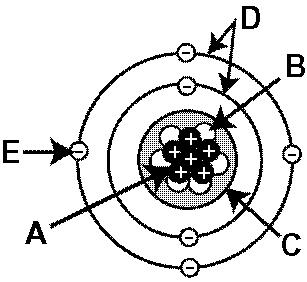
In the atom diagram shown, E is pointing to
a)
An electron
b)
a proton
c)
a neutron
d)
the nucleus
30.

In the atom diagram shown, A is pointing to the darker particles, these are known as

a)

electrons

b)

protons

c)

neutrons

d)

the nucleus

31.
B and C are found in the ______ of an atom.
a)
electron cloud
b)
Space
c)
Nucleus
d)
Outside
32.
A molecule is________
a)
two ions held together by opposite charges
b)
smaller than an atom
c)
can be physically separated into smaller atoms
d)
more than one atom bonded together by covalent bonds
33.
What charge does an electron have?
a)
Negative
b)
Positive
c)
Neutral
d)
Contrated
34.

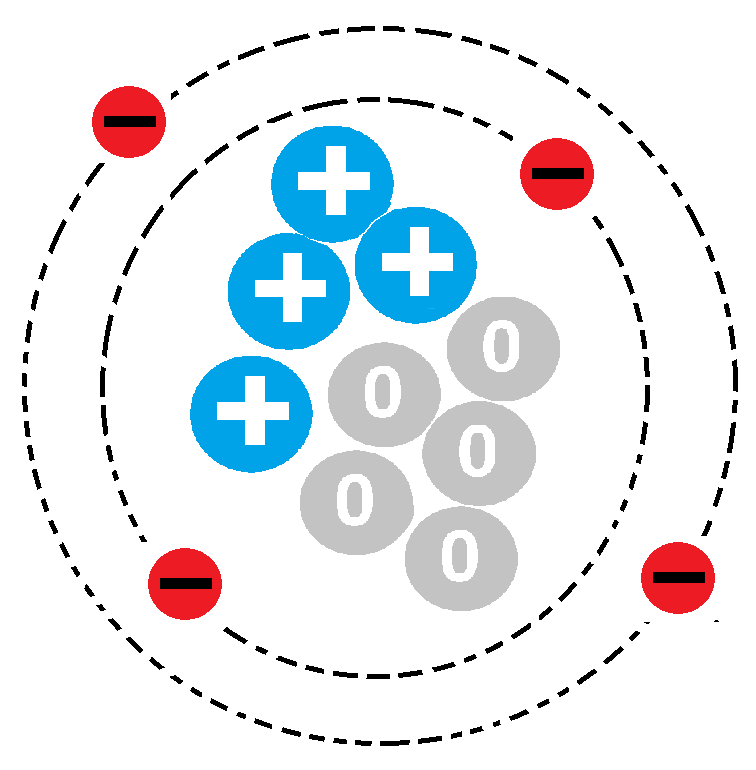
What is the atomic mass of this atom?

a)

1

b)

3

c)

4

d)

7

35.
What is the atomic number of this atom?
a)
4
b)
5
c)
9
d)
none of the above
36.
What is a valence electron?
a)
an electron that is found in the outermost orbital of an atom. 
b)
an electron found in the innermost orbital of an atom.
c)
an electron found in the middle orbital.
37.

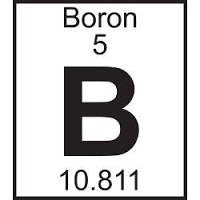
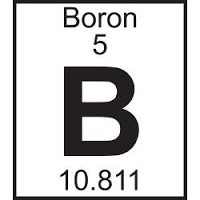
Using the information provided, determine how many electrons the a Boron atom contains.

a)

2.5

b)

5

c)

6

d)

10.81

38.
How many protons does this atom have?
a)
2.5
b)
6
c)
5
d)
10.811
39.

What do isotopes of carbon all have in common?

a)

They all have the same number of neutrons & mass number

b)

They all have the same atomic number and number of neutrons

c)

They all have the same atomic number and number of electrons

d)

They all have the same number of protons and neutrons

40.

What quantities vary between isotopes of an element?

a)

protons, electrons, and atomic mass

b)

protons, electrons, and atomic number

c)

neutrons and electrons

d)

neutrons and atomic mass

41.
The image shows the periodic grid for POTASSIUM. What is Potassium's atomic number?
a)
19
b)
39
c)
20
d)
Impossible to tell
42.
The image shows the periodic grid for POTASSIUM. What is Potassium's atomic mass?
a)
19
b)
39
c)
20
d)
Impossible to tell
43.
The image shows the periodic grid for POTASSIUM. How many PROTONS are found in a potassium atom?
a)
19
b)
39
c)
20
d)
Impossible to tell
44.
The image shows the periodic grid for POTASSIUM. How many ELECTRONS are found in a potassium atom?
a)
19
b)
39
c)
20
d)
Impossible to tell
45.
The image shows the periodic grid for POTASSIUM. How many NEUTRONS are found in a potassium atom?
a)
19
b)
39
c)
20
d)
Impossible to tell
46.
A(n) ____________________ is a pure substance made of a single type of atom and cannot be broken down.
a)
Element
b)
Compound
c)
Molecule
d)
Mixture
47.
What does the ATOMIC MASS tell us about an atom?
a)
Protons + Neutrons
b)
Protons + Electrons
c)
Neutrons + Electrons
48.
What holds atoms, molecules, and compounds together?
a)
Chemical Bonds
b)
Electromagnetism
c)
Magnetism
d)
Electricity
49.
How many protons does Carbon have?
a)
3
b)
4
c)
5
d)
6
50.
What is an element?
a)
An element is an atom and two atoms
b)
An element is one or more atoms of the same kind.
c)
An element is more than one of different kinds
51.
The smallest particle that all matter is made from is ....
a)
Matter
b)
Elastic Energy
c)
a Atom
d)
some Helium 
52.

Which particles have almost the same mass?

a)

proton and electron

b)

proton and neutron

c)

electron and neutron

d)

all three particles

53.

A certain atom has 26 protons, 26 electrons, and 30 neutrons. It mass number is ____.

a)

26

b)

30

c)

52

d)

56

54.

The three basic components of an atom are _____.

a)

protons, neutrons, and ions

b)

protons, neutrons, and electrons

c)

protons, neutrinos, and ions

d)

protium, deuterium, and tritium

55.

Based on his experiment, Rutherford concluded that atoms were ____.

a)

dense positively charged particles

b)

uniform throughout

c)

mainly empty space

d)

made of protons, neutrons, and electrons

56.

If two atoms have the same number of protons but different numbers of neutrons, they will have the same ____.

a)

half-life

b)

mass number

c)

atomic number

d)

degree of stability

57.

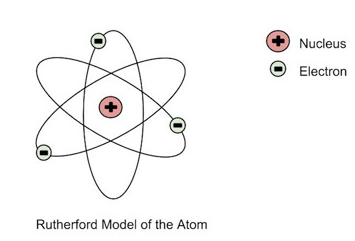
16. Which of the following statements best describes how the Bohr model of an atom is different from this one?

a)

Bohr’s model had more electrons around the nucleus.

b)

Bohr’s model shows electrons at certain distances from the nucleus.

c)

Bohr’s model placed the electrons in the nucleus.

d)

Bohr’s model did not distinguish positive and negative charges.

58.

Which scientist developed this model for atoms?

a)

Dalton

b)

Democritus

c)

Rutherford

d)

Thomson

59.

Which item best represents Thomson’s mental image of an atom?

a)

a sponge

b)

a chocolate-chip cookie

c)

a bowling ball

d)

a beach ball

60.

When Rutherford performed his metal foil experiment, he was surprised that most of the alpha particles ____.

a)

were deflected by the foil

b)

bounced back from the foil

c)

were absorbed by the foil

d)

passed straight through the foil

61.

Which of the following determined that cathode rays are negatively charged?

a)

Aristotle

b)

Dalton

c)

Rutherford

d)

Thomson

62.

How many electrons are needed in the outer energy levels of most atoms for the atom to be chemically stable?

a)

2

b)

4

c)

6

d)

8

63.

Sodium (Na) contains 11 protons and 12 neutrons. How can you use this information to determine the mass number of sodium?

a)

The mass is the number of protons

b)

The mass is the number of protons plus the number of neutrons.

c)

The mass is the number of protons minus the number of neutrons.

d)

The mass is the number of neutrons.

64.
What scientist is best known for his "Plum Pudding" model of the atom?
a)
J.J. Tomson
b)
Ernest Rutherford
c)
John Dalton
d)
Democritus
65.
J.J. Thomson provided evidence that an atom...
a)
is the smallest particle of matter
b)
contains negatively charged particles
c)
has an overall negative charge
d)
has an overall positive charge
66.
A tiny but very dense, positively charged portion of the atom that holds most of the atomic mass
a)
Electron Shells
b)
Orbitals
c)
Electron Cloud
d)
Nucleus
67.

Who is credited with the Atomic Theory?

a)

Dalton

b)

Thomson

c)

Bohr

d)

Democritus

68.
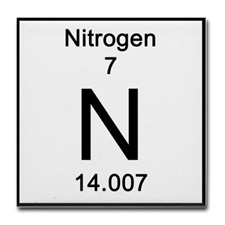
What is the number of protons that the element in this image contain?
a)
14
b)
7
c)
15
d)
18
69.

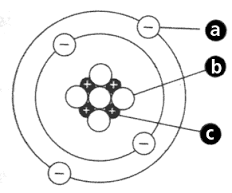
Which letter represents a proton?

a)

A

b)

B

c)

C

d)

D

70.
Which letter represents a neutron?
a)
A
b)
B
c)
C
d)
D
71.

How many neutrons does oxygen have?

a)

8

b)

7.999

c)

15.999

d)

24

72.
These particles orbit around the nucleus of an atom.  What are they called?
a)
electrons
b)
protons
c)
neutrons
d)
photons
73.
What is the atomic number of this nucleus?
a)
1
b)
3
c)
4
d)
7
74.
The first person to ever talk about an atom was
a)
Democritus
b)
Rutherford
c)
Dalton
d)
Me
75.
How did Rutherford discover the proton?
a)
Cathode tube ray experiment
b)
Gold Foil Experiment
c)
Planetary Model
d)
Plum Pudding Model
76.
Rutherford's gold foil experiment provided evidence that...
a)
negative and positive charges are spread evenly throughout the atom.
b)
alpha particles have a positive charge.
c)
gold is not a dense as previously thought.
d)
there is a dense positively charged nucleus at the center of an atom.
77.
The _____________ determines the identity of an object.
a)
# of Protons
b)
# of Electrons
c)
# of Neutrons
d)
Atomic Mass
78.
J.J. Thomson provided evidence that an atom...
a)
is the smallest particle of matter
b)
contains negatively charged particles
c)
has an overall negative charge
d)
has an overall positive charge
79.
Which scientist realized atoms are mostly empty space?
a)
Dalton
b)
Thomson
c)
Rutherford
d)
Bohr
80.

This diagram is an example of a Bohr Model.

a)

True

b)

False

81.

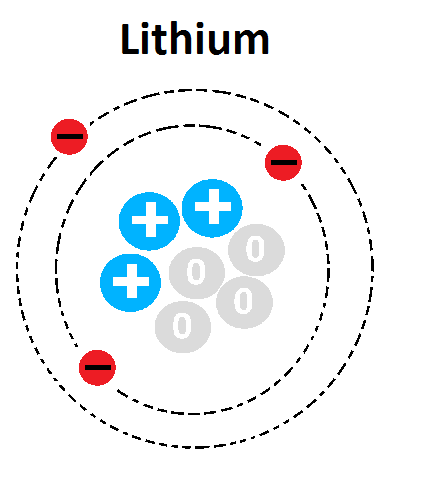
What is the atomic number of Lithium?

a)

3

b)

6.941

c)

7

d)

2

82.

How many neutrons in an atom of Lithium?

a)

3

b)

7

c)

4

d)

0

83.

What would you call an atom of Lithium with 4 electrons?

a)

An isotope

b)

An ion

c)

An atom with a positive charge

d)

Lithium cannot have 4 electrons

84.
Dalton's atomic theory helped to explain the law of conservation of mass because it stated that atoms
a)
could not combine
b)
could not be created or destroyed 
c)
all have the same mass
d)
were invisible
85.
Carbon-12 and Carbon-11 are
a)
isotopes 
b)
different elements
c)
compounds 
d)
neutrons
86.
Atoms of the same element that have different masses are called
a)
moles
b)
isotopes
c)
nuclides
d)
neutrons
87.
A boron isotope consists of  5 protons, 5 electrons and 7 neutrons. Its mass number is
a)
10
b)
11
c)
12
d)
2
88.
What is the atomic number for oxygen?
a)
8
b)
16
c)
6
d)
10
89.
A neutral atom of fluorine contains
a)
9 electrons
b)
18.9984 electrons
c)
10 electrons
d)
19.00 electrons
90.
An atom of calcium has 20 protons and 20 neutrons. What is its mass number?
a)
20
b)
40
c)
60 
d)
80
91.
A neutral nitrogen atom (atomic number 7) has
a)
7 electrons, 7 neutrons
b)
7 neutrons
c)
7 protons, 7 electrons
d)
7 protons, 6 neutrons
92.
What is the number of protons that the element in this image contain?
a)
14
b)
7
c)
15
d)
18
93.
How many protons are in an atom with an atomic number of 20, an atomic mass of 45, and a charge of +2?
a)
20
b)
10
c)
2
d)
18
94.
How many neutrons are in an atom with an atomic number of 20, an atomic mass of 45, and a charge of +2?
a)
20
b)
25
c)
2
d)
18
95.
How many electrons are in an atom that has an atomic number of 34, an atomic mass of 74 and a charge of -2?
a)
34
b)
36
c)
2
d)
40
96.
How many electrons are in an atom that has an atomic number of 34, an atomic mass of 74 and a charge of -2?
a)
34
b)
36
c)
2
d)
40
97.
Which color of visible light has the shortest wavelength (most energy)?
a)
yellow
b)
green
c)
violet
d)
red
98.
Which color of visible light has the longest wavelength (less energy)?
a)
red
b)
yellow
c)
green
d)
blue
99.
______________ is the energy that can travel through space in the form of waves. 
a)
telescopes
b)
electromagnetic spectrum
c)
observatory
100.
Which of the following type of electromagnetic radiation has the most energy
a)
infrared
b)
ultraviolet
c)
microwaves
d)
radiowaves
101.
Put the visible light colors in order from longest wavelength to shortest wavelength
a)
Violet, Indigo, Blue, Green, Orange, Yellow, Red
b)
Red, Yellow, Green, Orange, Violet, Blue, Indigo
c)
Red, Orange, Yellow, Green, Blue, Indigo, Violet
102.
What is the light that you can see called?
a)
observatory
b)
wavelength
c)
visible light
103.
Which has the SHORTEST wavelength and, therefore, the highest frequency/most energy
a)
Radio waves
b)
Ultraviolet Rays
c)
Gamma Rays
d)
X-rays
104.
The _______________ determines the color of visible light. 
a)
wavelength
b)
speed
c)
amplitude
d)
light
105.
Which model of the atom said that electrons circle the nucleus in orbits of a fixed radius?
a)
Bohr model
b)
Quantum mechanical model
c)
Not true of either model
d)
Both Bohr and Quantum mechanical model
106.
Emission of light from an atom occurs when an electron
a)
drops from a higher to a lower energy level.
b)
   jumps from a lower to a higher energy level.   
c)
   moves within its atomic orbital.
d)
falls into the nucleus.
107.
Which drawing represents the process by which an emission line is formed?
a)
A
b)
B
c)
C
d)
D
108.
The ground state is the highest energy state of an atom.
a)
True
b)
False
109.
For an electron to change from ground state to an excited stated it must...
a)
Absorb energy
b)
Release energy
110.
When talking about energy levels in an atom, what is an "excited state"?
a)
The highest energy state of an atom.
b)
Any level higher than the ground state.
c)
The lowest energy state of an atom.
d)
When an atom loses an electron
111.
Why are line emission spectra of elements called "atomic fingerprints"?
a)
They are all the same
b)
They are all unique
c)
They are all similar
d)
They all contain colored light
112.

According to the Bohr model of the atom, the single electron of a hydrogen atom circles the nucleus

a)

in specific, allowed orbits

b)

in one fixed orbit at all times

c)

at any of an infinite number of distances, depending on its energy

d)

counterclockwise

113.

A line spectrum is produced when an electron moves from one energy level

a)

into the nucleus

b)

to a higher energy level

c)

to another position in the same sublevel

d)

to a lower energy level

114.

If an electron moves from n=4 to n=2 it ____

a)

absorbs energy

b)

releases energy

115.

Based on the picture, choose the best description of how wavelength and frequency are related

a)

As wavelength increases, frequency increases

b)

As frequency increases, wavelength decreases

c)

As frequency increases, wavelength remains the same

d)

Frequency and wavelength mean the same thing

116.

Which type of spectrum is this?

a)

Emission Spectrum

b)

Absorption Spectrum

c)

Continuous Spectrum

117.

Which type of spectrum is this?

a)

Emission Spectrum

b)

Absorption Spectrum

c)

Continuous Spectrum

118.

Which type of spectrum is this?

a)

Emission Spectrum

b)

Absorption Spectrum

c)

Continuous Spectrum

119.

Kirchhoff's First Law states: A luminous solid, liquid or dense gas will emit light of all wavelengths, thus producing a continuous spectrum. What spectrum would we get from this?

a)

Emission Spectrum

b)

Absorption Spectrum

c)

Continuous Spectrum

120.

Kirchhoff's Second Law states: A Low-Density, hot-gas emits light whose spectrum consists of a series of bright emission lines. These lines are characteristic of the gas. Which Spectrum would this apply too?

a)

Emission Spectrum

b)

Absorption Spectrum

c)

Continuous Spectrum

121.

Kirchhoff's Third Law states: A cool, thin gas absorbs certain wavelengths of white light leaving dark absorption lines in their place. These lines are characteristic of the composition of the gas. Which Spectrum would this apply too?

a)

Emission Spectrum

b)

Absorption Spectrum

c)

Continuous Spectrum

122.
In a flame test the ______________
are excited
a)
protons
b)
neutrons
c)
electrons
d)
bonds
123.
Which of the following type of electromagnetic  radiation has the longest wavelength
a)
infrared
b)
ultraviolet
c)
microwaves
d)
radiowaves
124.
Which of the following type of electromagnetic radiation has the most energy
a)
infrared
b)
ultraviolet
c)
microwaves
d)
radiowaves