
 Worksheets
Reynolds Semester 1 Physics Final Review
Total questions: 107
Worksheet time: 2hrs 28mins
Scalar quantities are quantities that have magnitude and direction, for example: speed


An airplane accelerates down a runway at 3.1 m/s/s
for 8 s until it finally lifts off the ground.
Determine the velocity at take-off.
64 m/
2.5 m/s
0 m/s
24.8 m/s

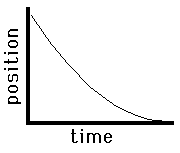
You toss a ball straight upward, in the positive direction. The ball falls freely under the influence of gravity.
At the highest point in the ball’s motion,
its velocity is zero and its acceleration is zero.
its velocity is zero and its acceleration is positive (upward).
its velocity is zero and its acceleration is negative (downward).
its velocity is positive (upward) and its acceleration is zero.
its velocity is positive (upward) and its acceleration is zero.
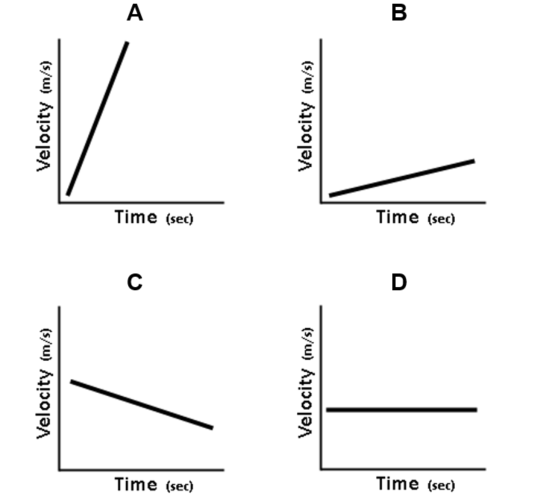
A car is traveling at 20.0 m/s. It slows to a stop at a constant rate over 5.00 s. How far does the car travel during those 5.00 seconds before it stops?
50 m
4 m
100 m
A ball is thrown downward from the top of a roof with a speed of 25 m/s. After 2 s, its velocity will be:
(Upward is positive)
19.6 m/s
-5.4 m/s
-45.0 m/s
45.0 m/s
Which of the following is an example of a velocity?
35 meters East
22 m/s
40 mph West
12 m/s2
A hacky sack is thrown up into the air with an initial velocity 2 m/s. What maximum height does the hacky sack reach?
0.15 m
0.46 m
0.20 m
1.8 m

What is the acceleration of the object at t=5 seconds?
0 m/s2
4 m/s2
0.8 m/s2
1.25 m/s2
A bowling ball is dropped. As it falls, the acceleration of the bowling ball
decreases
increases
remains the same

The Coffee cup in the picture is resting on a table. What force(s) are missing from the free body diagram?
No forces are missing
The normal force from the table pushing the cup up.
The normal force form the table pushing the cup down.
The friction force from the table pushing the cup left and right.

The coffee cup in the picture is at rest on the table. What is true about the Normal force?
The normal force is exactly 15
The normal force is less than 15
The normal force is more than 15
The normal force is -10

The hockey puck is moving at a constant velocity across the ice. What forces does the puck experience at this moment?
None
Gravity
Gravity and Normal
Gravity, Normal, and Friction
Gravity, Normal, Friction, and Applied
The hockey puck is moving at a velocity of 20 m/s. If the forces on the puck are in equilibrium, what will the puck's velocity be 2 seconds later?
0 m/s
1 m/s
2 m/s
10 m/s
20 m/s

Which equation would accurately describe the forces on this cup of coffee?
Fn − Fg = 0
Fn×Fg = 0
Fn−10Fg
Fn−Fg = −10

The forces on this chandelier are...
Gravity
Gravity and Normal
Gravity and Tension
Gravity, Tension, Friction, and Applied

A chandelier is hanging from the ceiling. If the force of gravity on the chandelier is 120 N, the force of tension must be ...
0 N
12 N
60 N
120 N

A squirrel sits on the ground and eats a donut. We know the forces on him must be balanced because...
Forces are always balanced
the squirrel is not accelerating
squirrels are projectiles
he's eating a donut

A squirrel sits on the ground and eats a donut. If the ground pushes up on the squirrel with a force of 11 N, The squirrel and donut together weigh ...
less than 11 N
Exactly 11 N
More than 11 N

The car in the picture is moving at a constant velocity. What forces does the car experience? (Ignore air resistance)
Gravity
Gravity and Normal
Gravity, Normal, and Friction
Gravity, Normal, Friction, and Applied

The Car in the picture is moving to the right at a constant velocity. Any friction present would be pushing the car to the ...
Up
Right
Down
Left
Two books rest on the same table. Book A weighs 20 N. Book B has a mass of 3 kg. Which one has a greater force of gravity on it? (HINT: F=m*a)
The same
Book A
Book B

A man pushes a box across the floor at a constant velocity. There is a force on the box pulling it toward the center of the earth. This is called the
force of gravity
normal force
friction force
applied force
A man pushes a box across the floor at a constant velocity. There is a force on the box from the floor pushing the box up. This is the ...
force of gravity
normal force
force of friction
applied force
A man pushes a box across the floor at a constant velocity. There is a force on the box resisting its motion. This is the ...
force of gravity
normal force
force of friction
applied force
A man pushes a box across the floor at a constant velocity. There is a force from the man pushing on the box. This is the ...
force of gravity
normal force
force of friction
applied force
A man pushes a box across the floor at a constant velocity. If another box were put on top of this box, what would happen to the force of friction?
It would increase
It would decrease
It would remain unchanged
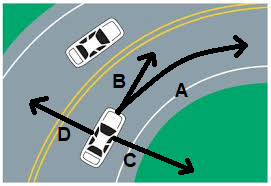
A car is rounding a bend as shown in the diagram. Which arrow correctly shows the direction of the cars velocity?
A
B
C
D
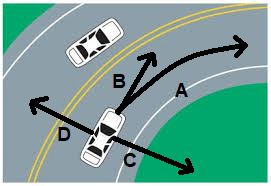
A car is rounding a curve as shown in the diagram. Which arrow correctly shows the direction of the centripetal force keeping the car in circular motion?
A
B
C
D
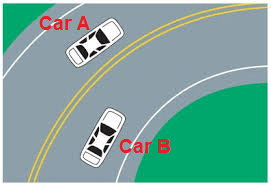
If car A and car B are both traveling at the same speed, which will require a higher centripetal force?
Car A
Car B
They have the same centripetal force


Where is the net force when the rollercoaster is at the top of the loop?
Towards the Right
Towards the Left
Towards the Ground
Towards the Sky

A record spins at 60 rpm (revolutions per minute), which is an angular velocity of about 3 meters per second. What is the approximate linear velocity of a fly that sits on the record, 10 cm from the center? Use 3 for Pi.
3 m/s
0.3 m/s
0.6 m/s
1 m/s
An object moves in a circular path at a constant
speed. Compare the direction of the object's velocity
and acceleration vectors.
Both vectors point in the same direction.
The vectors point in opposite directions.
The vectors are perpendicular.
The question is meaningless, since the
acceleration is zero.
When an object experiences uniform circular
motion, the direction of the net force is:
in the same direction as the motion of the object.
in the opposite direction of the motion of the
object.
is directed toward the center of the circular path.
is directed away from the center of the circular
path.
Is it possible for an object moving with a constant
speed to accelerate? Explain.
No, if the speed is constant then the
acceleration is equal to zero.
No, an object can accelerate only if there is a
net force acting on it.
Yes, although the speed is constant, the
direction of the velocity can be changing.
Yes, if an object is moving it is experiencing
acceleration

At the position shown in the diagram, which arrow indicates the direction the instantaneous (tangential) velocity of the cart?
A
B
C
D

A pilot experiences centripetal acceleration of 20 N of force while maneuvering a loop at a speed of 10 m/s. What is the radius of the loop? The pilot has a mass of 80 kg.
80 m
400 m
100 m
200 m
Potential energy depends on the ________ and ________ of the object.
Height (position)
Mass
Speed
Friction
What is the mass of a bicycle that traveling at a velocity of 10 m/sec if the kinetic energy is 1000 J?
50 kg
10 kg
20 kg
2 kg
Which is the correct unit for expressing gravitational potential energy?
Joule
Newton
m/s2
meter
Which of the following is the correct equation for calculating an object's gravitational potential energy?
PE = mgh
PE = mg / h
PE = mg + h
PE = gh
A 50.0 kg wolf has a kinetic energy of 2500 J. What is the velocity of the wolf?
50 m/s
5 m/s
10 m/s
250 m/s
Calculate the potential energy of a rock with a mass of 50 kg while sitting on a hill that is 3 m high. Assume gravity is 10 m/s^2.
1500 J
150 J
500J
30 J
What is the energy due to motion?
Kinetic Energy
Potential Energy
What is the energy due to Position?
Kinetic Energy
Potential Energy
What is the standard unit you measure Energy in?
grams
meters
meters/second2
Joules
The equation ____ Energy = mass x gravity x height is used to find which type of energy?
Kinetic Energy
Potential Energy
The equation _____ Energy = 1⁄2 mass x velocity2 is used to find which type of energy?
Kinetic Energy
Potential Energy
energy is the energy an object has because of its motion.
Kinetic
Potenial
Chemical
Magnetic
energy is stored energy due to position.
Kinetic
Potential
Chemical
Magnetic
Energy stored in chemical bonds is called .
elastic potential energy
chemical potential energy
kinetic energy
none of these
Which of the following is not used to calculate potential energy?
mass
gravitational acceleration
height
velocity
Work and energy are both measured in .
joules
N
ºC
j/kg
The kinetic energy of an object increases as its increases.
height above Earth
speed
potential energy
volume
Force applied through a distance
Work
Efficiency
Joule
Mechanical Advantage
The variable that responds to the changes in the other variable is the ___ variable.
Independent
Dependent
Constant
Control
The variable that the experimenter (or you) control is the ___ variable.
Independent
Dependent
Constant
Control
Which variable always goes on the y-axis (vertical)?
Independent
Dependent
Constant
Control
Which variable always goes on the x-axis (horizontal)?
Independent
Dependent
Constant
Control

What is the independent variable on this graph?
Year
Number of Visitors
Visitors to a Park
none of these
What is the dependent variable on this graph?
Year
Number of Visitors
none of these


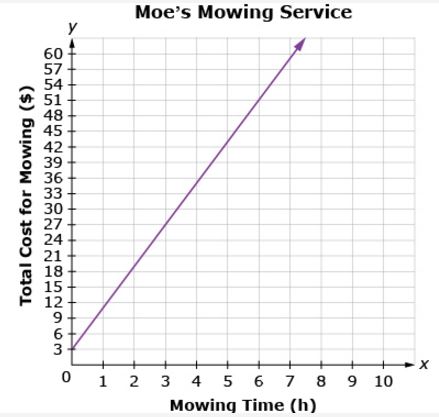

Which month had the biggest difference between the high and low temperatures?
January
April
October
November
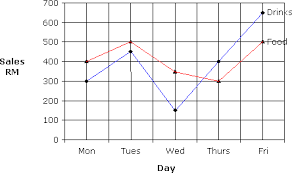


What is the independent variable for this graph?
The Relationship between Time Spent Studying and Test Grades
The effect of Time Spent Studying and Test Grades
Time Spent Studying
Test Grades
Which variable always goes on the y-axis (vertical)?
Independent
Dependent
Constant
Control
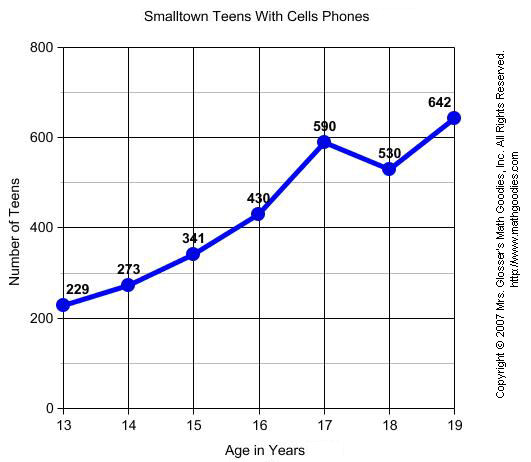
What label is along the y-axis in this graph?
Copyright 2007
Lines
Age in Years
Number of Teens
As mass decreases, gravitational force does what?
Increases
Changes
Decreases
Remains the same
Two factors effecting the magnitude of the force of gravity between 2 objects are...
mass and distance
mass and matter
distance and weight
weight and mass
If I double the distance between two objects, what happens to their gravitational Force?
4x bigger
2x bigger
4x smaller
2x smaller
What happens to Gravitational force if I double both of the masses but don't change their distance?
doubles
4x bigger
half as big
4x smaller
What is the gravitational force between a 140 kg tree and a 798 kg Lotus Elise Sprint that are 15 m away?
6.6*10-7 N
4.8*104 N
3.3*10-8 N
7.4*1012 N
Calculate the Force of an object (mass= 5kg) moved around a circle with a radius of 1.65 m and an velocity of 3.5 m/s.
28.9 N
2.4 N
37.1 N
10.6 N
Bruno the bat flies at a speed of 0.5 m/s in circle of radius 1 m. What is his acceleration?
0.25 ms-2
1 ms-2
0.5 ms-2
2 ms-2
What's the centripetal acceleration of an object traveling 2.3 m/s around a circle of diameter 0.6 m?
5 m/s2
10 m/s2
17.63 m/s2
8.81 m/s2
A bucket of water is swung over the teacher’s head in a circle with a radius of 2.2m with a centripetal acceleration of 2.0 m/s2. Calculate the tangential velocity of the bucket.
1.81 m/s
2.09 m/s
4.4 m/s
.91 m/s
A dad accidentally swings his daughter around in a circle on a swingset. The swing has a length of 5m and she moves at 12 m/s2. At any point, what is her tangential velocity?
7.7 m/s
2.4 m/s
60 m/s
12 m/s
On a roller coaster, where is maximum kinetic energy?
When going around a corner
At the top of a big hill
At the bottom of a big hill
When going upside down
Energy of motion is which type of energy?
Potential
Kinetic
Gravitational
Sound
Some students observing a classroom device being used, noticed the below energy transformations.
Electrical → Mechanical → Sound
A working flashlight used to light up a dark corner.
A projector displaying a diagram on the screen.
A pencil sharpener plugged into a wall outlet.
A triple beam balance measuring an object’s mass.
Energy is stored in the ___ of an atom.
proton
electron cloud
neutron
nucleus

