Font size
 Worksheets
Reproduction, coordination & response IG2
Total questions: 100
Worksheet time: 50mins
What are the primary reproductive organs in the male human reproductive system?
testes
stomach
liver
kidneys
What is the function of the fallopian tubes in the female human reproductive system?
Filtering waste from the egg
Producing hormones for egg development
Transporting the egg and providing the site for fertilization
Secreting enzymes to break down the egg
What is the average length of the menstrual cycle in females?
28 days
35 days
20 days
14 days
What hormone is responsible for triggering ovulation in the menstrual cycle?
Luteinizing hormone (LH)
Estrogen
Progesterone
Thyroid-stimulating hormone (TSH)
What is the process of reproduction in which offspring arise from a single organism and inherit the genes of that parent only?
Asexual reproduction
Budding
Mitosis
Sexual reproduction
What is the term for the transfer of pollen from the male reproductive organ to the female reproductive organ in plants?
photosynthesis
pollination
germination
fertilization
What is the term for the period of time during which a fetus develops inside a woman's uterus?
gestation
maturation
fertilization
incubation
What is the term for the release of an egg from the ovary?
ovulation
implantation
menstruation
fertilization
What is the name of the hormone that is produced by the placenta and helps maintain pregnancy?
estrogen
progesterone
insulin
testosterone
What is the term for the process of the release of a mature ovum from the ovary?
Ovulation
Fertilization
Implantation
Menstruation
Which hormone is responsible for the development and maintenance of female secondary sexual characteristics?
Estrogen
Progesterone
Luteinizing hormone (LH)
Follicle-stimulating hormone (FSH)
What is the term for the process of the fusion of a sperm with an ovum?
Fertilization
Ovulation
Implantation
Menstruation
What is the process by which pollen is transferred from the anther to the stigma of a flower?
Germination
Fertilization
Pollination
Photosynthesis
What is the term for the male reproductive part of a flower that produces pollen?
Pistil
Stamen
Style
Ovary
Which of the following shows the female reproductive parts of a flower?
anther, filament, ovary, ovule
stigma, filament, ovary, ovule
stigma, style, ovary, ovule
anther, filament, ovary, ovule
Which of the following about pollination is true?
Cross-pollination occurs between flowers of same plant.
Cross-pollination occurs between flowers of different plants that is of the same species.
Self-pollination occurs between flowers of different plants.
Cross-pollination occurs between flowers of different plants that is of different species.

The diagram shows a wind-pollinated flower. Which of the following characteristics must this flower have?
(Select all correct answers.)
Flower is scented.
Petals are dull in colour.
Anthers hang out of the flower.
Stigma is large and feathery.

The diagram shows an animal-pollinated flower. Which of the following characteristics must this flower have?
Stigma is sticky.
Flower has no scent.
Petals are large and colourful.
Produces sweet nectar.
The male parts of the flowers are the filament and __________.
stigma
anther
petal
ovary

A
B
C
D

A
B
C
D

A
B
C
D

A
B
C
D

A
B
C
D
Which is not a type of asexual reproduction?
budding
fission
fertilization
regeneration
The sloughing of the endometrium, resulting in flow of menstrual fluid
menstruation
menstrual cycle
ovulation
implantation
The phase that lasts from day 5 to 13 is
luteal
menstrual
follicular phase
ovulatory
Which phase of the menstrual cycle is characterized by the shedding of the uterine lining?
Follicular phase
Ovulation phase
Luteal phase
Menstrual phase
What change happen for boys and girls in puberty?
mood swings
crush on boys/girls
(begin to like boys or girls)
acne and body odor
All are true
What changes happen for GIRLS ONLY?
breasts develop
hips widen
ovulation begins
ALL are true
Which hormone is responsible to inhibiting FSH?
Adrenaline
LH
Progesterone
Oestrogen
Which hormone(s) are released from the pituitary gland?
FSH
LH
Oestrogen
Progesterone
Which hormone is released from the Corpus Luteum (yellow body)?
FHS
LH
Progesterone
Oestrogen
How do the hormones FSH and LH get to the ovaries?
Active transport
Synaptic communication
Nervous communication
Travel in the blood
What is the role of FSH?
Maintain lining of uterus
Build up lining of uterus
Ovulation
Mature egg cells
What is the role of Progesterone?
Maintain lining of uterus
Build up lining of uterus
Ovulation
Mature egg cells
Which of the following is not a secondary sexual characteristic in females?
Facial hair
Pubic hair
Armpit hair
Growth
What is the function of the human female reproductive system?
Produce ovum (egg cell)
Produce ovum, protect offspring before and after birth
Produce ovum, protect and nourish offspring before and after birth
Produce ovum, nourish offspring before and after birth
How many months does it typically take for a fetus to fully develop?
9 months
7 months
10 months
one year
The beginning of menstrual cycle
menarch
menopause
menstruation
menstrual cycle

What is implantation?
The process by which the fetus is delivered from the uterus
The formation of the placenta
The attachment of the fertilised egg to the uterine wall
The formation of the amniotic sac

What is the amniotic sac?
The fluid-filled sac that surrounds the fetus
The organ that connects the fetus to the mother's blood supply
The structure that forms around the fertilised egg
The structure that nourishes the egg before implantation

Where does the following occut?
A) Meiosis?
B) Fertilization?
C) Growth & Development of Baby?
A) 5
B) 4
C) 3
A) 4
B) 5
C) 3
A) 3
B) 4
C) 5
A) 3
B) 5
C) 4
When the menstrual cycle permanently stops, it is known as
Puberty
Menopause
Gestation
Menstruation
Which type of cells do all sense organs contain?
ciliated
effector
mesophyll
receptor
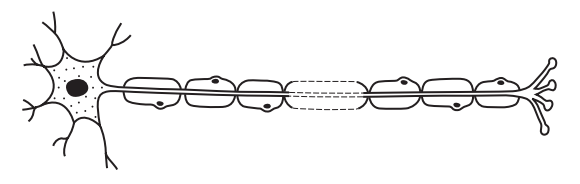
The diagram shows a cell.
What type of cell is shown?
ciliated cell
motor neurone
relay neurone
sensory neurone
When a bright light is shone into the eye, the diameter of the pupil decreases.
What is this an example of?
accommodation
a simple reflex
photosynthesis
voluntary response

The diagram shows a neurone carrying an impulse.
Which row describes the type of neurone and the direction of impulse?
Which choice describes the type of neurone and the direction of impulse?
type of neurone = motor; direction of impulse = towards the spinal cord
type of neurone = motor; direction of impulse = away from the spinal cord
type of neurone = sensory; direction of impulse = towards the spinal cord
type of neurone = sensory; direction of impulse = away from the spinal cord

The diagram shows some of the muscles and bones of the human arm.
When muscle X contracts, what happens to the arm and what happens to muscle Y?
arm bends; muscle Y contracts
arm bends; muscle Y relaxes
arm straightens; muscle Y contracts
arm straightens; muscle Y relaxes

The diagram shows a section through part of the human eye.
When a person looks at an object which is close to their eye, which of the following takes place?
suspensory ligaments slacken; lens becomes fatter
suspensory ligaments slacken; lens becomes thinner
suspensory ligaments tighten; lens becomes fatter
suspensory ligaments tighten; lens becomes thinner
A bright light suddenly shines into a person’s eyes.
What happens?
The lenses become more concave.
The lenses become more convex.
The pupils become larger.
The pupils become smaller.
When a person is frightened, adrenalin is released by the adrenal glands.
What are the effects of the adrenalin?
breathing rate decreased; heart beat rate decreased
breathing rate decreased; heart beat rate increased
breathing rate increased; heart beat rate decreased
breathing rate increased; heart beat rate increased
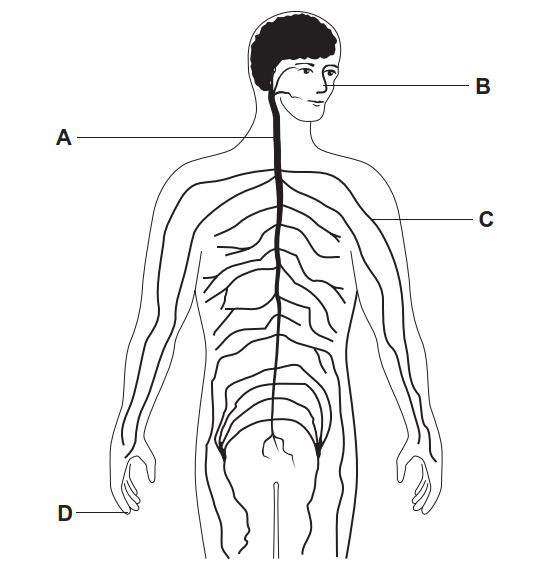
The diagram shows the human nervous system.
Which letter indicates a part of the central nervous system?
A
B
C
D

The diagram shows the muscles which control the size of the pupil in an eye.
How do the muscles make the pupil larger?
circular muscles contract; radial muscles contract.
circular muscles contract; radial muscles relax.
circular muscles relax; radial muscles contract.
circular muscles relax; radial muscles relax.
Which list describes the correct sequence of a simple reflex arc?
A receptor, relay neurone, motor neurone, sensory neurone, effector
B receptor, relay neurone, sensory neurone, motor neurone, effector
C receptor, sensory neurone, motor neurone, relay neurone, effector
D receptor, sensory neurone, relay neurone, motor neurone, effector
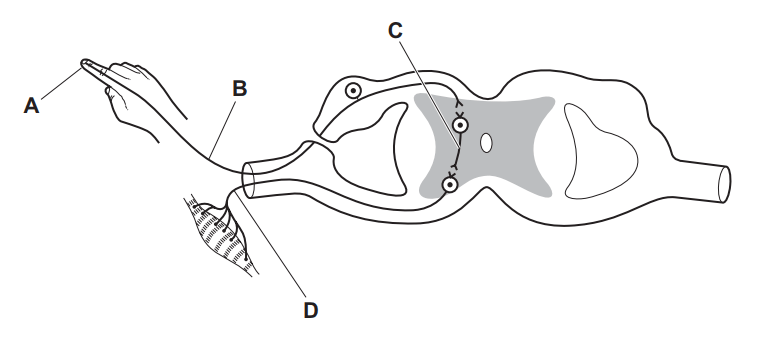
The diagram shows a simple reflex arc.
Which labelled part is the sensory neurone?
A
B
C
D
Some structures in the eye are listed.
1 cornea
2 iris
3 lens
4 retina
Which structures contain light receptors?
1, 2 and 3
2, 3 and 4
2 and 4 only
4 only
Which statement about light receptors in the retina of a normal human eye is correct?
The cones only work in dim light
The rods are found in the fovea.
There are three types of cone.
There are three types of rod.
How can we best describe a nerve impulse?
An electrical signal that passes along nerve cells called neurones
A chemical signal that is transferred to an electrical signal
An electrical charge that travels in nerve endings
Brain's response to an unfavourable change
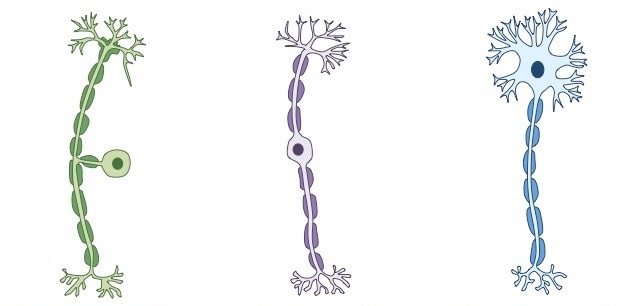
What type of neurone is shown on this picture as green?
Sensory
Relay
Motor
Synapse
Which structure of the eye contains light receptor cells?
Retina
Lens
Cornea
Iris
How does lens help us see objects that are far?
It stays the same
It becomes fatter
It becomes flatter
It becomes more spherical
What is a pupil?
Black dot
Empty space
Colourful part of the eye
Jelly
What is the job of optic nerve?
To carry nerve impulses to the brain
To convert light to electrical signal
To react to too much light
To help bending light
What do we refer to when we say "accommodation"?
How eye is adapted for converting light
How eye is protected from too much light
How eye reacts to too little light
How eye is adapted to see near or far
What is the main advantage of nervous response over chemical response?
Nervous response is safer
Nervous response lasts longer
Nervous response is unconscious
Nervous response is quicker
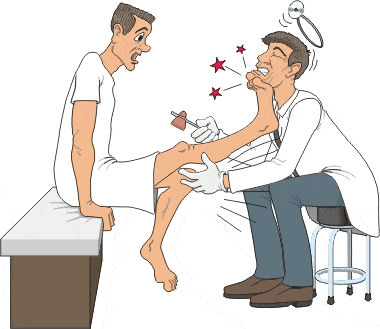
A doctor taps on a patient's knee. What is the response?
The patient kicks
The doctor taps on the patient's knee
Which of the following is NOT TRUE about the synapse?
At the synapse, neurotransmitters are released at the postsynaptic membrane.
At the synapse, chemical signals are converted into electrical signals.
Small gap between neuron is called synaptic cleft
Neurotransmitter binds to ligand-gated ion channel on post-synaptic membrane

Stucture that contain neurotransmitter is....
B
A
D
E
Neurotransmitters are released from the
Dendrites
Post-synaptic neuron
Presynaptic neuron
Schwann Cells
What is the chemical used by a neuron to transmit an impulse across a synapse to another nerve cell?
Neurotransmitters
Synapse
Threshold
Impulse

Diagram 24 shows the structure of a motor neurone. Which part labelled A, B, C or D conducts nerve impulses away from the cell body?
A
B
C
D


What type of receptors are found in the eye?
Mechanoreceptor
Chemoreceptor
Thermoreceptor
Photoreceptor
The fovea contains which types of photoreceptors?
Rods
Cones

What is a Neuron?
A cell
A transmitter to transmit messages to cells
A receiver for information
a gland
What does the axon carry?
Impulses away from the cell body
Impulses to the cell body
chemicals
messages
What do the motor neurons do?
carry messages from the brain and spinal cord to muscles and glands
carry impulses from skin and sends to organs the to spinal cord and brain
carry impulses from sensory neurons to motor neurons
store messages
FIGHT OR FLIGHT:
decreases heart rate
increase heart rate
reverses symptoms
makes you fly
Blinking is an example of
A reflex response
A voluntary response


Why is the sensation of thirst important to maintaining homeostasis?
Water removed by the kidneys must be replaced
Oxygen cannot diffuse into cells if a person is dehydrated
Water molecules are needed to carry carbon dioxide waste to the kidneys

Excess of glucose will be stored in what form?
insulin
glycogen
glucagon
glucose
Glucagon causes muscles and the liver to release _____ back into the bloodstream
glucose
glucagon
glycogen
insulin

This graph shows an example of...
Blood sugar regulation
Homeostasis
Negative feedback
Positive feedback
What is the difference between type 1 and type 2 diabetes?
People with Type 1 make more insulin than people with Type 2
People with Type 1 don't make insulin and people with Type 2 don't make glucagon
People with Type 1 make ineffective glucagon, people with Type 2 make ineffective insulin
People with Type 1 don't make insulin, people with Type 2 make ineffective insulin