
Font size
 Worksheets
S4 Chemistry_Review
Total questions: 123
Worksheet time: 2hrs 21mins
Which of the following is true about the formation of bonds between molecules?
Energy is given off when bonds are formed between molecules.
Energy is absorbed by the molecule when bonds are formed.
Energy is neither given off nor absorbed when bonds are formed.
Which of the following statement is true about the breaking of bonds between molecules?
To break a bond between molecules, energy must be released by the molecule
To break a bond between molecules, no energy is needed.
To break a bond between molecules, energy must be absorbed by the molecule.


The energy level diagram for the reaction between magnesium and hydrochloric acid is shown.
Energy is given out during the reaction
The products are at a lower energy level than the reactants
The reaction is endothermic.
Which reaction is endothermic?
acid neutralising alkali causing a temperature increase
adding magnesium to hydrochloric acid
calcium carbonate decomposing when heated combustion of fossil fuels
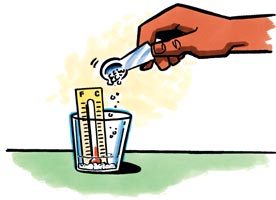

The initial temperature was measured to be 20oC and the final temperature was 10oC. The reaction was
exothermic
endothermic
The initial temperature was measured to be 20oC and the final temperature was 45oC. The reaction was
exothermic
endothermic

What type of reaction is this?
Exothermic
Endothermic
Energy Producing
No way to tell

The graph above is from which type of reaction?
Endothermic reaction
Exothermic reaction
When wood is burnt to keep us warm. This is an example of an ------------ reaction
displacement
exothermic
endothermic
An exothermic change is detected when the temperature ____
stays the same
increases
decreases
The energy taken into a reaction is higher than the energy given out, when the reaction is _____
endothermic
exothermic
Choose the examples of exothermic reactions
dehydration
displacement
nuclear reactions
combustion
photosynthesis
Heat is taken in when ammonium nitrate dissolves in water. This is an example of?
Thermal decomposition
Endothermic change
Exothermic change
Electrolysis

Which of the following energy changes corresponds to the activation energy required for the forward reaction to take place?
A
C
B
E
Which of the following is true about the formation of bonds between molecules?
Energy is given off when bonds are formed between molecules.
Energy is absorbed by the molecule when bonds are formed.
Energy is neither given off nor absorbed when bonds are formed.
The energy level diagram for the reaction between magnesium and hydrochloric acid is shown.
Energy is given out during the reaction
The products are at a lower energy level than the reactants
The reaction is endothermic.
Which is an endothermic process?
Burning hydrogen
Distilling petroleum
Reacting potassium with water
Using petrol in a motor car engine
Exothermic reactions feel
warm
cold
What type of reaction is this?
Exothermic
Endothermic
Energy Producing
No way to tell
The average bond enthalpies for O-O and O=O are 146 and 496 kJ/mol respectively. What is the enthalpy change, in kJ, for the reaction below?
H-O-O-H(g) → H-O-H(g) + ½O=O(g)
-102
+102
+350
+394
When the solids Ba(OH)2 and NH4SCN are mixed, a solution is produced and the temperature drops. Which statement about the energetics of this reaction is correct?
The reaction is endothermic and ΔH is negative
The reaction is endothermic and ΔH is positive
The reaction is exothermic and ΔH is negative
The reaction is exothermic and ΔH is positive
The following equation shows the formation of magnesium oxide from magnesium metal. Which statement is correct for this reaction?
2Mg(s) + O2(g) → 2MgO(s) ΔH = -1204 kJ
1204 kJ of energy are released for every mole of magnesium reacted
602 kJ of energy are absorbed for every mole of magnesium oxide formed
602 kJ of energy are released for every mole of oxygen reacted
1204 kJ of energy are released for every two moles of magnesium oxide formed
Is this equation endo- or exo-thermic?
PCl3 (s) + Cl2 (g) --> PCl5 (s) + energy
endothermic
exothermic
Is this equation endo- or exo-thermic?
2KNO3 (s) + energy --> 2KNO2 (s) + O2
endothermic
exothermic
How can we figure out if an overall reaction is endo- or exo-thermic? It is the difference between _______ and __________.
hot and cold temperatures
energy to break and energy to form bonds.
time to form a bond versus time to break a bond
When the solids Ba(OH)2 and NH4SCN are mixed, a solution is produced and the temperature drops. Which statement about the energetics of this reaction is correct?
The reaction is endothermic and ΔH is negative
The reaction is endothermic and ΔH is positive
The reaction is exothermic and ΔH is negative
The reaction is exothermic and ΔH is positive
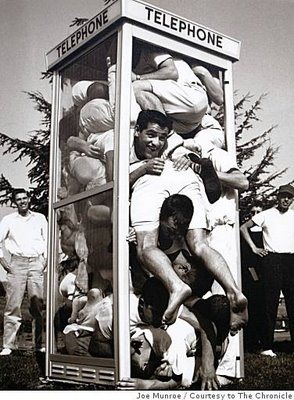


A ______ is a substance that speeds up the rate of a
chemical reaction without being used up in the reaction itself.
Concentration
Catalyst
surface area
When we investigate the rate of reaction we are looking at the...
amount of product formed
speed of reaction
concentration of reacting particles
combining reactants with products
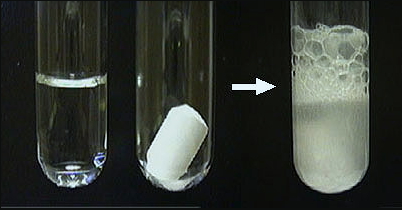
How could we make this reaction happen more quickly?
Decrease the concentration of the acid
crush the chalk to increase the surface area
Put the test tube in an ice bath
Creating fossils is a very _____ chemical reaction
Fast
Slow
It is not a chemical reaction
Hydrogen gas burns in air to form water.
2H2 (g) + O2 (g) → 2H2O(I) ΔH= - 572 kJ
How much heat energy (in kJ) is given off if a rocket carrying 200.0 kg of hydrogen gas is burnt in excess oxygen?
1.43 x 10⁶
1.43 x 10⁷
2.86 x 10⁷
4.92 x 10⁷
The gaseous oxides of nitrogen such as NO, N2O, NO2 and N2O4 have positive enthalpies of formation because
oxygen has high electron affinity.
the atomisation enthalpy of nitrogen is very high.
the nitrogen atom has a high electronegativity.
nitrogen has an extra stability due to its half-filled p orbitals.
The standard enthalpy of combustion of 2-methylbut-1-ene, C5H10 is -3114 kJ mol-1. Which of the following compounds is expected to have the same enthalpy of combustion?
Cyclopentane, C5H10
Cyclopentene, C5H8
Pent-2-ene, C5H10
Methylcyclobutane, C5H10
When an unknown mass of ethanol was burnt, the temperature of 1 dm3 water contained in a copper beaker increased by 7.2 °C. If the enthalpy of combustion
of ethanol is -1350 kJ mol-1, determine the mass of ethanol burnt. [Specific heat capacity of solution = 4.20 J g-1 °C-1; density of solution = 1.0 g cm-3; Mr of ethanol = 46]
1.03 g
1.55 g
1.88 g
2.25 g
The following table shows the change in the enthalpy of combustion (kJ mol-1) of a hydrocarbons.
C2H6 = -1560 ; C4H10 = -2880 ; C7H16 = -4848
The complete combustion of 0.05 mol of a hydrocarbon W releases 176.5 kJ. What could be the molecular formula of W if W is also an alkane?
C3H8
C5H12
C6H14
C8H18
In Thermite Reaction, a reactive metal such as aluminium is used to reduce iron(lll) oxide to iron. What is the enthalpy change when 2.0 moles iron(lll) oxide is reduced by 3.0 moles aluminium? [ΔHf (Al2O3) = -1676 kJ mol-1 ; ΔHf (Fe2O3) = -825 kJ mol-1]
-855.0 kJ
-1276.5 kJ
-1702.2 kJ
-3404.8 kJ
The standard enthalpies of combustion of graphite and hydrogen are -394 kJ mol-1 and -286 kJ mol-1 respectively. If the standard enthalpy of formation of ethane is -20.0 kJ mol-1, what is the standard enthalpy of combustion of ethane in kJ mol-1?
-1 220
-1 305
-1 537
-1 626
The standard heats of combustion per mole of butane, C4H10(g), hydrogen, H2(g), and 1,3-butadiene, C4H6(g) are -2878 kJ, -286 kJ and -2540 kJ respectively. What is the heat of hydrogenation of 1,3-butadiene?
C4H6(g) + 2H2(g) → C4H10(g)
-234 kJ mol-1
-325 kJ mol-1
-370 kJ mol-1
-408 kJ mol-1
When heated strongly, potassium chlorate(V) decomposes to form potassium chloride and oxygen.
2KCIO3(s) →- 2KCI(s) + 3O2(g)
If the heat of formation of KCIO3 and KCI are -391.2 kJ mol-1 and -436.7 kJ mol-1 respectively, what is the enthalpy change when 20 g KCIO3 is heated?
[Relative atomic mass: O = 16; Cl = 35.5; K = 39]
6.88 kJ
7.42 kJ
8.15 kJ
8.80 kJ
When 28.0 g of nitrogen reacts with oxygen to form nitric oxide, NO, and nitrogen dioxide, NO2, 103.0 kJ of heat was required. If no nitrogen remained, calculate the mass of nitric oxide, NO formed.
[ΔHf (NO) = 90.3 kJ mol-1, ΔHf (NO2) = 33.2 kJ mo-1]
4.8 g
9.6 g
19.2 g
24.3 g
What is the Heat of Reaction ΔH for this reaction?
-200 KJ
200 KJ
400 KJ
-300 KJ
Which of the following is true about the formation of bonds between molecules?
Energy is given off when bonds are formed between molecules.
Energy is absorbed by the molecule when bonds are formed.
Energy is neither given off nor absorbed when bonds are formed.
Which of the following statement is true about the breaking of bonds between molecules?
To break a bond between molecules, energy must be released by the molecule
To break a bond between molecules, no energy is needed.
To break a bond between molecules, energy must be absorbed by the molecule.
The energy level diagram for the reaction between magnesium and hydrochloric acid is shown.
Energy is given out during the reaction
The products are less stable than the reactants
The reaction is endothermic.
Which reaction is endothermic?
acid neutralising alkali causing a temperature increase
adding magnesium to hydrochloric acid
calcium carbonate decomposing when heated combustion of fossil fuels
The initial temperature was measured to be 20oC and the final temperature was 10oC. The reaction was
exothermic
endothermic
The initial temperature was measured to be 20oC and the final temperature was 45oC. The reaction was
exothermic
endothermic
What type of reaction is this?
Exothermic
Endothermic
Energy Producing
No way to tell
The graph above is from which type of reaction?
Endothermic reaction
Exothermic reaction
What is the rate of a reaction?
How fast something happens
How slow something happens
When two chemicals mix together and make something new
change in concentration per unit time of any one reactant or product
What is the instantaneous rate of reaction
Is the reaction time instantly
Is the rate of reaction at any one particular time during the reaction
Is the rate of reaction at multiple times during the reaction
Is the rate of reaction initially during the reaction
2 factors affecting the rate of a reaction are
Particle size
Time
Temperature
Solubility
the nature of reactants affects the rate of reaction. Which has a faster reaction rate
Covalent bonds
Ionic bonds
Why do covalent bonds have a slower reaction rate?
Double bonds need to be broken first
Electron transfer must occur
Single bonds need to be made first
They aren't slower than ionic
Particle size affects rate of reaction how
Large the particle size, the quicker the reaction due to a large surface area
Dust particles have a very slow reaction
Smaller the particle size, the quicker the reaction due to a large surface area
Cutting potatoes up into smaller pieces doesn't help it cook faster
For a dust explosion to occur, which of the following must be present?
Oxygen
Methane
Enclosed space
Open space

This image indicates what about concentration?
Decreasing concentration, decreases the rate of a reaction
Having equal amounts of both increases rate of reaction
Increasing concentration, increases the rate of a reaction
Increasing concentration, decreases the rate of a reaction

This image tells you what about higher temperature in terms of rate of reaction
Increase temperature, increase collisions as the particles have less energy and so collide more
Increase temperature, decrease collisions
Increase temperature, increase collisions as the particles have more energy and so collide more
Decrease temperature which increases collisions so the rate of reaction increases
What is a catalyst according to chemistry
A substance that speeds up the rate of a reaction without being used up in the reaction
A substance that slows down the rate of a reaction without being used up in the reaction
A substance that alters the rate of a reaction without being used up in the reaction
A substance that slows down the rate of a reaction and is used up in the reaction
Which of these are enzymes
Catalase
Brollase
Protease
Treease
The reaction of hydrogen peroxide and manganese dioxide is an example of
Homogeneous catalysis
Heterogeneous catalysis
Biological catalysis
Catalyst poision
The surface adsorption theory involves
Hydrogen and oxygen
Oxygen and carbon dioxide
Lead
Platinum
It converts pollutants from the exhaust gases into less harmful substances
Car engine
Car exhaust
Catalytic converter
Catalytic poison
Catalytic converter is an example of a
Catalyst poison
Heterogeneous catalysis
Homogeneous catalysis
Biological catalyst
Lead compounds are an example of
Catalyst
Catalyst poison
Catalytic converter blocker
Heterogeneous cataylst
Reactants have more energy than products in which type of reaction
Endothermic
Exothermic
When we investigate the rate of reaction we are looking at the...
amount of product formed
speed of reaction
concentration of reacting particles
combining reactants with products

How could we make this reaction happen more quickly?
Decrease the concentration of the acid
crush the chalk to increase the surface area
Put the test tube in an ice bath
Creating fossils is a very _____ chemical reaction
Fast
Slow
It is not a chemical reaction
What does the M after a concentration value stand for?
meters
music
Molarity
moles
Which is the highest concentration?
10m
2M
25 mmol
0.5M
The major theory of reaction rate is called
Collision theory
Crash theory
Newton's laws
Thermodynamics
When surface area is decreased the rate of reaction...
Decreases, because there are LESS possible sites for correct collisions
Increases, because there are LESS possible sites for correct collisions
Decreases, because there are MORE possible sites for correct collisions
Increases, because there are MORE possible sites for correct collisions

