wayground logo

Free Printable Worksheets

Font size

S
M
L
XL
Worksheets

Midyear review 23-24

Total questions: 71

Worksheet time: 2hrs 35mins

Name
Class
Date
1.

What are the FOUR most common elements in living things?

a)

Carbon

b)

Silicon

c)

Nitrogen

d)

Hydrogen

e)

Oxygen

2.

What is the function of carbohydrates?

a)

Perform cell's functions/tasks

b)

Fast energy

c)

Energy storage

d)

Alter other biomolecules

e)

Store information for cells

3.

Carbohydrates are primarily made out of...

a)

Carbon

b)

Hydrogen

c)

Oxygen

d)

Nitrogen

e)

Phosphorus

4.

What is the function of nucleic acids?

a)

Perform cell's functions/tasks

b)

Fast energy

c)

Energy storage

d)

Alter other biomolecules

e)

Store information for cells

5.

What is the function of lipids?

a)

Perform cell's functions/tasks

b)

Fast energy

c)

Energy storage

d)

Alter other biomolecules

e)

Store information for cells

6.

The building blocks or monomers of carbohydrates (sugars) are?

a)

amino acids

b)

fatty acids

c)

monosaccharides

d)

nucleotides

7.

What are the building blocks or monomers for proteins?

a)

monosaccharides

b)

fatty acids

c)

DNA

d)

amino acids

8.
A good example of a nucleic acid would be?
a)
sugar
b)
DNA
c)
fat
d)
glucose
9.
The function of nucleic acids, such as DNA are for building proteins and carrying the ___________ info.
a)
genetic
b)
disease fighting 
c)
bone building 
d)
energy
10.

The three main parts of a nucleotide are the sugar (made up of carbon, hydrogen, and oxygen), the phosphate group, and the _____________ base.

a)

carbon

b)

oxygen

c)

nitrogen

d)

hydrogen

11.
The three main elements that make up all life on Earth are?
a)
hydrogen, oxygen, sulfur
b)
hydrogen, oxygen, carbon
c)
carbon, oxygen, uranium 
d)
oxygen, carbon, helium.  
12.

What are the building blocks or monomers for nucleic acids?

a)

monosaccharides

b)

amino acids

c)

nucleotides

d)

fatty acids

13.
What 3 letters do enzymes typically end in?
a)
-ose
b)
-ase
c)
-ese
d)
-tic
14.
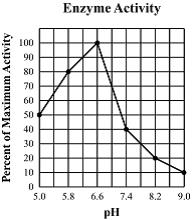
Which of the following conclusions can be drawn from this graph?
a)
The optimum pH of the enzyme is 6.6.
b)
The optimum pH of the enzyme is 5.8
c)
The enzyme’s activity increases as pH increases 5.0 to 9.0
d)
The enzyme’s activity is greater around pH of 8.0 .
15.
Which of these is NOT true?
a)
Enzymes can denature (change shape) when the temperature gets too high.
b)
Enzymes can only be used once in a chemical reaction. 
c)
Extreme pH can denature enzymes.
d)
Enzymes speed up chemical reactions. 
16.

In the diagram, what is letter A?

a)

product

b)

enzyme-substrate complex

c)

substrate

d)

active site

17.

Letter D...

a)

enzyme

b)

active site

c)

substrate

d)

products

18.

Letter B...

a)

substrate

b)

active site

c)

enzyme

d)

products

19.

Letter C...

a)

products

b)

substrate

c)

enzymes

d)

active site

20.

Letter E...

a)

active site

b)

products

c)

substrate

d)

enzyme

21.

In passive transport, the concentration gradient goes from..

a)

Low to low

b)

High to low

c)

Low to high

d)

High to high

22.
The cellular process in which materials are moved across a membrane from an area of low concentration to an area of high concentration is called
a)
Osmosis
b)
Simple Diffusion
c)
Active Transport
d)
Passive Transport 
23.
Describe the movement of molecules in the illustration.
a)
Molecules are moving from a lower concentration to a higher concentration. 
b)

Molecules are moving from a higher concentration to a lower concentration. 

c)
Molecules are moving from a higher concentration to a lower concentration and then from a lower to higher concentration.
d)

Molecules are moving from a lower concentration to a higher concentration and then from a higher concentration to a lower concentration and then a backflip

24.
How is diffusion different from this process?
a)
 Diffusion takes place due to osmotic pressure. 
b)
Diffusion requires cellular energy for the transfer of molecules.
c)
Diffusion requires protein channels as a passage-way for particles
d)
Diffusion transfers particles from an area of high to low concentration. 
25.
Osmosis is the diffusion of __________.
a)
water
b)
glucose
c)
air
d)
passive transport
26.
Passive transport requires no
a)
concentration gradients
b)
osmosis
c)
motion
d)
energy
27.
This cell organelle helps organisms maintain homeostasis by controlling what substances may enter or leave cells.
a)
vacuole
b)
nucleus
c)
cell membrane
d)
cell wall
28.
Large molecules, such as glucose, can easily pass through the cell membrane without any help...
a)
True- they pass right through
b)
False- they need a protein channel 
29.
When particles move out of a cell through facilitated diffusion, the cell ____________.
a)
Gains energy
b)
Uses energy
c)
Releases energy
d)
Does not use energy
30.
Which type of Passive Transport is being represented in this picture?
a)
Passive Diffusion
b)
Simple Diffusion
c)
Active Diffusion
d)
Facilitated Diffusion
31.
Which of the following correctly describes viruses?
a)
non-living because they grow and develop
b)
living because they can use energy
c)
non-living because they cannot reproduce on their own
d)
living because they can maintain homeostasis
32.
Viruses are...
a)
prokaryotic
b)
eukaryotic
c)
non-living
d)
endospores
33.
Which of the following is a trait that a virus shares with a living organism?
a)
They use oxygen
b)
They have genetic material
c)
They grow
d)
They digest food
34.
Which of the following is something bacteria and viruses have in common?
a)
they are both living
b)
they are both cells
c)
they can both cause disease
d)
they are both non-living
35.
What do viruses need to reproduce?
a)
they need genetic material
b)
They need a host cell
c)
They need  bacteria
d)
They need insulin
36.
Viruses can reproduce on their own
a)
False
b)
True
37.
Viruses are cells. 
a)
True 
b)
False
38.

A virus needs a host cell in order to do which of the following?

a)

Grow

b)

Develop

c)

Reproduce

d)

Live

39.

Which of the following statements is true?

a)

All cells are prokaryotes

b)

All eukaryotes have a nucleus

c)

All viruses are prokaryotes

d)

All viruses are living

40.

A bacterium reproduces asexually by dividing to form two new bacterial cells. What is the name of the process by which bacteria reproduce?

a)

meiosis

b)

mitosis

c)

budding

d)

binary fission

41.

Bacteria have a low mutation rate

a)

True

b)

False

42.

Bacteria can become resistant to antibiotics

a)

True

b)

False

43.

What are the 2 types of Prokaryotes

a)

Archaebacteria

b)

Heterotroph

c)

Eubacteria

d)

Autotroph

44.

Select all that are true regarding bacteria

a)

Unicellular

b)

Have a nucleus

c)

Contain Ribosomes

d)

They have mitochondria and other membrane bound organelles

45.

Students observe cells under a microscope. Which of the students’ observations will be most helpful in classifying a cell as either prokaryotic or eukaryotic?

a)

Shape of the cell.

b)

Presence of a nucleus.

c)

Presence of organelles.

d)

Visible DNA.

46.

The presence of which of the following characteristics differentiates prokaryotic and eukaryotic cells?

a)

DNA

b)

Ribosomes

c)

Nucleus

d)

Cytoplasm

47.

Students use a microscope to look for structures present in four different cells. The students placed an X for each structure that was viewed for each cell on the table shown. Which cell that was viewed is most likely a prokaryote?

a)

Cell W

b)

Cell X

c)

Cell Y

d)

Cell Z

48.

Which of the following correctly compares prokaryotes and eukaryotes? Select all that apply.

a)

Prokaryotes: smaller in size.

b)

Eukaryotes: less complex.

c)

Prokaryotes: nucleus absent.

d)

Prokaryotes and eukaryotes: have DNA.

e)

Prokaryotes and eukaryotes: membrane-bound organelles.

49.

A table with characteristics of three different cells is shown. Cell 2 is a _____.

a)

prokaryote

b)

eukaryote

50.

Plant and animal cells are examples of

a)

prokaryotic cells

b)

eukaryotic cells

51.

Which of the following structures is ALWAYS found in both eukaryotic and prokaryotic cells?

a)

nucleus

b)

mitochondria

c)

ribosomes

d)

cell wall

52.

PROKARYOTIC cells do NOT have

a)

membrane bound organelles

b)

cell membrane

c)

DNA

d)

ribosomes

53.

The smallest unit of a living thing are

a)

atoms

b)

cells

c)

DNA

d)

organelles

54.

The three stages of the cell cycle are __________, mitosis, and

cytokinesis.

a)

interphase

b)

anaphase

c)

metaphase

d)

prophase

55.

Identical cells formed during cell division are called:

a)

daughter organelles

b)

daughter cycles

c)

daughter nucleus

d)

daughter cells

56.

The process by which a cell nucleus divides is called:

a)

interphase

b)

mitosis

c)

cytokinesis

d)

cell cycle

57.

The final stage of the cell cycle is called:

a)

Interphase

b)

mitosis

c)

cytokinesis

d)

daughter cells

58.

True or False.

After a cell goes through cytokinesis, it immediately starts mitosis all over again.

a)

True

b)

False

59.
What does DNA Replication mean?
a)
DNA is made.
b)
DNA makes new cells. 
c)
DNA copies itself.
d)
DNA starts the cell cycle.
60.
What happens in the first part of Interphase?
a)
Mitosis
b)
Cell Growth
c)
DNA Replication
d)
Anaphase
61.
Which part of the Cell Cycle takes the longest?
a)
Interphase
b)
Mitosis
c)
Prophase
d)
Cytokinesis
62.
Fruit fly body cells have 8 chromosomes. After mitosis, you would expect a resulting fruit fly daughter cell to have ...
a)
16 chromosomes.
b)
46 chromosomes.
c)
8 chromosomes.
d)
4 chromosomes.
63.

What is the result of the cell cycle?

a)

Three cells

b)

Four daughter cells

c)

Two identical cells

d)

One clone cell

64.
Put the following actions in order: DNA replicates, cell grows, cell divides, cell prepares for mitosis. 
a)
DNA replicates, cell grows, cell prepares for mitosis, cell divides
b)
cell grows, cell prepares for mitosis, DNA replicates, cell divides
c)
cell grows, DNA replicates, cell prepares for mitosis, cell divides
d)
DNA replicates, cell prepares for mitosis, cell grows, cell divides
65.
Which sequence of DNA bases would pair with this partial strand
ATG TGA CAG
a)
ATG TGA CAG
b)
TAC ACT GTC
c)
GTA AGT GAC
d)
CAT TCA CTG
66.
In a molecule of double-stranded DNA, the amount of Adenine present is always equal to the amount of
a)
cytosine
b)
guanine
c)
thymine
d)
uracil
67.
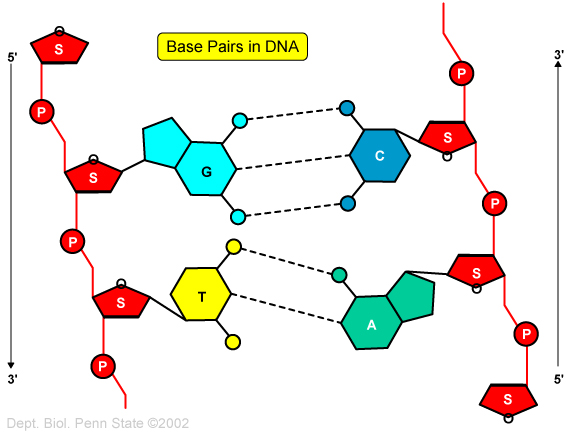
Guanine bonds with ______________.
a)
Adenine
b)
Guanine
c)
Cytosine
d)
Thymine
68.
Which 2 molecules form the sides (backbone) of the DNA ladder?
a)
deoxyribose sugar and adenine
b)
deoxyribose sugar and a hydrogen bond
c)
deoxyribose sugar and the nucleus
d)
deoxyribose sugar and phosphate
69.
Nitrogenous bases are joined by which type of bond?
a)
polar bonds
b)
ionic bonds
c)
covalent bonds
d)
hydrogen bonds
70.
DNA replication results in two DNA molecules,
a)
each one with two original strands
b)
each one with two new strands
c)
each one with one new strand and one original strand
d)
one with two new strands and the other with two original strands
71.
What are the 4 nitrogen bases?
a)
adenine, thymine, cytoplasm, and guanine
b)
adenine, thymine cytosine, and guanine
c)
adenine, thymine, cytosine, and gylcerol
d)
adenine, thymine, cytosine, and glucose