
 Worksheets
Physics Paper 2 Key Knowledge Recall Quiz (Triple) - P
Total questions: 121
Worksheet time: 3hrs 41mins
Which Class are you in?
11P-Ph1
11P-Ph2
11P-Ph3
Which factor would NOT increase stopping distance?
Day of the week
Higher Speed
Icy Roads
Listening to Music
What is Newton's third law?
For every action there is an equal and opposite reaction
The acceleration of an object is equal to the resultant force per unit mass of the object
An object will continue moving at a constant speed in the same direction, or remain stationary, unless acted on by a resultant force
Every object experiences forces

What is the resultant force?
2 N, upwards
0 N
20 N, upwards
2 N, downwards
A cyclist pedals a bicycle with a force of 1000 N moving it 250 m.
Calculate how much work has been done by the cyclist.
4 J
250 000 J
0.25 J
750 J
A tennis ball has a mass of 80g and is served with a velocity of 40 m/s.
What is its momentum?
3.2 kg m/s
3200 kg m/s
320 kg m/s
2 kg m/s
A car of mass 1000 kg is travelling at 13 m/s when it is involved in a collision. The car takes 2.2 s to stop.
What force did the car and its passengers feel?
28600 N
5909 N
13000 N
169 N
A man runs a 400 m race in 50 seconds.
What is his average speed?
350 m/s
8 m/s
20 000 m/s
450 m/s

Look at the graph.
What is the speed between 2 s and 5 s?
8 m/s
0.125 m/s
10 m/s
0.1 m/s

Look at the graph.
What distance is travelled in 25 s?
35 m
25 m
15 m
5 m

Calculate the deceleration in section Z.
(The unit is m/s2)
−12.5
−7.5
−3.8
−5

Describe the motion in section X.
Accelerating
Constant speed
Stationary
Decelerating
A car accelerates from 3 m/s to 12 m/s in 20 s.
What is the acceleration of the car? (The unit is m/s2)
0.6
0.15
0.45
0.75
Calculate the energy needed to extend an elastic band by 2 m.
Spring constant = 10 N/m
20 J
10 J
100 J
40 J

What is the spring constant?
0.2 N/cm
0.2 N/m
5 N/cm
8 N/m

What load is needed to increase the length of the spring by 2 cm?
3 N
1.5 N
2 N
1.8 N
What is the difference between a scalar quantity and a vector quantity?
Scalar quantities can be measured but vector quantities can't
Vector quantities can be measured but scalar quantities can't
Scalar quantities have magnitude but vector quantities have magnitude and direction
Vector quantities have magnitude but scalar quantities have magnitude and direction
The ride ‘Rita’ at Alton Towers accelerates at 10.92 m/s2.
The five carriages have a total mass of 2600 kg with all 20 seats occupied.
What force is needed for this acceleration?
28392 N
238 N
2611 N
2589 N
A car engine moves a car with a force of 10 kN and does 500 kJ of work.
How far has the car travelled?
200 m
0.02 m
5 000 000 m
50 m
What is work done?
The amount of energy used up
The amount of energy created
The amount of energy destroyed
The amount of energy transferred

Describe the motion in section Y.
Accelerating
Constant speed
Stationary
Decelerating
A lever is used to lift a box. A force of 30 N is applied to the end of the lever, which is 12 cm away from the pivot.
Calculate the moment when the lever is horizontal.
250 N m
2.5 N m
3.6 N m
360 N m

What is the resultant force?
50 N, downwards
15 N, downwards
15 N, to the left
50 N, upwards
What is the time taken for a plane travelling at 100 m/s to cover 3 km?
3 minutes
30 seconds
300 seconds
0.03 seconds

What is the increase in length produced by a load of 2.3 N?
2 cm
3 cm
4 cm
5 cm
How do crumple zones prevent injury to passengers in a car accident?
Crumple zones soften the crash
Crumple zones make the car bounce backwards
Crumple zones increase the impact time
Crumple zones stop the car doors bending so people can still get out of the car
Which factor would NOT change the momentum of an object?
Changing mass
Changing speed
Changing surface area
Changing direction
What kind of quantity is weight?
Scalar
Vector
Both
Neither
A 70 kg skydiver experiences 371 N of air resistance during her skydive.
What is her acceleration? (The unit is m/s2)
5.3
700
329
4.7
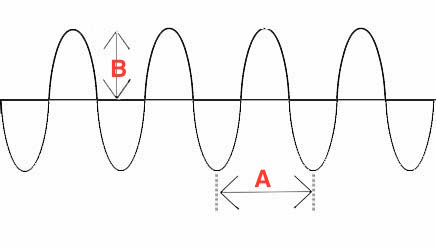
What property of this wave is represented by the letter "A"
amplitude
crest
trough
wavelength
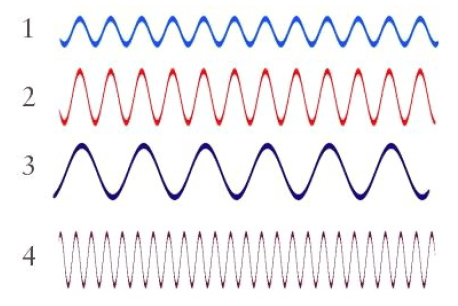
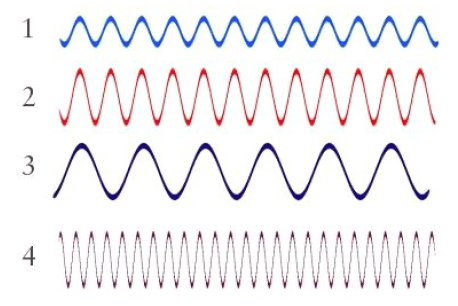
Which of the following can sound travel through?
solid
liquid
gas
all of the above
In which material does sound travel fastest?
solid
liquid
gases
What is transferred by a wave?
energy
matter
particles
mass

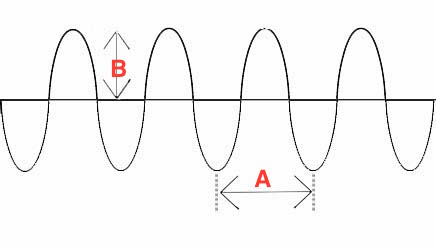
Which image represents a longitudinal wave?
A
B
Sound waves are which type of waves?
transverse
seismic
longitudinal
frequency


Which type of electromagnetic wave has the lowest energy of this group?
Radio
Microwave
Infrared
Ultraviolet

Radio waves and _______ are used in communication
Microwaves
Gamma rays
Visible light
Ultraviolet

What is the amplitude of this wave?
0.20 m
0.40 m
2.0 s
4.0 s
What is the time period of this wave?
0.20 m
0.40 m
2.0 s
4.0 s
What is the frequency of this wave?
0.25 Hz
0.50 Hz
2.0 s
4.0 s

The time period of this wave is 2 seconds. What is the wave speed?
1.0 m/s
2.0 m/s
4.0 m/s
8.0 m/s

A gamma ray has a frequency of 1.0 x 10 20 Hz and travels at 3.0 x 10 8 m/s. What is it’s wavelength?
3.3 x 10 -13 m
3.0 x 10 -12 m
3.3 x 10 11 m
3.0 x 10 12 m

Max is sitting in his boat observing water waves enter the harbour. He counts 20 waves passing into the harbour in one minute. What is the frequency?
0.33 Hz
3.0 Hz
20 Hz
1200 Hz

Which of the following is the correct order for the electromagnetic spectrum shown above?
Gamma, X-ray, UV, Visible, IR, Microwave, Radio
Radio, IR, Microwave, Visible, UV, X-ray, Gamma
Gamma, UV, X-ray, Visible, IR, Microwave, Radio
Radio, Microwave, IR, Visible, UV, X-ray, Gamma

Which of the following do all regions of the electromagnetic spectrum have in common?
Travel at the speed of light (3.0 x 10 8 m/s)
Cannot travel in a vacuum
Can be reflected, refracted and polarised
Need a medium to travel in

Which of the following is a danger of UV radiation?
Causes skin cancer
Causes hearing damage
Easily absorbed by water in the body’s cells
Can cause cancer of the brain

Which of the following is a danger of IR radiation?
Causes burns
Causes hearing damage
Easily absorbed by water in the body’s cells
Causes cancer
This is considered as the fastest kind of seismic waves.
Love waves
Body waves
Primary waves
Secondary waves
Which seismic wave can only travel through solids?
Sound waves
Infrasound waves
Primary waves
Secondary waves
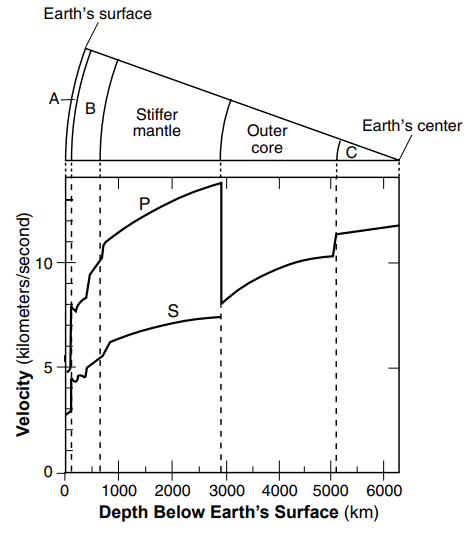
Primary (P) Waves can pass through...
solids only
liquids only
vacuum only
solids and liquids
Which seismic wave can travel through the earth's core?
S wave
P wave
Stars are formed from big clouds of gas and dust is known as:
dust cloud
space fog
neutron clouds
nebulae
The only force acting on the nebulae is:
thermal expansion
singularities
gravity
microscopic adhesion
A star is born when:
nuclear fusion starts
a nebula becomes a protostar
gases in a nebula condense
hydrogen is used up in fusion processes
When the core of a Red Giant collapses it becomes a:
White Dwarf
Supernova
Red Supergiant
Black Hole
When a massive star begins to cool and expand it is known as a:
Black Dwarf
Red Giant
Red Supergiant
White Dwarf
When the core of a Red Supergiant collapses, a bright event occurs, known as:
white dwarf
supernova
big bang
black hole
Our sun is currently in what star stage?
Protostar
Nebula
Main Sequence
Red Giant
A black hole is black because:
there is nothing in it
it is too small to see
it is inherently evil
even light cannot escape its gravity
One possible outcome that is left after a supernova is a super dense core called a:
Neutron Star
White Dwarf
Red Giant
Black Dwarf
After a supernova, the core can collapse into a neutron star, or if massive enough it can become a:
Black Hole
White Dwarf
Red Supergiant
Black Dwarf
When the core of a Red Supergiant collapses, a bright event occurs, known as:
white dwarf
supernova
big bang
black hole

Main sequence stars are made primarily of which elements?
Hydrogen only
Helium and Carbon
Carbon and Iron
Hydrogen and Helium
A star that has begun nuclear fusion will last for:
millions of years
a few thousand years
as long as the universe survives
forever
When a nebula condenses and takes on a shape it is called:
a red supergiant
a black hole
a white dwarf
a protostar
The stable and longest lasting period of a star’s life cycle is called:
The birth of a star
Nebula
Neutron star
Main Sequence
What is a celestial body that is composed of gas and emits light from nuclear fusion reactions?
Nebula
Star
Galaxy
Planet
The combining of two or more atoms in a stars core into a new heavier atom is called what?
Fission
Fusion
Nuclear Reactions
Nucleosynthesis
What is the name of the dense ball of concentrated matter at the center of a rotating disk of nebular material? This material will heat up and eventually form a star.
Protostar
Protoplanetary disk
Plasma ball
Incandescent star
What term do we use for an massive star that explodes? (These explosions are responsible for forming all atoms heavier than iron.)
Novas
Big bangs
Supernova
Thermonuclear detonation
The highly dense remains of a high mass star after a supernova. An object whose gravity is so strong that all atoms have been crushed into neutrons. What is it called?
Neutron star
Pulsar
White hole
Black hole
What is the term for the high-density remains of a high mass star after a supernova? An object whose gravity is so strong that nothing, not even light, can escape.
Black hole
Quasar
Cephid
Neutron star
At 10,000,000 degrees Celsius (10 million oC), hydrogen begins to change into helium and energy is released in a process called?
supernova
pulsar
nuclear fusion
nuclear fission

All stars begin their life in a ...?
(a)

What are the final two stages of a star about the same size as our Sun?
white dwarf - black dwarf
neutron star - black hole
supernova - neutron star
pulsar - neutron star
What stage in a stars life cycle is this describing?
What stage in the life cycle does this describe?
What stage in the life cycle does this describe?


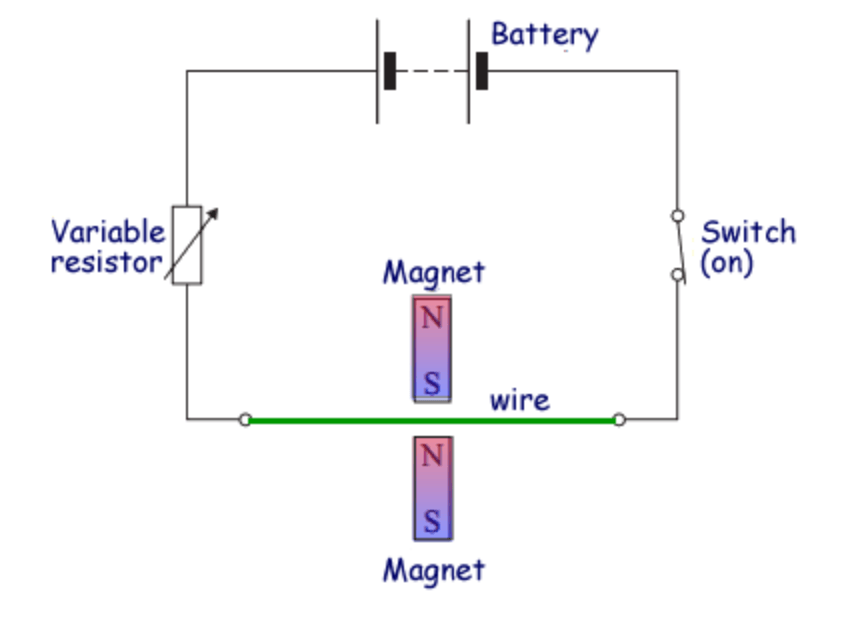
A __________ is an electrical device that converts AC electricity from one voltage level to another
transformer
primary coil
secondary coil
center tap
Which part (s) of the DC motor connect the power supply to the split-ring and coil?
Carbon brushes
Magnets
Commutator
Slip rings
Which rule is used to find the direction of magnetic field around a straight conductor
Flemming left hand rule
Lenz law
Flemmings right hand rule
Right hand thumb rule

