
 Worksheets
RC 3: DW 7 & 8
Total questions: 70
Worksheet time: 2hrs 52mins
A genus is ...?
a group of species that have different characteristics
a group of species that have similar characteristics
a group of single celled organisms
two name naming system
Binomial Nomenclature means...?
single name list of names
two name list of names
list of names
taxonomy

The more classification levels that organisms share, the more characteristics that they have in common.
True
False

Organisms in the ___ level have the most in common with each other.
kingdom
phylum
genus
species

Refer to the figure. Are Domestic Dog and the Wolf Spiders in the same kingdom?
Yes
No
Refer to the figure. Are Domestic Dog and the Wolf Spiders in the same class?
Yes
No

If two organisms belong to the same order, then they must also belong to the same...
Species
Class
Family
Genus
An organism's scientific name is based on how it is classified. Which of the following levels of classification determine the name?
kingdom & phylum
class & species
domain & order
genus & species
Largest and most general group into which organisms are classified is called...
Species
Class
Domain
Family

Within families, organisms are placed into groups called...
Genus
Kingdom
Class
Phylum

The order of the levels of classification is:
Domain, kingdom, phylum, class, order, genus, family, species
Domain, class, kingdom, phylum, order, genus, family, species
Domain, class, kingdom, phylum, order, genus, species, family
Domain, kingdom, phylum, class, order, family, genus, species

Which kingdoms make up the domain Eukarya?
Protista, Fungi, Plantae, Animalia
Archaebacteria, Eubacteria, Protista, Fungi
Plantae, Animalia, Archaebacteria
Eubacteria, Archaebacteria
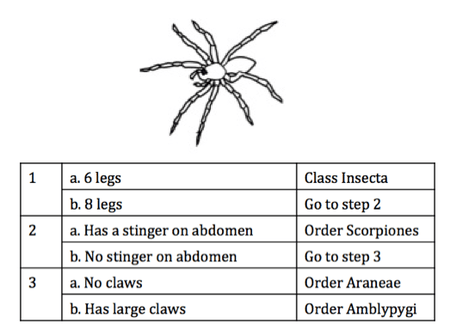

arachnids and insects?
What kingdoms are prokaryotic?
animalia
fungi
eubacteria
archeabacteria


Heterotrophic
Mobile
Eukaryotic
Multicellular
Heterotrophic
Mostly Multicellular
Immobile
Eukaryotic
What was the system Carolus Linnaeus invented called?
binomial nomenclature
binomiel nomencleaner
bionomal normanclure
nibromial clomanature
none of the answers are correct
What is the purpose of a scientific name?
To identify where the organism lives
To identify the mates of the organism
To reduce confusion in the scientific community
To reduce discussion in the scientific community
What is a taxonomic name used for?
To prevent confusion when discussing organisms.
To prevent extinction of organisms.
To create discussion about organims.
To create confusion about organisms.
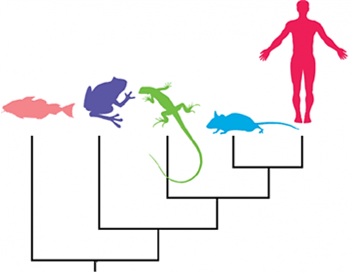
What is the human most closely related to?
Fish
mouse
Salamander
Human

According to this tree, which of these animal phyla are most closely related?
Arthropoda & Mollusca
Arthropoda & Chordata
Chordata & Mollusca

Where is the alligator and T. rex's common ancestor?
Point A
Point B
Point C
Point D
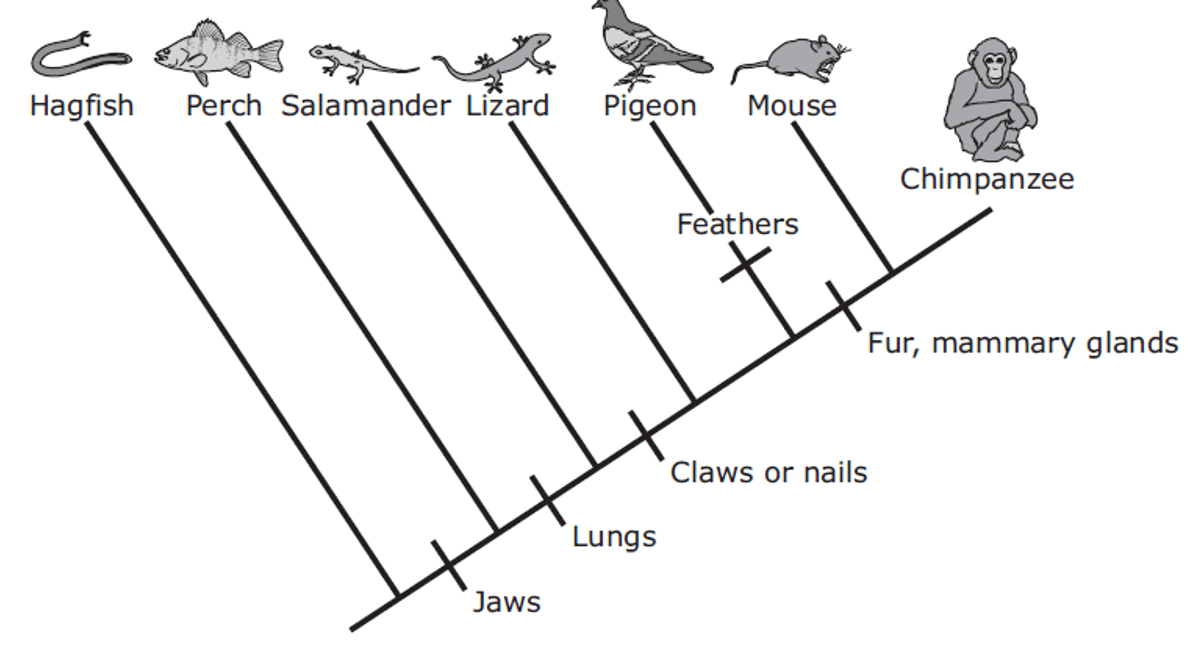

The diagram below represents possible genetic relationships between groups of organisms.
Which statement is a valid conclusion that can be drawn from the diagram?
Insects are more complex than mammals.
Earthworms and sea stars have a common ancestor.
Snails appeared on Earth before corals.
Sponges were the last new species to appear on Earth.

What do both the squirrel and lion have in common that the other animals do not?
They are both vertebrates
They both have lungs
They are both mammals
They both lose their canine teeth.

What do amphibians, birds, prosimians and humans all have in common? Check all that apply.
Hair
Endothermic
Eukaryotic
Tetrapod
Vertebrate

Which letter represents the most recent common ancestor of sponges and mushrooms?
A
B
C
D
E

Which trait should go where A is on the cladogram?
eyes
feet
lips
hat

This makes an organism more suited to its environment
species
lifespan
adaptation
mutation
Evolution
Natural Selection
Extinction
Artifical Selection
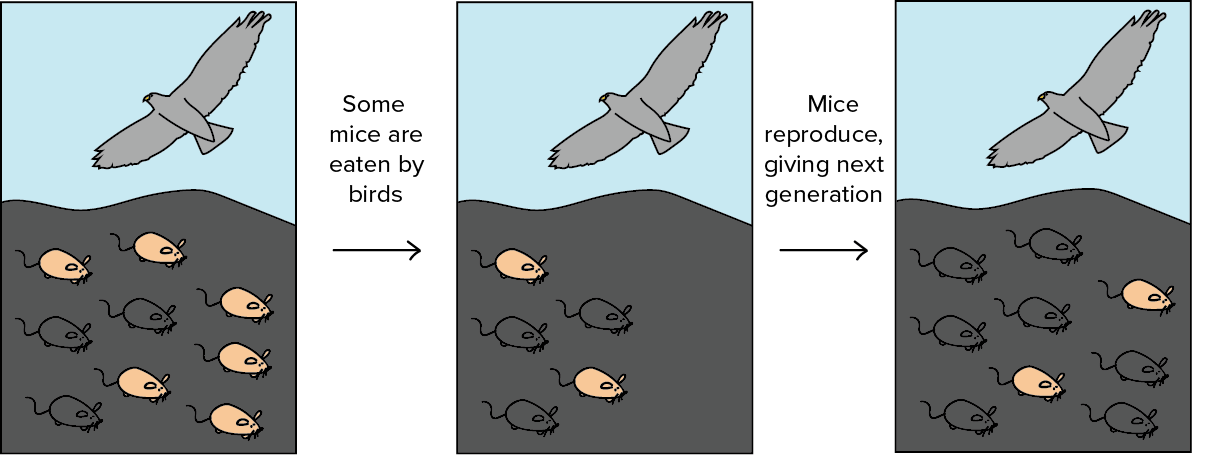
The light mice can reproduce more successfully than the dark mice
The hawks eat more dark mice than light mice because the dark mice taste better
The hawks eat more light mice than dark mice because they can see the light mice more easily
The hawks eat more dark mice than light mice because they can see the dark mice more easily
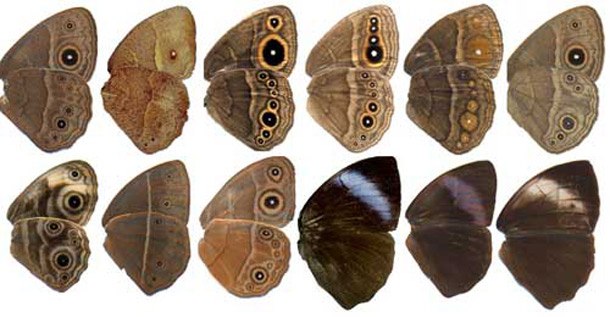
Natural Selection
Variation
Homeostasis
Extinction
Animals and plants can choose to adapt to their environment and the effects of natural selection can usually be seen in a very short time.
True
False
The _________________ _________________ occurs when there is a reduction in population due to natural disasters, over hunting or disease.
founder effect
gene flow
bottleneck effect
genetic drift
In which of the following populations would genetic drift be most likely to cause a rapid evolution of the population?
The human population of India
A large population of Mexican free-tailed bats living in central Texas
A geographically isolated population of 5000 green tree frogs
A small group of 12 cheetahs living in Namibia
As a population recovers from reduction due to the bottleneck effect, the population will experience -
a loss of genetic dicversity.
migration.
no change to allele frequency.
genetic regulation.
Genetic drift occurs most quickly in -
small populations.
populations with large genetic variation.
populations with small genetic variation.
large populations.
What is gene flow?
The addition or removal of alleles in a population due to individuals entering or leaving one population for another
A change in allele frequencies when a new population arises from only a few individuals
A reduction in population caused by natural disasters, disease, hunting, etc.
A change in the gene pool due to chance
Select all answers below that describe the founder effect.
Changes allele frequencies
Occurs when a new population arises from only a few individuals
Can result in a loss of genetic diversity
Is caused by a disaster that kills off most individuals in a population
Which of the following could not be a possible cause of the bottleneck effect?
Overhunting of northern elephant seals
A forest fire that destroys most of a population of deer
A crop that is destroyed by blight
A small group of fish that are added to a pond
What is genetic drift?
A population for which the gene frequencies do not change
A change in allele frequencies due to selection
The addition or removal of alleles in a population due to individuals entering or leaving one population for another
A change in the gene pool due to chance


Vestigial structures
structures that perform a similar function but are not similar in origin
remnants of once-important structures that have slowly lost all or most of their function
features found in different organisms that share structural similarities but may have very different functions
preserved remains of an organism

SELECT ALL THAT APPLY: Which of the following must be true in order for organisms to be considered the same species?
They must be able to mate
They must be able to produce viable offspring
They must have structural similaries
They must have the same bone structure

Why is it important to finish ALL of an antibiotic, even if you feel better?
If all of the infectious bacteria are not killed, the bacteria may continue to multiply. Some of these bacteria may have a mutation that makes them resistant to the antibiotic. This could cause resistant bacteria to spread.
If all of the antibiotic is not used, the surviving bacteria may learn how to fight off the antibiotic, causing the sickness to get even worse.
If all of the antibiotic is not used, the bacteria may begin ingesting your skin cells, causing a new sickness to arise.
If all of the antibiotic is not used, the surviving bacteria may cooperate with other infectious bacteria, resulting in two separate infections at the same time.

__________ is a pattern of new species evolving during short periods of rapid change.
gradualism
isolation
mate or reproduce
punctuated equilibrium
__________ is a pattern of new species forming over very long periods of time.
gradualism
isolation
mate or reproduce
punctuated equilibrium
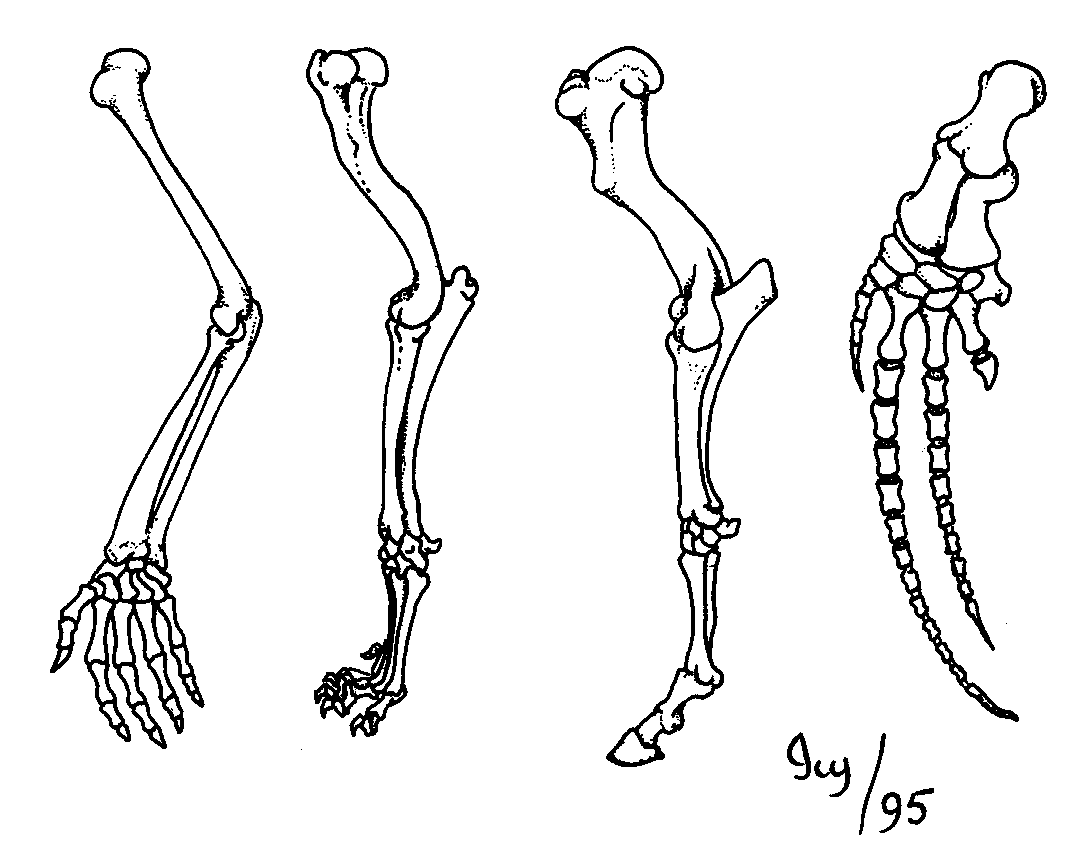


Which of the following can be determined by observing the embryos shown in the diagram

The picture shows a/an ___________
homologous structure
vestigial structure
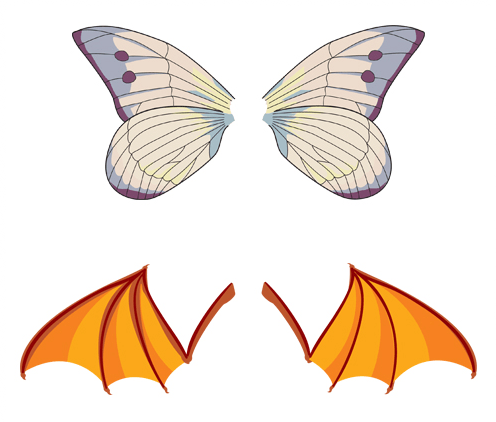
What is this an example of?
Homologous structure
Analogous structure
Vestigial organs
Functional adaption

What best describes the hind leg bones seen in the whale?
The bones are analogous structures to the fins of living fish.
The bones are vestigial structures that had a function in an ancestor.
The bones are homologous structures to the wings of butterflies.
The bones are fossil structures from an extinct ancestor.

Which structure is shown in the picture?
analogous structure
homologous structure
vestigial structure
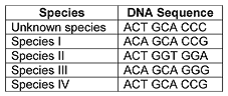
DNA

