
 Worksheets
MCB*2050 - Weeks 1-6
Total questions: 98
Worksheet time: 1hrs 8mins
Match the function to the component involved in eukaryotic chromatin decondensing:
A) Maintain euchromatic structure of the locus (bind to DNA on a regulatory sequence on one side of the helix and interact with proteins that will open up the chromatin)
B) Add acetyl groups to histone tails which neutralizes them (histone tails condensed into chromatin are positively charged and are attracted to negatively charged neighbouring nucleosomes)
C) Interacts with pioneer transcription factors to reposition the nucleosomes to reveal the enhancer and promoter regions so that transcription factors can bind to them
A) Histone acetylase complexes
B) Pioneer transcription factors
C) Chromatin remodeling enzymes
A) Chromatin remodeling enzymes
B) Pioneer transcription factors
C) Histone acetylase complexes
A) Pioneer transcription factors
B) Chromatin remodeling enzymes
C) Histone acetylase complexes
A) Pioneer transcription factors
B) Histone acetylase complexes
C) Chromatin remodeling enzymes
Which transcription factor binds the DNA first in eukaryotes?
TFIIE
TFIIB
TFIID
TFIIF
TFIIA
General elongation factor _____ is present in the paused and activated elongation complex but changes conformation between the two complexes.
SPT6
DSIF
P-TEFb
NELF
PAF
Which elongation factor stabilizes the paused state of RNA Polymerase 2?
PAF
P-TEFb
NELF
SPT6
Which elongation factors block further binding of NELF, which allows RNA polymerase 2 to resume elongation?
SPT6
DSIF
P-TEFb
NELF
PAF
True or False? In mammalian genes with a TATA box promoters, enhancers may be either upstream or downstream from the transcription start site.
True
False
Which of the following phosphorylates NELF, DSIF, and the CTD of RNA Polymerase II?
Histone acetylase complexes
TFII-H kinase
Pioneer Transcription Factors
P-TEFb
Which of the following is a class of RNA transcribed by RNA Polymerase I?
miRNA
mRNA
siRNA
snRNA
Pre-rRNA
True or false? miRNA and siRNA are made differently, but interact with the target molecule miRNA in exactly the same fashion.
False
True
Within the first polypeptide of RNA Pol II, there exists a clamp domain that is closed by a (a)
The synthesis of RNA takes place in the _____ of RNA polymerase II.
channel
catalytic center
clamp
bridge
Synthesized RNA exits the _____ of RNA polymerase II (specifically RBP1, the first polypeptide of RNA Pol 2).
channel
catalytic center
clamp
bridge
True or false? Promoter-proximal elements and enhancers are regulatory elements present in DNA that are neither gene nor cell-type-specific.
True
False
TFII-H kinase INITIALLY phosphorylates (upon transition from initiation to elongation) which residues in the CTD of RNA Polymerase II?
Thr
Pro
Ser
Tyr
Highly transcribed regions in genes have phosphorylated CTDS. T or F?
T
F
T or F? The core promoter elements (BRE, TATA, Initiator, DPE) box is on the nontemplate strand.
Which of the following core promoter elements is TFII-B associated with?
Initiator
BRE
DPE
Regions of chromosomes that are lightly stained and contain active genes is called:
(a)
Regions of chromosomes that are darkly stained and contain inactive genes is called:
(a)
Which of the following core promoter elements is TFII-D associated with?
Initiator
BRE
DPE
Which of the following are general transcription factors of RNA Pol 1?
TFIA
TFIB
TFIC
TFID
TFIE
Which of the following are general transcription factors of RNA Pol 3?
TFIIIA
TFIIIB
TFIIIH
TFIIIF
TFIIIS
Which of the following core promoter elements is RNA Pol 2 associated with?
Initiator
BRE
DPE
Through the generation of clusters of identical DNA fragments attached to a solid support, there are 9 (undefined, meaning you labelled these steps) steps. Fill in the missing steps.
1. Ligate (join) the linkers
2. ________
3. Anneal to primers (covalently linked to a solid structure)
4. DNA Synthesis
5. Denature
6. ________
7. Anneal to primers
8. DNA Synthesis
9. PCR x 10
True or False: The C-terminal domain of RNA Polymerase II (CTD) is phosphorylated in the PIC complex (prior to TFII-E and TFII-H joining)
In generation of clusters of identical DNA fragments (MASSIVE parallel DNA sequencing) attached to a solid support, the original strand is washed away, true or false?
False
True
Which of the following elements is required to convert RNA to DNA?
Primer
RNA Template
RNA-Dependent-DNA Polymerase (Reverse transcriptase)
Explain the concept of using fluorescent-tagged precursors for high-throughput sequence determination.
In an antibody, the 4 polypeptide chains are linked by (a) bonds
Which region of the antibody communicates with other immune cells to destroy the antigen?
Constant domain
Hyper-variable domain
Which region of the antibody recognizes the antigen?
Constant domain
Hyper-variable domain
T or F? ChIP occurs in-vitro.
Describe the ChIP technique (Short answer question)
TATA box containing promoters are highly transcribed. True or False?
True
False
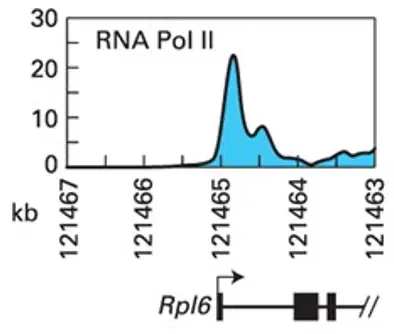
In viewing results from ChIP on a graph from a bidirectional promoter (CpG islands), what would you expect to see in terms of the peaks?
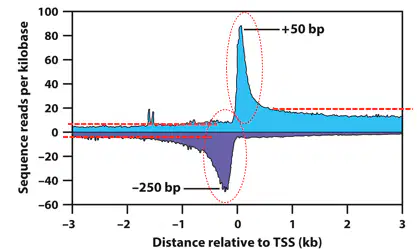
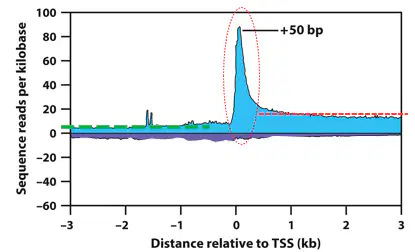
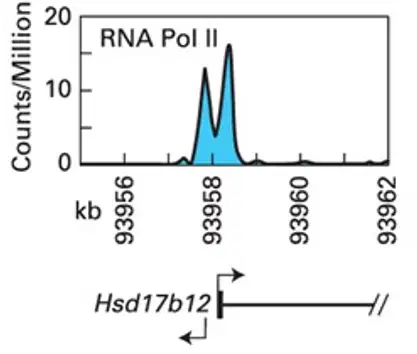
In viewing results from a procedure similar to immunoprecipitation, what would you expect to see in terms of the peaks of a bidirectional promoter (CpG islands)?
Massive parallel DNA sequencing can sequence _ billion DNA fragments at a time
(a)
In initiation of transcription, TF2_ and TF2_ help TF2_ sit on the DNA and bend the DNA in such a way that the initiator becomes exposed (allowing RNA polymerase to bind to both TF2_ and the initiator to form the core pre-initiation complex)
Type answer as TF2X, TF2Y, TF2Z
(a)
Which general transcription factor has both helicase and kinase activity?
TFIID
TFIIB
TFIIA
Strain on DNA structure assists the ____ N-terminal region and ____ to melt the DNA at the transcription start site, forming the transcription bubble.
TFIIB, RNA Polymerase 2
TFIIH, RNA Polymerase 2
TFIID, RNA Polymerase 2
Transcription activators and repressors are modular proteins containing two major domains. List these domains.
True or False? Promoter-proximal regulatory elements are usually functional if moved (position independent), while enhancers (distal regulatory elements) are position dependent and usually non-functional if moved.
True
False
True or False? Promoter-proximal regulatory elements drive transcription in one direction only.
True
False
A (a) is a frequently found sequence in proteins with a similar function
In a protein, motifs refer to ______ and domains refer to ______.
functions, sequences
sequences, functions
Which of the following motifs is DNA binding and characterized by regularly spaced cysteines, histidines, and a hydrophobic amino acid?
Zn++ finger motif
Leucine zipper motif
Helix-turn-helix motif
Helix-loop-helix motif
Match the domains of the receptor/transcriptional activator to their location on the protein:
A) N-terminal region
B) Center region
C) C-terminal region
A) Hormone-binding domain
B) DNA-binding domain
C) Activation domain
A) Activation domain
B) Hormone-binding domain
C) DNA-binding domain
A) Activation domain
B) DNA-binding domain
C) Hormone-binding domain
A) Hormone-binding domain
B) Activation domain
C) DNA-binding domain
A) DNA-binding domain
B) Activation domain
C) Hormone-binding domain
Which domain is responsible for the translocation of the lipid-Hormone receptors/transcription activators to the nucleus?
Activation domain
Hormone-binding domain
DNA-binding domain
Which histone protein is NOT part of the nucleosome octamer core?
H1
H2B
H2A
H3
H4
Transcription activators bound to enhancer interact with various proteins, co-activators, and other transcription factors. Which of the following is NOT a type of protein that interacts with transcriptional activators bound to enhancers?
Chromatin remodelling factors
Histone modifying enzymes
The mediator complex
General RNA Pol II transcription factors
Histones
True or False: Activators/coactivators stimulate the assembly of preinitiation complexes and move nucleosomes away from the promoters.
True
False
Which of the following motifs mediates the interaction between two polypeptides to make a dimer activator (has a stretch of hydrophobicity when a coil is formed)?
Zn++ finger motif
Leucine zipper motif
Helix-turn-helix motif
Helix-loop-helix motif
True or false? Although genetically inactive, heterochromatin is accessible to transcriptional machinery.
True
False
True or false? Pioneer transcription factors are NOT activators.
True
False
The _-termini of histones are modified by post-translational modifications (PTMs).
N-termini
C-termini
Epigenetic inheritance refers to chromatin structure that is not encoded in DNA, but encoded in (a) .
A nucleosome is made up of _ histone proteins (Type the number)
(a)
In yeast, two mating type loci, ___ and ___, are constantly repressed through chromatin structure.
Rap1
HMR
HML
TAR
____ is a repressor molecule that binds to telomeric repeats and recruits co-factors.
Sir3
Rap1
Sir4
Sir2
___ & ___ are co-repressors that bind to each other and bind to deacetylated histone tails (H3 and H4 N-terminal tails)
Sir3
Rap1
Sir4
Sir2
Telomere
____ is a co-repressor that also functions as a histone-deacetylase and removes acetyl groups from the lysines of histone tails
Sir3
Rap1
Sir4
Sir2
Telomere
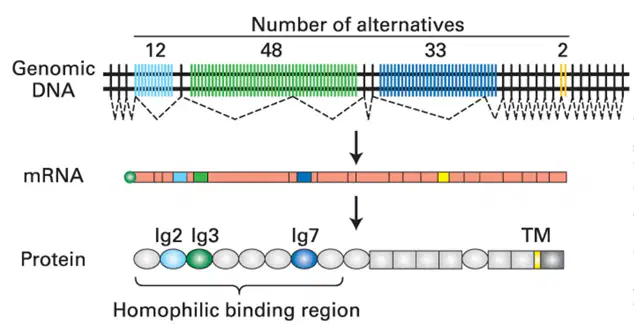
How many alternative transcripts can be produced by the DSCAM gene in Drosophila?
48
38016
95
17000
47
There are ___ possible isoforms of a membrane Ca++ -activated K+ channel
from a single mRNA.
1296
576
384
65
In the regulation of sexual differentiation in drosophila, ___ is a transcription factor that can work as an activator or repressor depending on an event of alternative splicing.
Sxl
Dsx
Tra
In the regulation of sexual differentiation in drosophila, ___ is an RNA binding protein that acts as an activator of splicing of specific exons
Sxl
Dsx
Tra
In the regulation of sexual differentiation in drosophila, ___ is an RNA binding protein that acts as an suppressor of splicing of specific exons
Sxl
Dsx
Tra
Lysine (K) → Arginine (R) substitutions in histone tails maintain permanent gene _______ at telomeres.
gene repression
gene activation
Lysine (K) → Glutamine (E) substitutions in histone tails maintain permanent gene _______ at telomeres.
gene repression
gene activation
Acetylation of the histone tails ______ their positive charge and _______ transcription
increases, induces
reduces, suppresses
reduces, induces
increases, suppresses
Pax6 contains _ alternative promoters, _ transcription initiation sites, and more than _ enhancers.
Type answer as numbers in A, B, C format.
(a)
True or False? The 5’ end of the mRNA transcript is capped by 7m-Guanosine before RNA polymerase II associates with NEFL and DSIF (elongation inhibitors)
Match the type of signalling to the description:
Affects target cells some distance from site of synthesis
Signaling by plasma membrane-attached proteins
Endocrine
Paracrine
Autocrine
Match the type of signalling to the description:
Cells respond to signals that they produce
Signaling by plasma membrane-attached proteins
Endocrine
Paracrine
Autocrine
Which of the following secondary messengers are water-soluble?
IP3
Ca2+ ions
cAMP
cGMP
DAG
Which of the following secondary messengers are lipid-soluble?
IP3
Ca2+ ions
cAMP
cGMP
DAG
Match the type of signalling to the description:
Affects target cells in close proximity
Signaling by plasma membrane-attached proteins
Endocrine
Paracrine
Autocrine
What is GAP in a GPCR signalling pathway?
The GPCR
The effector molecule
The G-protein
CREB
Which subunit of the tyrosine kinase has an activation loop?
True or False? Phosphorylation of the catalytic centers of the protein kinases leads to dimerization of the protein kinases.
True
False
In the MAP Kinase signalling pathway, Ras is a...
G-protein Coupled Receptor
GTPase switch protein
Receptor Tyrosine Kinase
Oncogene
Tumor Suppressor Gene
Which of the following domains is involved in signal transduction?
Transactivation domain
Leucine zipper
SH2
SH3
Zn finger
Which of the following residues is the SH2 domain within GRB2 highly specific to?
Phosphoserine residues
Proline residues
Serine residues
Tyrosine residues
The association between Ras and Raf means activation of the GTPase activity of ___
SOS
Sir2
GRB2
____ acts as a GEF (Guanine nucleotide exchange factor) that activates Ras by replacing GDP with GTP
Rap1
SOS
Sir2
GRB2
14-3-3 is dedicated inhibitor of ___
ERK (MAPKKK)
MEK (MAPKK)
Ras
Raf (MAPKKK)
___ goes to the nucleus and phosphorylates a transcriptional factor.
Ras
MAPKKK
MAPKK
MAPK
Raf
True or False? There is no second messenger molecule present in the Ras/MAP Kinase pathway.
True
False
True or False? Ras, an oncogene that ultimately changes the expression of Fos (another oncogene), is a G-switch protein that transmits a signal through a GPCR.
In the MAP Kinase pathway, when ERK (MAPK) goes into the nucleus, what does it do?
It phosphorylates transcription factors
In the MAPK pathway, how many transcription factors are needed to sit on the SRE (Considered a mini-enhancer upstream of the promoter)?
Six
Which kinase phosphorylates SRF (which ultimately binds to the SRE)
RSK
MAPKK
Ras
True or False? PI 3-phosphates and PI diphosphates (second messengers) contain PH domains.
True
False
In the PI-3 kinase phosphoinositide signaling pathways, PI-3 kinase produces which of the following second messengers?
PhosphoInositol 2,3,4- triphosphate (IP3)
PhosphoInositol 1,2,- biphosphate (IP2)
PhosphoInositol 3,4,- biphosphate (IP2)
PhosphoInositol 3,4,5- triphosphate (IP3)
PhosphoInositol 4,5,- biphosphate (IP2)
True or False? In unstimulated cells, PI2 and PI3 are high.
False
True
True or False? Inactive PKB (a kinase) exists in the cytosol.
True
False
After translocating to the membrane, membrane-bound PKB is phosphorylated by ___ and ___, thus becoming fully activated.
SH2
PI-3 Kinase
PDK1
PDK2
MAPK
WIthin the genome, genes that are in close proximity to (a) , which are large blocks of heterochromatin, are strongly repressed.
True or False? CDKs promote their own activation and inactivation.
True
False

