
 Worksheets
Biology Quiz - Midterm Practice
Total questions: 105
Worksheet time: 9hrs 45mins
Which of the following is NOT a goal of science?
to investigate and understand the natural world
to explain events in the natural world
to use data to support a particular point of view/opinion
to use derived explanations to make useful predictions
All living things maintain a balance within their cells and with the environment through the process of:
irritability
metabolism
stimulus
homeostasis
Biology is the study of
living things
the land, water, and air on Earth.
animals and plants only.
the environment.
Which is NOT a unit of measurement in the International System of Units, or SI (metric system)?
meter
ounce
liter
gram
Which organelle converts the chemical energy stored in food into compounds that are more convenient for the cell to use?
chloroplast
Golgi apparatus
endoplasmic reticulum
mitochondrion
Which organelle makes proteins using coded instructions that come from the nucleus?
Golgi apparatus
mitochondrion
vacuole
ribosome
The main function of the cell wall is to
support and protect the cell.
store DNA.
direct the activities of the cell.
help the cell move.
Under a microscope, a student observes a specimen containing a cell wall, nucleus, central vacuole, and chloroplasts. Which of the following could the specimen being observed belong to?
oak tree leaf
human
bacteria
cat hair
Which of the following is a function of the cell membrane?
breaks down lipids, carbohydrates, and proteins from foods
stores water, salt, proteins, and carbohydrates
regulates which materials enter and leave the cell
keeps the cell wall in place
If available, the body will always digest which macromolecule for energy first?
lipids
proteins
enzymes
Carbohydrates
The class of macromolecule that would most likely be involved in contracting muscles would be
lipids
proteins
enzymes
carbohydrates
Animals store most of their excess energy reserves as _______ because
glucose; it is easy to break down.
fat; they store twice as much energy per gram.
protein; it is a compact source of energy in their bodies.
carbohydrates; they store twice as much energy per gram of glucose.
In a hypotonic solution, water will move ____ the cell, causing the cell to ____.
Into; shrivel
Into; lyse/swell
Out of; lyse/swell
Out of; shrivel
This process occurs when the cell uses energy to bring something in from outside the cell.
Endocytosis
Exocytosis
Osmosis
Diffusion
Which of the following types of cellular transport does not require extra energy?
Endocytosis
Exocytosis
Molecular Pumps
Facilitated Diffusion
If an animal cell were placed in a solution of salt water taken from the ocean, what would happen to the cell?
the cell would swell because the water solution is hypotonic.
the cell would swell because the water solution is hypertonic.
the cell would shrivel because the water solution is hypotonic.
the cell would shrivel because the water solution is hypertonic.
Which of the following best describes an isotonic solution?
there is more solute outside the cell than inside the cell.
there is less solute outside the cell than inside the cell.
the concentration is equal on both sides of the membrane.
none of the above.
A climax community is reached
at the beginning of succession.
in the middle of succession.
at the end of succession.
when an ecosystem is destroyed.
In a food web, insect eating birds would be classified as:
carnivores.
decomposers.
herbivores.
omnivores.
Organisms that use energy from the sun to make their own food are called
detritivores.
consumers.
omnivores.
producers.
The algae at the beginning of the food chain in water would be:
consumers.
decomposers.
producers.
heterotrophs.
Which of the following organisms does NOT require sunlight to live?
chemosynthetic bacteria
algae
trees
photosynthetic bacteria
Fish, their predators, and the water, sunlight, and plants that they rely on would be considered a(n).
abiotic factor
population
community
ecosystem
A group of coyotes living around Rhode Island would be considered a(n).
abiotic factor
population
community
ecosystem
In general, which trophic level has the LEAST energy available to it?
producer/autotroph
primary consumer
secondary consumer
tertiary consumer
What animals eat both plants and animals?
herbivores
omnivores
heterotrophs
autotrophs

The figure above shows a trophic pyramid for an ecosystem. What happens to the amount of energy in the pyramid as it moves up through the different levels?
energy increases by 10% each level
energy decreases by 90% each level
energy decreases by 10% each level
energy increases by 90% each level
In food chains, the flow of energy is ALWAYS ________.
one-way
reversible
two-way
uncontrolled
Only 10 percent of the energy stored in an organism can be passed on to the next trophic level. Of the remaining energy, some is used for the organism's life processes, and the rest is:
used in reproduction.
stored as body tissue.
stored as fat.
eliminated as heat.
Carbon cycles through the biosphere in all of the following processes EXCEPT
photosynthesis.
transpiration.
respiration/breathing.
decomposition.
Why do the movements of energy and nutrients in living systems differ?
Energy flows in one direction, and nutrients recycle.
Energy is limited in the biosphere, and nutrients are always available.
Nutrients flow in one direction, and energy recycles.
Energy forms chemical compounds, and nutrients are lost as heat
Which is a biotic factor that affects the size of a population in a specific ecosystem?
number and kinds of predators in the ecosystem
type of soil in the ecosystem
average temperature of the ecosystem
concentration of oxygen in the ecosystem
Several species of warblers can live in the same spruce tree ONLY because they
have different habitats within the tree.
eat different foods within the tree.
occupy different niches within the tree.
can find different temperatures within the tree.
The symbiotic relationship between a flower and the insect that feeds on its nectar is an example of:
mutualism because the flower provides the insect with food, and the insect pollinates the flower.
parasitism because the insect lives off the nectar from the flower.
commensalism because the insect doesn't harm the flower, and the flower doesn't benefit from the relationship.
predation because the insect feeds on the flower.
What is one difference between primary and secondary succession?
Primary succession is slow, and secondary succession is rapid.
What is one difference between primary and secondary succession?
a. Primary succession is slow, and secondary succession is rapid.
b. Secondary succession begins on soil, and primary succession begins on newly exposed surfaces, like lava rock.
c. Primary succession modifies the environment, and secondary succession does not.
d. Secondary succession begins with lichens, and primary succession begins with trees.
What is the original source of almost all the energy in most ecosystems?
a. carbohydrates
b. sunlight
c. water
d. carbon
What can cause a population to grow?
a. The birth rate becomes higher than the death rate.
b. The birth rate stays the same, and the death rate increases.
c. The birth rate becomes lower than the death rate.
d. The birthrate and the death rate remain the same.
When individuals in a population reproduce at a constant rate, it produces a growth pattern called:
a. logistic growth.
b. growth density.
c. demographic growth.
d. exponential growth.
Which are two ways a population can decrease in size?
a. immigration and emigration
b. increased death rate and immigration
c. decreased birth rate and emigration
d. emigration and increased birth rate
Organisms that obtain nutrients by breaking down dead and decaying plants and animals are called:
a. decomposers.
b. omnivores.
c. autotrophs.
d. producers.
If a population grows larger than the carrying capacity of the environment, then
a. the birth rate may rise.
b. the death rate may rise.
c. population will grow faster.
d. carrying capacity will change.
What is the term for part of Earth where all living things, like plants and animals, exist?
a. biosphere
b. ecosystem
c. population
d. environment
What distinguishes a niche from a habitat?
a. A habitat is the physical location where an organism lives, while a niche is the organism's role or job in that place.
b. A niche is the physical location where an organism lives, while a habitat is the organism's role or job in that place.
c. Both habitat and niche refer to the physical location where an organism lives, with no difference.
d. Both habitat and niche refer to the organism's role or job in a specific place, with no difference.
What pattern of growth is shown by humans on Earth, whose population is growing out of control?
a. exponential
b. logistic
c. carrying capacity
d. population crash
Each of the following is a density-dependent limiting factor EXCEPT
a. competition.
b. unusual weather.
c. crowding.
d. disease.
Barnacles hitch a ride on a whale through nutrient rich waters. The whale is unaffected. This is an example of:
a. commensalism
b. mutualism
c. parasitism
d. predation
A volcano erupts and covers the entire island it is on with lava. Once it eventually hardens, primary succession begins to occur. Which of the following lists the correct order in which plant growth would occur?
a. shrubs → plants → coconut trees → sea grasses
b. volcanic rock → lichen → mosses → grasses → coconut trees
c. volcanic rock → shrubs → coconut trees → sea grasses
d. volcanic rock → sea grasses → coconut trees → shrubs
A logger clears a forest and the forest re-grows over many subsequent years. Which type of succession represents the regrowth of this forest?
a. primary succession
b. secondary succession
c.pioneer species
d. climax community
Which of the following is a density-independent factor?
a. earthquake
b. disease
c. predation
d. parasitism
Tapeworms feed off their host organism. This makes them a __________.
a. competitor
b. predator
c. host
d. Parasite
An insect gathers pollen and nectar for food, but at the same time is aiding in the plant's reproduction by spreading pollen to other flowers it visits. What does this relationship demonstrate?
predation
commensalism
mutualism
parasitism
All the interconnected feeding relationships in an ecosystem make up a food:
interaction
chain
network
web
Nitrogen fixation is carried out primarily by
a. humans.
b. plants.
c. bacteria in the soil.
d. consumers.
Each of the following is an abiotic factor in the environment EXCEPT
a. plant life.
b. soil type.
c. rainfall.
d. temperature
What is a common characteristic of pioneer species?
a. They are large mammals that dominate ecosystems.
b. They are the final stage in ecological succession.
c. They are typically the first to colonize newly formed or disturbed habitats.
d. They require stable and mature environments to thrive.
An interaction in which one organism captures and feeds on another organism is called
a. competition.
b. symbiosis.
c. mutualism.
d. predation.
The series of predictable changes that occur in a community over time is called
a. population growth.
b. ecological succession.
c. planting trees.
d. climate change.
The variety of species in an area is a measure of
a. population
b. biodiversity
c. niche
d. autotroph
What dispersal pattern describes individuals spaced irregularly throughout their habitat?
Clumped dispersal
Random dispersal
Uniform dispersal
Seasonal dispersal
The movement of organisms into a given area from another area is called
a. immigration.
b. emigration.
c. population shift.
d. carrying capacity.
Which of the following describes the largest number of individuals that an environment can support?
a. carrying capacity.
b. immigration.
c. emigration.
d. exponential growth.
The arrows in a food chain or web represent what?
they point to the organism being eaten
it shows the flow of sunlight
they show the direction of energy flow between organisms
they represent the movement of water
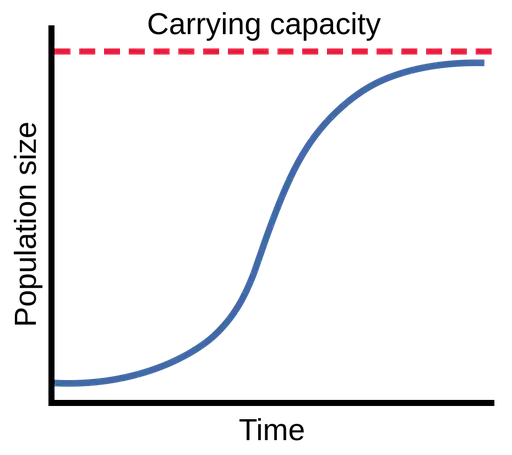
The graph above right shows:
exponential growth
logistic growth
biodiversity
carrying capacity
Which of the following best defines a keystone species?
A species that is abundant in an ecosystem and dominates the food chain.
A species that plays a critical role in maintaining the structure and functioning of an ecosystem.
A species that is at the top of the food chain and has no natural predators.
A species that is rare and has little impact on the surrounding environment
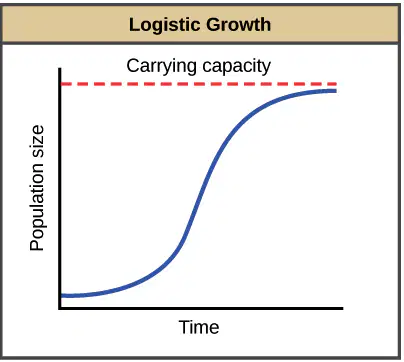
What does the dotted line in the graph represent?
The population increased at a constant rate.
The population increased rapidly and then leveled off.
The population increased at an exponential rate.
Ecosystems are able to support any number of species.
Which of the following describes the largest number of individuals that an environment can support?
carrying capacity
immigration
emigration
exponential growth
The movement of organisms into a given area from another area is called
carrying capacity
population drift
emigration
immigration
What dispersal pattern describes individuals spaced irregularly throughout their habitat?
clumped
random
uniform
seasonal
The variety of species in an area is a measure of
population
niche
autotroph
biodiversity
The series of predictable changes that occur in a community over time is called
population growth
ecological succession
planting trees
climate change
An interaction in which one organism captures and feeds on another organism is called
competition
symbiosis
predation
mutualism
What is a common characteristic of pioneer species?
they are large mammals that dominate ecosystems
they are the final stage in ecological succession
they are typically the first to colonize newly formed or disturbed habitats
they require stable and mature environments to thrive
What distinguishes a niche from a habitat?
A habitat is the physical location where an organism lives, while a niche is the organism's role or job in that place.
A niche is the physical location where an organism lives, while a habitat is the organism's role or job in that place.
Both habitat and niche refer to the physical location where an organism lives, with no difference.
Both habitat and niche refer to the organism's role or job in a specific place, with no difference.
controlled experiment allows the scientist to isolate and test
a conclusion
a mass of information
several variables
a single variable
Scientific hypotheses must be proposed in a way that:
ensures that an experiment will be valid.
enables them to be proved valid.
enables them to be tested.
doesn't contradict previous hypotheses.
What is 5 kilometers equivalent to in meters?
50 meters
500 meters
5,000 meters
50,000 meters
A scientific theory
is always true
is the opening statement of an experiment
may be revised or replaced as new evidence emerges
is a problem to be solved
All of the following are characteristics of all living things EXCEPT
growth.
reproduction.
movement of the whole organism.
use of energy.
When designing an experiment, scientists will test a relationship between a “cause” and an “effect”. The “effect”, also represented by what the scientist measures and records, is known as the:
constant
dependent variable
control group
independent variable
The basic unit of mass in the International System of Units, or SI, is the
meter
ounce
liter
gram
Which of the following descriptions about the organization of an ecosystem is correct?
Individuals make up populations, which make up species, and together they make up communities.
Communities make up species, which make up populations, and together they form individuals.
Populations make up individuals, which make up communities, and together they form species.
Species make up individuals, which make up communities, and together they form populations.
Which of the lab tools measures liquids most accurately?
beaker
Erlenmeyer flask
graduated cylinder
test tube
In an experiment, all variables are held constant except for one. Then, experimental results are compared to that one variable. What type of experiment is this?
a variable experiment
a multifactor experiment
a controlled experiment
a hypothetical experiment
Cells fall into two broad categories, depending on whether they
have a cell wall.
contain genetic material.
have a nucleus.
contain chloroplasts.
Eukaryotes usually contain
a nucleus.
specialized organelles.
genetic material.
all of the above.
Which statement is a fundamental principle of cell theory?
All cells have a plasma membrane.
Eukaryotic cells are larger than prokaryotic cells.
Living organisms are composed of cells.
The genetic material in cells is DNA.
The nucleolus is responsible for making
fats
ribosomes
DNA
cell membrane
Which statement is true about bacteria cells?
The cells are very large.
The cells have no nucleus.
They are eukaryotes.
They have organelles.
Plant cells have a large central vacuole to store
water
waste products
DNA
chlorophyll
The invention of the microscope allowed for scientists to study
ecosystems
cells
macromolecules
heterotrophs
The thin, flexible barrier around a cell is called the
cell membrane.
cell wall.
cell envelope.
cytoplasm.
Which cell structure contains the cell's genetic material and controls many of the cell's activities?
organelle
nucleus
cell envelope
cytoplasm
Which of the following statements best describes metabolism?
the process of breaking down food for energy
the storage of energy
the ability to move rapidly
the production of new individuals through reproduction
Proteins are made of monomers called
amino acids
monosaccharides
nucleotides
protein chunks
What is the primary macromolecule of the plasma membrane?
carbohydrates
lipids
proteins
nucleic acids
Which organelle digests foreign substances and worn out cell parts?
cell Membrane
flagella
lysosomes
mitochondria
Which organelle acts as a whipping propeller, moving a cell through its environment?
cell membrane
mitochondria
lysosomes
flagella
Which set of elements is most abundantly found in living organisms?
Sodium, Potassium, Oxygen, Nitrogen, Carbon, Hydrogen
Sulfur, Phosphorus, Oxygen, Nitrogen, Carbon, Helium
Silicon, Phosphorus, Oxygen, Nitrogen, Carbon, Hydrogen
Sulfur, Phosphorus, Oxygen, Nitrogen, Carbon, Hydrogen
Which principle of cell theory best supports the idea that new cells will replace damaged cells in a scraped knee?
all living things are made of one or more cells.
cells are the basic unit of life.
all cells come from other cells.
the nucleus of cells in animals reproduces when exposed to air.
Life can exist under frozen surfaces in polar seas because…
water is less dense as a solid.
water has a high surface tension.
water is a terrific solvent.
water has a high specific heat.
When placed in water, oil does not dissolve and stays separate. This means oil is ____ and ___ .
hydrophilic and polar
hydrophobic and polar
hydrophilic and nonpolar
hydrophobic and nonpolar
Which of the following is not likely to be a limiting factor on the sea otter population?
disease
competition
drought
predation
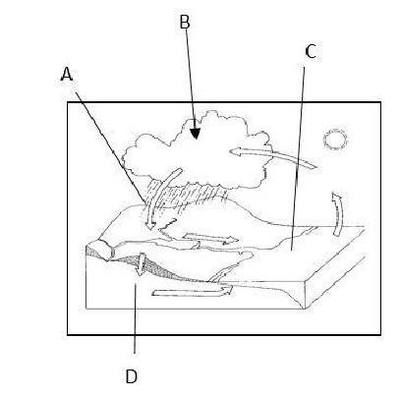
Arrow A is pointing to
evaporation
precipitation
transpiration
runoff
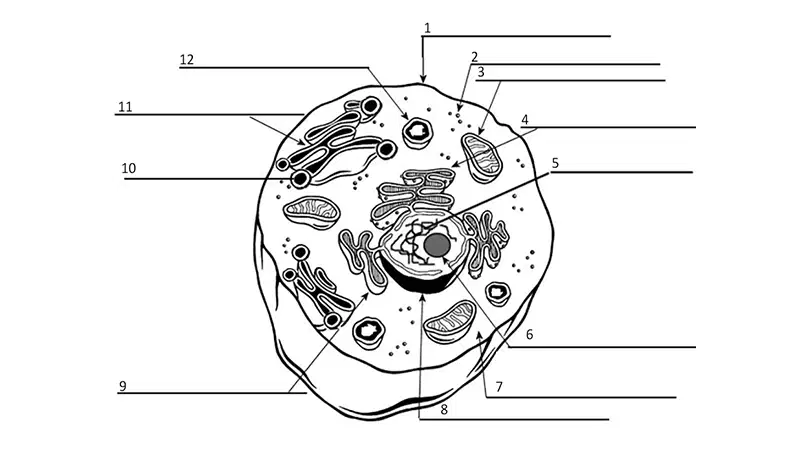
#6 is pointing to:
nucleus
nucleolus
ribosome
lysosome

