
 Worksheets
Physical Science Midterm Exam Practice
Total questions: 100
Worksheet time: 8hrs 20mins

Look at the figure. What kind of graph do you call this?
bar graph
line graph
circle graph
none of the above
Which of the terms below describes the systematic study of the structure and behavior of the physical and natural world through observation, experimentation, and the testing of theories against the evidence obtained?
measurement
curiosity
science
technology
Science and technology are related to each other. Which of the statements below best describes the relationship?
Technology is a branch of natural science.
Science is a branch of technology.
Advances in science may lead to advances in technology and vice versa.
Science and technology are not related.
Which area of Physical Science studies the nature of the universe?
Chemistry
Physics
Biology
Astronomy
What would be the unit used to measure the mass of an object?
grams
meters
Liters
Degrees Celsius
Which part of the scientific method requires that we use our senses?
making observations
analyzing data
drawing conclusions
revising a hypothesis
What happens when the results of an experiment do not support the original hypothesis of the experiment?
The scientist gives up and starts an investigation on a new topic.
The data must be incorrect and are thrown out.
The hypothesis is revised.
The data are altered so that they support the original hypothesis.
Which term below is a scientific statement that explains “how" things happen in nature?
a scientific law
a fact
a scientific theory
a hypothesis
In science, the variable that is being purposefully changed and tested by the scientist, is called:
control
dependent variable
independent variable
Hypothesis
Which of the following statements is true about scientific theories?
Scientific theories will become scientific laws and will never change.
Scientific theories are never proven they just have much supporting evidence and explain the “why”..
Scientific theories become hypotheses and will be changed over time.
Scientific theories summarize patterns found in nature and explain how things happen.
In an experiment, these are factors that don't change in the experiment; they are conditions that are kept the same for all groups in the experiment.
control groups
experimental groups
hypotheses
constants
The Big Bang is a
Scientific Theory
Scientific Law
Model
Hypothesis
What is a visual representation of an object or an event in science?
a theory
a model
a hypothesis
a scientific law
Why are scientific models important?
They prove scientific theories.
They help visualize things that are very complex, very large, or very small.
They make it harder to understand things.
They never change.
What is the real safety rule here?
Never work with chemicals.
Always use unbreakable glassware.
Always follow your teacher's instructions and textbook directions exactly.
Never do experiments that involve flames or hot objects.
Which of the following is an example of a safe laboratory procedure?
tying back long hair and loose clothing
eating or drinking from laboratory glassware
touching hot objects with your bare hands
testing an odor by directly inhaling the vapor
How is 0.00069 written in scientific notation?
69 × 10-5
6.9 x 10⁴
0.69 × 10⁻³
6.9 × 10⁻⁴
Which of the following conversion factors would you use to change 18 kilometers to meters?
1000 m/1 km
1 km/1000 m
100 m/1 km
1 km/100 m
There are 3 Liters of water in the container. This is the same as
3 g
300 kL
3000mL
0.3mL
Timers at a swim meet used four different clocks to time an event. Which recorded time is the most precise?
55 s
55.2 s
55.25 s
55.254 s
Which of the following clocks offers the most precision?
a clock with only one hand to measure the hour
a clock with only one hand to measure the minutes
a clock with a hand to measure the hour and a hand to measure the minutes
a clock with a hand to measure the hour, a hand to measure the minutes, and a hand to measure the seconds
On the Celsius scale, at what temperature does water boil?
0°
212°
100°
32°
A lab group got the following measurements after measuring the density of an aluminum block three times Trial 1: 2.56 g/cm³ Trial 2: 3.0 g/cm³ Trial 3: 3.21 g/cm³ If the true measurement of the density of the block of aluminum is 2.70 g/cm³, how would you describe the measurements taken by the lab group?
accurate
precise but not accurate
Both accurate and precise
Neither accurate or precise
The type of graph used to show how a part of something relates to the whole, represented by percentages, is this type of graph:
circle graph
bar graph
line graph
direct proportion
When analyzing data that involves numbers, it is considered
qualitative
error free
constant
quantitative
How do scientists communicate the results of investigations?
by publishing articles in scientific journals
by giving talks at scientific conferences
by exchanging emails
all of the above
How do scientists who speak different languages make their data understandable to one another?
They all use different systems of measurement.
They all use SI (Systeme International/metric system) of measurement
They communicate through a universal translator.
They all must speak French.
What is the part of an experiment that serves as a comparison in an experiment?
control group
hypothesis
independent variable
dependent variable
37 degrees Celsius converted to Fahrenheit, is:
98.6 F
80.6 F
-27 F
68 F
When creating a graph, the independent variable is placed on the ___ axis and the dependent variable on the ___ axis
y and x
x and x
y and y
x and y
The shape of an orbit of a planet around the sun is a(an)
ellipse
straight line
perfect circle
parabola
When our solar system was forming, nearly all of the mass of the solar nebula became part of
the terrestrial planets
the gaseous planets
the sun
the Oort cloud
Mars, Mercury, Venus and Earth are all.
terrestrial planets
gas giants
stars
asteroids
According to the nebular theory, the solar system formed from
gravity pulling particles of dust and gas together
large, thin cloud of dust and gas.
colliding planetesimals.
all of the above
The following statement is TRUE about terrestrial planets.
They are much larger than the other planets
They have a very low density
They are the outermost planets
They have a rocky surface or a crust and an iron core
In a model representing the solar system as heliocentric, what is located at the center?
The Earth
The moon
The sun
Mars
Which of the following is the most likely reason that ancient observers believed that Earth was the center of the universe?
The Earth seemed to move on its axis.
Earth's motions are only recently known because of high-powered telescopes.
Objects in the sky appear to circle around Earth.
Ancient observers believed the universe was stationary with no movement.
Which of the following helps explain why the planets remain in orbit around the sun?
gravity
density
magnetism
wind resistance
The sun's energy is produced by
the gravity.
nuclear fission.
nuclear fusion.
an ordinary chemical reaction.
What will happen to the relative amounts of hydrogen and helium in the sun over the next few billion years?
Hydrogen will increase and helium will decrease.
Hydrogen will decrease and helium will increase.
Both hydrogen and helium will decrease.
Both hydrogen and helium will remain the same.
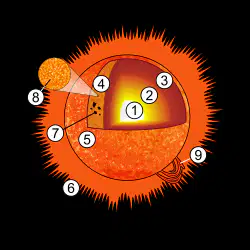
Examine the figure. #2 represents the sun's
a radiation zone.
b convection zone.
core
photosphere
The distance between stars is typically measured in
light-years.
kilometers.
astronomical unit
miles
What is the eventual fate of a star like the Sun, after it exhausts its nuclear fuel?
It expands into a red giant and then collapses into a black hole.
It undergoes a supernova explosion, scattering its outer layers into space.
It transforms into a white dwarf and gradually cools over billions of years.
It remains stable as a main-sequence star for an indefinite period.
How do astronomers primarily classify stars based on their characteristics?
By their color, temperature, and brightness
By their size, mass, and age
By their distance from Earth and luminosity
By their composition and spectral characteristics
At this point our Universe is estimated to be
4.8 million
4.8 billion
13.8 million
13.8 billion
The hottest stars in the sky appear
Red, they give off the most energy
Red, they give off the least energy
Blue, they give off the most energy
Blue, they give off the least energy
The sun remains stable over time because
it is constantly losing mass
it is a white dwarf
of solar flares
nuclear fusion in its core balances out gravitational forces trying to collapse it
The life cycle of a star begins with a cloud of gas and dust called a
protoplanet.
constellation.
protosun.
nebula
All stars remain on the main sequence.....
for about 90 % of their lifetimes
until they become protostars
until about 10 billion years
until they stabilize
Both high-mass and low-mass adult stars fusing Hydrogen into Helium are classified as ...
white dwarfs
main sequence stars
supernovas
neutron stars
Which kind of star is most likely to spend the longest time on the main sequence?
low-mass red star
high-mass blue star
a yellow medium mass star like the sun
a bright star
Low-mass and medium-mass stars like our sun eventually...
grow into a supergiant.
become supernovas.
become neutron stars
turn into white dwarfs
When the absorption lines of a galaxy shift toward the blue end of the spectrum, it means that the galaxy is (use EM spectrum to help-is blue more frequent or less?)
moving away from Earth.
moving closer to Earth.
small and young
large and old
The big bang theory explains the
origin of the universe
life cycle of the star
Doppler effect
arrangement of constellations
Hubble's Law states that the speed at which a galaxy is moving away is proportional to the
mass of the galaxy
galaxy's distance from Earth
number of stars in the galaxy
age of the galaxy
Which of the following provides support for the big bang theory?
red shift
cosmic background radiation
elliptical galaxies
both (a) and (b)
Dark matter can be detected by its
cosmic microwave background radiation.
red shift.
gravitational effects on visible matter.
velocity.
What term is used to describe the rapid expansion of the universe at the beginning, as proposed by the Big Bang theory?
formation of galaxies
nucleosynthesis
mystery
cosmic inflation
Using powerful new telescopes such as the Hubble Telescope, scientists are able to see ....
the life on other planets
100 billion light years away
far into the past
into the future
A mechanical wave moves through a medium, which can be
a liquid
a gas
a solid
all of the above
A mechanical wave generally does NOT
move the medium/matter from one place to another.
move through a medium.
move through solids.
disturb the medium.
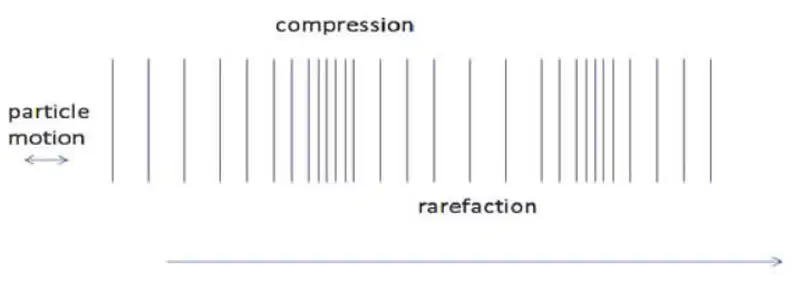
This is an example of
a transverse wave
a surface wave
a longitudinal/ compressional wave
light wave
Transverse and longitudinal waves both
have compressions and rarefactions.
transfer energy through a medium.
move at right angles to the vibration of the medium.
are capable of moving the medium a long distance.
Which wave causes the medium to vibrate only in a direction parallel to the wave’s motion?
a transverse wave
a longitudinal/ compressional wave
a surface wave
none of the above
A period is the length of time it takes for
a disturbance to start a wave.
two complete wavelengths to pass a fixed point.
a wave to travel the length of a rope.
one complete wavelength to pass a fixed point.
To determine the speed of a wave, you would use which of the following formulas?
speed = frequency × amplitude
speed = wavelength × amplitude
speed = wavelength × frequency
speed = wavelength × period
A wave has a wavelength of 10 m and a frequency of 5.0 hertz. What is its speed?
50 m/s
2.0 m/s
50 hertz/s
0.50 m/s

What is the amplitude of the wave on this figure?
0.3m
3m
-3m
-0.3m
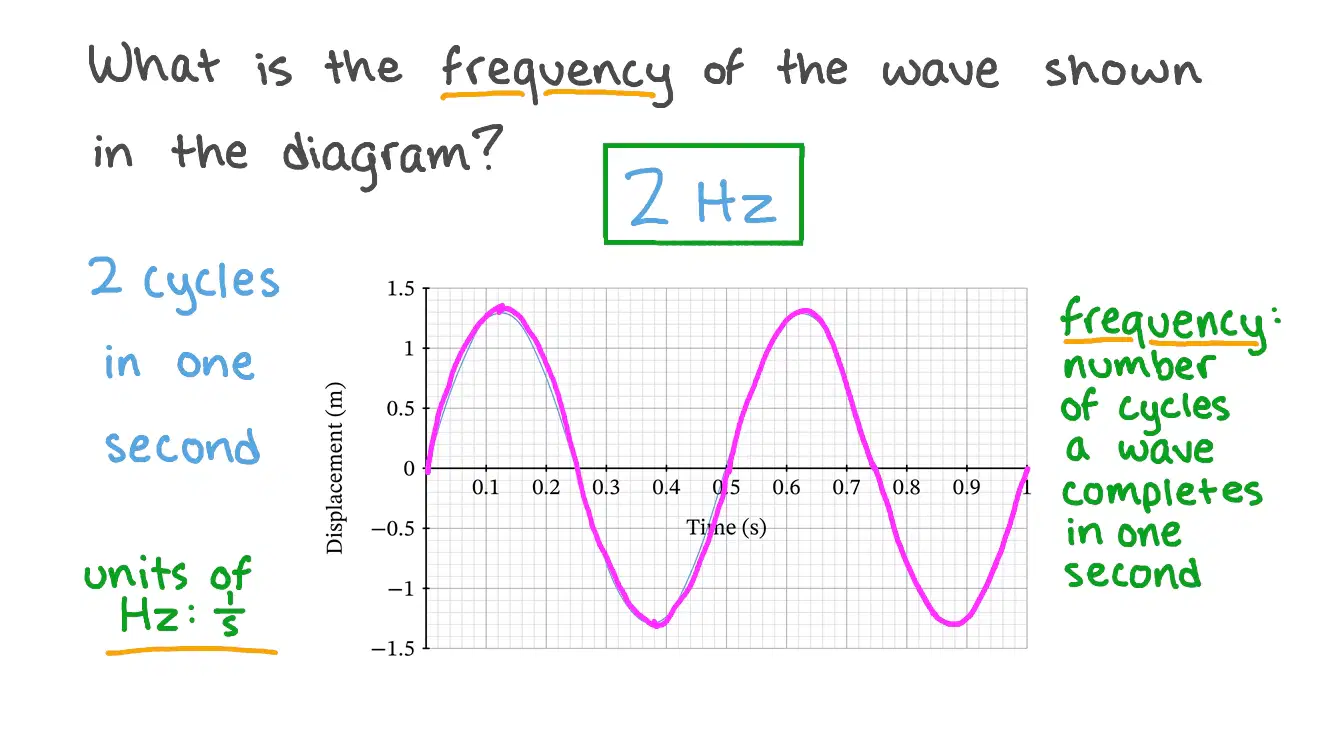
What is the frequency of this wave?
2 Hertz
0.5 seconds
0.2m/s
1 Hertz
To find the amplitude of a wave, measure
distance from midpoint to crest
the speed of the wave
the frequency of the wave
the wavelength from peak to trough
When a wave strikes a solid barrier, it behaves like a basketball hitting a backboard. This wave behavior is called
constructive interference.
refraction.
diffraction.
reflection.
When a wave travels from one medium to another, it
changes speeds.
always moves in the same direction.
stays in step.
travels in the opposite direction.
A sound wave is an example of a
transverse wave.
standing wave.
longitudinal/ compressional wave.
surface wave.
An ambulance siren sounds different as it approaches you than when it moves away from you. What scientific term would you use to explain how this happens?
ultrasound
rarefaction
diffraction
the Doppler effect
When a sound source approaches you, the pitch you hear is
lower
higher
unchanged
intesified
A rainbow is created as light passes through water vapor in the air this happens due to
Doppler effect
diffraction
refraction
reflection
Suppose two waves collide and the temporary combined wave that results is smaller than the original
waves. What term best describes this interaction?
diffraction
standing wave formation
destructive interference
constructive interference
These types of waves are the only ones that can travel through a vacuum. (empty space)
Longitudinal
Electromagnetic
Mechanical
Transverse
The speed of sound is
300 m/s
300,000,000 m/s
Can never be changed
Changes if it is louder
What is the wavelength of a sound wave with a frequency of 50 Hz? The speed of sound is 342 m/s.
6.84m
17,100m
0.146 Hz
6.84 Hz
What is the correct order of the 8 planets in our solar system from the Sun outward?
Venus, Earth, Mars, Mercury, Jupiter, Saturn, Uranus, Neptune
Neptune, Uranus, Saturn, Jupiter, Mars, Earth, Venus, Mercury
Mercury, Venus, Earth, Mars, Jupiter, Saturn, Uranus, Neptune
Earth, Mars, Venus, Mercury, Saturn, Jupiter, Neptune, Uranus
Examples of the Doppler effect in waves are
The Red Shift effect
changing pitch of sounds from moving objects
the Blue Shift effect
all of the above
Which two factors determine the gravitational attraction between two objects?
Time and temperature
Mass and distance apart
Shape and orbital speed
Color and hardness
Astronomers learn about the elements in stars by analyzing their
parallax
Apparent brightness
Absorption lines/Spectra
Red shift
Four fundamental properties used to classify stars are?
brightness, mass, luminosity. size
color, brightness, mass, composition
color, brightness, mass, amplitude of wave
color, brightness, mass, luminosity
Which element does our sun make through the process of nuclear fusion?
hydrogen
iron
helium
gold
Which scientist/astronomer was the first to propose that the universe was geocentric?
Ptolemy
Copernicus
Galilei
Aristotle
Which scientist/astronomer was the first to propose that the universe was heliocentric?
Ptolemy
Galilei
Copernicus
Aristotle
According to Kepler's laws of orbital motion, what describes the shape of a planet's orbit?
circular
elliptical
hyperbolic
round
When a massive star (many times larger than our sun) no longer fuse its atoms into anything heavier than iron, it will….
Slowly lose all its energy and become a black dwarf
Collapse and cause a violent supernova explosion
Puff off its outer layers into a planetary nebula leaving the core behind
Cause another big bang (start a new universe)
Our sun will eventually become a _____ when it “dies”.
protostar
white dwarf
neutron star
black hole
The heaviest elements (heavier than Iron), can be formed during…..
The Big Bang
fusion in smaller stars
fusion in massive stars
supernova explosions
What is the correct order of these objects from smallest to largest
Planet, star, solar system, galaxy, universe
Universe, galaxy, solar system, star, planet
Star, planet, galaxy, solar system, universe
Planet, star, solar system, universe, galaxy
What key evidence supports the Big Bang theory as the most widely accepted explanation for the origin of the universe?
Fossilized remains found on Earth
The observation of cosmic microwave background radiation
Patterns of stars in the night sky
Ancient texts describing the creation of the universe
Which of the following pieces of evidence strongly supports the Big Bang theory?
Observations of distant galaxies moving away from each other.
Discovery of extraterrestrial life.
Analysis of rock formations on Earth.
Measurement of Earth's magnetic field.
What determines the amplitude of a wave?
The speed of the wave.
The distance between two consecutive peaks.
The energy carried by the wave.
The frequency of the wave.
What property of a wave is represented by the distance between two consecutive points in phase, such as two adjacent peaks or troughs?
Wavelength
Amplitude
Frequency
Speed
What is the correct sequence of stages in the life cycle of a star?
Nebula, Red Giant, Supernova, White Dwarf
White Dwarf, Nebula, Red Giant, Supernova
Supernova, Nebula, Red Giant, White Dwarf
Nebula, Red Giant, White Dwarf, Supernova
What is the leading scientific explanation for the formation of our solar system?
The Ptolemaic model
The Steady State theory
The Nebular theory
The Geocentric model
According to the Nebular Theory, what is the role of a nebula in the formation of a solar system?
It's a black hole at the center of the system.
It's a cloud of gas and dust that collapses under gravity.
It's a massive star that explodes.
It's a collection of planets orbiting a star.

