
Font size
 Worksheets
Motion & Motion Graphs Quiz Review 24
Total questions: 37
Worksheet time: 42mins


Ashok

How far from Bristol is Anne at 08:00?
2O MILES
1O MILES
30 MILES

How far does the cyclist travel between A and B?
600 meters
800 meters
1200 meters
Match the description to the graph:
"The car is traveling at a constant speed."


In which of the following cases does a car have zero acceleration?
A car speeding up after a stoplight turns green.
A car slowing down when it approaches a stop sign.
A car set on cruise control so that is maintains 45 mi/hr.
A car turning a curve at a constant speed.
Which of the following is an example of deceleration?
a car approaching a stop sign and slowing down
a plane increasing speed down the runway and then taking flight
a roller coaster moving down a steep hill
an airplane cruising in a straight flight plan
An object with increasing acceleration is also increasing in which other property?
mass
temperature
velocity
volume

If a train went past you while standing on a platform, your frame of reference might be:
the background
a car moving in the opposite direction
a man on a pogo stick traveling at the same speed as the train in the same direction
Match the following
When the speed of an object remains the same, it does not increase or decrease, represented by a straight diagonal line on a distance vs. time graph
constant speed
the change in distance over a specific amount of time
speed
An object is at rest, represented by a straight horizontal line on a distance vs. time graph
no speed
an average of all speeds over a given time
average speed
Velocity
The rate at which the position changes
The rate and direction of an object's movement.
The speed of something in a given distance.
quickness of motion or action
In order to determine an object’s location, you need a _____.
time
displacement
speed
reference point
20 km/hr is an example of
direction
velocity
speed
distance
You are in a car going 20 km/h and another car passes you going in the opposite direction at 20 km/h. Do both cars have the same velocity?
Yes, because they are both going 20 km/h
No, because they are going in different directions
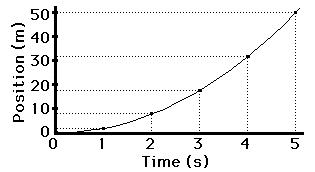
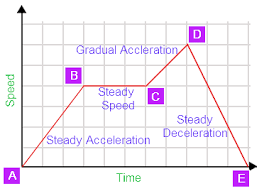
At what point is the speed the greatest?
C-D
B-C
A-B
D-E
A negative acceleration means that your object is _____.
doing nothing
moving in circles
speeding up
slowing down
Match the graph to the description:
"The car is accelerating."
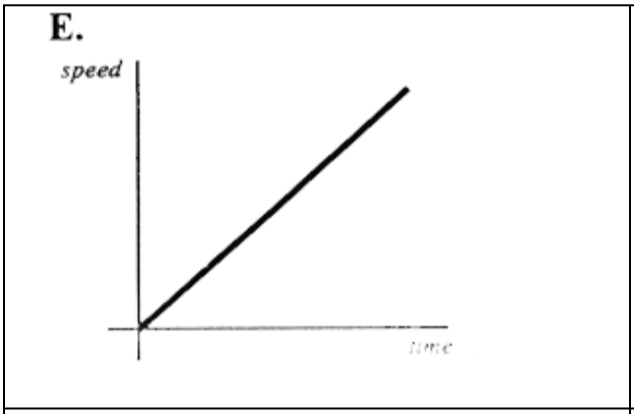
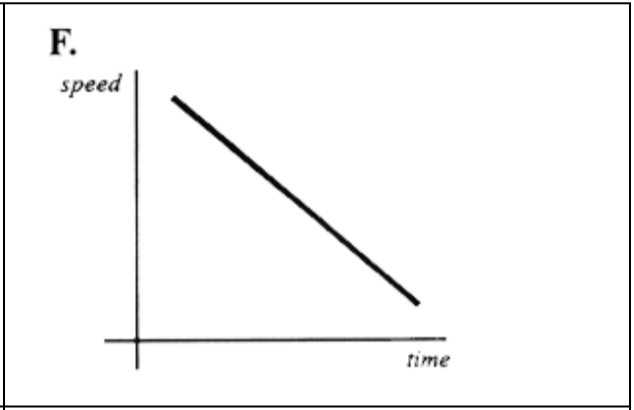
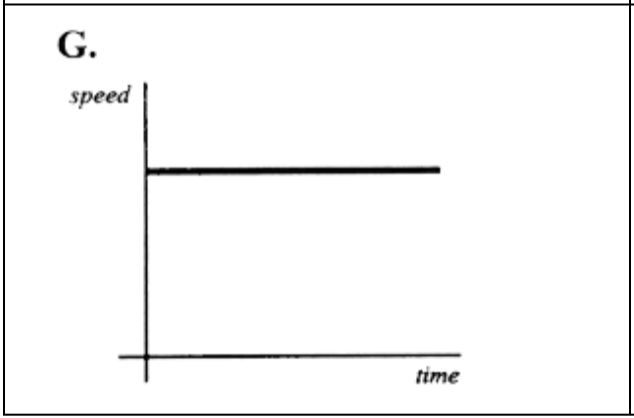
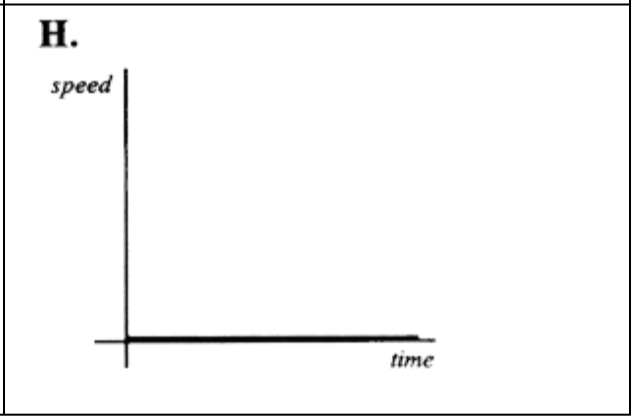

What is this graph showing?
Constant speed
Gradually speeding up
Gradually slowing down
At rest

What is this graph showing?
Fast constant speed
Slow constant speed
At rest
Accelerating
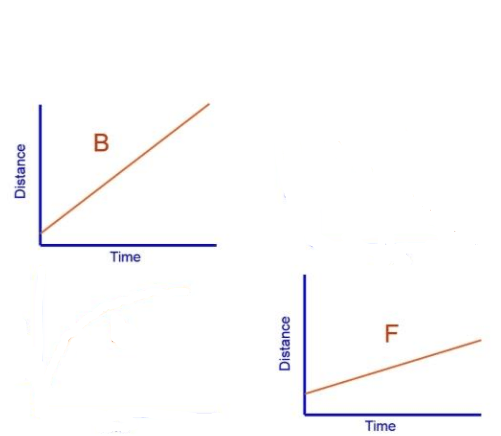

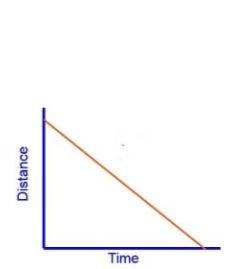
What is this line of this graph showing?
moving away from starting point at a constant speed
moving back towards the starting point at a constant speed
acceleration (getting faster)
deceleration (getting slower)

What is the difference between speed and velocity?
One involves acceleration, the other doesn't
One involves direction, the other doesn't
One involves time, the other doesn't
One involves force, the other doesn't

In which of the following situations is the object’s acceleration zero?
A sprinter taking off at the beginning of a race.
A car traveling at a constant speed down a straight road.
A skateboarder slowing and then rolling to a stop.
A ball falling after being dropped from the top of a building.
Which of the following examples accurately describes an object that is accelerating?
A race car moving at 150 miles/hour.
A sailboat moving west, then north.
A train halfway from New York to Houston.
A book sitting motionless on the bookshelf.
Which of the following best describes an object that is accelerating?
A basketball sits motionless on the gymnasium floor.
A hockey puck slows down as it hits the net.
A soccer ball travels at 3 m/s.
A bird travels 100 km to the northeast.
Two objects traveling at the same speed have different velocities if they
start at different times.
travel different distances.
move in different directions.
have different masses.

This graph represents an object moving at a _________ speed, __________ from the reference point
increasing , away
constant , away
increasing , towards
constant , towards

